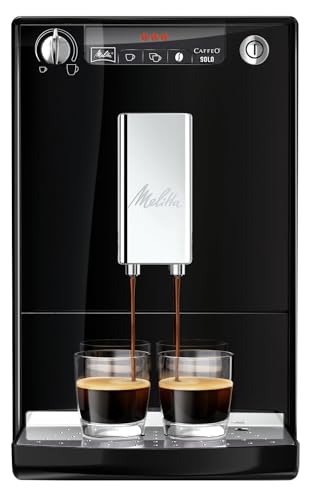
According to Melitta, the Melitta Solo is a bean-to-cup machine for two drinks, café crème and espresso, with no milk system and a body 20 centimetres wide. Melitta calls it the smallest bean-to-cup machine in its own range. Via the EAN 4006508194346, the ASIN in our price box belongs to the black version with Melitta article number 6774063. In the manufacturer’s shop the Solo comes in six colours, from Pure Silver to red, each with the same technical data.
In our price box it stands at approx. €268.98 on Amazon.de. Melitta itself asked €349 for the black variant and €329 for Silber Stripes in its own shop on 1 October 2026.
In the bean-to-cup machine comparison the Solo has 8.2 points and the label Beginner pick. We have not had it in our hands. What is written here comes from the product page on melitta.de, from the operating manual with the number 1828-0618 (dated August 2018) and from Melitta’s warranty terms. In two places the product page and the manual contradict each other, on the dimensions and on the display.
How much space does the Solo need?
Around 40 centimetres of width if you keep to Melitta’s clearance rule, plus air above for the water tank. The housing measures 200 millimetres in width, and the manual asks for a stable, dry and level surface with at least 10 centimetres of free space at the sides.
On depth and height the sources differ. The manual gives 455 millimetres of depth and 325 millimetres of height, the table on the product page 459 and 334. We would plan with the larger values. Empty, the Solo weighs 8.0 kilograms, on which the manual and the product page agree. The dimensions in the Amazon catalogue are of no use: converted, they would describe a machine of just under 13 by 18 by 8 centimetres.
The water tank does not come out of the front. You flip up its lid and lift it upwards out of the machine. You do not take out the bean hopper at all; only its lid comes off for filling. Under a wall cupboard, therefore, it is not only the height of the machine that counts but also the distance the tank needs when lifted out. This figure is not in any Melitta document. We would play it through with a folding rule at the planned spot.
The chapter on general safety lists eight points, two of which concern the location. In full: do not operate the machine in a cupboard or similar. Do not reach into the interior during operation. Keep children under 8 years away from the machine and mains cable. Children aged 8 and over, and people with reduced physical, sensory or mental abilities or a lack of experience and knowledge, may use it if they are supervised or have been instructed and understand the dangers. Children must not play with it; cleaning and user maintenance are barred to children under 8, and older children are supervised while doing it. If the machine is left unattended for a long time, it is disconnected from the power supply. It is not operated above 2,000 metres. And for cleaning, the care chapter of the manual applies.
Buttons, indicator symbols and what can be set
The manual lists six controls: the coffee quantity dial, one button each for one and two cups, the coffee strength button, the display and the on/off button. The buttons carry symbols instead of labels. On the product photo the quantity dial sits as a rotary knob at the top left and the on/off button on the right.
On the display the sources contradict each other. The table on melitta.de lists an LCD text display. The manual shows a symbol display whose indicator symbols stand for water, full drip tray, beans, cleaning, descaling, filter change and air in the system, among others. We go with the manual because it shows the control panel.
More can be set than the six controls suggest. You choose the strength in three steps, shown as one, two or three beans and rendered in the manual as mild, normal and strong. You regulate the quantity per cup continuously, with 30 ml at the far left and 220 ml at the far right, and according to the manufacturer’s text this also works while the coffee is running. For the brewing temperature there are three steps. The product page puts them at 85, 90 and 95 °C, with the middle one set at the factory. The usual reasoning for such steps is this: dark roasts release their compounds more easily and tolerate a lower step, while light roasts tend to need the hottest.
According to Melitta the Solo has no programmable brew buttons; a single coffee variation is preset. The control panel has no espresso button; as we understand it, the difference from café crème comes about through quantity and strength. Brewing temperature, water hardness and the two switch-off times, on the other hand, are retained as machine settings.
With the two-cup button two cups of the same type run at the same time, which Melitta calls Double Cup. A second press of the button cancels a brew. You slide the spout to the height that suits the cup. The product page also lists a passive cup warmer and a stainless steel drip plate.
In detail: conical burr grinder, pre-brewing and 15 bar
Grinding is done by a steel conical burr grinder. In this design a cone-shaped burr turns inside a ring, and the gap between the two determines how fine the powder becomes. The product page gives five grind settings. The manual instead describes a lever behind the right-hand side cover, fine to the left and coarse to the right, with no number of settings.
You are not meant to touch this lever any time soon. The manual recommends adjusting the grind size only after about 1,000 coffee preparations, which it equates to roughly one year. And then immediately after starting a brew, only while the grinder is running. For that you pull off the right-hand cover, behind which the brew unit also sits. Our assessment: if you want to readjust for every new type of bean, you do it here with the side wall open and a brew running, and that is awkward. If you drink one type over months, you rarely touch the lever.
Two faults from the fault table are tied to the grinder. If the coffee runs only in drops, the table says the grind is too fine; set it coarser, clean the brew unit or, if necessary, run the cleaning or descaling programme. For a loud grinding noise the table suspects a foreign object in the grinder and refers to the hotline.
Before the actual brewing, the Solo briefly moistens the fresh grounds. Melitta calls this the pre-brewing function or pre-infusion. The usual reason given for this technique: dry coffee grounds swell and release carbon dioxide as soon as they get wet. If that happens before the main flow, the water less often finds individual channels through the coffee puck and runs through more evenly. How many beans are ground per brew is regulated automatically by the machine, according to the product page.
As pump pressure the manual gives a maximum of 15 bar. That describes the performance limit of the pump, not the pressure during brewing. For espresso, around 9 bar at the coffee grounds is the usual figure, and how much builds up there depends on the resistance of the coffee bed, that is on grind size and amount of grounds.
Water, hardness levels and filter
As delivered, the Solo is set to water hardness 4, the highest of four levels. The manual assigns them as follows: level 1 up to 10 °dH (German degrees of hardness), level 2 from 10 to 15, level 3 from 15 to 20, level 4 above 20 °dH. A strip is included in the box with which you determine the hardness of your water before you set the level. It is the only part the manual explicitly lists as included. Why the right level matters for descaling and where to find out the hardness of your tap water is explained in the guide Water hardness and coffee.
The tank holds 1.2 litres, the bean hopper 125 grams. By calculation, one tank filling is enough for five mugs of 220 ml or 40 espressos of 30 ml, rinse water not included. Melitta asks for fresh water in the tank every day, and there must always be enough in it for operation.
As a filter Melitta recommends the PRO AQUA filter cartridge. It is screwed into a thread at the bottom of the water tank and, according to the manual, filters limescale and other pollutants from the water. As soon as it is in place, the Solo automatically sets itself to hardness level 1. It is changed every two months, or sooner as soon as the filter symbol appears.
In the Melitta shop the cartridge starts at €11.99. Whether this entry offer is a single cartridge or a pack, the listing leaves open. If it were a single one, six changes would add up to just under €72 a year.
Cleaning and descaling according to the manual
Three warnings come before any care: pull the mains plug before cleaning, never immerse the machine in water, and do not use a steam cleaner.
Three tasks fall due daily. The outside of the machine is wiped with a soft, damp cloth and a standard washing-up liquid, the drip tray is emptied, and the grounds container is emptied. The grounds container sits in the drip tray, the cup plate lies on top of it, and an indicator signals when the tray is full.
According to the manual’s recommendation, the brew unit should come out once a week. You switch the machine off, pull the right-hand cover off to the right, press the red button on the handle of the brew unit, hold it and turn the handle clockwise as far as it goes. Then you pull the unit out by the handle, rinse it thoroughly from all sides with clear water and let it drain. The manual marks one spot with an arrow; it must be free of coffee residues. Before the unit goes back in, you remove coffee residues from the machine. It is inserted with the red button pressed and a turn anticlockwise as far as it goes, after which you put the cover in until it clicks into place.
Every two months or after 200 cups, at the latest when the symbol lights up, the built-in cleaning programme is due. It takes about 15 minutes and, according to Melitta, removes residues and coffee oil that cannot be removed by hand. Beforehand you clean the brew group and the interior. It is started with the machine switched off and the tank filled up to the max. mark, by pressing two buttons at the same time for about 3 seconds. The drip tray goes into the machine without the grounds container, and the container stands under the spout. After two rinse cycles you place a tablet in the brew unit, then two stages of about 5 minutes each follow; before the first you slide the spout all the way down. Only Melitta PERFECT CLEAN cleaning tablets are permitted. From a little over three cups a day you reach the 200 cups before the two months are up.
Descaling is done every three months or when the descaling symbol lights up, and exclusively with Melitta ANTI CALC. The programme takes about 30 minutes. An inserted filter cartridge comes out beforehand and goes back in afterwards. You empty the drip tray and tank, add the descaler to the tank following the instructions on its packaging and start; after about 15 minutes you rinse the tank out thoroughly, fill it to the max. mark with tap water, and about 5 more minutes follow. At the end you empty the drip tray once more. Descaler can irritate the skin; on this the manual refers to the safety notes and quantities on the packaging of the product.
What Melitta leaves open
We searched for the following details on the product page, in the operating manual and in the warranty terms, without result:
- Noise level in decibels
- Heat-up time until the machine is ready for use
- Maximum cup height under the adjustable spout
- Capacity of the drip tray and the grounds container
- Material of the housing; only the drip plate is listed as stainless steel
- Type of pump
- Power consumption per cup and in standby; for this the product page refers to a separate page on energy consumption
- Length of the mains cable
- Country of manufacture
- Year of market launch; the date of the manual says nothing about it
- Prices of ANTI CALC and PERFECT CLEAN, and with them the annual care costs
- A descaling interval depending on water hardness
- How long spare parts for the Solo remain available; only what the shop listed on 1 October 2026 is documented
Solo, Esperto mini, Magnifica S or E8?
| Model | The difference | Price | Our rating | Choose this if |
|---|---|---|---|---|
| Melitta Solo (this one) | 20 cm wide, temperature with degree figures (85/90/95 °C according to the product page), neither milk nor hot water | approx. €268.98 | 8.2 | you only drink coffee without milk, do not need tea from the machine and want to adjust the brewing temperature (the Esperto mini cannot do that) |
| Tchibo Esperto mini | Housing approx. 16 cm wide according to Tchibo, around 46 cm of space with 150 mm wall clearance, tank approx. 1.1 l | approx. €229 | 8.0 | you want to save around €40 and can do without temperature selection |
| DeLonghi Magnifica S | Steam wand for milk foam and hot water | approx. €319.90 | 8.3 | you froth milk yourself now and then or brew tea |
| Jura E8 | Milk via a tube from an external container, brew unit permanently installed | approx. €1,049 | 9.4 | you want milk drinks at the touch of a button every day |
The prices are guide values from our price boxes and may look different on the day you buy. The rating is our editorial assessment from manufacturer documents; nothing was measured on any of the four machines.
When the Solo fits, and when another machine does
It fits if the coffee in your household is drunk black and tea comes from the kettle. If you would like an occasional cappuccino, a separate frother will do; what matters when buying one is covered in the milk frother buying guide.
If there are tea drinkers in the household or you regularly want some milk foam, we would go for the DeLonghi Magnifica S, which costs around €51 more in our price box. According to De’Longhi, hot water also comes through its steam wand, and its tank holds 1.8 litres. According to the manual its housing is 24 centimetres wide, 4 more than the Solo. But because De’Longhi only asks for at least 3 centimetres of clearance to the side walls, it manages with around 30 centimetres on the worktop.
The Tchibo Esperto mini has a narrower housing than the Solo: approx. 16 centimetres according to Tchibo, 4 fewer. On the worktop it still saves no space, because its manual asks for 150 millimetres of distance to walls, and the illustration there applies this distance on the left, on the right and at the back. Together that is around 46 centimetres of width, 6 more than for the Solo. At around €40 below the Solo it is also cheaper in our price box. Its brewing temperature cannot be adjusted, its tank holds approx. 1.1 litres according to Tchibo, and the hot water it dispenses is, according to its manual, intended only for warming cups.
If you want cappuccino and latte macchiato at the touch of a button and never want to hold the brew unit under the tap yourself, the Jura E8 in our price box is around €780 above the Solo, at just under four times the price. There the milk comes through a tube from an external container, and the brew unit is permanently installed and cleaned by a tablet programme.
If your household pulls five mugs of 220 ml each in the morning, the tank is empty afterwards, rinse water not counted. Then the tap should be within reach, because it is refilled every day and under some circumstances several times.
It is not intended for the office tea kitchen. According to the manual it serves to prepare coffee drinks from coffee beans and is intended for use in private households; any other use counts there as not as intended and can lead to injury and damage to property.