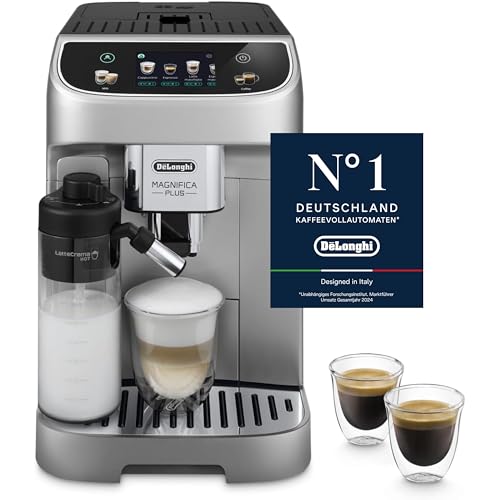
The Magnifica Plus with model number ECAM322.70.SB is a bean-to-cup machine from De’Longhi with a built-in grinder, a colour touch display and a milk carafe that De’Longhi calls LatteCrema Hot. The manufacturer lists it as Silver Black and promises 18 drinks at the touch of a button. In our price box it stands at approx. €650 on Amazon.de, and on Amazon it cost €599 on 7 September 2026. According to the data set on the manufacturer’s page it has been available since 1 November 2023, and the same date appears in the Amazon catalogue.
In our bean-to-cup machine comparison it scores 8.5 points, which puts it behind all three appliances in the table further down. We have not handled the machine and have not drunk anything from it. The details come from the German product page together with the data set in the page source, from the operating manual for the ECAM32X.6Y to 32X.7Y series and from the safety booklet, which according to De’Longhi applies to all its coffee machines. Romania is entered as the country of origin in that data set, but it does not appear in the visible page text. Where two sources contradict each other, both values are given.
Does the Magnifica Plus fit under your wall cabinet?
Yes, if at least 51 centimetres are free between the worktop and the cabinet. The machine is 36 centimetres high, and the safety booklet requires at least 15 centimetres of clearance above it because it gives off heat to its surroundings.
According to the manual it is 24 centimetres wide and 44 deep. The product page prints the same three numbers, but without a unit and without assigning them to the axes. For the weight, three values are in circulation: 9.5 kilograms in the manual with the addition “varies by model”, 9.752 with no unit on the product page, and, converted, 9.7 kilograms at Amazon.
The safety booklet gives four points on placement. At least 3 centimetres stay free at the side walls and the back wall. The machine does not go next to taps or sinks, because water getting in can damage it. It does not stand in any room where the temperature can fall below freezing, because it can be damaged if the water inside it freezes. And you route the mains cable so that neither sharp edges nor hot surfaces such as hobs can damage it. Separately there is a CAUTION notice: the worktop must be more than 850 millimetres above the floor. The machine must not stand inside a cupboard while in operation.
The cable measures 1200 millimetres, and the data set notes a Schuko plug. It connects to 220 to 240 volts and 50 to 60 hertz at 1450 watts, to an earthed socket that according to the safety booklet can take at least 10 amperes. According to the data set, cups up to 140 millimetres high fit under the height-adjustable coffee spout.
Grinder, pump pressure, heating system
According to the manual, the bean hopper holds 250 grams at most, the water tank 1.9 litres. In the table on the product page the tank reads “19”. 1.9 is meant: that is the value the manual gives, and it is also what the page of the sister model ECAM320.60.B shows.
How the grinder is built is not revealed by any of the documents, so also not whether cones or discs grind and what material they are made of. The 13 grind settings come from the manufacturer’s text in the Amazon catalogue. On the dial, which the manual lists as A2, the digits 7, 5, 3 and 1 are printed with intermediate marks.
The manual attaches two rules to this dial. You turn it only while the grinder is running at the start of a preparation. After a change, at least three coffees should run through before you adjust further, because the effect only shows then. If the coffee comes out too thin, the troubleshooting table sees the cause in a grind that is too coarse or in unsuitable, old beans, and advises coffee for espresso machines. Green, caramelised and candied beans are taboo because they stick to the grinder and can damage it. Do not be surprised by powder residue in a new machine: the grinder is run in before sale for adjustment. How to feel your way to a new variety is described in the guide Bean-to-cup machine settings.
The manual gives the pressure as 15 bar, that is 1.5 MPa. That describes what the pump can deliver. During brewing, usually less is applied to the coffee grounds. Around 9 bar is usual for espresso, and how much actually arrives depends on the resistance of the coffee bed.
On the heating system the sources do not agree. The data set on the product page says thermoblock, whereas the manual speaks, in the chapter on switching on, of heating up the boiler. A thermoblock heats the water as it flows through a heated metal block, whereas a boiler keeps a reserve warm. Which statement is right cannot be decided from the documents. At switch-on, the manual describes a preheating and rinsing cycle that cannot be interrupted; hot water comes out of the coffee spout during it. At switch-off the machine rinses again, provided coffee was made beforehand.
If the coffee reaches the cup too cool, the troubleshooting table lists four reasons: cooled pipes when two to three minutes have passed since the last coffee, a coffee temperature set too low, cold cups and overdue descaling. As remedies the manual names a rinse before the coffee, cups that you warm with hot water, and a higher coffee temperature. You set that in the menu, and according to the manual a change has a stronger effect with large quantities.
18 drinks, four profiles
On the product page the drinks are sorted into groups. Hot coffee drinks: Americano, Coffee, Doppio+, Espresso and Long. Hot milk drinks: Caffè Latte, Cappuccino, Cappuccino Mix, Cappuccino+, Cortado, Espresso Macchiato, Flat White, Hot Milk and Latte Macchiato. Cold: Cold Coffee and Cold Americano. Plus hot water. That makes 17 names. The drinks table in the manual arrives at 18 because it counts 2X Espresso as a drink of its own.
So the Magnifica Plus dispenses milk only hot. For the two cold coffees you choose Iced or Extra iced, and before the start the machine suggests how many ice cubes belong in the glass.
From the factory an espresso runs at 40 ml, adjustable from 20 to 180 ml. 2X Espresso dispenses 40 ml twice. Coffee starts at 180 ml (100 to 240), Long at 160 ml (115 to 250), Doppio+ at 120 ml (80 to 180). The Americano has the greatest range, from 70 to 480 ml with a factory setting of 150 ml, and hot water runs from 20 to 420 ml. For a large mug the Americano is therefore the suitable recipe, provided the mug fits under the spout.
You can set up to four user profiles. You change the quantity and intensity of a drink via a bar on the start screen, and this is saved only in the profile currently selected. With the my function you determine the quantity of each ingredient for a hot favourite drink by pressing stop during preparation. The order of the drinks on the display depends on how often you select them. Extra Shot adds an additional espresso of 30 cc to a hot drink; quantity programming and powder are then unavailable.
The control panel also has touch keys for on and standby, for the Coffee and Milk menus and for profile selection. You place two cups side by side under the spout and lower it as close to the rims as possible. According to the manual, the my function also applies to the double drink. Whether two milk drinks can be made at once, on the other hand, it leaves open: as a double drink its table knows only 2X Espresso.
LatteCrema Hot: carafe, froth selector and CLEAN
You attach the carafe at the connection point A17: slide the flap down and press the carafe on firmly until it clicks into place. It consists of a lid, milk container, froth selector, a removable connector, the height-adjustable milk spout with an adjustable extension and a silicone suction tube. In the product photo it sits to the left of the coffee spout.
The froth selector has three positions. Fine is for Caffelatte and unfrothed hot milk, Creamy for Latte Macchiato, Flat White and Cortado, Firm for Cappuccino, Cappuccino Mix, Espresso Macchiato, Cappuccino+ and frothed hot milk. The manual traces large bubbles or too little froth to milk that is too warm or unsuitable, to a dirty lid or to water in the channel under the selector.
The product page speaks of automatic cleaning at the touch of a button. In practice that means: after every milk drink the machine prompts you to turn the selector to Clean. Hot water and steam then rinse the lid, and the function ends by itself; you must not interrupt it. With several milk drinks in a row, you tap Cancel at the prompt and clean after the last one.
What happens to the carafe afterwards is laid down precisely in the manual. With milk left in it, it goes into the fridge straight after Clean and stays there two days at most, after which you clean all the parts. If it is empty or has stood outside the fridge for more than 30 minutes, then according to the safety booklet it is freed of all residues, taken apart and cleaned completely. That can be done in the dishwasher, which De’Longhi recommends, in the top rack on a 50 °C programme such as ECO Standard, or by hand: at least 30 minutes in water of at least 40 °C with washing-up liquid. You scrape out the recess and channel under the knob with a toothpick if needed; no milk residue may stay there. The machine reminds you of this thorough cleaning regularly and shows the order of the steps, and the menu also has a tutorial on it.
Expect some waste at the start. Until the result in the cup is satisfactory, the machine needs at least four to five cappuccinos at first start-up, according to the manual. For first use, the safety booklet lists what is poured away: five hot-prepared coffees as well as three preparations each with steam, with hot water, with milk and carafe and with cold brew, in each case if the model has the function. A steam wand and cold brew are missing from the Magnifica Plus equipment.
Cleaning and descaling according to the manual
The manual counts ten points for regular cleaning: the internal circuit, the coffee grounds container, drip tray with grid, the interior of the appliance, the water tank, the ground coffee chute, the coffee spout, the brew group behind the service flap, the control panel and the milk carafe. Of these, only the drip tray grid and the carafe may go in the dishwasher. You clean the drip tray, grounds container, cup rest, water tank and brew group by hand.
The brew group comes out at least once a month, the safety booklet says every 30 days, and never with the machine switched on. You remove the water tank, open the service flap on the right, press the two coloured release buttons and pull the group out. It soaks in water for about five minutes and is rinsed under the tap. In capital letters the manual says: “Rinse it with water only. No detergents, no dishwasher.” To insert it, you press firmly on PUSH until it clicks, or on both levers first if it is stiff. The coloured buttons then stick out to the sides.
Solvents, abrasives and alcohol are ruled out for cleaning, and you do not tackle encrusted deposits with metal objects, because they can scratch surfaces of metal or plastic. According to De’Longhi, the machine needs no chemical additives for cleaning. The safety booklet adds alkaline cleaners and flammable liquids and allows a soft cloth, if necessary with neutral detergent. You never immerse the coffee machine in liquids for cleaning. Before checking the interior of the appliance, about once a month, you switch off and pull out the plug, and then a sponge and a crumb vacuum come into play.
According to the manual, you clean the water tank about monthly and after every filter change with water at around 40 °C and a soft cloth. The safety booklet also requires that the water in the tank is changed at least every three days. With several milk drinks in a row, the metal cup grid heats up. The manual warns of scalding: do not touch it until it has cooled, and only handle it at the front.
Descaling is done exclusively with De’Longhi descaler. Unsuitable products or descaling at irregular intervals can, according to the manual, cause defects that are not covered by the manufacturer’s warranty. You fill descaler up to the printed mark A into the tank, which corresponds to a 100 ml pack, then water up to mark B at 1 litre. A container of 2 litres belongs underneath. The manual’s table reckons with about 25 minutes, the message on the display with about 30. After about 15 minutes the actual descaling is over, then rinses with fresh water follow, and anyone who does not fill the tank to MAX for this gets a third one. The hot, acidic water can scald, and spilled descaler can damage sensitive surfaces.
The machine reports the time after an operating period that depends on the set water hardness. You measure the hardness with the strip supplied: dip for about a second, and after around a minute one to four red squares appear, each standing for one level. What the levels mean for taste and for the machine is explained in the guide Water hardness and coffee. The water filter lasts two months in normal use; if the machine stays unused for three weeks with the filter inserted, you also change it, even without a prompt.
Accessories, running costs and what De’Longhi leaves open
The manual lists as accessories a water hardness strip, a measuring spoon for pre-ground coffee, descaler, a water filter and a hot water spout, with the note that type and number vary by model. The scope-of-delivery picture on the product page shows the milk carafe, water filter, hardness strip, hot water spout and measuring spoon, but no descaler. Whether it is in the box with the ECAM322.70.SB, we would check before the first descaling.
We do not work out an annual total for the running costs, because the prices are missing. The quantities can be documented: anyone who uses the filter continuously consumes six a year, and every descaling uses one pack of descaler. The manual does not provide for cleaning tablets for the milk system or brew group. According to the manual, repairs are carried out exclusively by De’Longhi technical customer service.
We searched in vain for the following details in the product page, manual, safety booklet and data sheet:
- the type of pump and the pressure applied to the coffee grounds during brewing
- the brewing temperature in degrees and the number of temperature levels
- the heat-up time to the first coffee
- the noise level in decibels
- how much milk the carafe holds; in the scope-of-delivery picture it carries a scale up to 5 and MAX with no unit
- how many grams the coffee grounds container takes
- whether the bean hopper can be removed
- the material of tank, drip tray and housing in detail; the data set says only plastic and metal
- the energy consumption per cup or per year
- prices for spare parts and how long they are available
- an app or wireless connection; in the data sheet there is no value for the radio frequency range
- whether the water filter extends the descaling interval
The Magnifica Plus or one of the other three?
| Model | The difference | Price | Our rating | Choose this one if |
|---|---|---|---|---|
| DeLonghi Magnifica Plus ECAM322.70.SB (this one) | no pot function, removable brew group | approx. €650 | 8.5 | you do not need a pot and rinse the brew group yourself every month |
| DeLonghi Dinamica Plus 380.95 | according to De’Longhi 24 drinks with coffee pot | approx. €589 | 8.7 | you often need a whole pot of coffee for guests |
| DeLonghi Rivelia | two interchangeable 250 g bean hoppers on one grinder | approx. €660 | 8.9 | you regularly switch between two kinds of beans |
| Jura E8 | fixed brewing unit, cleaned by tablet programme | approx. €1,049 | 9.4 | you never want to take the brew group out yourself |
The prices are guide values from our price boxes and may differ from the daily price. The rating is our editorial assessment from data sheets and manuals; we measured nothing on any of the four appliances.
When the Magnifica Plus fits, and when another appliance does
Half of the drinks list depends on the carafe. Anyone who drinks almost only espresso and black coffee pays for the milk system as well and rarely uses it. Anyone who makes a cappuccino or flat white every day, on the other hand, should plan realistically for the care workload described in the carafe section.
For guests a pot function is missing. The Dinamica Plus 380.95 has one according to De’Longhi, plus Ristretto and Espresso Lungo as drinks of their own. In our rating it ranks ahead of the Magnifica Plus. Its tank holds 1.8 litres according to the manufacturer, its bean hopper 300 grams. Our assessment: between these two, little in our data speaks for the Magnifica Plus, unless it is clearly cheaper than the Dinamica on the day you buy.
If you often change the bean in your household, for example between an espresso blend and decaf, you quickly hit limits with a single hopper and powder for single cups only. The Rivelia has two interchangeable hoppers of 250 grams each and costs around €10 more in our price box. For this use we would prefer it.
If you never want to touch the brew group, the Magnifica Plus is the wrong choice. On the Jura E8 the brewing unit is fixed and cleaned by a tablet programme, and with the CLARIS Smart+ filter inserted, descaling is also unnecessary according to Jura. That costs around €400 more in our price box. We would pay this surcharge only if that one task really bothers you, because you keep buying filters there as well.
If you live in an area with very hard tap water, sparkling water and distilled water are no way out of descaling less often: the safety booklet rules out both, and only fresh water belongs in the tank. What remains is the correctly set hardness, because with the value programmed correctly the descaling prompt comes less often, according to the manual. Anyone who buys from the De’Longhi shop anyway will find two sister models there; their prices from 1 October are given in the questions above.