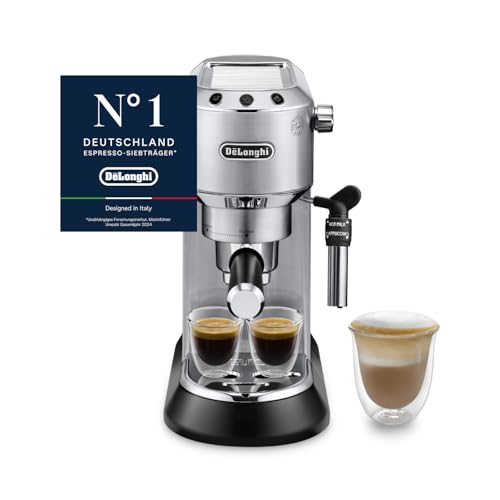
The Dedica EC685 is a portafilter machine with a thermoblock, and De’Longhi advertises it as 15 centimetres wide. The product data on the De’Longhi page gives the more precise figure: 149 millimetres. It has no grinder, and you froth milk by hand at a steam wand. What matters more for the purchase than the width, though, is something else, namely the design of the baskets.
Which Dedica this is and what it costs
The manufacturer calls it the Dedica Style. The German De’Longhi shop lists it in six colour variants, EC685.M (Metal), EC685.BK (black), EC685.R (red), EC685.W (white), EC685.BL (blue) and EC685.TB, all with the suffix EX:4. This review is about the silver Metal version, which Amazon offers under the ASIN B06WGTZ874.
Our price box puts it at approx. €124 on Amazon.de. The De’Longhi shop also sells the EC685.M directly, but under a different article number from the Amazon listing (more on this in the FAQ).
When it came out can only be narrowed down. Amazon gives March 2017 as the release date. The manufacturer’s product data gives 1 October 2024 as the availability date for the article number that belongs to the Amazon listing, which looks more like this specific version than the launch of the range. China is given as the country of origin, and the manual names De’Longhi Appliances in Treviso as the manufacturer.
De’Longhi itself puts the superlative in context. “Our narrowest espresso machine so far” is what the product data says, which is a comparison within its own range and not a statement about the whole market. In our espresso machine comparison the Dedica scores 8.3 points and carries the Value pick badge.
Housing, tank and control panel
De’Longhi gives the dimensions as 149 × 330 × 305 mm. Which figure is the height is only stated by Amazon: 30.3 centimetres, which leaves 33 centimetres for the depth. The product photo shows a narrow, tall body with the steam wand and its frothing sleeve sticking out sideways on the right. Whether this wand is already included in the 149 millimetres cannot be read from the photo and the dimensions. If you are planning to the millimetre, you should measure it when you set it up.
Two figures circulate for the weight. De’Longhi’s product data for the Amazon article number gives 4.22 kg, Amazon itself 9.3 pounds, so around 4.2 kg. The 5.48 kg on the support page is identical to the packaging weight; the box measures 38.7 × 19.7 × 36.7 cm.
The water tank holds 1.1 litres, can be removed and has a water level indicator. For the housing, De’Longhi states Metal, brushed. The short text on the same page speaks of stainless steel with a glossy blue finish, which does not fit the silver version. We stick with Metal, brushed.
At the top front there are three illuminated buttons with symbols: one cup, two cups, steam. There is also the main switch, an orange indicator lamp for descaling and, at the top right, a rotary knob that lets steam and hot water out at the wand. There is no display, and settings are made through button combinations. A cup warmer sits on top of the housing, and the safety booklet warns that the cup tray can become hot during operation.
It connects with a Schuko plug to 220 to 240 volts. For power consumption the manufacturer fields contradict each other: 1,450 W on the product page, 1,350 W in the article number’s data set, 1,300 W on the support page. The valid value is on the rating plate on the underside of the machine, which we did not have.
What is missing from the documents
Some details you would expect for a portafilter machine appear neither in the product data nor in the operating manual or the quick start guide. We have neither estimated them nor gathered them from elsewhere:
- the diameter of the portafilter
- single-wall baskets: the accessory list names a 1-cup, a 2-cup and a pod basket, and the product data classes the baskets as pressurised (dual-wall) baskets
- the pump type; only the thermoblock and 15 bar of pump pressure are documented
- a heat-up time
- the brew temperature in degrees; there are only the three levels
- the pressure that reaches the coffee grounds
- a 3-way valve, neither as present nor as absent; backflushing does not appear in the manual
- noise level in decibels
- the material of the portafilter, baskets, tank and drip tray
- basket capacity in grams and a recommended extraction time
- a descaling interval in weeks or litres
- cable length and power consumption per shot
- spare part prices and how long spare parts remain available
In detail: thermoblock, pressurised baskets, three temperature levels
A thermoblock does not keep hot water in reserve. The pump pushes water from the tank through a heated metal block, and it is heated on the way. That is why such a machine is ready sooner than one that first has to heat a boiler full of water. The 40 seconds to readiness come solely from the Amazon text. The manual nevertheless speaks of a boiler in two places, when cooling down after steam and in connection with the seal. We read that as a shared heater for coffee and steam, which fits the cool-down requirement in the steam section.
The 15 bar is the pump pressure. How much of it is present in the basket depends on the resistance of the coffee bed and, on many pump machines, on a pressure relief valve.
The design of the baskets changes more. De’Longhi lists them as pressurised or dual-wall baskets, and the cleaning instructions confirm this: you pull the perforated inner basket out by a tab, and the hole on the back is meant to stay clear. With this basket type the small outlet opening builds up part of the resistance itself. That forgives a grind that is not quite right and allows pre-ground coffee, which the product data expressly provides for. Conversely, fine-tuning at the grinder brings less, by the logic of this design, than with a single-wall basket, where the coffee bed alone provides the resistance.
What the manual says about the grounds is brief: finely ground and made specially for espresso, evenly distributed, lightly pressed down. If you tamp too hard, the coffee runs slowly and comes out strong; if you tamp too little, it runs fast and comes out weak.
You reach the settings by holding the steam button for 10 seconds until the three buttons flash one after another. Then the 1-cup button selects the brew temperature, the 2-cup button the water hardness and the steam button the automatic switch-off. For the temperature there are the levels low, medium and high, and according to the manual it refers to the water in the thermoblock, not to the cup. After 15 minutes without input the machine leaves the menu by itself, and the same route lets you reset it to factory settings.
You can programme the volumes. From the factory the 1-cup button dispenses 35 ml, adjustable between about 15 and 90 ml, and the 2-cup button 70 ml, adjustable between about 30 and 180 ml. For this you hold the button down and release it as soon as there is enough in the cup; after that every dispense stops automatically. Which ratio of grounds to water suits your cup is worked out by the brew calculator.
If the espresso arrives too cool, the manual names four levers: warm the cups with hot water, insert the portafilter with the basket but without coffee and let hot water run through, raise the temperature level in the menu, and use the cup warmer.
Is the steam wand enough for several cappuccinos?
Yes, according to the manual, if you stick to its order: first all the espressos, then the milk for all the cups. Steam should run for no more than 60 seconds at a time. After that the lamps of the 1-cup and 2-cup buttons flash at the same time, and the machine is too hot for espresso. You put a container underneath, open the steam knob and let hot water run until the output stops by itself.
The wand has a selector ring. When it is set to CAPPUCCINO, froth is produced; when it points up to HOT MILK, you get steamed, hot milk. De’Longhi reckons on about 100 g of milk per cappuccino, skimmed or semi-skimmed and at about 5 °C from the fridge. The volume grows to two to three times as much. By calculation the jug therefore needs at least 300 ml, which is our derivation from these figures. You stop at the desired froth density and about 60 °C, which the manual gives as the ideal value.
If the milk does not froth at all, the fault table lists four causes: the ring is set to HOT MILK, the milk is not cold enough, the frother is dirty, or limescale has built up. Basics on milk temperature and choosing a jug are in the guide How to froth milk.
What else is worth considering?
| Model | The difference | Price | Our score | Take this one if |
|---|---|---|---|---|
| DeLonghi Dedica EC685 (this machine) | 149 mm wide, pressurised (dual-wall) baskets, manual steam wand | approx. €124 | 8.3 | you have little width to spare and want to start without your own grinder |
| DeLonghi Classic EM450 | according to the De’Longhi data field around 226 mm wide, but a 1.7 l tank instead of 1.1 l | approx. €127 | 7.8 | you have just under 8 cm more space and want to refill less often |
| Sage Bambino Plus | automatic steam wand with 3 temperature and 3 froth levels each, 54 mm portafilter, plus single-wall baskets | approx. €480 | 8.4 | you make milk drinks every day and do not want to steer the froth yourself |
| Gaggia Classic Evo Pro | 58 mm portafilter, conventional baskets too, 3-way solenoid valve | approx. €500 | 9.4 | you have or are buying an espresso grinder and want to find the grind size yourself |
The prices are guide values from our catalogue, not daily prices, and the score is our editorial assessment based on the available data and the construction. Nobody measured it.
When the Dedica fits and when another machine does
Footprint is the argument De’Longhi advertises, and the safety booklet adds some back on. It requires at least 3 cm of clearance to the side walls and the back wall and at least 15 cm of air above the machine. From 149 mm that makes a niche width of around 21 cm. If you take Amazon’s height of 30.3 cm, you need a good 45 cm up to the underside of the wall cupboard. The worktop must be higher than 850 mm above the floor, and the machine must not stand in a cupboard during operation. The narrow strip right next to the sink is also ruled out: the booklet prohibits setting it up near taps and sinks.
On quantity, the tank helps less than the change interval. According to the safety booklet, the water in the tank should be changed at least every 3 days. If the machine has stood for more than 3 days, you empty the tank, and before the next drink you prepare hot water, steam and hot coffee and pour everything away. If you only make espresso at weekends, you therefore flush through every time.
Milk drinks work, but following the sequence from the steam section. If you make three cappuccinos for the family in the morning and do not want to do that yourself at the wand, you are better served by the Bambino Plus, which costs around €356 more in our catalogue.
The grinder is the real switch. If you buy one as well, then in our assessment conventional baskets and a known basket diameter are worthwhile, and the Gaggia Classic Evo Pro has both with its 58 mm portafilter. In our catalogue it costs around €376 more than the Dedica, grinder not included.
That leaves the Classic EM450 from the same company. In our catalogue it costs around €3 more and according to De’Longhi has a 1.7 litre tank. De’Longhi gives the dimensions as 226 × 283 × 310 mm; if you read the first figure as the width, as with the Dedica, it is just under 8 cm wider. If the width fits, we would lean towards the EM450 because of the larger tank, even though it scores 7.8 in our rating, below the Dedica.
Accessories, baskets and water filter
The manufacturer’s packing picture shows four parts: the portafilter, a 1-cup basket, a 2-cup basket and a measuring spoon with tamper. The accessory list in the manual is longer, but carries the note “only with some models” for the pod basket, measuring cup with tamper, separate tamper, descaler and milk jug. The packing picture does not show a pod basket, whereas the Amazon text mentions inserts for pods. This fits with the product data counting two baskets in one place and three in another. The safety booklet in any case requires you to check after unpacking that all the accessories are there.
A water filter is not included. The manual names the De’Longhi water filter with the EAN 8004399327252, available from authorised customer service points. Under the same EAN we list the water filter DLSC002, approx. €7.49 in our price box. As for the water itself, the safety booklet says only fresh water belongs in it, no sparkling water and no distilled water.
Order tampers, dosing rings or third-party portafilters only once you have measured your own portafilter; the diameter is listed above under the missing details. The manufacturer’s warranty excludes damage caused by non-original accessories, as well as the replacement of consumables such as filters.
Cleaning and descaling according to the manual
The manual states the most important sentence unmistakably: “None of the parts or accessories of the coffee machine may be cleaned in the dishwasher.” Solvents, abrasives and alcohol are forbidden; the safety booklet adds alkaline cleaning agents and other flammable liquids and recommends a soft cloth, if necessary with a neutral detergent. You never immerse the machine itself in water, “it is an electrical appliance”. Before cleaning any outer parts you switch off, pull the plug and let it cool down.
You are supposed to clean the drip tray, the coffee baskets, the coffee spout, the water container and the outlet for hot water and steam regularly. In the drip tray a red float shows the water level; empty it before it sticks out of the cup grid, otherwise it can overflow. You rinse the baskets under running water after every shot. Every 200 coffees you let about 0.5 litres of water run through the spout without grounds. You clean the tank about once a month with a soft cloth and mild detergent, and the brew head after preparation with a clean, damp cloth. A little water in the compartment under the tank is normal according to De’Longhi and is wiped out now and then.
For first use, according to the safety booklet, you pour away five coffees, three steam and three hot water preparations. If the machine has stood for more than a week, you flush through beforehand as for first commissioning.
You descale when the indicator lamp flashes. When that is depends on the water hardness, which you set in the menu in three levels; the accessory list in the manual also includes a water hardness checker. The manual permits only De’Longhi descaler and warns that unsuitable products or irregular descaling can lead to faults that the manufacturer’s warranty does not cover. Beforehand you detach the portafilter and fill in the solution up to MAX. You hold the steam button, set the steam knob to hot water and start with one more press of the steam button. After that the machine flushes by itself in intervals with pauses. In between you close the steam knob so that the coffee spout is flushed through as well, and at the end there are two rinses with fresh water up to MAX. We list a De’Longhi descaler as EcoDecalk; the 500 ml bottle is approx. €7.98 in our price box. The steps in context are explained in the guide Descaling and cleaning.
Who is it suitable for?
It is the wrong choice for the office coffee corner and, as we read the lodging rules in the booklet, for the holiday flat as well. The safety booklet says: “This appliance is intended for household use only. Use is not intended in: staff kitchen areas in shops, offices and other working environments, farm houses, hotels, motels, guest accommodation and other lodging environments.” The manufacturer’s warranty also excludes commercial use.
In families with children it is worth a look at the booklet, because it contradicts itself on the same page. In one place it says the appliance may be used by children from 8 years old, provided they are supervised or have been instructed in safe use. Right next to it is: “This appliance must not be used by children.” We would stick to the stricter sentence.
It is also unsuitable as a machine for an unheated garden shed: if the temperature falls below freezing, the residual water can freeze and damage the appliance, and it should only be used up to 2000 m above sea level.