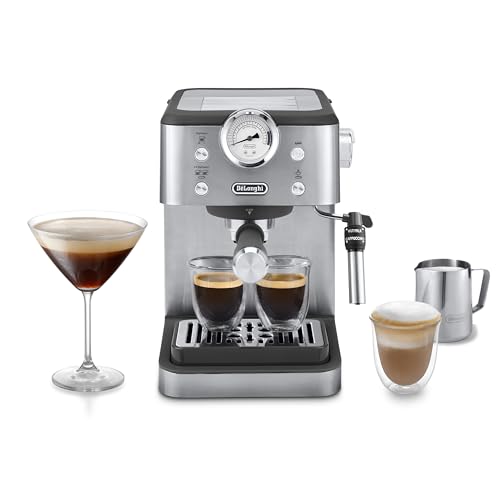
The De’Longhi Classic EM450 is a portafilter machine with a thermoblock and a round pressure gauge in the middle of the front. It has no grinder: espresso powder or an ESE pod goes into the portafilter. You froth the milk yourself with a steam nozzle, and there are two buttons for the coffee: one cup, two cups.
What the EM450 is and what it costs
De’Longhi sells it as the De’Longhi Classic, manual espresso machine, model EM450.M in the colour metal. On delonghi.com, only this one version appears under the name Classic. The manufacturer named in the instruction manual is De’Longhi Appliances in Treviso.
In its title, Amazon calls it a portafilter machine “with professional milk frother” and a full-metal housing. De’Longhi itself words it more soberly and speaks of an adjustable cappuccino system. The same component is meant, a steam nozzle with a selector ring.
Our price box stands at approx. €127 on Amazon.de, which is how the Amazon catalogue listed the machine on 7 September 2026. The EM450.M is also available in the De’Longhi shop, where the price differs from the Amazon catalogue.
In our portafilter machine comparison, it is the second cheapest of 17 machines after the Dedica EC685. With 7.8 points, it also has the lowest rating there. According to the safety booklet, it is intended for coffee and milk drinks, plant-based drinks and hot water, and only water belongs in the tank.
Housing, dimensions and control panel
According to De’Longhi, the housing is made of stainless steel with chrome elements. According to the product data, the cup tray is also stainless steel.
The product page and the manual give the same 226 × 283 × 310 mm, the manual explicitly in the order width, depth, height. In the product photo, the rotary knob and the steam nozzle on the right stick out beyond the body, and the dimensions do not make clear whether the 226 mm include these two parts. The inch values on Amazon convert to the same three numbers.
The sources differ on weight. The manual gives 4.1 kg, Amazon about 4.44 kg converted, and the 5.502 in a data field of the product page is identical to the packaging weight. The carton measures 28.5 × 35.5 × 40.5 cm. To move it, according to the safety booklet, you grip the intended points, never the portafilter.
The water tank holds 1.7 litres, can be taken out and has a lid and a handle. The drip tray is removable, and a red level indicator shows how much water is in it. Four figures circulate for cup height: up to 13 cm in De’Longhi’s product text, 127 mm and 110 mm in two data fields on the same page, and on Amazon an adjustable drip tray for 100 to 130 mm. For a tall latte glass, we would plan with the smallest figure, that is 110 mm.
According to the manual, the control panel has four buttons with white indicator lights: main switch (ON/STANDBY), one cup, two cups and steam. They carry symbols instead of labels. There is also an orange light for descaling and, on the right, the rotary knob for steam or hot water; the hot water button that Amazon lists does not exist according to the manual. It connects to 220 to 240 volts, the power consumption is 1,325 W, and the socket must be earthed and rated for at least 10 A.
What is missing from the manufacturer’s documents
The product page, instruction manual, safety booklet and energy data sheet leave a number of basic details open. We have not estimated any of them:
- heat-up time in seconds or minutes; De’Longhi speaks only of a fast heat-up time
- brewing temperature in degrees
- pressure at the coffee puck; only the pump’s 15 bar is documented
- type of pump
- how many grams of powder a measuring spoon holds
- diameter of the portafilter
- whether the baskets are single-walled or pressurised
- a 3-way valve, neither as present nor as absent
- material of the portafilter, handle, buttons and steam nozzle
- duration or setting of a pre-infusion; the word coffee pre-infusion appears only in the section on the pressure gauge
- material of the thermoblock, steam output and waiting time until steam
- descaling interval in weeks or litres
- a water hardness setting: a data field on the product page reports one, the manual describes none
- which water filter fits; that one can be used appears only in a data field on the product page
- noise level in decibels and cable length
- country of origin and market launch
- spare part prices and how long parts remain available
In detail: thermoblock, 15 bar and the needle in the pressure gauge
A thermoblock does not keep hot water in reserve. The pump pushes water from the tank through a heated block and heats it on the way through, rather than heating a whole boiler. That is why such a machine is usually ready faster. De’Longhi credits the technology with a fast heat-up time and higher temperature stability.
The 15 bar from the manual is the pressure the pump produces. How much of that arrives at the coffee puck depends on the resistance the powder offers in the basket. Finely ground and tamped, it slows the water; ground coarsely, it lets the water through quickly.
For the powder, the manual calls for finely ground coffee specifically for espresso, one measuring spoon for one cup and two for two cups. You control everything else through grind size and tamping, and that is exactly what the pressure gauge in the front is for.
Its scale has three zones: grey dotted, red dotted and, between them, a range the manual calls “optimal”, without expressly saying that the needle should sit there during espresso. The needle sits in the grey field during heat-up, during water and steam dispensing, when rinsing the brew unit and during coffee pre-infusion; according to the manual, this is normal. That it moves into the middle zone during rinsing is also described there as normal. Red means too high a pressure in the machine: disconnect the machine from the mains and open the steam control. After an extraction, the needle can stay on the last marks, and the manual considers it harmless to make the next coffee before the pressure has fully dropped.
Dispensing stops by itself, and the quantities can be programmed, up to a maximum of 90 ml for one cup and 160 ml for two. The manual provides no temperature selection, and that sets the EM450 apart from the Dedica EC685 from the same maker, which has three levels according to De’Longhi. The brew calculator works out which ratio of powder to water suits your cup.
Can the EM450 make several cappuccinos in a row?
Yes, if you keep to the order from the manual: first extract all the espressos, then froth the milk for all the cups. Steam should not run for more than 60 seconds at a time.
The heating element is behind this order. After steam operation it is too hot for espresso, the indicator lights then signal that it has to cool down, and you let water run off through the steam and hot water outlet until the right espresso temperature is reached again. From this we conclude that coffee and steam share the same heater. If you switch back and forth between espresso and milk, you do this cooling step every time.
The nozzle has a selector ring with two positions, CAPPUCCINO for foam and HOT MILK for hot milk without foam. The manual assumes about 100 ml of milk per cappuccino, chilled to roughly 5 °C, and gives 60 °C as the ideal final temperature. The volume roughly doubles in the process. By our calculation, for two cups at once the jug therefore needs a capacity of at least 400 ml.
For technique at the jug, we have our guide How to froth milk. For the EM450 itself, the safety booklet warns of splashes with steam and hot water, urges caution if the steam wand is blocked and points out that the cup tray can get hot during operation. The heating element and outer parts can stay hot for a few minutes after use.
What are the alternatives?
| Model | The difference | Price | Our rating | Choose this if |
|---|---|---|---|---|
| DeLonghi Classic EM450 (this machine) | Pressure gauge, 1.7 l tank, no temperature selection | approx. €127 | 7.8 | you want to start on a small budget and see the pressure during extraction |
| DeLonghi Dedica EC685 | 149 mm wide, 1.1 l tank, three temperature levels, pressurised or double-wall baskets | approx. €124 | 8.3 | your counter space is narrow or you want to choose the brewing temperature |
| DeLonghi La Specialista Arte EC9155 | built-in grinder, 8 grind settings on the EC9155.MB according to De’Longhi | approx. €369 | 8.6 | you do not have an espresso grinder yet and do not want to buy a separate one |
| Gaggia Classic Evo Pro | lead-free brass boiler, 58 mm portafilter, 3-way solenoid valve | approx. €500 | 9.4 | you are sure to stay with portafilter machines and plan on a grinder of your own |
The prices are the guide values from our price boxes, not daily prices. The rating is our editorial assessment from manufacturer data and construction; nothing was measured for it.
When the EM450 fits and when another machine does
Space first. The safety booklet requires at least 3 cm of clearance to side walls and the back wall and at least 15 cm of air above the machine. Calculated on the manufacturer’s dimensions, that is a niche of just under 29 cm wide, a good 31 cm deep and 46 cm high up to the underside of the wall cabinet. The counter must be higher than 850 mm above the floor. During operation the machine must not stand in a cupboard, it should not stand near a tap or sink at all, and the power cable must not run over sharp edges or hot surfaces.
Then the question of how often you make espresso. According to the same booklet, the water in the tank should be changed at least every 3 days. If you only make coffee at weekends, you will therefore tip out the tank almost every time.
Between the Dedica EC685 and the EM450 there are about €3 in our catalogue, with the Dedica the cheaper one. It is 77 mm narrower, and its tank holds 0.6 litres less. Because of the three-day rule, the EM450’s larger tank saves you refills only if you actually use up the 1.7 litres in that time.
The real fork in the road is the grinder. Without a built-in grinder, every espresso depends on your powder, and an espresso grinder comes on top of the purchase price. In our catalogue the La Specialista Arte EC9155 costs about €242 more than the EM450 and has the grinder built in. Whether that pays off depends on the price of the grinder you would otherwise buy; the grinder guide gives an overview of the types.
The Gaggia Classic Evo Pro costs about €373 more than the EM450, not counting a grinder. In our assessment, its 58 mm portafilter is the deciding factor: with this size, third-party accessories become predictable.
Pods, water and descaler
Besides powder, the EM450 takes pods in the ESE standard according to De’Longhi. For water, the safety booklet calls for fresh water and rules out sparkling and distilled water.
On descaler, the manual commits itself: “It is important to use only De’Longhi descaler.” According to the manual, the manufacturer’s warranty does not cover unsuitable products or incorrect procedure. We list the De’Longhi descaler as EcoDecalk; in our price box it stands at approx. €7.98. How often you need it is decided by the descaling light.
Cleaning and descaling according to the manual
The sentence that saves the most trouble appears in the manual without any qualification: “None of the parts are dishwasher safe.” You never immerse the machine itself in water, “it is an electrical appliance”. Before any cleaning, you switch off, pull out the mains plug and wait until it has cooled down. Solvents, abrasives and alcohol are forbidden, and so are metal objects against crusts and coffee deposits.
According to the manual, the drip tray, the coffee baskets, the coffee outlet, the water tank and the hot water and steam outlet are to be cleaned regularly. You empty the drip tray before the red indicator sticks out of the cup tray. For all other parts: “Use only a soft, damp cloth.”
The frother nozzle is due after every use. You release the residual steam, wait until it has cooled down, unscrew the nozzle, pull the rubber nozzle off and check the holes; you clear blocked ones with a needle. You rinse the coffee basket after every extraction and check its holes as soon as it stays dirty, but at the latest once a month. Every 200 coffees, you run about 0.5 litres of water without coffee through the outlet. You clean the tank about once a month with warm water at around 40 °C, and in addition when it has stood unused for more than three days.
A self-diagnosis runs before the first coffee, and afterwards you rinse: a container of at least half a litre under the outlet, the 2-cup button three times, then hot water. According to the safety booklet, you then pour away the first five coffees, three steam and three hot water preparations. If the machine has stood for more than a week, you repeat the rinse. It must never run without water in the tank or with no tank at all.
You descale when the orange light comes on; our guide Descaling and cleaning describes the procedure in context. You place a container with a capacity of 1 litre under each of the hot water outlet and the coffee outlet, the run-through takes about 25 minutes, and afterwards you rinse with fresh water. You reset the light by pressing the steam button for 10 seconds. Descaler can damage sensitive surfaces, so dry any splashes immediately.
The safety booklet also requires you to check the machine regularly for material deterioration, including micro-cracks, blisters and corrosion.
Who is it suitable for?
Not for commercial use or rental. The safety booklet states: “This appliance is intended for household use only. Use is not intended in: staff kitchen areas in shops, offices and other working environments, agricultural tourist establishments, hotels, guest room rentals, motels and other accommodation establishments.” In our reading, a holiday flat counts as a guest room rental, and the office coffee corner is expressly named.
Families with children will find two sentences in the same booklet that contradict each other. In one place, children aged 8 and over may use the appliance if they are supervised or have been trained in safe use. Elsewhere it says: “This appliance must not be used by children.” We would stick to the stricter sentence.
It does not belong in the garden shed either. It may only be operated indoors, protected from sun and moisture, in no room that can fall below freezing, and only up to 2000 m above sea level.