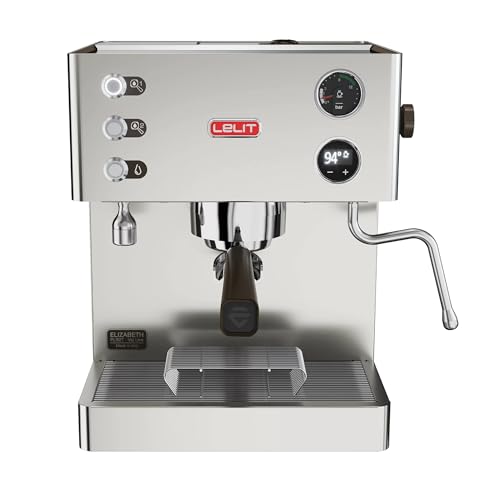
Lelit sells two machines called Elizabeth, and this text covers the older one. In the Amazon catalogue, the ASIN B07Q5V179F carries the model designation PESEL01BSS3QXX1 with the part number PL92T. Lelit’s German shop lists the “Elizabeth” with exactly this model designation as its SKU, and the international product page calls it PL92T. The Elizabeth3 (PL92T3) is a separate product with a different coffee boiler. What both share is the principle: one boiler for the coffee, a second for steam and hot water, and so espresso and milk foam at the same time.
Which Elizabeth this is and what it costs
The manufacturer is LELIT srl a socio unico, based at Viale del Lavoro 47 in Castegnato in the province of Brescia. Lelit states that all its own products are designed and built in Italy.
Besides the product page and data sheet, this text draws on two manuals from different years. One is an English Lelit manual dated 20 September 2018 (revision 01), the other the German operating manual with a 2022 copyright. The English manual describes an earlier revision of the same PL92T, with a different weight and different dimensions. Where a figure appears only there, we call it the older manual or add the year.
In our price box the Elizabeth stands at approx. €1,187 on Amazon.de. The Amazon catalogue extract of 7 September 2026 listed €1,136.59. In its own web shop, on the other hand, Lelit asked €1,349.00 on 24 September 2026. In our espresso machine comparison no machine is more expensive; the next in the price list is the Sage Barista Touch at approx. €972.
Two boilers, one LELIT58 group, 15.3 kilograms
The coffee boiler holds 300 ml and is made of brass. The boiler for steam and hot water holds 600 ml and is made of AISI 316L stainless steel. Both are supplied from a 2.5 l water tank, which according to the manual you fill with room-temperature water up to the maximum mark. The machine should stand on a firm, flat and dry surface, and before the first shot the protective cardboard pieces under the brew group come out.
At the front sits the brew group, which Lelit calls LELIT58 and describes as a commercial group. If you expect an E61 in a dual boiler at this price: Lelit does not use that designation for the Elizabeth anywhere. Between the group and the drip tray sits a 3-way solenoid valve: after the shot it directs excess water straight into the tray, according to Lelit so that the coffee puck dries. The portafilter has a spout that Lelit calls Coffee Slide. According to the manufacturer, its angle, length and open surfaces are designed for the result in the cup.
For milk and tea there are two separate nozzles, a multidirectional steam nozzle with burn protection and a fixed hot water nozzle. The housing is tall enough, Lelit writes, for hot water to run straight into the cup. According to the manufacturer, mugs also fit under the brew group.
The housing is brushed stainless steel, and the drip tray carries a wire grid. The cup tray on top is heated; the Amazon description calls it boiler-heated.
On dimensions, the sources contradict each other. The English data sheet from 2024 gives 32 × 38 × 38 cm (length, depth, height), the German Lelit shop 38 × 32 × 38 cm and overwrites that with width, depth, height. The Amazon catalogue converts to roughly 38 × 31 × 27 cm and so comes closer to the dimensions in the older manual (31 × 27 × 38 cm). The height of 38 cm is certain, as it appears in all three sources. Lelit gives the weight as 15.3 kg, the Amazon catalogue converts to the same value, and the older manual still said 12 kg. The machine connects to 230 to 240 V and 50 Hz, with a type E+F plug.
In detail: temperature, pressure and the LCC
A single-boiler machine has one boiler and therefore only ever one temperature. For espresso it lies below boiling point, for steam well above it, and if you want both, you heat up and cool down again. A heat-exchanger machine solves this with an exchanger that runs through the steam boiler: the brew water is merely passed through there, and its temperature depends on the steam boiler. The Elizabeth takes the third route. Each boiler has its own temperature, and neither has to wait for the other.
Lelit gives higher thermal stability, simultaneous output of coffee and steam and a shortened heat-up time as the reasons for the design. How the control works, Lelit describes only through the result: coffee and steam temperature are adjustable in the LCC, whereas the word PID does not appear in Lelit’s documents on the Elizabeth. From the factory the coffee boiler is set to 95 °C and the steam boiler to 135 °C; for hot water the manual also gives 95 °C. The older manual gives an adjustment range of 80 to 110 °C on the coffee boiler and 120 to 145 °C on the steam boiler.
The backlit pressure gauge shows the brew pressure. A green zone marks the range between 8 and 12 bar, and the manual requires the needle to arrive there during the shot. If it stays below, the grounds are usually too coarse or the dose too small; how to approach the grind size is explained in our guide on setting your grind size. The cover page of the 2018 manual gives 15 bar pump pressure. A figure like this stands for the most the pump can build up; during the shot, less is applied to the coffee grounds, and exactly this range is what the green zone shows.
The same cover page gives 1,200 W for the heating element on the coffee boiler and 1,000 W on the steam boiler. The manual requires a circuit with a suitable circuit breaker and an earthed supply. It prohibits adapters, multi-socket strips and extension cables; if they cannot be avoided, they must comply with the applicable standards and their current rating must not be exceeded.
The Elizabeth is operated via the LCC, the Lelit Control Center. It consists of an OLED graphic display and backlit stainless steel buttons, which the manual numbers 1 to 4. You can set coffee and steam temperature, Celsius or Fahrenheit, pre-infusion, brew time, automatic rinse and standby; there is also an automatic cleaning programme and the option to switch off the steam boiler. The display shows the shot time and the coffee, hot water and steam temperatures, and reports a lack of water in the tank. A counter records partial and total doses.
From the factory, button 1 has a pre-infusion of 3 s and button 2 one of 6 s, the automatic rinse lasts 5 s, and the brew duration is set to OFF. The way we read the table, a shot then runs until you stop it. In the older manual, brew time ranges from 1 to 99 s and pre-infusion from 1 to 20 s. You give the group a short rinse by pressing coffee buttons 1 and 2 at the same time. If the tank runs empty mid-extraction, a symbol appears, and the machine dispenses coffee for 60 seconds at most. On the very first switch-on, water runs from the brew group for about 40 s. According to the manual, it takes at most 4 minutes until the hydraulic circuit is full.
What is missing from the current Lelit documents is gathered here: the pump type (vibration or rotary pump), a pump pressure, the power consumption in watts, the end value of the pressure gauge scale, the adjustment range of the brew temperature, a noise level, the cup height under the spout in centimetres, the cable length, the consumption in standby, the material of the portafilter handle, how many milk jugs the steam boiler can manage in a row, a descaling interval by water hardness, the year of market launch and anything on spare parts supply. For some of these points there are figures in the older manual; where we use them, the year is given. We use our own estimates for none of these points.
Do you need two boilers if you stick to one cappuccino?
Probably not. With a single cappuccino, on a single-boiler machine you wait once for the steam, and then it is over. The Elizabeth plays to its strength only when several milk drinks are made one after another, because then no boiler has to switch back and forth between brewing and steam temperature. That is how we read the design.
Work through a Sunday morning with four cappuccinos. On a single-boiler machine, the boiler heats to steam temperature after the espresso, and before the next espresso it has to come down again, four times in a row. On the Elizabeth the espresso runs from the coffee boiler while the milk for the same cup is already being frothed at the steam boiler.
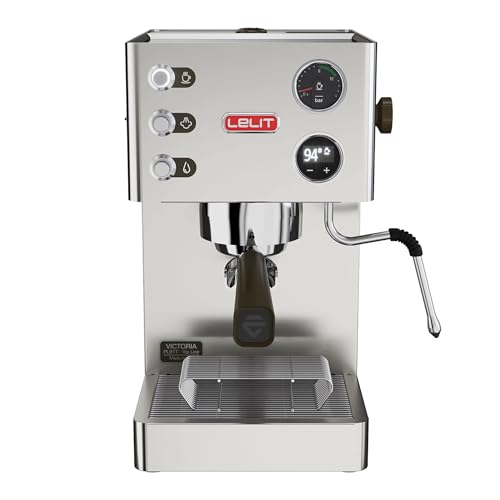
What the second boiler costs is shown by the Lelit Victoria (PL91T): in our catalogue about €390 lies between them, and Lelit gives the same water tank size for both.
If you drink only espresso, the steam boiler heats along with nothing to do. The LCC lets you switch it off; what you lose by doing so is covered in the steam boiler question below.
The Elizabeth or one of the others?
| Model | The difference | Price | Our rating | Choose this if |
|---|---|---|---|---|
| Lelit Elizabeth PL92T (this machine) | two boilers, espresso and steam at the same time | approx. €1,187 | 9.2 | you make two or more cappuccinos in a row in the morning |
| Lelit Victoria | one brass boiler for brewing and steam, same LELIT58 group | approx. €799 | 9.1 | you mostly drink espresso and would rather put the money into the grinder |
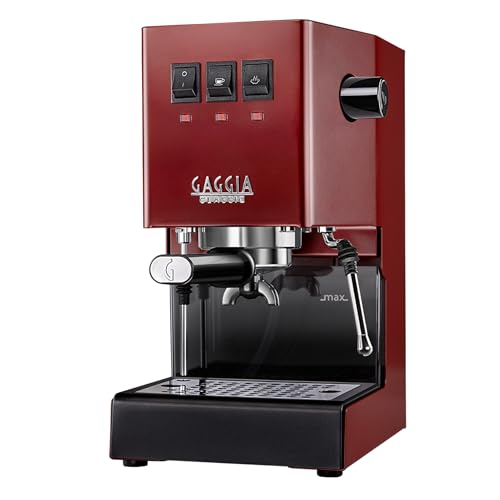
| Gaggia Classic UP | one brass boiler with PID, brewing and steaming one after the other | approx. €951 | 8.8 | you want a single-boiler machine outside Lelit and rarely froth milk |
| Gaggia Classic Evo Pro | one boiler with thermostat instead of PID | approx. €500 | 9.4 | you are starting with a portafilter machine and would rather put the roughly €690 difference to the Elizabeth into the grinder |
The prices are the guide values from our price boxes and may differ at the retailer. The rating is our editorial assessment from the available data and price, which is why an inexpensive machine like the Evo Pro can rank above a technically more elaborate one.
When the Elizabeth fits and when another does
Plan the footprint with 38 × 38 × 38 cm, that is, with the larger value in each case from the data sheet and the German shop, and with 15.3 kg on the worktop. Under a wall cabinet, height alone is not enough as a measure: how you reach the tank compartment is not clearly shown in the documents, as the manual mentions only a removable cover. Before buying, therefore, also measure the space above the machine.
For espresso you need a grinder that adjusts finely and in small steps; what to look for is explained in our grinder guide. As a worked example: with the Eureka Mignon Specialità from our catalogue (approx. €432), you would come to around €1,619 together.
A resin filter in the tank holds back the limescale. How hard your water is and what that means for filter changes is explained in the guide on water hardness and coffee. If you prefer to descale your machine yourself, you should look for a different one; why is covered below under care.
The LCC takes temperatures and times off your hands, but not grind size and dose. If you are still torn between the types of machine, you will find the basics in our espresso machine buying guide.
In the box, matching accessories, running costs
In the box are the LELIT58 portafilter with a double Coffee Slide spout and three IMS baskets: one for a single dose of 9 to 11 g, one for two doses of 14 to 18 g and a blind basket. Also included are a tamper and a spoon, both plastic according to the manual, a resin filter for water softening with 35 l capacity, a cup riser and an initial cleaning set of three sachets of powder and a bottle of liquid cleaner.
We see the plastic tamper as an emergency solution. If you buy a replacement, you need a tamper for the LELIT58 group, whose diameter Lelit gives as 58.55 mm in an accessory text.
Running costs arise from cleaning agents and filters. Lelit lists the cleaning powder as PLA9201 (40 sachets of 3.5 g each) and the liquid cleaner for the steam wand as PLA9203 (10 bottles of 125 ml each). Following the manual’s weekly routine, three sachets of powder go per week, two for soaking the portafilter and baskets and one for backflushing. One pack therefore lasts a good 13 weeks; over a year you need 156 sachets, so just under four packs. The initial cleaning set covers exactly the first week’s powder. The resin filter is the second item; you will find its replacement interval in the frequently asked questions.
Cleaning and descaling according to the manual
The German manual from 2022 divides the work into daily, weekly and annual.
Daily: you clean the surfaces with a soft cloth, preferably microfibre, dampened with clear water. After every extraction you remove the coffee residue in the basket, wash the portafilter with the basket inserted under running water and brush the coffee powder off the seal. You wipe the tip of the steam nozzle with a damp cloth after every use and release a small amount of steam. The drip tray must be rinsed by hand with neutral soap and warm water.
Four jobs are added weekly. Portafilter and baskets soak for 15 minutes in about 1 l of hot water with two sachets of cleaning powder, with the handle kept out, then they are rinsed thoroughly. For backflushing you insert the blind basket with one sachet of powder and press buttons 1 and 4 at the same time; the process then runs automatically; afterwards you rinse with the two-dose basket. Water splashes from backflushing must be wiped off the body of the machine at once with a damp cloth, otherwise, according to the manual, damage to the outer surfaces is possible. You dip the steam nozzle in 500 ml of cold water with liquid cleaner and release steam ten times for 5 seconds with a 5 second pause each, then the same with 1 l of clear water. You change the tank water often, clean the tank by hand with mild soap, and for longer periods of non-use it is emptied and dried.
The older manual still recommended backflushing once a month. For the current machine we follow the 2022 manual with its weekly rhythm.
Once a year the hydraulic circuit is descaled. Beforehand a dealer or specialist technician should check its condition, and the descaling itself must, according to the manual, be carried out by a specialist technician. The 2018 manual states in capital letters that descaling agents must under no circumstances be put into the water tank. General information on both jobs is in our guide to descaling and cleaning, but for the Elizabeth the Lelit manual applies.
A few more rules come from the older manual: the machine must be cleaned at least once a week, beforehand you pull the plug and let it cool down, abrasives are taboo, and you must not immerse it. According to the safety section, it must also not be cleaned with a jet of water. Baskets and portafilters never go in the dishwasher. If the machine stands in a room below freezing point, the tank and water lines must be emptied.
Care also has a contractual side. Lelit’s warranty terms exclude malfunctions and damage resulting from lack of or incorrect maintenance, expressly naming an uncleaned product and harmful cleaning agents.
Who is it suitable for?
The 2018 manual describes the Elizabeth as a machine for one or two cups of coffee, with two nozzles for steam and hot water, built for home use and not suitable for continuous professional use. As household-like places of use it lists: staff kitchens in shops, offices and other work environments, farmhouses, guests in hotels and motels, and bed and breakfasts. It is intended only for espresso, for hot drinks via the hot water or steam nozzle and for warming cups. Lelit calls any other use improper and possibly dangerous.
In our assessment, it therefore fits a household or a staff kitchen where someone takes on the weekly care. It is wrong for a small café in continuous operation, which the manual itself rules out.
According to the manual, children aged 8 and over and people with limited abilities may use the machine only under supervision or after instruction by a person responsible for their safety. Children must not play with it, and they may clean it only if they are older than 8 and supervised. The machine and cable belong out of the reach of children under 8.