Eureka does not list the Mignon Specialità as an ordinary household appliance but in its own catalogue under Professional Home Grinders, Silent Range series. For approx. €431.90 on Amazon.de (as of September 2026) you get a unit from that corner of the catalogue in a slim housing: 55 mm flat burrs, stepless adjustment and a touchscreen timer.
Who builds the grinder, and what sits next to it in the catalogue
The brand belongs to Conti Valerio S.r.l. of Sesto Fiorentino near Florence, and the Specialità is part of the Eureka 1920 line. Aurelio Conti founded the company in Florence as a maker of espresso grinders, and Eureka still states that all its products are 100 per cent Made in Florence and fully assembled by hand at the Florentine factory.
The catalogue contains four grinders with Specialità in the name: the Specialità itself, the Compatto, the UP and the SMART. The Amazon title for this ASIN reads Eureka MIGNON SPECIALITA 55 Espressomühle, schwarz/schwarz, Timer 1&2 Tassen, DELUXE. The addition DELUXE appears nowhere in the Eureka catalogue, and the article number stored in the retailer listing, VP-KM-5055-BAG-4PK-CF1-2FLT-DL51, is assigned by the retailer and does not appear at Eureka. For parts and accessories, searching for Mignon Specialità is therefore the more reliable route.
As standard colours Eureka lists Matte Black, Grey, White, Ferrari Red, Gourmet Green and Blue, plus more than 20 special colours and the special editions Dubai Gold, Rose Gold and Aged Copper. The front panels go by the codes 15BL, 16CR, 17NX and 18WD.
Burrs, motor and how deep it is
The burrs are flat, 55 millimetres across and made of hardened steel. Eureka classes them as All Purpose, so intended for more than one brewing method. They are driven by an AC motor running at 1,350 revolutions per minute with a power consumption of 310 watts; the product page and the manual agree on both figures.
The unit weighs 5.6 kilograms and is 350 millimetres high and 120 millimetres wide. On depth, the manufacturer’s documents contradict each other: the product page and data sheet say 140 millimetres, the technical data table in the manual 180. Amazon gives 35 x 12 x 18. The table in the manual covers the whole Mignon family, so we consider the smaller value from the product page the closer fit for this model. In the product photo the body is a slim, tall tower; beyond the footprint, the hopper on top and the portafilter fork at the front stick out.
Grinding speed also has two manufacturer figures side by side. The product page and data sheet give 1.8 to 2.5 grams per second for espresso and 2.5 to 3.5 grams for coarser preparations. The manual’s table gives 1.4 to 1.8 grams per second in the espresso range and 1.9 to 2.5 grams in the brew range for the Silent series with 55 millimetres. We work with the more cautious figure: 18 grams for a double espresso then takes roughly 10 to 13 seconds, while according to the product page it would be 7 to 10. Both ranges are our own division of the manufacturer’s figures.
A whole block of information, on the other hand, is missing from every source Eureka offers, that is both language versions of the product page, the data sheet, the manual and the warranty conditions: for the housing, outlet and bean hopper the manufacturer names no material (in the product photo the hopper is transparent, the manual only mentions a plastic lid), there is no absolute noise level in decibels, no cable length, no figure for the retention in the burrs, no grind range in microns and no statement of how many notches a full turn of the adjustment knob has. Neither a launch year nor a recommended retail price is given anywhere.
The lower burr is what moves
The adjustment is stepless and micrometric. According to the data sheet, the system has an infinite number of setting points and is the only one based on repositioning the lower burr. Eureka names maintenance without losing the setting you have found as the benefit. We read that this way: because the lower burr is adjusted, the position stays put when you open the upper burr carrier for cleaning.
Why the fineness of the adjustment matters at all for espresso: the water is forced through the puck at around nine bar, and the flow time depends much more steeply on the grind size than with filter or French press. With a stepped grinder, the right point may lie between two clicks. Then the main way out is to change the dose.
The adjustment is operated with the knob on the housing. Clockwise makes the grounds finer, anticlockwise coarser. The manual asks you to proceed step by step and to grind a little coffee every two notches, and warns that if the knob is turned by a whole revolution while the motor is stopped, the machine can stall. Before starting work, a fine adjustment is needed anyway depending on the coffee blend, that is, on the roast level. How this works in practice is covered in our guide to setting the grind size.
For the outlet, Eureka names the ACE system, translated as Anti-Clump and Electrostatic. According to the data sheet, it prevents clumping and controls the flow of the ground coffee. Finely ground espresso builds up an electrostatic charge during grinding and clumps, and clumps in the basket are one of the causes of channelling.
Touchscreen, two doses, one counter
The display measures 26 by 40 millimetres, is touch-sensitive and, according to the data sheet, has the programme type 2 Doses plus Manual: two programmable quantities, minus and plus buttons for the grinding time and an Extra Dose mode. Grinding is started via the microswitch on the portafilter fork or directly on the display.
If you press both dose buttons at the same time, continuous dispensing runs, for a maximum of 60 seconds at a time. Everything is counted: the portion counter records single portions, double portions and continuous dispensing, and it shows large numbers in pairs, one after the other, for two seconds each. At 142536 portions dispensed, 14 appears, then 25, then 36. The next time it is switched on, the grinder keeps the settings that were active when it was switched off.
It has no scale. Dosing is by time, and grinding time multiplied by throughput gives the same weight only as long as the bean and the fill level stay the same: a different roast level, an oily surface or an almost empty hopper shifts the throughput. If you want to dose to the gram, put a scale next to it. You can work out the brew ratio for that with our brew calculator.
How loud is the Specialità?
Eureka promotes the noise insulation as Silent Technology, with the sentence “Quiet grinding anywhere, in the café or at home”. As a figure the manufacturer gives a difference: according to the data sheet, the anti-vibration solution reduces the grinding noise by around 20 dB compared with conventional grinders.
Twenty decibels less sound pressure level corresponds mathematically to a tenth of the sound pressure, which would be a lot. Eureka does not say which grinder counts as conventional, though, and without that reference point the figure describes a direction, not a level in your kitchen.
What else is worth considering?
In our overview of electric coffee grinders, the Specialità sits at the top as the comparison winner 2026.
| Model | The difference | Price | Our score | Choose this one if |
|---|---|---|---|---|
| Eureka Mignon Specialità (this one) | Stepless via the lower 55 mm burr, dosing by time | approx. €431.90 | 9.4 | you fine-tune a setting and want to keep it afterwards |
| Eureka Libra 16CR | Scale in the unit, dosing by gram instead of by second | approx. €639 | 9.2 | you reweigh every shot anyway |
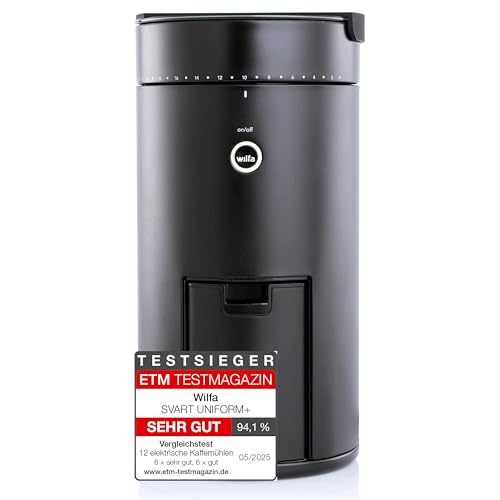
| Wilfa Svart Uniform+ | 58 mm burrs with 41 click steps, scale in the lid | approx. €330 | 9.1 | you grind for filter and weigh in fresh for each brew |
| Sage Smart Grinder Pro | 60 grind settings according to Sage instead of stepless adjustment | approx. €199 | 8.8 | you are starting out with espresso and want to stay under €200 |
The prices are guide values as of September 2026 and they move; the score in the fourth column is our editorial assessment and is based on comparing the data sheets. In terms of purchase price, the Eureka Libra 16CR costs around €207 more, the Wilfa Svart Uniform+ around €102 less and the Sage Smart Grinder Pro around €233 less than the Specialità. The Sage adjusts a conical burr set in fixed steps, the Wilfa a flat burr set in clicks. Both therefore have fixed positions that you can find again, where the Eureka allows any number of intermediate positions between two points.
Incidentally, the Libra does not belong to the Specialità series. Its three sister models, including the Smart with the Burrs Distance Detection System, are not yet in our catalogue.
When this grinder fits and when another one does
Measure upwards first. Under a wall cabinet, 350 millimetres of height count, plus room for the hand that takes off the lid and refills the beans. In width the grinder needs 120 millimetres, and the manual requires a horizontal, stable surface that can carry the weight of the appliance.
Then the volume. For correct operation Eureka sets two limits: no more than 160 grams of coffee per activation, and for the motor a duty cycle of 60 seconds on with a pause of 120 or 600 seconds. Two or three double shots in the morning are far from that. At the counter of a bed and breakfast, where grinding happens twenty times in a row, the duty cycle matters most, because a single double shot never reaches the 160 grams per activation. We read the 60 seconds as grinding time that adds up over shots following each other closely: at 10 to 13 seconds per double shot, the pause would then be due after about four to six shots.
The bean hopper holds 300 grams, and Eureka offers 510 grams as an option; the manual says 500 there. At the 18 grams per double shot assumed above, the standard fill lasts for about 16 shots, so with two doubles a day a good week. If you change varieties often, you do not need a full hopper; for that case Eureka sells a Single Dose Hopper as an accessory.
Not every preparation is intended, but more than just one: the data sheet lists Turkish, Espresso, Moka, Drip and French Press as recommended uses. In our assessment, the resolution of the adjustment is built for espresso; with French press it remains largely unused. If you only make French press or pour-over, in our view you are better served by a stepped grinder until a portafilter machine joins the setup.
Cleaning, wear and what Eureka requires
You take off the bean hopper, wash the inside with water and neutral soap, removing the oil film left by the beans, then rinse and dry thoroughly; the same goes for the plastic lid. Two sentences of the manual belong here, in translation: “Do not wash in the dishwasher. We recommend cleaning at least once a week.”
The grinding system, by contrast, stays dry. After removing the lid you open the upper burr carrier and clean burrs and inner parts with a dry brush or a dry cloth, if necessary with a vacuum cleaner or compressed air. For complete hygiene Eureka refers to commercially available cleaning tablets for coffee grinders. All cleaning and disinfection must be carried out with food-safe products.
The appliance, cable and plug must not be immersed in water or other liquids, the inner parts must not come into contact with liquids, and water jets, unsuitable cleaning agents and steam cleaners are ruled out. Before any cleaning and maintenance the mains plug is pulled, by the plug, not by the cable. Otherwise, too, according to the manual the grinder should not stay switched on unnecessarily: when it is not in use, the plug belongs out of the socket.
Two requirements in the manual go strikingly far: maintenance and cleaning work must be carried out by qualified personnel authorised by the manufacturer, and non-original spare parts and makeshift repairs are prohibited. This cannot be fully reconciled: the same manual describes cleaning the hopper and burrs to the user and prescribes, for domestic use, switching the grinder off and disconnecting it from the power before replacing components. When replacing the burrs we would still stick to the qualified-personnel clause: according to Eureka, use that deviates from the manual excludes any warranty condition and the manufacturer’s responsibility.
The burrs are the wear part. The manual wants them checked every 250 kilograms of coffee and replaced if necessary, while the product page puts their service life at 300 kilograms. What that means for you can be worked out: 250 kilograms is enough for around 13,900 doubles of 18 grams each, so at four a day about nine and a half years. For access, you disconnect the machine from the mains and take off the hopper, then follow the screw on the cover and the screws underneath; according to the data sheet, the burr carrier itself can be taken apart by loosening nine screws.
The rest concerns the beginning and the end. When unpacking, Eureka first wants a look at the outer packaging, then at the unpacked appliance and at the integrity of the components; defects or damage go straight to the authorised dealer, and cardboard, cellophane, staples and polystyrene are kept out of children’s reach. The manual itself should be kept dry, clean and protected from heat and be available to the user and the service technician at all times. At the end of its life the grinder belongs at a collection point for the recycling of electrical and electronic equipment.
What the manual allows and what it excludes
The manual describes two areas of use. The first: intended for commercial use, for example in the kitchens of restaurants, canteens and hospitals and in commercial businesses such as bakeries, butchers and the like, but not for continuous mass production of food. The second: intended for use in households and similar applications, for example in staff kitchen areas of shops, offices and other workplaces, on farms, and by clients in hotels, motels or other residential and bed-and-breakfast environments.
Only roasted coffee beans may be ground. Any other use counts as improper and dangerous for the manufacturer and excludes its liability. On children the manual is not consistent. In one place it says that children and untrained personnel should not use the appliance. In another, children from the age of eight and people with reduced abilities may operate it under supervision and after instruction, but not clean it without supervision. With children in the household, we advise the stricter version.
The grinder does not belong outdoors. The manual rules out extreme ambient conditions and sets the limits at minus 5 and plus 30 degrees Celsius, and the machine must not be exposed to atmospheric influences such as sun and rain. An outdoor kitchen is therefore out, as is an attic room that exceeds 30 degrees in high summer.