At Sage, the Smart Grinder Pro is called the BCG820, and the EU version is the SCG820. Our Amazon link leads to the variant SCG820BST4EEU1, which Sage lists as “Black Stainless Steel” (the German shop calls it “Schwarzer Edelstahl”). The same grinder is also available in Brushed Stainless Steel Grey and Truffle Black. The coffee grinder category of the German Sage shop contains exactly two grinders: this one and the smaller Dose Control Pro (BCG600).
Our price box shows approx. €199 on Amazon.de (as of September 2026, Amazon catalogue of 7 September). In the Sage shop the grinder regularly costs €259.90 (as of 25 September 2026).
It is designed for two ways of grinding: fine and in portions straight into the portafilter, or coarser into a container for a pot, pour-over and French press. In our overview of electric coffee grinders it appears as an espresso grinder with conical burrs.
Design: hopper on top, portafilter niche below
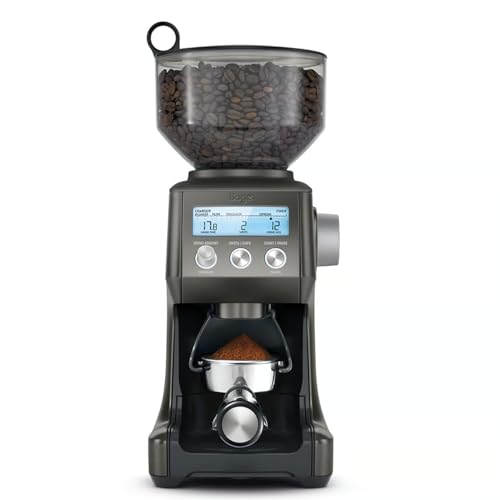
On the product photo, a transparent bean hopper with a lid sits on top and widens towards the top. Below it is the front with the backlit display and three round controls, and a larger dial sticks out on the right-hand side. At the bottom is an open niche in which a portafilter hangs in its cradle. In the picture the display shows 17.8 seconds, 2 shots and grind setting 12.
The parts overview in the manual runs from A to K: bean hopper lid, bean hopper, conical burr set, backlit LCD display, GRIND AMOUNT / PROGRAM dial, SHOTS / CUPS button, grinder outlet, catch tray, grind setting dial, START / PAUSE / CANCEL button and the portafilter activation switch. The appliance itself carries English labels (GRIND AMOUNT / PROGRAM, SHOTS | CUPS, START | PAUSE / CANCEL); the German names are the manual’s translation.
According to Sage, it measures 21.5 × 16 × 38.9 centimetres on the outside (width, depth, height). Sage itself does not state an appliance weight. The Amazon catalogue lists approx. 47 × 27.5 × 19.5 centimetres and approx. 3.68 kg. That matches no edge of the appliance and probably describes the carton, so the 3.68 kg is not usable as the weight of the grinder.
According to the product page, the housing and burrs are made of stainless steel, and the manual specifies the conical burr set as hardened stainless steel. The motor draws 165 watts. Sage is not entirely consistent on the mains data: the product page and the manual’s power specifications give 220 to 240 volts, the section on first use a socket with 230 to 240 volts, and for the frequency the German part says 50 hertz, the English part 50 to 60. The German mains supply of 230 volts and 50 hertz lies within each of these ranges.
According to Sage, the bean hopper holds 450 g. It is fitted from above: align the marks at the base, place the hopper on and turn the dial by 90 degrees until it locks.
In detail: 60 settings, and half of them belong to espresso
In a conical burr set, a cone-shaped grinding body turns inside a ring. At the top, where the gap is wide, the beans are cracked open, further down they are ground, and the narrowest distance at the outlet decides how fine the grounds come out. You set this distance with the grind setting dial on the side.
Sage’s coffee table divides the 60 settings like this: 1 to 30 fine for espresso, 31 to 45 medium for the coffee machine, 46 to 54 medium-coarse for filter coffee, 55 to 60 coarse for the French press. Thirty settings for one method, six for another. The weighting has a reason. With espresso, the machine forces water through a firmly compacted puck, and even a small change in particle size shifts the flow time noticeably. A French press steeps for several minutes without pressure and is far more forgiving.
As a starting point for espresso, Sage recommends setting 12, then going coarser or finer from there. For freshly roasted beans, the manual advises single-wall filter baskets. How to work your way systematically from a starting value is covered in our guide Adjusting your grind size.
If the scale is not enough, you move the upper burr. Sage describes this as extending the range and advises changing only one setting at a time. The procedure according to the manual: unlock the bean hopper, tip the beans into a container, run the grinder empty, remove the hopper and the upper burr, release the wire handle, set the burr one number coarser or finer, put the wire handle back, lock burr and hopper in place. Afterwards you check the extraction.
If the grind setting dial turns stiffly, the manual says to start the grinder with START / PAUSE / CANCEL and only turn the dial while it is running. This loosens bean residue between the burrs.
According to the manual, it may only grind roasted whole coffee beans. Unroasted green beans and underroasted beans can damage or destroy the burr set.
Dosing IQ: seconds, shots and cups
Sage calls the timer control Dosing IQ. With SHOTS / CUPS you choose the quantity, according to the coffee table 1 to 8 espresso shots or 1 to 12 cups. According to Sage, cups are meant for the cafetière (French press) and shots for espresso. With the GRIND AMOUNT dial you change the time, to the right for longer, to the left for shorter. The display shows the grind setting, the time and the selected count.
Once a time is right, you hold PROGRAM until the grinder beeps twice. Only the quantity currently shown on the display is saved. If you reprogram two shots, one shot, three shots and every cup count stay as they were, and another brewing method keeps its setting as well. You return to factory settings by holding SHOTS / CUPS until a long beep sounds.
How finely the time can be adjusted is described inconsistently by Sage. The product page speaks of “steps of up to 0.2 seconds”, the category and spare parts page of steps between 0.2 and 1 second, and Amazon’s manufacturer text of 0.2-second steps. None of these places makes clear whether the 0.2 seconds apply across the whole setting range. We read it as the finest step Sage states.
There are two ways to start. Either you tap START / PAUSE / CANCEL briefly, or you press the handle of the portafilter once against the switch in the niche. The grinder then grinds the set amount and stops by itself. If you hold the button or the portafilter, it grinds until you let go. A press during grinding pauses for 10 seconds, and the next one grinds the rest. We would use the pause to spread the grounds in the basket briefly before the second portion drops.
With the cradle fitted, a maximum of 2 espresso shots is possible. For larger amounts, you pull the cradle out of the grinder outlet at the bottom and place an open container or filter underneath. Sage names portafilter, airtight container, basket filter and paper filter as targets. After 5 minutes without use, the grinder switches itself off.
Do you still need a scale with the Smart Grinder Pro?
For espresso we would say yes, at least with every new bean. The grinder repeats a time, not a mass, and its display shows no weight. How much ground coffee passes through in one second depends on the grind setting and the bean.
Fine grounds flow out of the burr set more slowly than coarse ones. Dark roasted beans are lighter and more porous than light ones, so at the same volume less mass ends up in the basket. This is general grinding technology and nobody has measured it on this grinder. If you change from setting 12 to setting 16, the amount shifts even though the seconds stay the same.
In practice that means: when you change variety, weigh one dose, adjust the time with GRIND AMOUNT and save it with PROGRAM. After that the grinder repeats the time until the next bag arrives. With a pot, one gram more or less matters far less than with an espresso dose of around 18 g. How much coffee suits your amount of water is worked out by the brew calculator.
Portafilter cradles and accessories
According to Sage, the box contains two portafilter cradles, one for 50 to 54 mm and one for 58 mm. There is also a grinding container with a lid and sealing cap and a cleaning brush for the conical burr set. A portafilter of 51 or 54 mm therefore belongs in the small cradle, one of 58 mm in the large one.
Sage does not provide for third-party attachments, and the safety notes say: “Only use the attachments supplied with your appliance.” If your portafilter fits neither cradle, we would grind into the grinding container and transfer from there.
For the BCG820, Sage runs its own spare parts page. The product hub for the grinder also holds the instruction manual, a cleaning guide as a video, tutorials on initial setup, grinding and personalising the settings, and product registration.
This grinder or one of the others?
| Model | The difference | Price | Our rating | Choose this if |
|---|---|---|---|---|
| Sage Smart Grinder Pro (this one) | 60 settings, stored grind time for each shot and cup count, cradles for 50 to 54 and 58 mm | approx. €199.00 | 8.8 | you grind espresso and a pot with one grinder and want to store times |
| Sage Dose Control Pro (review) | no LCD with stored quantities, 340 g bean hopper, 34.2 cm tall | approx. €153.25 | 8.4 | you mostly grind the same amount and need to save height under a wall cabinet |
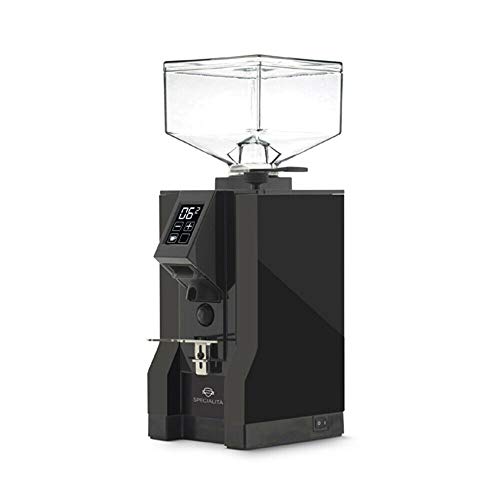
| Baratza Virtuoso+ (review) | 40 settings, timer with 0.1 s resolution, grinds into a grounds container (Baratza: coffee grounds container) | approx. €229.95 | 9.0 | you mainly make filter, AeroPress or French press |
| Eureka Mignon Specialita (review) | 55 mm flat burr set, stepless adjustment | approx. €431.90 | 9.4 | you grind almost only espresso and want to fine-tune the grind setting steplessly |
The prices are our guide values as of September 2026, and the rating is our editorial classification. The technical data on the three other grinders come from their manufacturers.
When the Smart Grinder Pro fits and when another does
The mix decides. If you pull espresso during the week and make a pot on Sunday, this grinder covers both with stored quantities. The switch costs a turn of the grind setting, a press of SHOTS / CUPS and pulling out the portafilter cradle so that the grinding container fits underneath. In our comparison, this is its strongest argument.
If you grind almost exclusively espresso and want to adjust between two clicks, we would go for the Eureka Mignon Specialita. In our catalogue it is €232.90 higher.
If you mostly brew filter, you do not need the portafilter cradles. Then quite a lot speaks for the Baratza Virtuoso+. For just under €31 more, it grinds into its own grounds container and sets the timer in tenths of a second.
With a tight budget and limited height, the Dose Control Pro comes into the conversation. It costs €45.75 less with us and, according to Sage, is 4.7 centimetres lower, but its hopper holds 340 instead of 450 g, and it does not store programmes per quantity. In our assessment, anyone who pulls the same double shot every morning will hardly miss the programmes.
On footprint: 21.5 × 16 centimetres of base area is little, the critical figure is the height of 38.9 centimetres. You need headroom above, because the bean hopper is fitted from above, turned and removed again for cleaning, and Sage does not state how much clearance that requires. Under a wall cabinet, it is best to place it so that you can pull it forward for this.
It is the wrong choice for anyone who wants to dose to the exact gram without putting a scale next to it. According to Eureka, the Eureka Libra grinds by weight instead of by time, but costs €440 more.
Cleaning and care according to the manual
The manual prescribes four steps. First, empty the bean hopper and grind out the beans that cannot be removed. Second, pull the mains plug. Third, wash hopper and lid “in warm soapy water, rinse and dry carefully”. Fourth, wipe the outside of the appliance “with a soft, damp cloth and polish”. (These are our translations of the German manual text.)
Two notes come with this: “Do not use alkaline or abrasive cleaners or steel wool, as these can damage the surface.” And: “Please do not wash grinder parts or accessory parts in the dishwasher.” This includes the grinding container and the portafilter cradles.
For the burrs, Sage justifies the care by the result: regularly cleaned burrs “achieve more even grind results, which matter above all for espresso coffee”. The manual’s picture steps begin as for moving the upper burr further up, until hopper and burr are removed. Then you brush the lower and upper burr with the supplied brush, clean the grinder outlet with a small brush, push the upper burr back in until it locks, and finally fit the bean hopper.
Of the safety notes, three sentences concern cleaning directly: “Always switch the appliance off, unplug it and let it cool down before moving, cleaning or storing it.” “To protect against electric shock, do not immerse the plug, power cord or appliance in water or other liquids.” And: “Have all maintenance other than cleaning carried out only by authorised Sage® customer service centres.” (Again our translations of the German manual text.) What generally builds up in grinders is explained in the guide Cleaning a coffee grinder.
What Sage leaves open
Collected in one place, what neither the product page nor the manual states: the diameter of the conical burr set, the speed, the throughput in grams per second (without it, seconds cannot be converted into grams), the noise level in decibels, the grounds retained in the burr set, the material of the bean hopper, lid, catch tray and grinding container, the capacity of the grinding container, the cable length, the number of positions on the upper burr (the numbers in the manual’s graphic are not legible), the shortest and longest programmable grind time, the factory default times, a measured value for the reduced grinding heat that Sage promises only in general terms for its grinders, the operating time until overheating, the country of production and the year of market launch. Whether the Smart Grinder Pro and the Dose Control Pro share the same burr set is stated nowhere.
Which parts the spare parts page for the BCG820 lists in detail and what they cost, we could not read out, because the page only loads its list afterwards by script.