Sage’s German Coffee Grinders category contains two electric grinders, and the Dose Control Pro is the one with the dial instead of the display. The other is the Smart Grinder Pro. Apart from these, the category holds only two espresso machines with a built-in grinder, the BES875 and the BES882.
The model designation is BCG600, and the European version is the SCG600. Sage offers it in silver and in Truffle Black, and our price box points to the silver version with the part number SCG600SIL2EEU1. On Amazon.de it costs approx. €153.25 (as of September 2026). In the Sage shop on 25 September 2026 it stood at €219.90, the same in both colours.
Amazon gives 15 April 2018 as the release date. If you are looking for the company behind it: the data record on the German Sage page lists Breville as the brand, and the Amazon catalogue gives BRG Appliances as the manufacturer, the same name that appears in the copyright of the 2023 manual.
The grinder is built for households that grind straight into the portafilter and also brew filter coffee or French press. In our overview of electric coffee grinders it is listed as an espresso grinder with conical burrs.
Design: hopper on top, time at the front
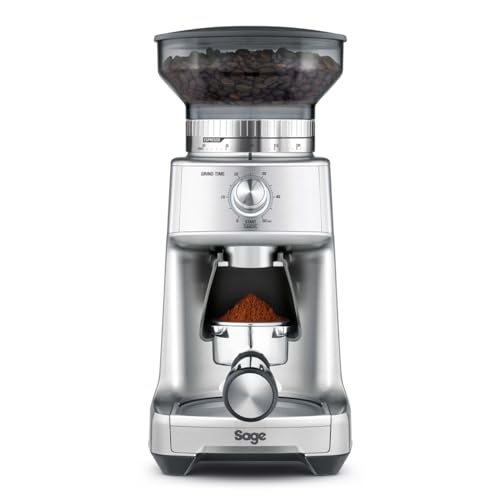
Sage gives the dimensions as 20.4 × 16 × 34.2 centimetres (width, depth, height). In the product photo, a transparent, dark-tinted bean hopper with a lid sits on top, with a silver ring below it carrying a printed scale. This ring is the grind size adjustment. You turn the whole hopper until the marker points to the setting you want; the grinder has no separate knob for the grind size.
At the front in the middle is the dial for the grind time, labelled GRIND TIME in the photo, with the START / CANCEL button in its centre. Below it opens a recess. There, a holder keeps the portafilter under the grinder outlet, and the catch tray lies at the bottom.
The manual’s parts overview lists nine items: bean hopper lid, bean hopper, conical burrs, grind size adjustment, GRIND TIME dial, START / CANCEL button, grinder outlet, 50 mm knife and catch tray. The knife probably means the separately supplied 50 mm blade of the Razor dosing tool, which page 7 describes, and not the diameter of the burrs.
The burrs are conical burrs in hardened stainless steel, and the upper and lower burrs are removable. According to Sage, they minimise heat during grinding in order to protect the oils in the bean.
The hopper holds 340 g of beans. According to the manual, the motor draws 130 watts, at 220 to 240 volts and 50 hertz. To fit the hopper, you line up the markers, press the hopper down and turn the dial by 45 degrees until it clicks.
In detail: the amount comes from the clock
The Dose Control Pro has no scale, and no second dial for the amount either. It grinds for as long as you set on the GRIND TIME dial. In the illustration in the manual, its scale runs from 0 to 50 seconds, labelled in steps of ten. That the time can be adjusted in 1-second steps is stated on the product page and in the Amazon text, but not in this form in the manual itself.
While grinding, pressing the START / CANCEL button stops the grinder for up to 10 seconds. During the pause the button flashes slowly. A second press grinds the remaining amount, and holding it for one second cancels. For manual operation you hold the button down, and the grinder runs until you let go.
How precisely a timed dose works depends on the throughput, that is, how many grams per second fall out of the outlet. This is not a fixed quantity. In common experience with conical grinders, finely ground coffee passes through the burrs more slowly than coarse, and bean variety, roast level and age also play a part. Sage notes this beneath its own coffee chart: grind time and grind size vary with the type, age and roast of the beans. If you change the grind size by a few steps or open a new bag, you therefore get a different amount for the same number of seconds.
Our recommendation: after every change to the grind size, weigh the ground coffee once on the kitchen scale and adjust the dial. The time then holds until the next bag.
Which grind setting for espresso, filter or French press?
The coffee chart in the manual divides the scale into four ranges: espresso 1 to 25 (fine), coffee machine 26 to 34 (medium), filter coffee 35 to 45 (medium-coarse), coffee press or French press 46 to 55 (coarse). For espresso, Sage advises starting at 15.
From 15, there are 14 settings finer and 10 coarser within the espresso range. So 25 of the 60 settings go to a single brewing method, and there is a technical reason for that. In espresso, the machine forces water under pressure through a solid coffee puck, and the flow time reacts sensitively to particle size. In a pour-over or a French press the contact time is long, so a jump of one setting matters less.
Two small details in the manual do not quite fit together. In the illustration, the scale on the ring starts at 0, where FINE and the ESPRESSO marking are, while the text has the espresso range begin at 1. And the chart ends at 55, so settings 56 to 60 have no brewing method assigned. Sage describes the whole chart as just a starting point anyway.
If the hopper is hard to turn, the manual suggests a trick: press the START / CANCEL button and turn the hopper while the grinder is running. This loosens bean remnants between the burrs. How you work towards a bean step by step is described in our guide Adjusting grind size, and the Brew Calculator works out the water quantity for a given amount of coffee.
Into the portafilter, into a tin or straight into the filter
For the portafilter, the manual says two holders are included, one for 50 to 54 mm and one for 58 mm. You fit the right holder, then the portafilter, and the grinder holds it in place during grinding. For a tin or a filter, you pull the holder down out of the grinder outlet and place the vessel directly underneath.
The ground coffee piles up in the basket as it does so. According to the manual this is normal, because untamped coffee has about three times the volume of tamped coffee. For tamping the manual gives 15 to 20 kg, which means the force with which you press: roughly as if a weight of that size were resting on the tamper.
The Razor follows, an adjustable dosing tool. Its blade comes in three widths: 58 and 54 mm are attached to the Razor body, and the 50 mm blade is supplied separately. After tamping you place the Razor in the basket until the blade rests on the rim of the basket. If it does not reach the coffee, there is too little in the basket, and you turn the GRIND TIME up. In this way the Razor provides the control that the timer lacks: it shows whether the amount fits the basket.
The Dose Control Pro or one of the others?
| Model | The difference | Price | Our score | Choose this one if |
|---|---|---|---|---|
| Sage Dose Control Pro (this one) | Timer dial 0 to 50 s without a readout, holder for 50 to 54 and 58 mm | approx. €153.25 | 8.4 | you want to grind straight into the portafilter and set the amount via time |
| Sage Smart Grinder Pro | illuminated LCD, grind time programmable in steps of up to 0.2 s according to Sage | approx. €199.00 | 8.8 | you want to read grind time and grind size off a display |
| Baratza Encore ESP | no timer, settings 1 to 20 finely stepped for espresso, dosing cup for 54 mm with a 58 mm ring | approx. €179.95 | 9.0 | you weigh every dose on the scale anyway |
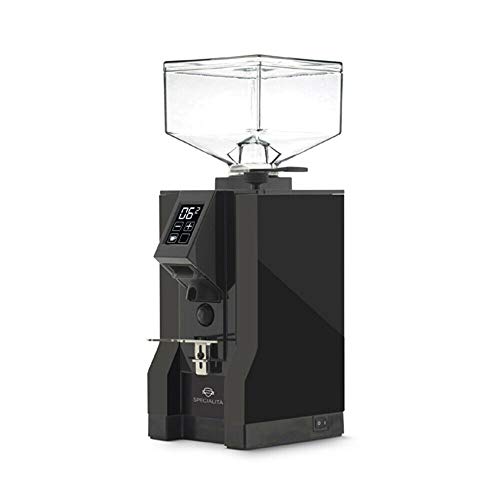
| Eureka Mignon Specialita | 55 mm burrs, stepless adjustment, touch display with two doses | approx. €431.90 | 9.4 | you pull almost only espresso and want to adjust between two clicks |
The prices come from our price boxes, as of September 2026. The score is our editorial assessment based on build quality, performance, handling and value for money; we did not measure anything on any of the four grinders.
When the Dose Control Pro fits and when another grinder does
First, the portafilter. If it fits one of the two holders, the Dose Control Pro holds it itself while grinding. The Encore ESP works with a dosing cup instead: you grind into it and tip it into the portafilter, and the supplied cup is designed for 54 mm, with an adapter ring for 58 mm.
Then the dosing. If you weigh every portion anyway, you do not need a timer, and the Encore ESP costs just under €27 more. If you want to read the time off rather than estimate it on a dial, the Smart Grinder Pro is the alternative from the same company, for just under €46 more. What else it does differently is covered below in the questions.
If you pull almost only espresso and find that the right flow time lies between two clicks, a grinder with fixed steps will not help. According to Eureka, the Eureka Mignon Specialita adjusts steplessly and costs around €279 more. An overview of designs and price classes is given in our grinder guide.
Under a wall cabinet, the bare height of the appliance is not enough as a measure. It is filled from above after removing the lid, and to adjust it you turn the hopper. On top of the 34.2 cm appliance height, therefore, allow at least a hand’s width of clearance above so that the lid comes off and your hand can grip the hopper.
One point that is easily overlooked is your machine’s baskets. For grinding fresh beans, Sage requires single-wall filter baskets. Double-wall, that is pressurised, baskets are intended for pre-ground coffee; if you own only those, you should clarify before buying whether single-wall ones are available for your machine.
And changing beans. If you switch to decaf in the evening, you have to empty the hopper and grind the burrs empty, as described further down under cleaning. In our assessment, a grinder with a storage hopper is awkward for this routine.
Cleaning according to the manual
Before the first grind, you remove promotional stickers and packaging, wash the bean hopper and holder in warm soapy water and dry them carefully, and wipe the housing damp on the outside. Then you place the grinder on a level surface and plug it in.
The manual gives four steps for routine care: empty the hopper and grind out the remaining beans, pull the plug, wash the bean hopper and lid by hand and dry them as the first time, and finally wipe and polish the housing with a soft, damp cloth. According to Sage, alkaline or abrasive cleaning agents and steel wool can damage the surface. No grinder part and no accessory may go in the dishwasher, and to protect against electric shock you never immerse the plug, cord or appliance in water. According to the safety notices, the grinder should also have cooled down before cleaning, and likewise before moving or storing it.
The burrs should be cleaned regularly, because according to Sage cleaned burrs grind more evenly, which matters most for espresso. The manual shows 13 picture steps for this: unlock the bean hopper, hold it over a tin and tip the beans into it by turning, position the hopper correctly again, run the grinder empty, remove the hopper, remove the upper burr, clean the upper burr, the lower burr and the grinder outlet each with a small brush, push the upper burr in firmly, let it lock in place, position the hopper correctly, and finally let it lock in place.
Descaling is not needed, because no water runs through the grinder. General information on grinder care is in the guide Cleaning a coffee grinder. In the BCG600 product hub, Sage has videos on five topics: cleaning instructions, care and maintenance, personalising settings, grinding coffee and initial setup.
What Sage leaves open
After the product page, manual, category page and product hub, these points remain open, collected in one place: the weight of the appliance, the diameter of the burrs, the speed, the throughput in grams per second, the noise level, the material of the housing (Sage names stainless steel only for the burrs), the material of the bean hopper, lid, holders and catch tray, the cable length, the amount left in the burrs, an anti-static measure, the maximum continuous grind time, standby consumption and automatic switch-off, individual spare parts with prices (the spare parts page loads its list only in the browser), the country of production and the year of market launch. Amazon lists 6.61 pounds, that is approx. 3.0 kg, and dimensions of approx. 44.2 × 27.0 × 34.3 centimetres. The length and width do not match Sage’s appliance dimensions, so the entry probably describes the box, and for that reason we do not adopt the weight either.
Placement, cable, children: what the safety notices stipulate
According to the manual, the grinder belongs “at a safe distance from edges on a stable, heat-resistant, level and dry surface”, and not on or next to a heat source such as a gas or electric hob or a hot oven. So there is no place for it right next to the hob. The power cord is fully unrolled before use, does not hang over worktops or table edges and stays away from hot surfaces. As an additional protective measure, Sage recommends a residual current device with a maximum rated current of 30 mA; an electrician can advise on this.
On the intended use, one notice says in full: household use only, use only as intended, not in moving vehicles or boats, not outdoors, because misuse can lead to injury. During operation the grinder is not left unattended and stays where it is. Grinding takes place only with the lid fitted on the bean hopper, and fingers, hands, hair, clothing and utensils stay away from the hopper. In addition: “Only use the inserts supplied with your appliance.” In our understanding, this rules out aftermarket holders from other suppliers.
For children, the manual sets out four rules side by side. Do not let children play with the appliance. Do not let children under 8 years carry out cleaning, and only under supervision. Keep the appliance and power cord out of the reach of children up to 8 years. And: “Do not allow children to operate the appliance. Keep the appliance and cord out of the reach of children.” The last notice has no age limit, which makes it the stricter one, and it is the one we follow.
When the grinder has reached the end of its life, the manual says it does not belong in household waste, but at a municipal recycling centre or with a specialist retailer.