Baratza sells three Encore models in Germany, and the ESP is the middle one. In the manufacturer’s shop (as of September 2026) the standard Encore costs €149.95, the ESP €179.95 and the ESP Pro €279.95. On Amazon.de the ESP costs approx. €179.95 (as of September 2026), the same as directly from the manufacturer.
Baratza describes the ESP as optimised for espresso, with grind adjustment by turning the hopper and a dosing cup in the box. It also covers filter coffee, French press and cold brew, which is what the second half of the scale is for. It was designed in Seattle and is made and assembled in Taiwan. The type designation is ZCG495; the black EU version carries the number ZCG495BLK4FEU1A, the white one ZCG495WHT4FEU1A.
When it came out cannot be stated cleanly. The German operating manual is dated as version 1.0 from February 2023, the English one from January 2023; a launch date is therefore not documented. In our overview of electric coffee grinders you will find it among the espresso grinders with conical burrs.
Build: hopper on top, niche below
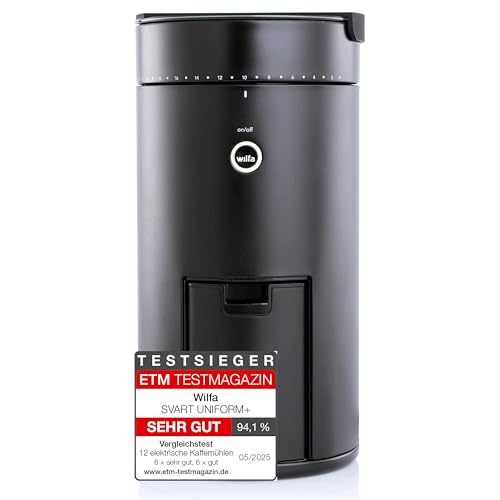
In the product photo, a transparent bean hopper that widens towards the top sits on a black, angular housing. Below it is an open niche into which the grounds fall. At the front under the lettering you can see the pulse button, and on the right-hand side the on/off knob.
The hopper is also the control. You turn it, and a silver grind indicator points to a number between 1 and 40. According to Baratza the hopper holds 300 g of beans and the grounds container 120 g. According to the manufacturer, the adjustment system is made of metal.
Baratza gives the outer dimensions as 13 × 15 × 34 centimetres (width, depth, height). The Amazon catalogue lists approx. 14.5 × 11.0 × 35.0 centimetres; Amazon does not explain where the difference comes from, and we go with the manufacturer. With weight it is the other way round: the field on the Baratza page is empty, and only Amazon gives 5.73 pounds, so approx. 2.6 kg. In the manual the base is simply called “weighted base”.
Electrically, the EU version is designed for 220 to 240 volts alternating current at 50 or 60 hertz, with 70 watts, 0.5 amperes and protection class II. As safety marks Baratza lists UL, CSA, CE and EK. The colours are black and white.
According to the parts list in the manual, the on/off knob is packed in the grounds container together with the dosing cup, cup base, 58 mm adapter ring and brush. You push it onto the switch rod on the right of the unit yourself and press it firmly. The shims are also in the original packaging.
In detail: 40 clicks with two resolutions
The burr set is a 40 millimetre conical burr set in M2 steel. M2 is the standard designation of a high-speed steel of the kind used for tools. On the outside sits a removable outer burr, on the inside the central conical burr turns on the drive shaft. The gap between the two determines the grind, and turning the hopper changes exactly this gap.
According to the manual, the grind changes only slightly between two settings in the range 1 to 20. Between 21 and 40 the jumps per click are larger, so that 40 clicks are enough from the finest espresso to the coarsest cold brew. Baratza calls the lower half high-resolution.
The reason this makes sense lies in the brewing. With espresso, the machine forces water under pressure through a firmly tamped coffee puck, and the flow time reacts sensitively to particle size. A step that is too coarse can make the difference there between too fast and too slow. In a pour-over or French press the contact time is long and the coffee bed is loose, so a larger jump hardly matters. A grinder with equal steps across the whole range would have to choose; the Encore ESP splits the scale instead.
At no load the burrs turn at 550 revolutions per minute. For throughput Baratza gives two points: 1.3 g per second at setting 10 and 2.2 g per second at setting 30. An espresso dose of 18 g at setting 10 would therefore be ground in just under 14 seconds, which is our calculation.
One rule from the manual is worth remembering: “When adjusting the grind setting, the burrs must either be running or completely empty, to avoid damage to the unit.”
If setting 1 is eventually no longer fine enough, shims are included. One of them shifts the whole range by about five steps; what was setting 10 before then corresponds roughly to setting 15. This does not create finer intermediate values; the 40 clicks stay the same.
Which setting for espresso, V60 or French press?
In the manual Baratza gives starting values: espresso 15, AeroPress 22, Hario V60 25, filter machine 28, Chemex 30, French press 32. These are starting points. From there you feel your way towards your bean with single clicks.
The espresso value applies to a medium roast and 18 g of coffee. For darker roasts or larger quantities, the manual says to set a higher number, for lighter roasts or smaller portions a lower one. Below 15 you are left with 14 fine clicks, above it five before the coarse half begins.
If you open the German manual, you will stumble over two Dutch entries in the table: “Automatische Brouwer” means the filter machine, “Franse Pers” the French press. For cold brew there is no number at all, although the product page expressly designates the range 21 to 40 for it. We would start at a value above the French press.
Between AeroPress and French press there are only ten clicks, and all of them lie in the coarse half with its larger jumps. How to approach a grind setting systematically is described in our guide Setting the grind size, and the brew calculator works out the right amount of coffee for your pot.
Dosing cup, adapter ring and single-dose hopper
For espresso you fit the cup base and the dosing cup instead of the grounds container. The cup is built for 54 mm portafilters. With the included adapter ring it fits 58 mm; at 54 mm you take the ring off before dosing.
Transfer is done upside down. You grind into the cup, place the portafilter on it upside down and turn both over together so that the grounds end up in the basket.
In its accessories shop Baratza sells a single-dose hopper. It is intended for a workflow in which you weigh and add each portion individually instead of storing beans in the 300 g hopper.
For filter and French press you grind into the grounds container. The manual points out that the coffee piles up in the middle of it, and advises emptying it before it reaches the max line. If the grounds rise above it, the burrs can clog and be damaged. At setting 30 and 2.2 g per second, 120 g would be reached in just under a minute by our calculation. The safety note fits here: “Do not leave your grinder unattended when it is switched on.” The on/off knob has two positions, “I” starts and “O” stops; the pulse button grinds only while you hold it down.
What else is worth considering?
| Model | The difference | Price | Our rating | Choose this one if |
|---|---|---|---|---|
| Baratza Encore ESP (this one) | 40 click steps, 1 to 20 finely spaced, no timer | approx. €179.95 | 9.0 | you grind French press or cold brew as well as espresso and have a scale anyway |
| Sage Dose Control Pro | electronic timer, grinds directly into the portafilter (inserts for 50 to 54 and 58 mm) | approx. €153.25 | 8.4 | your portafilter is smaller than 54 mm or you want to repeat the dose by time |
| Baratza Virtuoso+ | same 40 mm burr in M2 steel, timer with 0.1 s resolution, burr on a thread | approx. €229.95 | 9.0 | you mostly brew filter and want to dose by timer |
| Eureka Mignon Specialita | 55 mm flat burrs, stepless adjustment, touch display | approx. €431.90 | 9.4 | 20 fine steps are not enough for you with espresso |
Prices are as of September 2026; the rating is our editorial classification based on build quality, performance, handling and value for money.
When the Encore ESP fits and when another grinder does
What decides it is what you brew. If you pull espresso in the morning and make a litre of French press at the weekend, the Encore ESP gives you both from one scale. If you brew almost only filter, you do not need the fine half; the Virtuoso+ with its timer would then be the alternative, for €50 more.
The second question is dosing. The ESP knows only the pulse button and continuous running; there is no time control. So you weigh beans or grounds. If you would rather repeat a set time, look at the Sage Dose Control Pro, which costs just under €27 less and, according to Sage, grinds directly into the portafilter.
For the portafilter itself, the diameter decides. The dosing cup serves 54 and 58 mm, other sizes it does not.
And then there is fineness. If espresso is your main interest and you find that the flow time you want lies exactly between two clicks, no click step will help. The Eureka Mignon Specialita adjusts steplessly according to Eureka and costs a good €250 more. Within the Encore family the ESP Pro would be the way to go; its features are listed below in the questions.
At 34 centimetres tall, it is worth looking upwards if a wall cabinet hangs above the spot. Because you turn the hopper to adjust and lift it upwards to clean, we would plan extra clearance above the grinder. An overview of designs and price classes is given by our grinder guide.
Cleaning and care according to the manual
Before every cleaning you pull out the mains plug; the instructions insist on this with a separate caution note. Before removing the hopper you should also take out all beans and grind the rest empty.
On water the manual is strict, and the passages are given here as quoted in the German manual. For initial setup: wash the hopper lid, bean hopper, dosing cup and grounds container “by hand in warm soapy water” and let them air dry. “Do not wash the outer burr (5) with water, or it will rust.” In the care section the caution box reads in full: “Do not put the hopper, hopper lid and grounds container in the dishwasher. Hand wash only. Do not immerse the grinder housing in water. Do NOT wash the burrs with water, as they will rust.” According to the safety notes you clean the housing “only with a dry or slightly damp cloth”, and neither the grinder nor the plug nor the cable may go into water or any other liquid.
The dosing cup does not appear in the dishwasher box. That is not a release; at initial setup it is to be hand washed like the other parts.
With daily use you brush the burrs about once a month with the supplied brush. You do not have to remove them for this, but it is more thorough. If you often grind dark, oily or flavoured coffee, you may need cleaning tablets for grinders, because accumulated oil sets and can clog and damage the burrs. Substances other than these tablets should not run through the burrs for cleaning.
This is how you get at the parts. Turn the hopper fully anticlockwise until the indicator is at the triangle at 40, and lift it off; the hopper seal may come loose with it, and the manual advises placing it with the thick side down on the plastic rim of the outer burr. For the outer burr, turn the grind adjustment ring fully anticlockwise, otherwise it is locked, and lift it straight out by the two lever tabs. The inner burr is held by the quick-release knob: turn the knob clockwise to remove it and lift the burr straight up. Under the knob there is a small shim, which comes out with it. If the knob is stuck, use a cloth or glove, or if necessary pliers, and be careful, as the burr can be sharp.
Reassembly is in reverse order. Tighten the quick-release knob anticlockwise until the inner burr turns along when you rotate it. For the outer burr, align the red tab with the red mark on the adjustment ring, guide the three tabs into the three slots and press it down.
If the grinder clogs anyway, according to the manual this is usually due to grounds above the max line or to oily coffee without regular cleaning. With the burr removed, the grinding chamber is exposed, whose sides and floor are made of white plastic according to the manual. You loosen the compacted coffee with a hard tool, such as a small hex key or the handle of the brush. The exit chute lies directly below the red mark on the adjustment ring and must be completely clear. If that does not help, Baratza refers you to support. What generally builds up in grinders and how often you should clean is covered in the guide Cleaning a coffee grinder.
Spare parts and what Baratza leaves open
In its German parts shop Baratza lists individual parts for the Encore ESP, such as the on/off knob in black and in white (part number 6738-W for white). We did not find a burr there that is clearly identified as an ESP part. The quick-release fitting at least makes swapping mechanically easy, and the manual describes removal and fitting step by step.
There is an inconsistency in the Amazon listing. The model number given there is ZCG495BLK4FEU1A, the black EU version of the ESP. The part number, however, is ZCG410WHT4GUK1A, and Baratza uses the prefix ZCG410WHT for the white Encore without ESP. We consider the model number authoritative. After delivery we would still check whether the dosing cup, cup base and adapter ring are in the grounds container.
After the product page, manual and parts shop, these points remain open, collected in one place: the weight (only Amazon gives a figure), the noise level in decibels, the housing material, the supplier of the burrs, the grind range in micrometres, motor type and overheating protection, the cable length, the maximum continuous grinding time, the capacity of the dosing cup, the amount left in the burrs, the number of shims included and notes on placement.
Children, cable, socket: what the safety notes specify
Families with small children should know the safety notes, specifically all three that concern children. Keep the unit and cable out of the reach of children under 8 years. Children aged 8 and over, and people with reduced physical, sensory or mental capabilities or a lack of experience and knowledge, may use the grinder if they are supervised or instructed in its safe use and understand the hazards. Children must not carry out cleaning and maintenance without supervision.
You may run the grinder only on alternating current of the correct voltage; which one that is appears on the label on the base. It should not run with a damaged cable or plug. According to the manual, a broken mains cable is replaced by the manufacturer, its customer service or a similarly qualified person, to avoid a hazard.
Besides before cleaning, you also pull the plug before every assembly and disassembly, and you do so by the plug itself, never by the cable.