A timer grinder measures time. How much coffee ends up in the basket in that time depends on the bean and the grind setting. The Eureka Libra 16CR measures weight instead: the portafilter hangs in a fork that weighs along while grinding, and as soon as the set number of grams is reached, the motor switches off.
Our price box lists the grinder at approx. €639 on Amazon.de. The figure has stood there unchanged since July 2026. When we retrieved the Amazon catalogue on 7 September, no price was stored for this ASIN, so there is no current cross-check.
Mignon Libra with 16CR front panel
Eureka itself calls the device Mignon Libra. It belongs to the Eureka 1920 line and is listed on the manufacturer’s site under Prosumer Grinders. By 16CR Eureka does not mean a model variant but the front panel. As standard colours the manufacturer lists matt black, grey, white and Ferrari red, and the grinder is available in chrome as a special colour. Amazon lists it as “Eureka Libra 16CR Schwarz, 618373” with the part number EMR55-001.
It is built by Conti Valerio in Sesto Fiorentino near Florence, and the manual gives its model designation as MS. Eureka writes about itself that the company has been designing and manufacturing its grinders in Florence since 1920.
Eureka sells three grinders under the Libra name: the Mignon Libra, the Mignon Libra Brew and the Mignon Libra 65 All Purpose. According to Eureka, the Brew grinds into a catch container instead of a portafilter. The product photo for this ASIN shows the fork, and the 55 in the part number fits 55 millimetre burrs, not the 65 millimetres of the All Purpose. So the espresso model is the one reviewed here.
Burrs, motor and space required
The burrs are flat, measure 55 millimetres and are made of hardened steel according to Eureka. They are driven directly, which the data sheet calls “Traction Direct”. According to the product page the AC motor turns at 1,350 revolutions per minute and draws 310 watts. Against clumping and electrostatic charge in the grounds, Eureka also cites the ACE System.
On grinding speed, Eureka’s own documents contradict each other. The product page and data sheet give 1.8 to 2.5 for espresso and leave out the unit. The manual works in grams per second and arrives at 1.4 to 1.8 in the espresso range and 1.9 to 2.5 for coarser brew grind sizes. For a double shot of 18 grams that means, by our division: 10 to 13 seconds according to the manual, 7 to 10 seconds according to the product page, if grams per second is also meant there. Since the Libra stops at the target weight anyway, the contradiction only decides how long you stand in front of it.
The grinder is 390 millimetres tall and 124 millimetres wide. For the depth, the product page and data sheet say 192 millimetres, the manual 193. With the optional 510 gram hopper the height grows to 430 millimetres. Empty, the Libra weighs 6.5 kilograms, and the manual requires a level, stable surface that can carry this weight.
Before deriving anything about space requirements from these figures, we looked at the product photo. The display and fork sit on a chrome part that sticks out of the front of the black housing, and on top stands a transparent, angular bean hopper. Whether the 124 and 192 millimetres include these parts cannot be gathered from the documents. For the place you put it, we would therefore leave a few centimetres of spare room at the front.
In detail: weighing instead of a stopwatch
Why weigh at all? A timer grinder assumes that the same amount of grounds comes out every second. That is only roughly true, because the throughput shifts with the bean and with every change to the grind setting. After switching to a different bean, the old time no longer fits. If you want to dose precisely then, you put the portafilter on a scale, read it off, correct the seconds and grind again.
Eureka turns the procedure around and calls it Instant Grind Weighing Technology, patented by its own account. You set a target weight, the scale in the fork weighs while grinding, and the motor stops at the set value. The target can be adjusted in steps of a tenth of a gram. The promised accuracy is coarser: plus/minus 0.2 grams. Whether you set 18.0 or 18.1 grams therefore lies within the tolerance Eureka promises.
Two further tasks hang on the scale. If you remove the portafilter during grinding, the motor stops immediately. And if the weighing system detects no change in the gram count during the grinding phase, it also stops; the manual classes this as overheating protection. It does not list which situations trigger this. An empty bean hopper or a closed bean slide would be obvious candidates, but that is our guess.
For the anti-vibration system it pays to lay the product page and the manual side by side. The product page promises that a shot runs to its end even with disturbances or knocks against the portafilter. The manual sounds more cautious. A knock against the portafilter or fork pauses the process, and without a restart within 5 seconds the system resets. Some kinds of disturbance, it continues, the grinder may interpret as removal of the portafilter, and then the dose is gone. If you like to jiggle the portafilter while grinding, in the worst case you start from the beginning.
Operation at the display and the grind dial
The touch display measures 26 by 40 millimetres and has four buttons: one with a single cup symbol for the single dose, one with two cups for the double dose, plus Plus and Minus. You programme the two doses separately. Grinding only starts once the portafilter or another container sits on the fork. A dosing cup therefore works just as well, as long as it fits the fork.
A second press of the dose button pauses. If you do not resume within 30 seconds, the shot starts anew. During the pause you may only change the dose as long as the ground weight has not yet exceeded the new value: if 17 grams are already in the basket, you can no longer switch to 16. According to the product page you can also switch between single and double dose during grinding.
If you press both dose buttons at the same time, continuous dispensing starts. The grinder runs until you let go, but for 30 seconds at most. Weighing takes place here too; the Amazon catalogue text says “Mahlen nach Gewicht auch im manuellen Modus” (grinding by weight in manual mode too).
Some functions sit behind key combinations. If you hold Plus and Minus together, the dose setting is locked, which helps in an office kitchen with several people. If you hold Minus and single dose while switching on, you get the total amount of all ground grams displayed, in successive pairs of digits. You set the contrast from 1 to 10, and after switching off the grinder keeps the last active settings.
For the grind size, Eureka built in the Stepless Micrometric Regulation System, stepless and also patented according to the manufacturer. The data sheet describes a larger dial with a vertical measuring scale. Clockwise grinds finer, anticlockwise coarser. The manual requires adjusting step by step and grinding a little coffee at most every two steps. More important is the warning next to it: if you turn the knob a full revolution with the motor stopped, the machine may stall according to the manual. Before starting work, the grinder is in any case to be set to the roast level of the coffee blend. How to work your way towards an espresso grind size is explained in our guide Setting the grind size, and the matching dose for your brew ratio is worked out by the brew calculator.
Cleaning and safety according to the manual
The bean hopper is tightened at the back with a locking screw. A tab at its base opens and closes the passage. The German manual calls the hopper “Trichter” (funnel) in the cleaning chapter, and the Italian original says campana; in both cases the bean hopper is meant. Chapter 6.2 says: “Wash the inside of the funnel with water and mild soap to remove the oily layer”. Then rinse and dry, the plastic lid likewise. Then comes: “Do not wash it in the dishwasher.” And: “Cleaning is recommended at least once a week.”
The burr set stays dry. You take off the lid, open the upper burr holder, and then chapter 6.3 applies: “Then clean the coffee grinder and other internal parts with a brush or a dry cloth. If necessary, use a vacuum cleaner or a jet of compressed air.” For a complete clean, Eureka refers to standard cleaning tablets for coffee grinders, and all cleaning and disinfecting agents must be approved for food use. The reason is given in 6.1: a neglected grinder can affect the preparation and the accuracy of dosing and grinding. For a grinder that weighs its dose, the second half of that sentence is the more interesting one. How dry burr care works in general is explained by our guide Cleaning a coffee grinder.
The cleaning chapter contains four warnings. Do not leave the portafilter on the fork. Disconnect from the power before cleaning and maintenance, without pulling on the mains cable or the device. Maintenance and cleaning only by specialist staff authorised by the manufacturer. No makeshift or unsafe repairs and no non-original spare parts.
The third warning fits poorly with a chapter that explains step by step how you clean the hopper and burr set yourself. We would do exactly what chapter 6 describes and leave everything beyond that to the specialist trade. According to the manual, use that departs from it voids any warranty and manufacturer liability. Chapter 7, troubleshooting, consists of a single sentence: “Contact specialist staff.”
The general safety introduction exists only in Italian, English and French. Most of it applies to any electrical appliance, from the cable that should not hang over the edge of the counter to the ban on operating the grinder outdoors. On children the versions differ. The English one only requires supervising them so they do not play with the appliance. The Italian one is more precise: it allows use from the age of 8 under supervision and rules out cleaning by unsupervised children.
A separate notice rules out water jets, unsuitable cleaning agents and steam cleaners. For domestic use Eureka also requires you to switch the grinder off and pull the plug before changing accessories or approaching moving parts.
What Eureka does not state
We went through the German and English product pages, the data sheet, the manual and Eureka’s warranty notice. These details appear in none of the sources: a noise level in decibels (Eureka advertises a Silent Technology that is meant to work through the anti-vibration system), a separate warranty period for the Libra, the maximum weighing range and the measuring principle of the scale, the dead space in the burr set, the division of the scale on the dial, the cable length, prices for spare parts and how long they stay available, and the year of market launch. Whether a sample weight for recalibration is included remains open, because the manual lists no scope of delivery. For the housing, fork, hopper and dispensing spout Eureka names no material, only a plastic lid is mentioned. The certifications section on the product page is empty.
The table of technical data also contains the abbreviations Ton 30 s and Toff 300 s, which are explained nowhere. In electrical engineering such abbreviations usually denote on time and off time, which would translate to 30 seconds of operation, then 300 seconds of rest. The 30 seconds match the maximum duration of continuous dispensing. Whether Eureka means it that way, we do not know. If you grind several portions in a row, five minutes of rest after half a minute of running keeps you on the cautious side.
Is the extra cost over the Mignon Specialita worth it?
Only if you re-weigh every espresso anyway. According to Eureka, the Libra and the Mignon Specialita have a burr set with the same specifications (55 mm, hardened steel, 1,350 revolutions, 310 watts), and the roughly €207 difference pays for the scale in the fork and the operating logic that hangs on it.
The Specialita doses via a time-based timer and has no scale. What that means after switching beans is covered above under weighing instead of a stopwatch.
Our assessment: if you load a different roast every week, the Libra saves you a work step every morning, and that is what it is built for. Because the extra cost lies solely in the dosing, the Specialita still comes out narrowly ahead in our rating, even though it can do less.
This grinder or one of the other three?
In our overview of electric coffee grinders the Libra is the most expensive. We set these three against it:
| Model | The difference | Price | Our rating | Choose this if |
|---|---|---|---|---|
| Eureka Libra 16CR (this one) | Scale in the portafilter fork, stops at the target weight | approx. €639 | 9.2 | you want to dose every espresso by the gram without moving the portafilter |
| Eureka Mignon Specialita | same 55 mm specifications, dosing by time | approx. €431.90 | 9.4 | you already own an espresso scale and do not want to pay extra for the dosing |
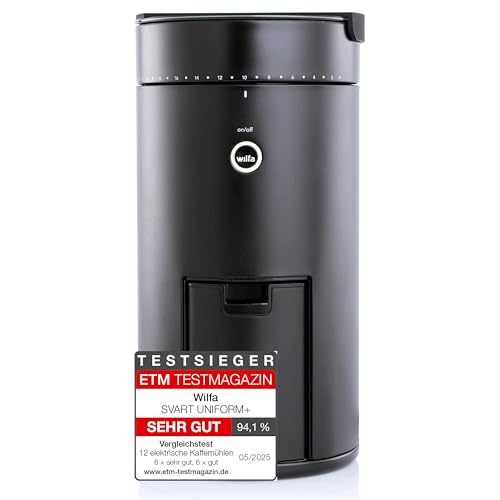
| Wilfa Svart Uniform+ | removable scale in the lid (0.1 g), weighing happens before grinding, focus on filter | approx. €330 | 9.1 | you mostly make filter coffee and still want to dose by weight |
| Sage Smart Grinder Pro | Conical burrs, 60 settings, timer in 0.2 second steps | approx. €199 | 8.8 | you are getting into portafilter espresso and prefer to re-weigh externally |
The prices come from our price boxes and they move. The rating is our editorial assessment based on data sheets and manuals; none of the four grinders has been on our table. The Wilfa is roughly €309 below the Libra.
When the Libra suits, and when another grinder does
First, the brewing method. Eureka recommends the Libra for espresso and for dark roasts; on the German product page the roast recommendation is given in Italian as scura. If you mostly make pour-over or French press, you pay for a fork you hardly need, and in our catalogue you are better served by the Wilfa. For filter, Eureka also has its own Libra models, more on which in the questions above.
Then the quantity. The manual sets the limit at 160 grams of coffee per activation, which a single double shot is far from. It gets tighter with continuous dispensing. By the time it switches off, the throughputs in the manual add up arithmetically to 42 to 54 grams of espresso grounds, or 57 to 75 grams at a brew grind size. For a large pot of filter coffee, one pass may not be enough.
The 300 gram hopper lasts a good 16 shots at 18 grams per double. As accessories, Eureka lists among others a Libra dosing funnel, a metal and a wooden lid for the bean hopper, the King Size Grind Dial, a tamper and a knock box. Under a wall cabinet the bare height of the grinder is not enough, because to refill you lift the lid upwards.
On where it can be used, the manual is broader than you would expect for a home grinder. It describes the grinder as designed for commercial use and names restaurant kitchens, canteens, hospitals and shops such as bakeries and butchers, but excludes continuous food production. As household-like applications it lists staff kitchens in shops and offices, farm houses, guests in hotels and motels, and bed-and-breakfast settings. The Libra may only be operated between minus 5 and plus 30 degrees Celsius. A small guesthouse is therefore covered; because of the unexplained rest time, though, we would not plan on continuous grinding for many guests in a row there.
The wrong choice is the Libra for someone who is just buying their first portafilter machine and paying for machine and grinder out of one budget. The Sage Smart Grinder Pro is around €440 cheaper, and in our assessment that money is better spent on the machine.