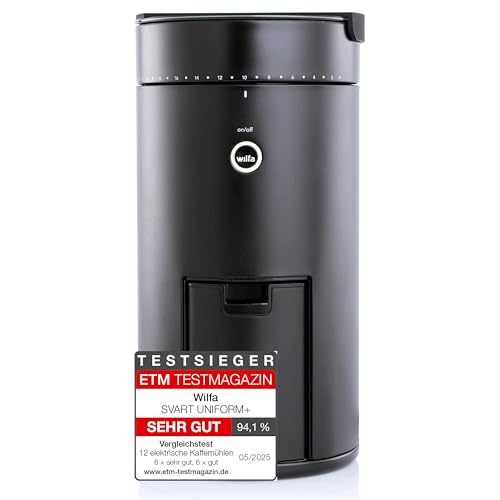
Wilfa sells this device as the Uniform, model number WSFBS-200B. The Plus appears only in the Amazon title, and that is where the grinder got its name with us. What sets it apart from the other electric grinders in our catalogue sits on top: the lid is a removable digital scale with its own battery, stopwatch and Bluetooth. Our price box lists the grinder at approx. €330. On wilfa.com it appears at 4,699 Norwegian kroner with the note Sold out (as of September 2026).
Uniform, Uniform+, WSFBS-200B: which device is which
Wilfa is a Norwegian company based in Oslo, founded in 1948. Under the name Uniform it offers five grinders, and the model numbers are the safest way to tell them apart:
- WSFBS-200B, the grinder on this page. Wilfa describes it as a new grinder with an improved and upgraded precision scale.
- WSFBS-100B, the older Uniform with a scale, listed by the manufacturer as discontinued. Its lid scale resolved to 0.3 grams.
- WSFB-100S in the colour Steel, with the same 58 mm burr and the same 41 steps, but without a scale.
- Uniform Evo and Uniform Evo Solo with 64 mm burrs. In its blog post on the Evo of 30 September 2025, Wilfa calls the Uniform the predecessor.
The German-language manual for the WSFBS-200B exists as a PDF with a creation date of 16 November 2021. There is no official market launch date; the PDF is only a rough guide.
On the product page Wilfa highlights the approval by the European Coffee Brewing Centre (ECBC). According to Wilfa, the checks cover how precise the grind size is, whether the grinder delivers consistently, what temperature is produced and how much coffee stays behind in the burrs. How exclusive the approval is, three texts describe in three different ways. The English Wilfa page speaks of one of four grinders in Europe, the German one of one of the few in Europe, the Amazon text of one of four worldwide. We adopt none of these counts as long as we do not have the ECBC’s own list.
Build: burrs, hopper, grounds container
Grinding takes place between two flat stainless steel burrs 58 millimetres in diameter, produced in Italy according to Wilfa. The motor draws 80 watts, and the technical data in the manual give 220 to 240 volts at 50 hertz. Wilfa advertises slow grinding in which the beans do not overheat.
The manual lists nine components: on/off switch, scale, bean hopper, grinding disc, burr set, grounds container, grind size adjustment, cleaning brush and housing. You set the grind size by turning the bean hopper to the desired position, before you grind. The grinder itself has a mechanical control panel with one start button and one white LED. Press once and release, and it runs. Once the last bean has gone through, it stops by itself, the LED flashes three times (two seconds on, two off) and goes out. If you want to stop earlier, press the start button a second time.
Wilfa names steel and aluminium as materials. According to the manufacturer’s page, it is the container for the ground coffee, the part at the bottom front, that is anti-static and made of stainless steel, not the hopper at the top. According to the Amazon catalogue the hopper takes up to 75 grams of beans; at Wilfa the same figure appears only on the page of the sister model WSFB-100S. The product photo shows an upright, round body in matt black with the grind scale at the top edge and the grounds container in a recess at the bottom front.
In detail: weigh, grind, until the hopper is empty
Wilfa calls the lid scale Uni. It measures to 0.1 gram and, according to the manual, carries at most 2,000 grams; beyond that the display reports overload.
Why a scale sits on a grinder with auto-stop is explained by the procedure the manual describes: first choose the grind size, then weigh the beans for the desired amount of coffee. You pour the portion into the hopper, and the grinder runs until nothing is left. What you weighed is ground, minus what stays stuck in the burrs. This way of working is called single dosing. It also explains the small hopper: the supply sits in the bean tin, and the grinder holds only the next portion. How much ground coffee stays behind in the burrs, Wilfa does not state. That is exactly what the ECBC checks, and for the buyer it would be the most interesting figure.
On operation: first switch on the mains switch at the back, then briefly press the on/off button on the display. At start-up the scale tares automatically. If you place a container on it and press the scale button (scale symbol), the display jumps to 0.0. Three seconds on the same button switches between grams and ounces. The stopwatch behind the clock button is hidden at switch-on and appears after a short press; the next press starts it, the following one stops it, and holding for one second resets it.
The tips on page 83 contain a second trick. A short press on on/off tares and sets the timer to zero at the same time. At the pour-over filter that would mean (our deduction, the manual names no brew method for it): the weight and the time of the brew begin at the same moment. If nothing new is placed on the scale for ten minutes, it switches off. On an uneven surface it cannot even be activated, because according to the manual it then stands unstably.
Grind sizes according to the manual
On page 78 Wilfa distributes the 41 steps like this: espresso 3 to 7, AeroPress 14 to 26, pour-over (Übergießen) 14 to 28, filter 22 to 32, French press 30 to 38. Steps 39 to 41 are called Stark in the German table and Steep in the English original, meaning coffee with a long steeping time. As usual brewing times the same page gives 20 seconds for espresso, 4 to 6 minutes for filter, 6 minutes for French press and 8 minutes for Stark.
Read the table across once. AeroPress, pour-over and filter share the range from 14 to 32 and overlap widely, so there the Uniform has many clicks to experiment with. For espresso a narrow range remains at the fine end. With a stepped grinder there is no intermediate position between two neighbouring steps, and with espresso even a small step in grind size shifts the flow time noticeably. The size of the steps therefore decides whether you hit your target or land between two clicks. Steps 1, 2 and 8 to 13 are not assigned to any brew method by the table.
How to tell whether you need finer or coarser is in our guide on setting the grind size. The brew calculator works out the amount of coffee for the amount of water, and the weighed portion then lands directly on the lid.
Is the Uniform good for espresso?
As a grinder for occasional espresso, yes; as an espresso grinder for every morning, we would not buy it.
Five of the 41 clicks are intended for espresso, Wilfa recommends step 5 as a starting point and notes that every grinder varies slightly in its setting. The troubleshooting on page 80 then becomes specific. At grind size 1 to 4 the burrs can clog, and depending on bean type, wear and factory setting the limit lies elsewhere. Wilfa describes how to find it: lower the setting step by step until the grinder clogs, and regard the step above as the finest setting. If it clogs at 3, 4 is your minimum. You clear a blockage by setting 25 and, with the motor running and beans in the hopper, gradually turning back to your grind size. If finer steps are hard to set, ground coffee may be stuck in the burrs; in that case too, let the motor run and make the setting finer while it does.
Then there is the route into the portafilter. The Uniform grinds into its grounds container, from where you transfer into the basket, one more step with every shot. At Wilfa, adapters for the portafilter only come with the Evo.
If you stand at the portafilter every day, our catalogue has the Eureka Mignon Specialita, a grinder with stepless adjustment and a portafilter fork, for approx. €431.90 and thus around €102 above the Uniform.
Care according to the manual, and where it contradicts itself
Here we reproduce the manual faithfully, because anyone who smooths the wording easily overlooks point 6, and that is tied to the warranty. The chapter Maintenance and cleaning on page 79 has six points:
- If you grind espresso at the finest step, you must expect the device to stop occasionally. Then grind with a coarser setting, around step 25, run the remaining coffee through the burrs and clean the device with a brush. After that it is fully usable again according to Wilfa.
- Never immerse the device in liquids or water and do not put it in the dishwasher.
- Clean the scale with a slightly dampened cloth, no chemical or abrasive cleaners.
- Do not clean or service while the plug is connected to the mains.
- Clean the housing, the lid of the coffee bean tray or the scale, and the coffee bean tray with a dry cloth, never with a wet or strongly chemical cleaner.
- Do not open the product, otherwise the purchase warranty lapses.
Point 3 and point 5 do not fit together. The scale is to be cleaned with a slightly damp cloth, the lid, which on this grinder is the scale, with a dry one. On page 83 the manual repeats the slightly dampened cloth for the scale and forbids hot water and aggressive chemicals there. Our assessment: a dry cloth breaches none of the passages, a damp one breaches point 5. Until Wilfa resolves this, we would wipe dry.
A small cleaning brush is included, and the manual lists it in the parts list as number 8. The safety notes also require that coffee bean residue be emptied from the device regularly, and that the device always be disconnected from the mains when left unattended and before it is assembled, disassembled or cleaned. A grinder needs no consumables such as filters or descaler. What wears out is mainly the burrs. Whether the scale’s built-in battery falls under this as well, Wilfa leaves open: the warranty excludes parts that can be expected to be replaced regularly and names filters and batteries as examples.
What Wilfa does not state
For the following points we found no figure on the two product pages or in the 172-page manual. We do not estimate them either:
- noise level in decibels and motor speed
- grinding rate in grams per second
- the step size of a click step
- capacity of the grounds container
- material and hardness of the burrs beyond stainless steel from Italy, material of the bean hopper
- country of manufacture of the device (Italy applies only to the burrs)
- cable length, battery charging time and Bluetooth version
- weight and dimensions (the weight field on the product page is empty)
- the year of the ECBC approval and an inspection report
- a reminder for cleaning intervals in the app
What else comes into question?
| Model | The difference | Price | Our rating | Choose this if |
|---|---|---|---|---|
| Wilfa Svart Uniform+ (this one) | 58 mm flat burrs, 41 click steps, scale in the lid | approx. €330 | 9.1 | you weigh every portion and mostly grind for filter, pour-over or AeroPress |
| Eureka Mignon Specialita | 55 mm flat burrs, stepless adjustment, portafilter fork | approx. €431.90 | 9.4 | you make espresso at the portafilter every day and want to fine-tune the setting |
| Fellow Opus | 40 mm conical burr, 41 steps plus inner ring for fine adjustment | approx. €230 | 8.6 | you already own a coffee scale and want a grinder from espresso to cold brew |
| Baratza Virtuoso+ | 40 mm conical burr, timer to the tenth of a second instead of a scale | approx. €229.95 | 9.0 | you would rather dose by grinding time than weigh every portion |
The prices are the guide values from our price boxes. For the Uniform, the Amazon catalogue showed no price at the last retrieval on 7 September 2026; the value comes from an earlier capture. The rating is our editorial assessment from the data comparison, not a measurement result.
When the Uniform, when another grinder?
The Uniform is worth it if you weigh every portion anyway. Then the lid replaces the coffee scale, and the stopwatch for the brew comes with it. If you already have a good scale next to the pour-over filter, you pay for it a second time with the Uniform; the Fellow Opus and the Baratza Virtuoso+ are each around €100 below it.
It looks different if you grind more than one large pot at once in the morning. With the common rule of thumb of 60 grams of coffee per litre of water (not a Wilfa figure), the 75 grams that fit in the hopper according to Amazon are enough for just over 1.2 litres. Beyond that you weigh and fill twice. The Virtuoso+ doses through its timer: you set the time once and press.
Before buying, it is worth checking the space under the wall cabinet. The Amazon catalogue gives approx. 29.0 centimetres in height and approx. 15.0 centimetres each in length and width; whether these are device or packaging dimensions is not clear from the catalogue. Since the hopper is filled from above and turned to adjust, you need clearance above it. As weight Amazon gives approx. 4.25 kilograms.
Then availability. Wilfa does not mark the WSFBS-200B as discontinued. What counts more for us is that the replacement burrs were available to order in September 2026 (article number in the FAQ). We do not list the Evo in the catalogue, which is why it is missing from the table; if you want to stay with Wilfa and grind espresso more often, you will find the differences to it in the FAQ.
The wrong choice is the Uniform for an office or a small café. According to the manual, the five-year manufacturer warranty applies only to products bought for and used in private households; with commercial use it lapses.


