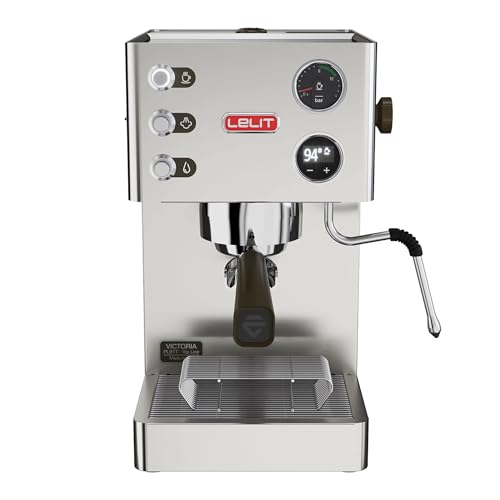
The Victoria is Lelit’s single-boiler machine for the kitchen: a 300 millilitre brass boiler for brewing water, hot water and steam, a brew group in the LELIT58 format and a small OLED display on which you set the temperature in degrees. Lelit writes that all its own products are designed and built in Italy, and the company is based in Castegnato in the province of Brescia. On the group: on its own warranty page, Lelit presents itself as a brand of Sage Appliances GmbH, as does Breville. Our price box lists the machine at approx. €799 on Amazon.de. In the German Lelit shop it cost €879 on 24 September 2026.
Two points up front, because many descriptions say something different and this page used to say something different as well. Lelit calls the group LELIT58 and a commercial-grade brew group, and E61 is not mentioned anywhere in the documents on the Victoria. And the word PID does not appear in any of the Lelit documents on this model that we read. What is documented is a control unit called the LCC, short for LELIT Control Center, in which coffee and steam temperature can be adjusted.
Two machines run under the name Victoria at Lelit: the one discussed here, with type number PL91T, and its successor the Victoria3 (PL91T3). The Amazon title names a Lelit Victoria coffee machine with milk frother in silver, without the digit 3. In the German Lelit shop the machine is listed as item PESVI01 with the old number PL91T and the EAN 8009437001675. We did not have Amazon catalogue data with a model number for this ASIN. The match therefore rests on the name, the price and the small plate at the bottom left of the product photo, which reads VICTORIA and PL91T. If you buy from another retailer, it is best to compare the EAN.
Boiler, group, housing
Lelit calls the brewing system a “single boiler made of brass”. The manual gives the pump as 15 bar and the power consumption as 1,200 watts. According to the German data sheet, a 3-way solenoid valve dries the coffee puck.
On the product photo there are three buttons one below the other on the left, with symbols for a cup, steam and a water drop. The manual classes them as the coffee, steam and hot water buttons and lists the on/off switch as a separate control. At the top right sits the pressure gauge, below it the round display with a plus and a minus button, and on the right side of the housing a knob that releases steam and hot water. The gauge is backlit and shows the pressure during extraction. According to Lelit, a green zone marks the value to aim for, and during the shot the needle should, according to the manual, sit exactly there.
The water tank holds 2.5 litres and detects by itself whether there is water in it. If it is missing, a warning symbol appears in the LCC, and according to the shop description the machine switches to an automatic reserve mode. The housing is brushed stainless steel, the drip tray has a wire grid, and on top there is a wide cup warmer. According to Lelit, mugs also fit under the spout. The portafilter has a spout that Lelit calls the Coffee Slide and that serves one or two cups. The German version runs on 230 to 240 volts and 50 hertz, with a type E+F plug.
On dimensions and weight, Lelit’s own documents contradict each other. The product page and the German data sheet say 23 × 38 × 38 cm, the manual 22.5 × 27 × 38 cm. The German shop lists 38 × 23 × 38 cm under width, depth, height, which would make a machine 38 centimetres wide. The product photo, however, shows a front that is clearly narrower than it is tall, and that fits a width of around 23 centimetres. All sources agree on a height of 38 centimetres. The depth, 27 or 38 centimetres, remains open, and it cannot be read from a front view. Our advice: plan with 38 centimetres, then the machine fits either way. On the photo, the steam wand sticks out beyond the housing on the right, so you need room there to swing it.
What Lelit does not state for the Victoria: the setting range of the temperatures and the factory setting in degrees, how tightly the LCC holds the temperature, how long the group needs to warm through and the boiler to reach steam temperature. Also missing are a duration for pre-infusion, the pump type, steam pressure and steam output, the material of the brew group and portafilter, a maximum cup height under the spout, the cable length, the standby consumption in watts and a descaling interval. There is likewise no information on spare parts availability, prices for cleaner, brush and resin filter, or the year in which the Victoria came onto the market. The 1,200 watts appear only in the manual, not on the product page. We have not estimated any of these values.
In detail: what the LCC sets
The LCC consists of an OLED graphic display and backlit stainless steel buttons. According to the shop and the manual, this is where you set the temperature for coffee and hot water, separately the steam temperature, switch pre-infusion on or off, choose between Celsius and Fahrenheit and set the standby time. According to the manual, pre-infusion moistens the coffee for a few seconds before the actual shot begins. The LCC also counts the shots, once as a partial and once as a total counter, and only the partial counter can be reset. In operation the display shows the coffee, water and steam temperature as well as the running brew time. The German shop additionally lists an automatic cleaning programme among the LCC functions.
What this changes compared with a machine with a thermostat: a thermostat switches the heating on and off at fixed points, the water temperature swings between them, and when you start the shot helps decide how hot the water arrives at the coffee. With a setpoint in degrees and a display, by contrast, you can see what the boiler is meant to work with, and you can shift the value for a lighter or darker roast.
The manual supplies reference values for an espresso: 7 ± 0.5 grams of coffee, 25 seconds for 30 millilitres, 88 to 92 °C when brewing, 80 °C in the cup and 8 to 10 bar during extraction. The 15 bar of the pump is therefore what it can deliver, and the 8 to 10 bar is what Lelit wants to see at the coffee grounds. The green zone of the gauge fits with this. For quantities, Lelit gives about 20 millilitres for a ristretto, 30 for an espresso and 60 for a lungo.
The dose deserves a second look. Lelit recommends 7 grams for one cup and 14 grams for two. The data sheet gives the double basket as 14 to 18 grams and the single basket there as 9 to 11 grams, while the product page gives the single basket as 7 to 9 grams. According to the product page, the recommendation therefore sits at the lower end of the single basket, and according to the data sheet below it. Our suggestion for starting out is therefore the double basket with 14 grams, because that is where the recommendation and the basket specification agree. From there you work the dose upwards. The brew calculator works out the quantities for other ratios.
How long does the Victoria take to heat up?
Less than ten minutes, as the German Lelit shop puts it. The international product page speaks only of a few minutes. Our advice: leave the portafilter locked in while it heats up, so that it warms through with the group and the first shot does not hit cold metal.
More than the number of minutes, standby counts in everyday use. From the factory, the Victoria goes into energy-saving mode after 30 minutes without use: display and heating switch off, and the coffee button flashes every 3 seconds. If you pull an espresso in the morning and a second one an hour later, you therefore wait again. The standby time can be changed in the LCC, and Lelit refers to the standard CEI EN 50564 in this context. The manual also says that the appliance should not be left unattended and that you pull the plug when you are not using it. A machine that stands hot and ready all morning does not fit these notes.
On first switch-on, the Victoria fills its own boiler. For around 40 seconds water runs out of the group, and the LELIT logo flashes on the display. After that you run about half a litre through the group without coffee. The tank should be filled with water at room temperature.
Milk foam with one boiler
After you press the steam button, the Victoria heats its only boiler from brewing to steam temperature. A bar runs on the display while it does, and according to the manual you wait until it is full. If you do not use the steam for a while, the machine returns to the coffee and water function by itself. With hot water, an electronic control stops the dispensing after a preset time.
The steam and hot water wand can be swung in several directions and has a handle meant to protect against burns. For a cappuccino, Lelit describes 100 millilitres of cold whole milk in a jug filled no more than halfway, heated to no more than 65 °C. According to the manual, you never point the steam at your body, and you take care with the wand itself because it gets hot. If no steam comes out, the fault table names a blocked hole at the wand tip as the cause, which you clear with a needle. How to guide the milk is explained in our guide How to froth milk.
What else is worth considering?
| Model | The difference | Price | Our rating | Choose this if |
|---|---|---|---|---|
| Lelit Victoria (this machine) | a 300 ml brass boiler, temperature adjustable in degrees in the LCC | approx. €799 | 9.1 | you want to read off temperature and brew time and plan for a separate grinder |
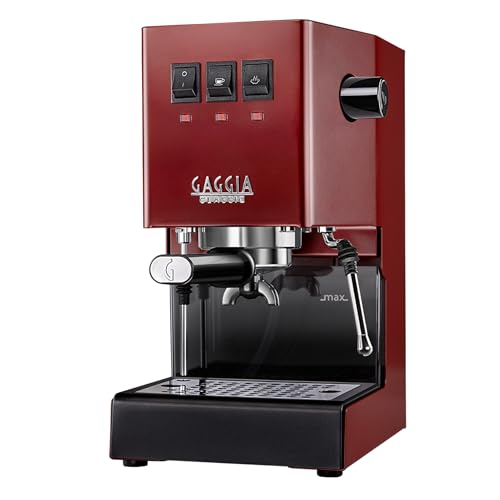
| Gaggia Classic Evo Pro | thermostat instead of a display, three rocker switches with indicator lights | approx. €499.52 | 9.4 | you want to save around €300 and control the temperature through timing |
| Rancilio Silvia | also a 0.3 l coffee boiler, thermostat-controlled according to Rancilio | approx. €829 | 9.0 | you prefer a pure thermostat and are willing to spend €30 more for it |
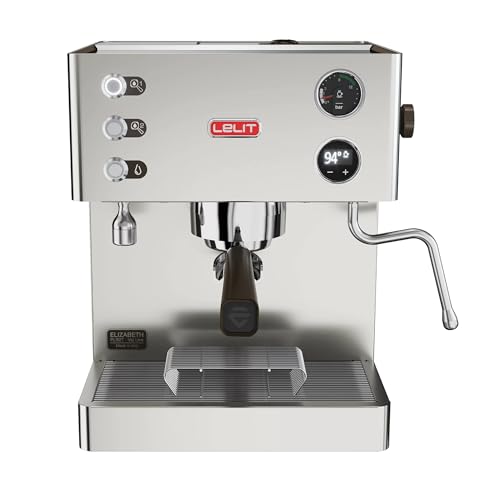
| Lelit Elizabeth | two boilers, brewing and steam at the same time | approx. €1,187.29 | 9.2 | you want to pull espresso and froth milk at the same time |
The prices are guide values from our catalogue and not a same-day lookup, and the rating is our editorial assessment based on the available data and the construction.
When the Victoria, when another machine?
The first question is milk. If you mainly drink espresso and now and then a cappuccino, the single boiler hardly gets in the way. If you regularly make milk drinks for three or four people at the weekend, we would seriously work out the numbers for the Lelit Elizabeth. In our catalogue it costs around €390 more, but you no longer have to switch between brewing and steam.
The second is the budget, and that means with a grinder. The Victoria has no grinder, and on its product page Lelit points to its own William PL72 grinder. If you land on around €800 as your upper limit, you have spent the money on the machine with the Victoria and have not yet ground a single bean. For the same total, the Gaggia Classic Evo Pro leaves around €300 of room for a grinder, though without adjustable temperature and without a display. What matters in a grinder for espresso is covered in our guide to buying an espresso machine, and you can find all the machines in the category in the espresso machine comparison.
Then the space it takes up. Measure the distance to the wall cupboard: you need 38 cm plus the height of your cups if you want to put them on top of the cup warmer. According to the manual, the machine belongs on a level surface and neither on nor next to a gas or electric cooker. The cable should not hang over the edge of the worktop, because children can pull on it or someone can trip over it.
And the willingness to fine-tune. In the manual, Lelit writes that its own machines are not automatic, and that anyone who wants a good coffee must know how to operate them properly. The Victoria does not take grind size or dose off your hands. If you want to press one button in the morning and be done, a bean-to-cup machine serves you better than any espresso machine in this table.
What is in the box, and accessories
According to the German data sheet, the box contains a LELIT58 portafilter with a design handle and Coffee Slide spout, a single and a double filter basket from IMS, a blind filter basket also from IMS, a tamper, a coffee spoon, a water filter rated at 35 l and a cup riser for espresso cups. The manual additionally lists the power cable and describes the tamper as a plastic part.
On accessories, Lelit writes of LELIT58 barista tools that match the group. The manual draws a clear line here: Lelit accepts no liability for unauthorised spare parts or accessories, the same applies to repairs outside authorised service centres and to interference with the appliance, and in all these cases the warranty lapses. According to the manual, accessories that the manufacturer does not recommend can cause fire, electric shock or injury. Whether 58 mm accessories from other brands fit and count as authorised, Lelit does not say. Before buying a third-party basket or tamper, it is therefore worth asking Lelit customer service.
The cleaner sachets and the group brush are not in the box, and both are listed with item numbers in the section on care.
Cleaning, backflushing, limescale
The manual requires cleaning at least once a week, and beforehand you pull the plug and let the machine cool down. You wipe the housing with a soft cloth dampened with clear water, and Lelit names microfibre. Abrasives are taboo, and the machine must be neither immersed in water nor cleaned with a spray jet. You may rinse the removable parts under warm running water. Filter baskets and portafilter never go in the dishwasher.
After every use you clean the steam wand and portafilter thoroughly. You wipe the wand damp on the outside and release a little steam. According to the manual, you do not have to clean the baskets after every shot, just make sure they do not clog.
Lelit recommends backflushing once a month. For this, 3.5 grams of cleaner go into the blind filter basket, and Lelit names its own cleaner sachets PLA9201. Then you hold the coffee button down and press the hot water button within 2 seconds, after which you repeat the cycle without cleaner. You brush the group, the group seal and the mounting rims with the brush PLA9101. While the machine is working, you must never remove the portafilter, and the manual points this out specifically.
On limescale Lelit goes its own way. The manual recommends softening the water with the LELIT resin filter in the tank. The filter loses its effect after a certain amount of water and must be replaced regularly, and for the interval the manual refers to the filter packaging. How fast limescale forms depends, according to Lelit, on how often the machine is used and on water hardness, and limescale can clog pipes and lower the brewing temperature. With hard tap water, changing the filter therefore belongs firmly in the calendar; how to determine hardness is covered in our guide Descaling and cleaning. For descaling itself, the manual writes in capital letters to put only natural descaling products into the water tank.
If the machine stands in a room where it freezes, the tank and water lines must be emptied beforehand.
Who is it suitable for?
For the place of use, the manual names the household and similar areas: staff kitchens in shops, offices and other working environments, farmhouses, guests in hotels, motels and other residential environments, and bed and breakfasts. According to the manual, the machine is designed for one or two cups per shot and not for continuous professional use. As its purpose, Lelit names only espresso, hot drinks via the hot water or steam wand and warming cups; any other use counts as improper and can be dangerous. Anyone wanting to equip a small café or a kiosk is therefore wrong with the Victoria. It must not stand outdoors either, and it should not get rain, sun or ice.
With children in the house, the manual says: keep the machine and cable out of reach of children under 8 years. Older children and people with reduced abilities use it only under supervision or after instruction, children may clean it only under supervision, and they must not play with it. Plastic bags and polystyrene from the packaging also belong out of children’s reach. Parts marked CAUTION HOT are, according to the manual, very hot, and the surfaces stay hot for a while after use. You do not touch the cup warmer when it is switched on, and you put only cups and glasses for the machine on it, and dried ones at that.