Rancilio makes espresso machines for bars, the first of which Roberto Rancilio built in 1927. It was called La Regina and was made in Parabiago in the province of Milan, where the Rancilio Group is still based; it has belonged to the Ali Group since 2013. The Silvia joined the range in 1997 as a machine for the home and, alongside the Silvia Pro X, is one of two espresso machines in the Home Line. When Rancilio introduced the Silvia Pro in 2020, the manufacturer itself wrote that little had changed on the Silvia in more than twenty years.
Our price box lists it at approx. €829 on Amazon.de. The buy link opens an Amazon search, because we do not have a unique article number for this machine. That has a consequence we return to under heating up: the Silvia exists in two variants, and which one a particular retailer ships cannot be determined this way.
Revised on 6 September 2026, based on the product page, the 2020 Home Line catalogue and operating manual no. 46900112 in the 10/2019 edition. We removed heat-up times of 6 and 15 to 20 minutes, 9 bar at the basket as a pressure figure for the Silvia, a descaling interval of 4 to 8 weeks, a boiler material and a sentence about modifications; none of these statements was backed by a Rancilio document. We corrected the tank capacity (2 instead of 2.5 litres) and the power (1,150 instead of around 1,100 watts). The statement that backflushing is not intended on the Silvia was wrong: the manual requires it.
Housing, boiler, switches
The Silvia measures 23.5 centimetres wide, 29 deep and 34 high. It weighs 14 kilograms, and according to the data sheet it has no adjustable feet.
Housing, drip tray and cup rest are stainless steel; you remove the latter two for cleaning. The same goes for the built-in water tank of 2 litres. Inside, a single boiler works for brewing water and steam, insulated and fed by a vibration pump. On 230 volts the Silvia draws 1,150 watts. The brew group is brass, the portafilter is chrome-plated brass, with a handle that Rancilio calls ergonomic and that can be personalised. The manual puts the noise level during operation at below 70 dB.
It is operated with four switches: main switch, coffee switch, hot water switch and steam switch. In addition there is a stainless steel dial that opens the valve for steam and hot water. Two lamps report the status, green for switched on and orange while the boiler heating is working. A display does not appear in the list of controls, and for the pressure gauge the data sheet says No.
The basket situation is confusing. According to Rancilio, the portafilter holds baskets of up to 21 grams. As standard the data sheet marks baskets for 8 and 16 grams; one line below, it lists filter baskets for 14 and 18 grams, without saying whether they are included or are accessories. The 2020 catalogue counts a tamper made of black wood with a flat stainless steel base and a diameter of 58 millimetres as part of the equipment.
After the product page, catalogue and manual, the following also remain open: the pump pressure in bar, the brewing temperature and the switching points of the control thermostat, the diameter of the brew group, the boiler material, a steam output, the maximum cup height under the spout, the cable length, a water filter for the tank, warranty and spare parts supply, the place of manufacture of the current Silvia, and a manufacturer’s price. Rancilio does not list the scope of delivery completely either; whether, for example, the blind filter disc from the cleaning instructions is in the box remains unclear. For the boiler there is only the declaration of conformity of the Silvia E dated 7 October 2019: for all parts that come into contact with water or coffee it lists, together, stainless steel, copper, lead-free brass, plastic, rubber and silicone, without assigning the materials to individual components. We have not estimated any of these values or taken them over from other models.
In detail: thermostat instead of PID
The data sheet puts it briefly: temperature control manual, control by thermostat. A thermostat switches the heating off as soon as the boiler reaches a fixed temperature, and back on when it has fallen a little below it. In between the water fluctuates, and when you start the shot helps decide how hot it arrives at the coffee. A PID control, by contrast, measures continuously and doses the heating power so that the boiler stays close to a set target value. In the electrical diagram of the Silvia three thermostats appear, at 100, 140 and 165 °C, all three labelled there as safety thermostats. The manual does not explain which of them switches during operation.
For you, the only signal that remains is the orange lamp. Before drawing coffee you wait, according to the manual, until it goes out, and before steaming likewise. Consistent results without a PID therefore require a fixed routine. Our suggestion: always wait the same length of time after it goes out, and change only one variable from shot to shot, dose or grind size, but not both at once.
You start and stop the espresso by hand at the coffee switch. If you want to keep track of the ratio of grounds to drink, put a scale under the cup; the brew calculator works out the quantities for your basket. If a shot runs too fast or too slowly, the troubleshooting table sends you to the filter basket, brew group and grind size: coarser ground coffee runs through faster, finer ground coffee more slowly.
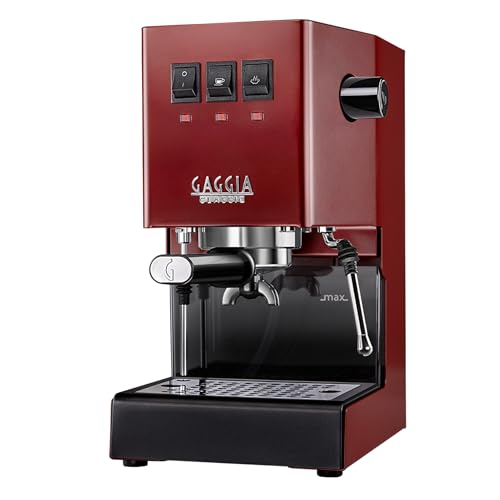
On pressure the manual has a single paragraph. It can be adjusted at a screw under the cup rest, by one turn at most, and this work may only be done by a specialist, with the plug pulled and the machine cooled down. For context, independent of the Silvia: around 9 bar at the coffee grounds is usual for espresso. Higher figures such as the 15 bar nominal that Gaggia states for the Classic Evo Pro describe the power of the pump and not the pressure at which the water passes through the coffee.
How long does the Silvia need to heat up?
Rancilio does not state a number of minutes. According to the manual, the Silvia is ready when the orange lamp for the boiler heating goes out.
However, the lamp only tells you something about the boiler. Brew group and portafilter are brass, so metal parts that need their own time to warm through, and the machine reports nothing about that. We would therefore leave the portafilter locked in while heating up and do a short blank shot before the first espresso. That is trade logic, not a manufacturer specification.
You may only switch the Silvia on with the tank filled, otherwise according to the manual the heating element is damaged. It cannot preheat automatically; the data sheet lists the switch-on timer as No.
Then the question of variants. Alongside the Silvia there is the Silvia E, which switches itself off 30 minutes after the last draw of coffee or hot water. According to the manual, the E is only available in some countries, and the product page lists the automatic switch-off as a feature available only in the EU. For your morning that means: if you pull an espresso at seven and a second at eight, the E heats up twice. Before buying, ask whether the retailer supplies the Silvia or the Silvia E.
Milk foam and hot water from one boiler
For steam the single boiler has to get hotter than for coffee, which is why espresso and milk foam only work one after the other. The manual describes steaming in twelve steps. You switch on the steam switch, let condensed water run from the wand for two seconds, wait until the orange lamp goes out, dip the wand into the milk and open the valve carefully. When the desired temperature is reached, you close the valve and take the milk away. Then you switch the steam switch off, release steam for two seconds and wipe the wand with a damp cloth. Finally you switch on the hot water switch, open the valve, close it as soon as water emerges, and switch the hot water switch off again.
Our reading of this last step: when drawing hot water, the pump feeds fresh water into the boiler, which has lost water during steaming and is still considerably hotter than for brewing. For the Classic Evo Pro, Gaggia expressly prescribes lowering the boiler temperature by dispensing water before the next coffee, otherwise according to the manual there is a risk of scalding. We would do the same for the Silvia.
Hot water for tea comes from the same wand: rinse out two seconds of condensed water, place a cup underneath, operate the hot water switch, open the valve carefully and close it at the desired amount, switch off. For the best result the milk should, according to the manual, be stored at 5 °C at most, so straight from the fridge. If the steam comes irregularly, the troubleshooting table names a blocked nozzle on the wand as the cause. How to guide the milk while frothing is in our guide How to froth milk.
Setting up and first start
Before the Silvia heats for the first time, the manual prescribes eleven steps. The machine goes on a stable, level surface, with enough clearance on all sides. You fill the tank with drinking water, immerse both hoses fully and put the lid on. Then you open the valve, switch on only the coffee switch, plug in the mains cable, switch on the main switch and close the valve as soon as water comes out of the steam wand. Afterwards you flush the brew group with half a litre of water into a container placed underneath, switch the coffee switch off and empty the drip tray. After a long period of standstill the same chapter applies again.
The way we read the sequence, it ensures that the boiler is filled before the heating element runs without water for any length of time. The water from the steam wand is your sign that it is ready.
Several safety notes in the manual concern the location. The Silvia belongs on a level, stable, dry and water-repellent surface; as examples Rancilio names laminate, steel and ceramic. The surface may be tilted by 5 degrees at most so that the machine does not fall over, and because the feet are fixed, you have to ensure that at the worktop. It must not stand next to heat sources such as an oven, hob or fireplace, not in damp rooms such as the bathroom, and not where a water hose or pressure washer is used. You must not expose it to the weather. The ambient temperature must not fall below 5 °C; the machine is to be protected from frost. Enough free space should remain all around for operation and maintenance.
The Silvia or one of the three others?
| Model | The difference | Price | Our rating | Choose this if |
|---|---|---|---|---|
| Rancilio Silvia (this machine) | Thermostat without display, stainless steel housing, 14 kg | approx. €829 | 9.0 | you can manage without a temperature display and want to learn the timing of the orange lamp |
| Gaggia Classic Evo Pro | by our classification also a thermostat, brass boiler according to Gaggia, 8.1 kg | approx. €499.52 | 9.4 | you want the same control and put the money saved into the grinder |
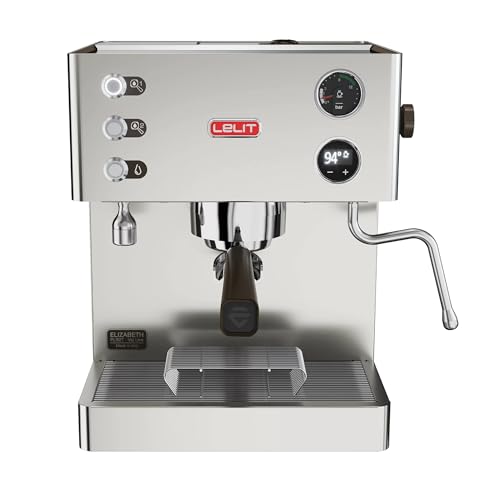
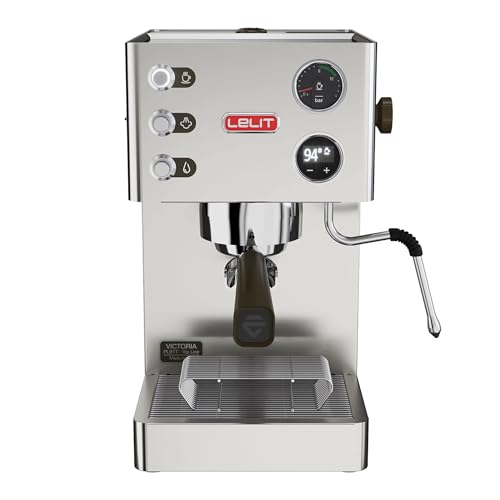
| Lelit Victoria | Temperature adjustable in degrees in the LCC, pressure gauge | approx. €799 | 9.1 | you want to see what temperature you are brewing at |
| Gaggia Classic UP | according to Gaggia two PIDs and three-stage pre-infusion | approx. €950.89 | 8.8 | a PID from the factory is worth the extra to you |
The prices come from our catalogue and may differ at the retailer. The rating is our editorial assessment from the available data and the construction; the table says nothing about the espresso from the four machines.
When the Silvia, when another machine?
Temperature first. If you want to see what the machine brews with, and to be able to raise the value for a lighter roast, the Silvia is the wrong choice. The Lelit Victoria shows coffee and steam temperature in the display, adjustable in degrees, plus a pressure gauge. The Gaggia Classic UP comes with two PID controllers and three-stage pre-infusion according to Gaggia. What both cost compared with the Silvia is in the table above.
Then the milk. If you mainly drink espresso and make a cappuccino now and then, one boiler is enough. With four milk drinks in a row you repeat the sequence of steaming, drawing water and waiting for the lamp for each of them. In that case we would work out the numbers for a machine with two boilers, which at Rancilio would be the Silvia Pro X.
It is best to work out the budget including the grinder. With approx. €829 as the upper limit, the Silvia pays for the machine and not a single bean has been ground. With the Gaggia Classic Evo Pro around €330 remains for the grinder, with a single-boiler machine that by our classification also regulates by thermostat. What the Silvia brings for the extra money is, in our assessment, mainly mass: 14 instead of 8.1 kilograms. What matters in an espresso grinder is explained in our espresso machine buying guide; you can find all machines of the category in the espresso machine comparison.
For space under a wall cupboard, the height of the machine is not enough as a measure. In the drawing in the manual the tank sits at the top rear under a lid, and to fill it you must be able to reach it from above.
That leaves tinkering. The manual draws the line narrowly: the pump pressure is adjusted by a specialist, as described above, and for trouble-free operation you should use only original spare parts from the manufacturer. Before opening, the machine must be switched off and disconnected from the mains. Anyone who wants to retrofit a temperature control is moving outside what Rancilio describes.
Cleaning according to the manual
Solvents and abrasive cleaners are taboo. If you need a cleaner, the instructions on its packaging apply, and you must not immerse the machine in water.
The 10/2019 edition summarises daily cleaning in twelve steps. You rinse the brew group and brush the seal clean, but expressly not the filter shower. Then the blind filter disc goes into the portafilter, together with a cleaning agent for coffee machines. You insert the portafilter and remove the cup grid. Now you switch the coffee switch on for 5 seconds, wait 10 seconds and repeat this until clear water runs into the drip tray. Afterwards you remove the portafilter and blind filter disc, rinse both with drinking water, put both back in and rinse several times. Next: empty the drip tray, take out the filter basket and clean all parts, using hot water against coffee oils. Finally you reassemble the portafilter, lock it in, put the cup grid back and wipe the housing with a damp cloth, stainless steel parts in the direction of the satin finish.
The 2019 edition states this as daily. The older edition 08/2016 lists cleaning the brew group with the blind filter disc as a weekly job and in addition has the portafilter and filter basket soak in cleaning solution for at least 20 minutes, with the machine switched off and cooled down.
For the steam wand the manual provides four steps daily. The steam valve goes into milk cleaning solution, is heated with steam and left to work; how long depends on the product, and Rancilio recommends at least 10 minutes. Then you pour the solution away, fill the container with fresh water, heat the immersed steam valve in it and finally clean the wand. You must not use an aluminium container for this.
Neither edition contains a chapter on descaling, so there is no interval and no agent. How to find out the hardness of your water is in our guide Descaling and cleaning, which also has an interval for each hardness range. That is our own assessment and not a value from Rancilio; next to it are the manufacturer values of other machines. Before the first descaling we would ask customer service which agent is approved for the Silvia.
If the Silvia is to stand unused for a longer time, the order is: empty the water tank, draw off the residual water and switch off immediately when the system is empty, main switch off, clean the machine, pull the plug, cover it and store it dry, away from the weather. When it has reached the end of its life, it does not belong in normal household waste but is disposed of according to national regulations.
Who is it suitable for?
According to the manual, the Silvia is designed for preparing coffee and hot drinks in the home; the 2020 catalogue recommends it for home and office. Neither statement covers equipping a café or a kiosk with it.
In our view it is right for someone who wants to take over the handling themselves: wait for the lamp and stop the shot by hand. If you want to press one button in the morning and be done, our finder leads to bean-to-cup machines that take these steps off your hands.