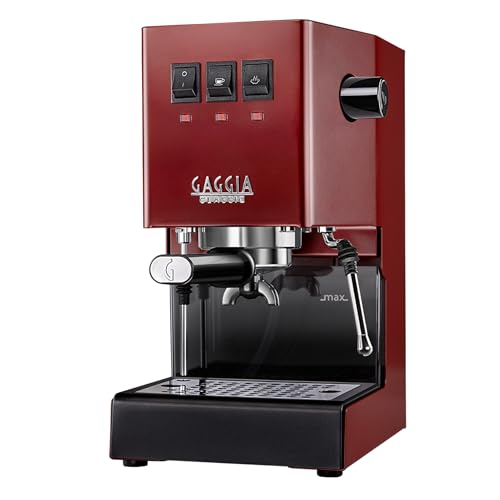
In Europe this machine is called the Classic E24. On Amazon it appears as “Gaggia Classic Evo rot RI9481/12” (rot = red), Gaggia North America lists the same generation as Classic Pro E24, and in one of the Amazon bullet points Gaggia itself calls it “Gaggia Classic Evo Pro Polar Red”. The manufacturer’s product search lists the model reference RI9481/12 as CLASSIC E24 RED, and the Amazon catalogue adds the part number RI9480/12. One machine, four names. Underneath all four is the same thing: a single boiler with one boiler for brewing and steam, a 58 mm portafilter, no PID.
Origin, year of launch, price
Achille Gaggia filed patent no. 365726 on 5 September 1938, from which the brand emerged. The first Classic came onto the market in 1991, even then with a stainless steel housing. The Evo generation followed in 2023, the year of the 85th anniversary of that patent. For the series Gaggia states 100 per cent design and manufacture in Italy; the company headquarters is at Via Torretta 240 in Gaggio Montano in the province of Bologna.
The price is approx. €499 (as of September 2026). The Amazon catalogue record for ASIN B0C5HRRDG5 has no price field; you can see the daily price in the shop. In our espresso machine comparison that puts it in the same price window as two competitors, both of which come with PID control from the factory.
Construction: brass, stainless steel, 2.1 litres
The portafilter measures 58 millimetres and is made of stainless steel according to Gaggia. The brew group and boiler are made of lead-free brass. The manufacturer justifies the brass boiler by saying that it stores more heat and therefore keeps temperature and steam pressure more stable. Between the pump and the brew group sits a 3-way solenoid valve: according to Gaggia it keeps the water pressure in the portafilter constant and dries the coffee puck after the shot, which makes removal and cleaning easier.
As controls Gaggia names three rocker switches with their own indicator lights: on and off, espresso, steam. The equipment list names no display or menu. The water tank holds 2.1 litres and is pulled out towards the front, as is the plastic drip tray with its stainless steel grid. On top there is a stainless steel cup tray with room for five cups. Two cups at once are possible according to the manufacturer. The stainless steel steam nozzle has two holes and a removable tip.
Connection values for the EU version: 230 volts, 50 hertz, 1200 watts. The same table gives 120 volts with 1350 watts for other markets and 220 volts with 1100 watts for Korea. Gaggia gives the weight as 8.1 kilograms, the Amazon catalogue as 17.64 pounds, which is around 8.0 kilograms. On dimensions the manufacturer’s pages contradict each other: the German product page gives 23 × 38 × 24 cm (length × height × depth), the English one 20 × 35.5 × 27 cm. Which of the two pages is right cannot be decided from the outside, so we work with the larger value in each direction, that is around 23 cm wide, 27 cm deep, 38 cm high.
From the manual comes a detail that appears on no product page: after 20 minutes without use the machine switches itself off.
For this machine there is a whole series of details that Gaggia publishes nowhere. So that you do not have to search for them across five sections, they are collected here: boiler volume (the tech table only speaks of a higher capacity compared with the previous generation), pump type, brew temperature in degrees, the switching points of the thermostat, steam pressure, heat-up time to brewing readiness, standby consumption, noise level in decibels, cable length, sheet thickness of the housing, a recommended water hardness, the prices of the accessories and everything about spare parts supply. Plus one gap in the manual: backflushing with a blind basket, familiar from portafilter machines, does not appear in it, and no blind basket is included either. We have not gathered any of these details elsewhere, and we have not estimated them either.
When choosing a colour there is one more point. The red RI9481/12 belongs to the Color Vibes range, and for this range Gaggia states a galvanised steel housing. Brushed stainless steel is reserved for the standard version. The colour range includes Deep Blue, Industrial Grey, Polar White, Cherry Red and Thunder Black.
In detail: 15 bar pump pressure and the pressure at the basket
The European manufacturer page gives a nominal pump pressure of 15 bar. That is the maximum value the pump can build up against a closed resistance, not the pressure that reaches the coffee grounds. In this design an overpressure valve usually sits between the pump and the basket and discharges the excess. To what value Gaggia sets it is not stated on any manufacturer page for the EU version.
Gaggia North America gives 9 bar at the basket for its version of the same series. We do not transfer that figure to the machine you buy in Germany: the page applies to the 120 volt version sold there, not to the 230 volt machine from the European catalogue.
Gaggia names no control type for the Evo Pro. In our assessment it holds its temperature without a PID by means of a thermostat that swings around a target value: it heats, switches off, the water cools, it heats again. At which point in this swing the shot starts is decided by the person beforehand. Anyone who starts earlier or later brews with a different water temperature at the basket, and it is exactly this fluctuation that a PID takes off the user.
A pointer for the shot time comes from the manual’s fault table: if the espresso runs through in less than 20 seconds, Gaggia lists that as a fault. With the guide to grind size you can feel your way towards the right setting, and the brew calculator works out the ratios for your cup size.
Steam: 60 seconds, then a cool-down pause
The design slows down milk drinks in series. Gaggia limits steam output to 60 seconds in one go, because the boiler can otherwise run empty. And after every frothing session the manual requires you to lower the boiler temperature by dispensing water before the next espresso. How long that takes, Gaggia does not say.
The sequence: press the steam button, wait 15 to 20 seconds until the indicator lamp for steam temperature lights, then froth, for no longer than a minute. Afterwards let water out until the boiler is back at brewing temperature. The manual does not word this as advice but as a warning: without the lowering, according to Gaggia there is a risk of burns.
Applied to a Sunday morning with four milk drinks, that means: before every espresso that follows a steaming session comes this cool-down. One boiler never delivers brewing and steam temperature at the same time. A dual-boiler machine separates the two and costs more.
A milk jug, incidentally, is not included; Gaggia sells it as a separate accessory.
What are the alternatives?
| Model | The difference | Price | Our rating | Choose this if |
|---|---|---|---|---|
| Gaggia Classic Evo Pro (this machine) | Brass boiler, 58 mm, thermostat instead of PID | approx. €499 | 9.4 | you want to stay under 500 euros and have the 58 mm size |
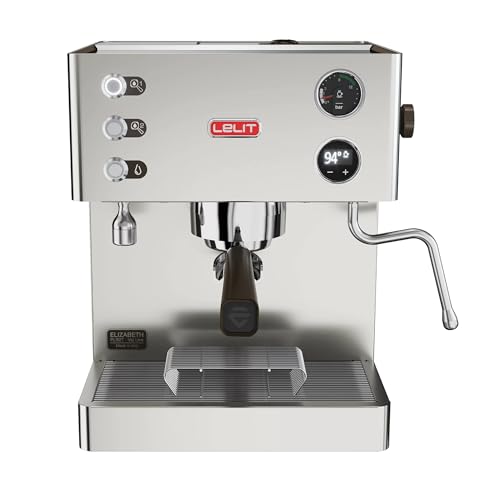
| Lelit Anna PL41TEM | PID from the factory, but 57 mm baskets (LELIT57) instead of 58 mm | approx. €489 | 8.6 | regulated temperature matters more to you than the more common basket size |
| Sage Barista Express | Built-in conical burr grinder, PID, 54 mm portafilter | approx. €489 | 9.0 | 500 euros is your total budget and no separate grinder is to be added |
| Rancilio Silvia | also 58 mm (Rancilio names a tamper with a 58 mm base for the Silvia), 0.3 l boiler, like the Gaggia no PID from the factory | approx. €829 | 9.0 | you accept the same manual work without PID and spend around 330 euros more for the quantified 0.3 litre boiler |
The prices are the guide values from our catalogue on Amazon.de as of September 2026 and not a live daily query. The ratings are our editorial assessment from the available data and the construction, not a measurement result.
When this machine suits you and when another does
Milk drinks are the point where this design fails most often. How the switch between steam and espresso works is described above in the section on steam, and practice does not change that.
The time budget in the morning is the second point. Before the first shot, according to the manual around 150 millilitres of water should run through, after which the portafilter heats along for a few minutes until the machine has reached the right temperature. If you lack the time for that in the morning, a machine with automatic temperature control is the more honest choice.
On grind size, the supplied Crema Perfetta pressurised basket makes the start easy, because it builds up the resistance itself. The two conventional baskets demand the right grind size and a clean tamp. If adjusting annoys you instead of interesting you, buy a bean-to-cup machine. What else matters with a portafilter machine is covered in our espresso machine buying guide.
Two espressos at the same time are possible according to Gaggia. How many shots in direct succession are possible before the single boiler has to reheat, the manufacturer does not say, and boiler volume and heat-up time belong to the gap described further up.
For the footprint, allow 38 centimetres of height plus air for the tank lid and the cup tray. Your water hardness changes nothing about the care interval; more on that below. And the grinder is a second item, because there is no grinder in the box. Gaggia requires freshly ground coffee for good results. Without this item you are buying a 500 euro machine for supermarket powder.
Three baskets and a 58 mm portafilter
Three baskets are included: a Crema Perfetta pressurised basket for one or two cups, a conventional filter for one cup or one pod, and a conventional one for two cups. The Crema Perfetta filter may only be used together with the pearl-jet frother, which the parts list gives as component 16. Without it the machine sprays the coffee out, the manual warns, and there is a risk of burns. When switching to the conventional baskets, both parts have to come out, filter and frother.
The 58 millimetre format is the size that commercial machines also use, and Gaggia partly serves it itself. Its range includes, among other things, a bottomless portafilter with an ash wood handle for the Classic (portafilter diameter according to the manufacturer 59 mm, total length 220 mm, product code 421946507221) and the matching Barista Pro IMS Filter 20 g Nanotech with 70 mm diameter, 26 mm height and 661 holes in AISI 304 steel (product code 421946509311). There are also the Crema XL System, a portafilter with a wooden handle, a tamper with a wooden handle, a tamping mat, Intenza water filter, descaler and cleaning tablets.
The accessory page lists the bottomless portafilter only generally for the Gaggia Classic, without a model year or model number, and we did not find an express approval for the E24 generation there. Anyone who wants to upgrade should know this gap rather than rely on the number 58. On the water filter, the manufacturer pages contradict each other again: the English tech table leaves the field empty, the German one says YES.
One sentence from the safety booklet belongs here: Gaggia expressly prohibits accessories from other manufacturers and those it does not recommend itself. Anyone who nevertheless upgrades with such accessories acts against this requirement and, according to the booklet, loses the warranty.
Descaling, rinsing, washing the baskets
Gaggia specifies the interval in months of use, not in litres and not by water hardness: every two months of using the machine. You descale in Munich in the same rhythm as in Hamburg. The manufacturer’s tech table lists the descaling cycle as manual and leaves the field for a rinse cycle empty. Only the Gaggia descaler is permitted; vinegar and other descalers are expressly forbidden.
The manual requires you to take the baskets out of the portafilter daily and wash them out with warm water. If the holes are blocked, it names ten minutes in boiling water as a remedy. For more thorough cleaning it recommends Gaggia’s cleaning tablets, a pack of six. The same accessory page assigns exactly these tablets to the brand’s bean-to-cup machines. Both sentences come from Gaggia, and we pass them on as they stand there.
The pressurised filter holder must not go in the dishwasher or come into contact with washing-up liquid. What running the machine costs per year cannot be stated reliably, because the price list for the accessories is missing from the collection above. The rhythm, on the other hand, is fixed: six descaling runs a year with continuous use and daily washing of the baskets. Seals are wear parts by design and at some point an item of their own. The procedure step by step is described in our guide Descaling and cleaning.
One more note for anyone with an unheated utility room: according to the safety booklet the machine must not stand below 0 °C, because residual water in the heating system can freeze and cause damage.
Who is it for?
For people who want to learn espresso as a craft and are willing to invest a few minutes in the morning before the first cup runs. The 58 mm format, the brass boiler and the 3-way solenoid valve are the points that led, in our espresso machine category, to the rating of 9.4 and the badge Comparison winner 2026. On temperature it loses in the same comparison: Lelit and Sage regulate at the same price by PID, the Gaggia works with a thermostat.
Wrong for anyone who wants to get going straight away in the morning. Without the warm-up time with the portafilter inserted, the first shot of the day starts on cold metal, and that is exactly what the warm-up is meant to prevent. Anyone who wants to modify the machine right after buying it should also look closely: the safety booklet prohibits accessories from other manufacturers, and the warranty lapses with them.
That leaves the middle way for anyone who wants regulated temperature without having to master the timing: the Gaggia Classic UP from the same brand has two PID controllers (brewing and steam) and automatic pre-infusion in three stages, but costs almost double in our catalogue.