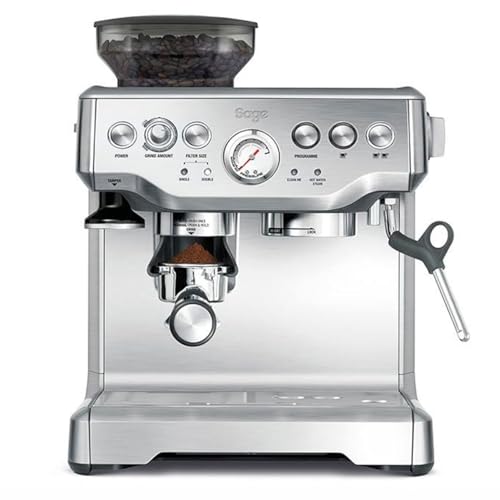
The Barista Express has a conical burr grinder and brew group in the same housing. On its product page, Sage sums this up as grinding, dosing and extracting in one machine. That means there is no second grinder on the worktop next to the machine. On the German manufacturer page the model runs as the Barista Express with thermo milk jug under the number BES875, and the Amazon catalogue shows the part number SES875BSS2EEU1A and BRG Appliances as the manufacturer. It has been listed there since 1 April 2018, which is a good eight years in the range.
Our benchmark price for the machine is approx. €489 on Amazon.de (as of September 2026). Sage itself asks €599.90 in its own shop. That puts around €111 between the manufacturer’s price and the benchmark in the shops for the same machine.
Dimensions, tank and power
Sage gives 31.8 cm width, 35.1 cm depth and 40.4 cm height, and the housing is brushed stainless steel, which is also what the colour is called in the Amazon catalogue. The water tank holds 2 litres, is removable and, according to the manufacturer, is BPA-free. According to the manual, the bean hopper holds 250 g. In the shops the figure 450 g also circulates for the same hopper, but the smaller one is the documented figure. In practice: a 250 g pack goes in whole, a 1 kg bag in four portions.
The portafilter measures 54 mm and is made of stainless steel, and the matching 54 mm tamper clips onto the machine. In addition there is an espresso pressure gauge on the housing, a cup warming plate on top, a separate hot water outlet and a removable drip tray that separates wet and dry coffee. The gauge shows the pressure during the shot, and next to time it is the display you use to check the grind size.
The only weight for this machine is in the Amazon catalogue: 23.13 pounds, so around 10.5 kg. The catalogue also lists dimensions of around 46.9 x 40.7 x 42.0 cm, which do not match the manufacturer’s figures and look like the shipping carton. For kitchen planning, the Sage numbers therefore count. For the question of whether you can move the machine on your own, only the catalogue value remains, with the same caveat: if that too belongs to the carton, the machine itself weighs less.
Electrically, the Barista Express runs from a 230 V socket. The manual gives 220 to 240 V at 50 Hz and a power consumption of 1560 to 1850 W. The 1,850 W is the upper limit of that range, not a fixed value, and at 230 volts it corresponds to around 8 amps. On a kitchen circuit protected at 16 amps there is room left beside it, as long as a kettle is not running at the same time.
Thermocoil, PID and the 9 bar at the basket
Sage calls the heating system Thermocoil and gives 93 °C with PID temperature control. Where “heating block” appears below, that is our wording for the same design. Water flows through such a block: it heats up on its way to the brew group instead of sitting ready in a boiler. This means no boiler contents cool down between two shots, but the control has to match the flow. That is exactly the job of PID control: it adjusts the heating power to follow the target temperature instead of just switching the heater on and off.
The brew temperature can be changed. In the advanced temperature mode you shift it up or down by 1 or 2 °C using the existing buttons, plus 2 °C for example via the 2 CUPS button. For very light roasts that is one more lever. The others are the grind size, the dose, the shot volume and the length of the pre-infusion, which you determine yourself on a manual shot.
Sage advertises an Italian 15 bar pump and states 9 bar for extraction on the same product page. The two numbers describe different states. 15 bar says what the pump is designed for while no water is flowing. As soon as the coffee bed is flowed through, the pressure drops, and what arrives at the basket is the 9 bar. The larger number is therefore of little use as a comparison between two machines.
Before full pressure there is a low-pressure pre-infusion, during which the pressure rises gradually according to the manufacturer. On a manual shot it runs for as long as you hold the button, after which the machine moves on to the actual extraction. As default settings, the manual gives approx. 30 ml for one cup and approx. 60 ml for two. There are also two checking times: output should start after 8 to 12 seconds, and the whole shot should take 25 to 30 seconds. This is how to read the window: if output starts later, the grind is too fine or the tamp too firm; if it comes earlier, the grind is too coarse. The brew calculator works out the ratio from ground coffee dose and target weight before you turn the grind size dial.
What Sage does not publish for this model
A whole series of figures is nowhere to be found for the Barista Express. So that you do not have to search for them across eight sections, they are gathered here: heat-up time to brew readiness, manufacturer weight, volume and material of the heating block, number of circuits, a 3-way valve (neither confirmed nor denied), material and diameter of the burrs, the range of the adjustable upper burr, grinding time per dose, noise level in decibels, cable length, power consumption per cup, usable height under the portafilter spout, volume of the supplied milk jug, the quantities of the included consumables, prices and availability period of spare parts, and the country of manufacture.
Checked for this were the German and the British product page, the EU manual for the SES875 and the Amazon catalogue entry. What is not stated there is not stated by us either, neither estimated nor taken from a forum or a retailer text.
Are 16 grind settings enough for espresso?
For espresso, yes. Sage recommends setting 8 as the starting point, and the upper burr can be adjusted, which extends the grinding range beyond the 16 clicks. Whether the setting is right is shown by the two checking times from the section above and by the gauge during the shot.
The conical burr grinder grinds with dose control straight into the portafilter. So you hold no intermediate container underneath and lose no grounds when transferring. That is the real reason this design counts as an entry point: two error-prone steps drop out, weighing in a cup and transferring into the basket.
After grinding you tamp with 10 to 15 kg of pressure, as the value is given in the manual, and then use the supplied razor blade, with which Sage levels the dose in the basket to a uniform amount. How to work your way systematically to the right setting is explained in our guide to grind size, and the order always stays the same: first set the dose, then turn the grind size, then measure the time again.
In our data sheets the Barista Express Impress has 25 settings and the Barista Pro 30. The comparison comes from our own catalogue.
Milk froth by hand
The steam wand swivels through 360 degrees. The Express has no automatic milk system. Sage advertises hand-made microfoam, so the machine supplies the steam, and you determine air intake and jug angle. As a target temperature for the milk, the manual gives 60 to 65 °C, and why this window is so narrow and how to guide the wand for it is explained in the guide to frothing milk.
A Temp Control milk jug comes with the machine, and in the product name Sage calls it the thermo milk jug.
Four milk drinks in a row means frothing by hand four times on this machine, with wiping and a short steam purge in between. If two cappuccinos have to be ready in five minutes in the morning and nothing is to be adjusted along the way, an automatic milk system is the better buy, even at the price of the portafilter machine. For an Americano or for warming the cup there is the separate hot water outlet, which does not run through the steam wand.
What else is worth considering?
| Model | The difference | Price | Our rating | Choose this one if |
|---|---|---|---|---|
| Sage Barista Express (this one) | Thermocoil with PID, conical burr grinder with 16 settings, hand tamping | approx. €489 | 9.0 | you have 32 cm of width free and are prepared to get through several bags of beans for the first usable cup |
| Sage Barista Pro | ThermoJet instead of Thermocoil, to extraction temperature in 3 seconds according to Sage, 30 grind settings | approx. €474 | 8.9 | you pull single espressos spread through the day and change roast often |
| Sage Barista Express Impress | Assisted tamping via a lever instead of hand work with 10 to 15 kg | approx. €379 | 8.9 | you do not want to get used to even tamping pressure |
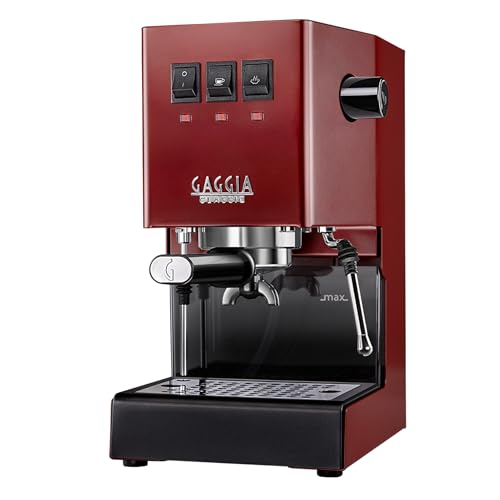
| Gaggia Classic Evo Pro | 58 mm, but without a grinder; Gaggia prohibits accessories from other makers in its safety booklet | approx. €500 | 9.4 | you already have a grinder and want a 58 mm machine |
All four prices are the benchmark values from our data sheets, as of September 2026, rounded to whole euros. The rating is our editorial assessment from manufacturer and catalogue data, not a measurement result and not a tasting. What the table is not good for: it says nothing about availability in the shops and nothing about promotional prices, which change weekly.
When the Express fits in your kitchen
Width and depth are uncritical in most kitchens, but height is not. Above the machine you need extra room to open the lid of the bean hopper, plus space to take out the removable water tank. Under an extractor hood or a low-hanging cupboard, only a folding rule before purchase helps.
The water hardness where you live decides the care effort. At Sage hardness level 4 the manual recommends descaling every 90 days, at level 6 every 60 days. If you land at level 6, that is six dates a year, and in between come the back-flush cycles, which fall due independently of that.
Until grind size, tamping pressure and shot time fit together, it costs several bags of beans in our assessment. A bean-to-cup machine takes these steps off your hands, and control over them with it. If you are still undecided between the types, the coffee machine finder sorts by brewing method and budget.
Scope of delivery, baskets and care
For the Barista Express, Sage lists a dosing funnel, razor, 54 mm portafilter, filter baskets, tamper, stainless steel milk jug, cleaning kit, hardness strips and water filter. The manual adds a cleaning disc, cleaning tablets, descaling powder, a water filter holder and an Allen key. The dosing funnel is expressly given there as 54 mm, so it depends on the same format as the portafilter. The drip tray cover comes only with the coloured machines.
There are two types of baskets, each for one and for two cups: single-wall and dual-wall. The manual is clear on this: single-wall baskets are intended for freshly ground whole beans, dual-wall baskets for pre-ground coffee from a pack. The reason lies in the construction: a dual-wall basket builds up resistance via a second wall with a small opening, not via the coffee bed, and therefore forgives a grind that would be too coarse for a single-wall basket. Sage allows only roasted whole beans into the grinder itself.
The CLEAN ME light calls for the back-flush cycle. For this, the cleaning disc and a tablet go into the basket, and the run takes around 5 minutes according to the manual. Sage expressly writes that this cleaning cycle is separate from descaling: they are two procedures with two different agents. Anyone who does one and skips the other has only half cared for the machine.
The third care date belongs to the water filter in the tank, and it runs on its own clock: according to the manual it is changed after 90 days or 40 litres. The steam wand you wipe after every use, independently of that, and purge briefly, otherwise milk residue dries in the opening.
Consumables are the water filter, the cleaning tablets and the descaling powder, all three come with the machine and all three run out at some point. Sage lists spare parts on its own page for the BES875. For everything you buy there or elsewhere, the same restriction applies: 54 mm is the Sage format, every basket, tamper and funnel comes from that format, and accessories in the 58 mm size do not fit the machine. If you want to keep the choice of third-party 58 mm accessories open, in this price class you are better off buying a 58 mm machine without a grinder and putting a grinder beside it.
Who the Express suits and who it does not
In our assessment it is a convenient entry with its own grinder. In the espresso machine comparison the Impress stands right beside it, taking one step further from here with assisted tamping.
The argument that lasts longest is the budget. The Gaggia Classic Evo Pro is at approx. €500 in our catalogue, so around eleven euros above the Express, and there the grinder comes on top. If, on the other hand, you already have a grinder on the worktop or buy your coffee ground in a pack, you are paying here for a conical burr grinder you do not touch.
If you watch the clock in the morning, you will find no figure for the Express: its heat-up time is one of the items in the list further up. Only the other side is quantified: for the Barista Pro with its ThermoJet, Sage gives 3 seconds to extraction temperature. That is a manufacturer statement, not our own measurement, and it does not apply to steam readiness.