In the Amazon catalogue this machine is listed under the model number SES876BSS4EEU1, while Sage itself lists the model as BES876. In both cases it is the Barista Express with a lever that presses the ground coffee in the portafilter so that you do not have to do it yourself with a manual tamper. Sage sums it up in one sentence: “The best of the Barista Express with the Impress Puck System.” Our reference figure is approx. €379 on Amazon.de (as of September 2026), the price at which the machine stood in the Amazon catalogue on 7 September.
Where the Impress comes from and where it stands
Sage is backed by Breville, and the product page carries the copyright notice of Breville Pty Limited. The manual gives BRG Appliances Limited in London as an address and, for Germany and Austria, Sage Appliances GmbH in Krefeld.
Sage sells the Impress in seven variants with their own article numbers. The Amazon listing is one of them, and the catalogue lists it in the colour brushed stainless steel. A small difference between the variants lies in the accessories: according to the manual, Sage only includes the drip tray cover with the coloured machines.
The machine belongs to the espresso machines with a built-in grinder. In our espresso machine comparison it therefore sits alongside machines that grind, dose and brew in one housing, and alongside pure espresso machines for which you buy a grinder separately.
Build: 33 by 38 by 41 centimetres, 2-litre tank, 250 grams of beans
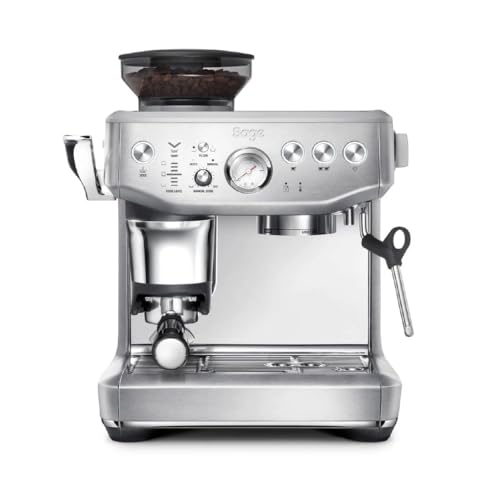
In the product photo, the bean hopper sits at the top left above the grinder. Below it the portafilter hangs in the Impress station, and the tamping lever protrudes from the housing on the left. The pressure gauge sits in the middle of the control front, the brew group next to it on the right, and the steam wand at the far right. According to Sage, the housing is made of stainless steel.
The German product page gives 33 × 38 × 41 cm (width × depth × height), and the Amazon catalogue arrives at the same values when converted. Sage’s British page differs and gives 42.2 × 36.7 × 31 cm, also labelled width, depth, height. We use the German figures because two sources back them. The weight comes solely from the Amazon catalogue, 29.76 pounds, so around 13.5 kg; the entry does not make clear whether this means the machine alone or the package.
The water tank holds 2 litres, is removable and sits at the back; you pull it out by the handle. If the level drops below the MIN mark, the machine cannot be used. At the top the bean hopper takes 250 g. The grinder works with 40 mm conical burrs, made of steel according to the British product page, and has 25 settings on the dial. Lower numbers grind finer, higher ones coarser. If the range is not enough, according to the manual it can be extended with the adjustable upper burr. If there are too few beans in the hopper for a full dose, the grinder switches itself off with most varieties. You may only run it with the hopper lid on.
The connection values: 220 to 240 V, 50 to 60 Hz, 1,560 to 1,850 W. According to the product page, 1,600 W of that goes to the Thermocoil. Next to the steam wand there is a separate hot water outlet that dispenses a maximum of 240 ml per draw; the manual warns that the cup is then roughly 90 °C hot. On top there is a cup warming plate, and behind the drip tray a removable accessory compartment.
Some things are missing from all three manufacturer sources, that is the German and British product pages and the manual, and we have not estimated them either: a weight from the manufacturer itself, the year of market launch, the country of manufacture (only the pump comes from Italy according to Sage), the noise level in decibels, the cable length, standby consumption and the minutes until power-saving mode, the material of the water tank, bean hopper, tamper stamp and drip tray, the preset shot volumes in millilitres, the steam output and the number of holes in the steam tip, the capacity of the water filter in litres, a descaling interval in days, a water hardness setting, and prices and availability of individual spare parts. There is a spare parts page for the BES876, but its parts list loads by script and could not be read.
In detail: what the lever does and what it leaves to you
Why a lever at all? In the coffee bed, water finds the path of least resistance. If the puck is pressed more loosely in one spot or is crooked, more water runs through there, and the rest of the grounds are barely extracted. With a manual tamper, pressure and angle depend on the hand that guides it. With the Impress, Sage fixes the pressure. That the angle no longer depends on you either is something we infer from the guided station; Sage does not say so itself.
The sequence according to the manual: the portafilter stays inserted in the same position for grinding, dosing and tamping. The grinder fills the grounds centrally, and the machine calculates the dose from the last amount ground. Whether this central filling makes distributing the grounds by hand unnecessary is not described by Sage in any of the sources. Then you press the lever down until a beep sounds. Sage gives a pressure of 10 kg for this, plus a 7-degree turn, which the manufacturer calls the Barista Twist. According to the manual, slow, even pressing gives a nicer puck, and Sage recommends tamping twice.
A bar display shows whether the amount is right. The middle bar with the smiley symbol stands for the ideal tamping level. If there are too few grounds in the basket, the Dose button flashes; pressing it tops up with the A Bit More function, if necessary in two to three passes, and only in automatic mode. If there are too many, you either level off the excess with the Razor dosing tool or hold the Filter button for 3 seconds, which shortens the grind time by 3 seconds. Once the machine has reached the ideal amount, it adjusts the dosing time for the next pass by itself.
If you want your own tamping height, you switch to manual mode. There you set the grind time on the dial, clockwise for longer, anticlockwise for shorter. Automatic mode always keeps the height that Sage specifies as ideal.
The troubleshooting table names two typical faults at the lever. If tamping is difficult, the basket is usually heavily overdosed or there are coffee deposits in the mechanism. If grounds stick to the puck surface, the lever was pulled too fast. A safety note belongs here, verbatim: “Do not put your fingers into the tamping channel when pressing down the tamping lever.”
93 degrees, 9 bar, 25 to 30 seconds
Sage calls the heating system Thermocoil. The manual describes it as an integrated stainless steel heat exchanger that regulates the water temperature. By this principle the water is heated on its way through the stainless steel water path, instead of standing as a reserve in a boiler. The electronic PID control is meant to hold the temperature constant, and Sage gives exactly 93 °C as the value.
For pressure, two figures appear on the product page. The pump is a 15 bar pump from Italy, and according to Sage extraction takes place at 9 bar, after a low-pressure pre-infusion phase. The 15 bar describes the maximum the pump can build up. What counts at the coffee grounds is the extraction pressure, and the gauge in the front shows you that during the shot. You can lengthen the pre-infusion yourself: you hold the chosen brew button for as long as the pre-infusion should last. You can also programme both buttons to your own shot volume by holding them for three seconds until they flash.
For the fill quantity, the manual gives 8 to 11 g in the basket for one cup and 16 to 19 g for two, and the product page names 18 g as the ideal dose. According to the extraction guide, the coffee should start to flow after 8 to 12 seconds and the whole shot should take 25 to 30 seconds. Over 35 seconds it counts as over-extracted, under 20 as under-extracted. If it runs too fast, you set a finer grind; if it runs too slowly, a coarser one. How to work your way towards it is in the guide Setting the grind size; the brew calculator works out the ratios for other cup sizes.
Is the Impress more expensive than the standard Barista Express?
No, in our catalogue there is no extra charge for the lever; the Impress is even below it: approx. €379 against approx. €489 for the Barista Express (as of September 2026), so around €110 less.
Sage lists the Barista Express as a variant with a thermal milk jug (BES875). The shop prices at the manufacturer change constantly, which is why we only give our catalogue reference figures here.
What really differs is in Sage’s documents. The Barista Express has 16 grind settings instead of 25 and a built-in, removable 54 mm tamper that you guide by hand. The same are the stainless steel 54 mm portafilter, the Thermocoil with PID, the 2-litre tank and the 250 g bean hopper. The Impress is built slightly larger: for the Barista Express Sage gives 31.8 × 35.1 × 40.4 cm, which is 1.2 cm less in width and 2.9 cm less in depth.
We would therefore not make the decision on price, but on the one question of whether you want to tamp yourself. If you want to learn that, you get it with the Barista Express.
If you want to automate even further, Sage has the Barista Touch Impress (BES882) with cold extraction. We do not have a review of it.
The Impress or one of the others?
| Model | The difference | Price | Our rating | Choose this if |
|---|---|---|---|---|
| Sage Barista Express Impress (this machine) | Lever tamps with 10 kg, the dose adjusts itself | approx. €379 | 8.9 | you do not want to guide the tamper yourself |
| Sage Barista Express | Manual tamper instead of lever, 16 instead of 25 grind settings | approx. €489 | 9.0 | you want to learn tamping yourself |
| DeLonghi La Specialista Arte | Grinder built in, tamping is done by hand with the supplied tamper | approx. €369 | 8.6 | you want to tamp yourself and stay just under the price of the Impress |
| Gaggia Classic Evo Pro | 58 mm portafilter, but no grinder in the housing | approx. €499 | 9.4 | you already have an espresso grinder or will buy one and want accessories in the 58 mm size |
The prices are reference figures from our catalogue, not daily prices. The rating is our editorial assessment based on the available data and the construction; we have not measured anything on any of the four machines.
When the Impress suits and when another machine does
Milk drinks are the first point. The manual says: “If you are making milk-based coffee, remove the portafilter from the brew head before you froth the milk.” Steam and hot water run through a shared dial. A cappuccino is therefore made in two steps, and with four cups for guests you repeat both four times. According to Sage the steam wand swivels through 360 degrees, and the box contains a 480 ml stainless steel milk jug. The frothing technique is in our guide How to froth milk; the target temperature is given by the manual itself: 60 to 65 °C.
For the footprint, allow 41 cm of height with no clearance above, since the bean hopper is filled from above. The tank comes out to the back, so the machine either needs space behind it or has to be pulled forward for refilling. On the surface, the manual is detailed: the appliance belongs on “a stable, heat-resistant and water-resistant, level, dry surface, not at the edge of the worktop”, not on or next to a heat source such as a hob, oven or gas cooker, not in an enclosed area or cupboard and not on a sink drainer or on wooden and porous surfaces. If you have a solid wood worktop, you have to plan for that last point.
For the grinder, fresh beans count. The troubleshooting table advises using beans with a printed roast date within 5 to 20 days of that date. For water, heavily filtered, demineralised or distilled water is ruled out; fresh, cold tap water goes into the tank every day.
In our assessment the Impress is the wrong choice for two groups. First, for anyone who already tamps confidently and wants to decide the puck height themselves: they would either not use the lever at all or only in manual mode. Second, for anyone who already owns a good espresso grinder, because here you pay for a second grinder; the Gaggia from the table brings none with it and has a 58 mm portafilter. More on these fundamental questions is in the espresso machine buying guide.
In the box, the 54 mm format and spare parts
The manual lists thirteen accessories: the stainless steel 54 mm portafilter, a stainless steel milk jug, the water filter holder with filter, single-wall and double-wall filter baskets, cleaning powder, the Razor dosing tool, an Allen key, a cleaning tool for the steam wand, a cleaning disc, descaling powder, a cleaning brush and the drip tray cover, which is only included with the coloured variants. Instead of the cleaning powder, the product page names cleaning tablets. A separate manual tamper is on neither list, and with this machine you do not need one.
The filter baskets come for one and for two cups, in the 54 mm format. What is built for 58 mm machines such as the Gaggia does not fit here. You cannot do entirely without a basket either: preparing coffee in the portafilter without one of the supplied filter baskets is described by the manual as improper use that can lead to injuries or damage to the surfaces around the machine. For 54 mm accessories from other suppliers the manual is clear: “Do not use accessories other than those supplied with the appliances. Using accessories not sold or recommended by Sage may result in fire, electric shock or injury.”
Sage itself names one wear part. Over time the silicone seal of the inner shower screen has to be replaced; new seals are available from Sage customer service or on sageappliances.com. Maintenance and repair may only be carried out by an authorised service partner, and you should not open the programming port on the appliance, which is intended without exception for authorised service staff. For Germany the manual gives the free service number 0800 505 3104.
What the manual prescribes for care
Before the first coffee you remove all labels and packaging material and rinse the water tank, portafilter, filter baskets and jug with warm water and mild washing-up liquid. You soak the water filter in cold water for 5 minutes, rinse the holder and let it click into the tank. Then you flush the brew head, hot water and steam once each, and according to the manual you repeat the procedure three times.
For back-flushing, the CLEAN/DESCALE indicator with the i symbol flashes. You insert the 1-CUP basket, put the cleaning disc and the cleaning powder in, and hold 1 CUP, 2 CUP and POWER together for three seconds. The cycle takes around 5 minutes and flushes the brew group with the solution. It has nothing to do with descaling.
Descaling is carried out when the same indicator stays on permanently. First the water filter comes out of the tank. You dissolve one pack of Sage descaling powder completely in one litre of tap water, expressly not bottled water, because it may contain dissolved solids. With the machine switched off, you hold 2 CUP and POWER for five seconds, which starts descaling mode. After that, the manual guides you through the sections in separate steps: descaling the coffee components takes roughly 25 seconds according to the manual, and the steam and hot water components roughly 13 and 8 seconds. You must under no circumstances remove or completely empty the tank during this. Afterwards you rinse it out, fill it to the maximum mark of 2 litres and repeat the rinsing steps. If nothing happens in descaling mode for 5 minutes, the appliance switches itself off.
You wipe the steam wand with a damp cloth straight after every frothing and briefly turn the dial to STEAM. If it stays blocked, you unscrew the tip with the wrench in the cleaning tool and soak it in hot water. You rinse baskets and portafilter under hot water straight after the shot so that no coffee oils remain; if holes are blocked, they sit for 20 minutes in hot water with cleaning powder dissolved in it. The manual has you wipe the brew head and inner shower screen with a damp cloth, and the drip tray should be emptied and cleaned regularly.
At the grinder, you unlock and empty the bean hopper, let the grinder run empty, remove the hopper and upper burr, and brush out both burrs and the chute. The manual warns here that the grinder is extremely sharp. An extended clean with a 10 mm socket is only intended for a blockage between the grinder and the outlet. For the Impress station you remove the tamper cover, clear the tamping surface and the station of coffee powder, hold the lever down, brush with the tamper cleaning brush and let it go slowly.
For materials, the wording applies: “All parts should be cleaned by hand with warm water and a mild washing-up liquid”, and further: “Do not clean any of the parts or accessories in the dishwasher.” According to the manual, abrasive cleaners, scouring pads or cloths can scratch the surface. It expressly warns against alkaline cleaning agents, to avoid damage to the appliance, and names a soft cloth and a mild washing-up liquid instead. You wipe the housing and warming plate with a soft, damp cloth and rub them with a dry one. The power cord, plug and appliance must never be immersed in water or other liquids. The whole procedure with agents and intervals for other machines is in the guide Descaling and cleaning.