The La Specialista Arte grinds the beans itself, straight into the portafilter. You tamp by hand, it brews through a thermoblock, and you froth milk on a steam wand. Our price box lists the machine at approx. €369 on Amazon.de (as of September 2026), and the Amazon catalogue showed the same amount on 7 September 2026.
In our espresso machine comparison there are two machines from De’Longhi’s La Specialista range, and the Arte is the one with less automation. It has no touchscreen and only three preset drinks.
Does the Arte have 8 or 15 grind settings?
The machine behind our Amazon link has 8. Under the ASIN B09RR1C9FB, Amazon lists the EC9155.MB, and for this model De’Longhi and Amazon agree on 8 grind settings. The 15 belong to the successor, the EC9155.MB EX:2.
The two are easy to confuse, because they share the same base number. In De’Longhi’s German shop, only the EX:2 is now listed, at €379 in black and €399 as the white EC9155.W EX:2 on 25 September 2026. The category page La Specialista Arte shows four colours (MB, W, GR, YE), all with 15 settings. The old product page of the EC9155.MB can still be opened, but there is no offer on it any more.
How certain is the match? No page from the manufacturer links to Amazon. We therefore rely on the Amazon catalogue itself: model and part number read EC9155.MB there, and the bullet point on the grinder speaks of 8 grinder settings. This text describes the EC9155.MB according to its manual, which applies to the EC915X series.
From the factory, the grind setting on the EC915X is at 5, and on the EX:2, according to its manual, at 9. The same number on the selector therefore means something different on the two machines, and if you take over a setting from a video, you should know which Arte was on the worktop there.
Housing, dimensions and the space under the wall cupboard
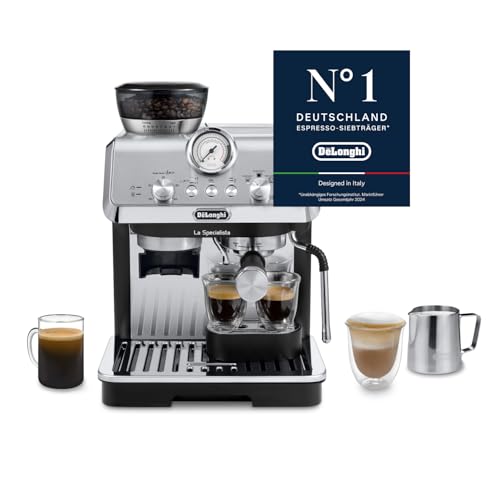
In the product photo, the bean hopper sits at the top left, with a ring with a scale at its base. Below it is a recess, judging by its position the grinder outlet A13, against which you press the portafilter to grind. The centre of the front panel is taken by a pressure gauge (B1 in the manual), below which sit two dials with a row of round buttons between them. The steam wand sticks out on the right, and the drip tray with grid finishes the front at the bottom.
De’Longhi gives the dimensions as 285 × 365 × 399 mm, measured with the bean hopper, but without assigning them to width, depth and height. In the front photo, the machine is clearly taller than it is wide. That ratio fits 399 to 285 mm; 399 to 365 mm does not fit. We therefore read the figure as 28.5 cm wide, 36.5 cm deep and 39.9 cm high. What the Amazon catalogue gives, converted roughly 50 × 10 × 48 cm, are evidently not machine dimensions.
Because the Arte gives off heat to its surroundings, the safety booklet requires at least 3 cm of clearance to side walls and back wall and at least 15 cm of air above. With our reading of the axes, that means: around 55 cm of clear height up to the underside of the wall cupboard, 34.5 cm between two walls and 39.5 cm from the wall to the front edge.
According to the data field, cups up to 120 mm high fit under the outlet. The machine has no cup warmer, and no display either; in the energy data sheet, the standby value with display therefore reads N/A.
On the housing, the sources contradict each other. The data field on the manufacturer’s page names metal and plastic, the Amazon text a stainless steel housing. The other values are unambiguous: the water tank holds 1.7 l, can be taken out and has a water level indicator, and so does the drip tray (A18). It connects to 220 to 240 V at 50 to 60 Hz, and the power is 1,400 W.
In detail: grinding into the portafilter, dosing, brewing
You place the dosing funnel C2 on the portafilter and press it against the grinder outlet until it clicks. The grinder then starts and stops by itself; a second press cancels it. Then you pull the portafilter out, tap it against the funnel, tamp the grounds with the tamper C11 (on the tamping mat C12 for models with a mat), remove the funnel and insert the portafilter at the coffee outlet A10.
How much ground coffee falls is determined by the dial B4. You begin at Min. The manual warns against taking its scale literally: the numbers correspond neither to a grind size nor to grams or grinding time. The measure is the basket. Inside it has a raised line, and once tamped the coffee should reach exactly up to there.
You adjust the grind size on selector A2, and only while the grinder is running. The factory setting is 5, and for most coffees De’Longhi recommends 3 to 6. According to the manual, the very fine settings 1 and 2 are meant for special, lightly roasted coffee or for worn grinding burrs. If the espresso runs too slowly, it is over-extracted, and you set it coarser. If it runs too fast, you set it finer.
Our assessment of the number of settings: fewer clicks over the same adjustment range mean bigger jumps between two settings. The quantity dial compensates only a little, because more ground coffee does give the water more resistance, but the line in the basket fixes the fill height. The order in which to change grind size and dose is shown in our guide Setting the grind size.
Heating is done with a thermoblock. It heats the water only as it flows through a heated metal block; there is no reserve as in a boiler. Because of its design, a thermoblock generally needs less space than a boiler and reaches temperature faster, but a control system must hold the temperature during extraction. Whether a PID controller or a thermostat does this on the Arte, the manufacturer leaves open. It advertises full temperature control: the water temperature stays constant while brewing.
Three brewing temperatures are available, all between 92 and 96 °C. The manual assigns them to roast levels: MIN for dark, MED for medium-dark, MAX for light to medium roasts. It wants robusta at a low temperature and arabica at a high one, and dark or freshly roasted beans are treated like robusta. What is meant is always the water in the thermoblock. At the outlet and in the cup, the temperature differs from that, according to De’Longhi.
The data sheet states 15 bar pump pressure. Espresso is usually brewed at around 9 bar at the coffee puck, and the pressure figure of a portafilter machine generally describes the maximum the pump can manage. During extraction, you have the pressure gauge in front of you.
Every extraction begins with a pre-infusion phase, whose pause you set in the settings menu to none, 1 or 2 seconds. You enter the menu by holding buttons B5 (one or two cups) and B7 (coffee temperature) together for 3 seconds. The extended grinding range, the automatic switch-off and the water hardness are also found there. After 30 seconds without input, the menu closes. If you hold the steam button B9 in it for 3 seconds, everything returns to factory settings.
De’Longhi advises against filling beans in advance; the hopper should hold only as many as you need for the preparation. If you change the variety, you vacuum the hopper empty with a vacuum cleaner or grind everything through, and then reset the quantity as for first use. When full, the hopper holds 180 g.
Three drinks on the selector, milk on the wand
On the function selector B8, you choose espresso, americano or hot water; the fourth position is for descaling. Amazon additionally lists a cup of coffee, while De’Longhi itself speaks of three preparations.
According to the drinks table in the manual, around 35 ml of espresso goes into the cup from the factory, a double around 70 ml. For an americano it is around 120 ml, a double around 240 ml, and for hot water around 250 ml. If you do not like a quantity, you hold the OK button until the cup holds as much as you want. For a single espresso this works from around 15 to 90 ml, for a double from 30 to 180 ml. For an americano you set espresso and water separately, the water for a single to 25 to 150 ml, for a double to 50 to 240 ml. Hot water ranges from around 65 to 300 ml. Only the drink quantity is stored in this way; how much is ground remains a matter for the quantity dial, and you do not programme the steam at all.
De’Longhi calls frothing on the wand advanced manual frothing, and the Amazon text speaks of the My LatteArt system. A milk jug is included.
When frothing, the milk volume doubles to triples, the manual says. For us this means: so that nothing overflows, fill the jug no more than one third. For even foam, De’Longhi recommends fresh whole cow’s milk at fridge temperature, around 5 °C, a jug that has also been in the fridge, and a brief swirl after frothing. With plant-based drinks, the foam turns out differently.
What is in the box and what costs money afterwards
The manual lists the scope of delivery with identification letters: portafilter (C1), dosing funnel (C2), 1-cup basket (C3), 2-cup basket (C4), Total Hardness Test strips (C5), descaler (C6), softballs (C7, only with some models), milk jug (C8), cleaning brush (C9), cleaning pin (C10), tamper (C11) and tamping mat (C12, likewise only with some models). For this ASIN, the Amazon text lists a stainless steel tamper, tamping mat, dosing aid and milk jug. Whether softballs are in the box remains open for this listing; according to Amazon, the mat is included.
According to the data field, both baskets are single-walled. Such a basket builds up resistance solely through the ground coffee, so grind size and quantity have to be right. A double-walled pressurised basket, which cushions mistakes in grind size, is not included.
The data field of the manufacturer’s page allows a water filter; the manual instead describes the softballs: soak them in water overnight, put them in the tank, replace every 3 months. Not in the box is the cleaner the manual specifies for the housing, Eco MultiClean (EAN 8004399333307).
The recurring cost is mainly descaler, with 100 ml going into the tank per cycle. Our price box lists the DeLonghi EcoDecalk at approx. €7.98, and the 500 ml bottle is enough for 5 uses according to De’Longhi. That works out at around €1.60 per use. How many cycles you need per year depends on your water hardness; more on this under care.
What De’Longhi does not state
No document gives the grinder type (conical or flat) or the material of the grinding burrs. The portafilter diameter is missing, which you need if you want to buy a different tamper, a bottomless basket or a dosing ring, as is the material of the portafilter and tamper (stainless steel for the tamper appears only in the Amazon text). There is no reliable weight: the data field of the EC9155.MB shows 13 without a unit, and thus exactly the packaging weight, while the EX:2 pages show 9.76.
On operation, there are also no figures for heat-up time, steam output and the waiting time between espresso and milk foam, noise level, the capacity of the milk jug and drip tray, cable length, an article number for a suitable water filter, gram figures for single and double dose, the temperature of each individual setting, an overpressure valve, a descaling interval in weeks, the country of origin, the year of market launch, and prices and availability of spare parts such as grinding burrs and seals.
Cleaning and descaling according to the manual
Only fresh water belongs in the tank, neither sparkling nor distilled water. According to the safety booklet, you clean the tank itself every 30 days.
After each frothing, you wipe the milk residue off the steam wand with a soft cloth, let steam out for a few seconds and, once it has cooled, keep the hole clear with the cleaning pin C10. For the brew head, the safety booklet asks for a clean, damp cloth after preparation, taking care with the hot parts. With the brush C9, you clean the locking area and the coffee chute on the grinder. According to the manual, water in the drip tray is part of normal operation, and you empty it regularly.
Which parts are cleaned how is set out part by part in the cleaning table of the manual. Only the drip tray with grid may go in the dishwasher, and it also tolerates running water with washing-up liquid. The water tank, portafilter and baskets you wash under running water with washing-up liquid; the dishwasher is ruled out for them. The bean hopper gets only a cloth, the housing Eco MultiClean and a cloth, also no dishwasher.
Before any cleaning of the outer parts, you switch off, pull the mains plug and let the machine cool. The manual says: “Never immerse the coffee machine in water during cleaning: it is an electrical appliance.” The safety booklet rules out solvents, abrasive and alkaline cleaners, alcohol and other flammable liquids and requires a soft cloth, if necessary with a neutral cleaning agent. Against encrustations and coffee deposits, metal objects are off limits, because they could scratch metal or plastic surfaces.
When to descale is determined by water hardness. You measure it with the enclosed hardness strip and set one of 3 levels in the menu: 1 for soft, 2 for normal, 3 for hard or very hard water. The indicator light B3 comes on after a preset operating time that depends on this level.
To descale, you turn B8 to descaling, take out the portafilter, fill descaler up to mark A and water up to B (1 litre) into the tank, and place a container with a capacity of 2 litres under the coffee outlet, hot water outlet and steam wand. You hold OK for at least 3 seconds. The cycle takes around 40 minutes, after which you fill the tank to MAX and start the rinse cycle. Only descaler from De’Longhi is permitted for this: unsuitable descalers or irregular descaling can, according to the manual, cause damage that is not covered by the manufacturer’s warranty. You wipe up spilled descaler immediately.
The Arte or one of the other three?
| Model | The difference | Price | Our rating | Choose this if |
|---|---|---|---|---|
| DeLonghi La Specialista Arte EC9155 (this machine) | 8-setting grinder in the housing, dose via dial and line in the basket | approx. €369 | 8.6 | you want to learn grinding and tamping yourself and do not want a second machine on the worktop |
| Sage Barista Express Impress | Tamping lever with 10 kg tamping pressure according to Sage | approx. €379 | 8.9 | you do not want to practise dose and tamping pressure by hand |
| DeLonghi La Specialista Touch EC9455 | Auto LatteArt wand also froths automatically | approx. €549.97 | 8.8 | you drink almost only milk drinks and do not want to learn frothing |
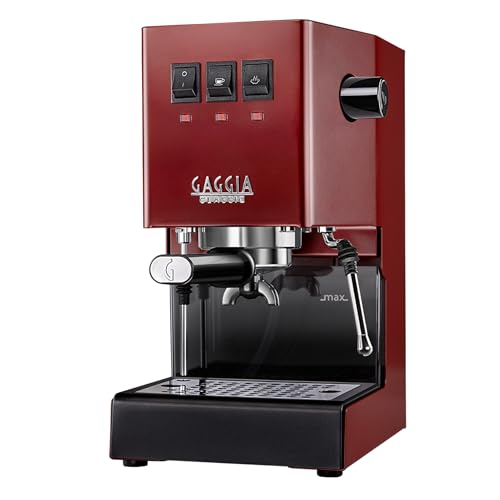
| Gaggia Classic Evo Pro | no grinder, 58 mm portafilter | approx. €499.52 | 9.4 | you already have an espresso grinder or want to choose one separately |
The prices are the guide values of our price boxes, and the rating is our editorial grading and not a measured value. The technical details on the three other machines come from their manufacturers.
When the Arte, when another machine
Milk decides fastest. If you make two cappuccinos in the morning and do not want to froth yourself, the Touch is the right one: the La Specialista Touch also froths by itself with its Auto LatteArt wand, has 15 grind settings and a colour touch display according to De’Longhi, and costs around €181 more in our catalogue.
It gets close with the Sage Barista Express Impress, which costs only €10 more in our catalogue. According to Sage, it has 25 grind steps, a 54 mm portafilter, PID temperature control and a tamping lever. We would take the Impress if few steps in the morning matter and finer grind steps are important. The Arte suits someone who wants to keep quantity and tamping in their own hands.
If a good espresso grinder is already in the kitchen, with the Arte you pay for a second grinder as well. In that case, we would reach for the Gaggia Classic Evo Pro, which costs around €131 more for us and has no grinder. Without an existing grinder, its price comes on top, and the sums tip in favour of the Arte.
Before ordering, a folding rule under the wall cupboard is worthwhile. With the clearance from the safety booklet, the Arte, by our reading of the dimensions, needs a good half a metre between worktop and cupboard base (the exact calculation is above under housing and dimensions). If the cupboard hangs lower, it belongs at another spot on the worktop.
Light roasts are not ruled out by the Arte; the fine settings and the MAX temperature are there for that. But if you constantly switch between light and dark beans, you empty the hopper at every change and have few intermediate values to choose from. For that case, we would prefer a separate grinder with finer graduation, or the EX:2 straight away. If none of the machines in the table fits, the coffee machine finder narrows down the choice according to your answers.
Outside the household, the Arte is the wrong purchase. The safety booklet that De’Longhi issues for all its coffee machines intends the machine exclusively for domestic use. Not intended is use in rooms set up as staff kitchens for shops, offices and other work environments, in agricultural tourist establishments, hotels, guest rooms, motels and other accommodation. The office tea kitchen and breakfast at a guesthouse are therefore excluded.