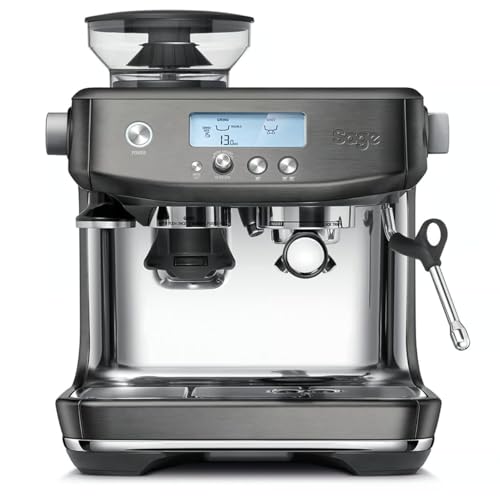
Sage lists the Barista Pro under model number BES878, and the EU manual also carries SES878. It is a portafilter machine with a built-in conical burr grinder: the beans go into the hopper at the top, the grounds fall straight into the portafilter below, and you operate it with buttons, dials and an LCD display. The ASIN behind our price box belongs to the Black Stainless Steel colour variant, part number SES878BST. The Amazon catalogue lists BRG Appliances as the manufacturer, and the same name appears in the copyright line of the 2026 manual.
On price, the figures are far apart. Our price box shows approx. €474, and the Amazon catalogue showed exactly €439.00 on 7 September 2026. Sage itself asks €729.90 in its German shop, for the black variant as for three further colours, one of which was sold out (as of 25 September 2026). A special series with the abbreviation ART costs €1,249.90 there.
How quickly is the first espresso ready?
Besides the 3 seconds Sage quotes for the heating system, most of the time until the cup is filled goes on other steps: 13 seconds of grinding for the dual wall basket at factory settings, then levelling and tamping, then 8 to 12 seconds until the espresso starts to flow.
How to work your way towards the right setting is covered in our guide to grind size. The manual sets the direction: when it flows, the espresso should have the consistency of dripping honey. By the usual espresso logic, a clearly earlier flow points to grounds that are too coarse, a later one to grounds that are too fine or tamped too firmly.
The obvious comparison is the Barista Express, which also combines grinder and 54 mm portafilter in one housing, and that is exactly where the data gets thin: for the Express heating system, which Sage calls Thermocoil, no Sage source gives a heat-up time. Whether the Pro leads on heating up therefore remains a question without a manufacturer figure. The gap can be put in numbers for the grinder, with 30 grind settings on the Pro and 16 on the Express.
Before the very first shot, the manual requires a complete operating cycle in which the machine is flushed and the heating system made ready for use. In everyday use another number matters afterwards: after 30 minutes without use, the Barista Pro switches itself off. If you drink one espresso in the morning and one in the afternoon, you therefore switch on twice. In our assessment, the short heat-up time helps most in exactly this pattern of spread-out single shots. If you make four cups in a row in the morning, you gain little from it.
ThermoJet, PID and two pressure figures
Temperature is controlled electronically by PID. A controller of this kind measures continuously and adjusts the heating output, instead of just switching on and off like a thermostat. Sage justifies the choice with more consistent temperature stability.
You can change the brew temperature in the menu under SHOT TEMP, using the GRIND AMOUNT dial. The display shows a bar between HOTTER and COOLER. No figure in degrees appears there or anywhere in the manual. For very light roasts the setting is still a lever, in our assessment, but you shift relatively without knowing the starting value.
On power, Sage makes a comparative claim: the ThermoJet uses up to 32% less energy than a thermoblock heating system. As its basis, the disclaimer on the product page cites internal benchmarks from November 2022, so this is a manufacturer figure from its own measurement.
The same page carries two pressure values that are easily confused. Sage advertises an Italian 15 bar pump and describes the actual extraction as taking place at 9 bar, preceded by pre-infusion at low pressure. The larger number describes what the pump is designed for. The smaller one is what the machine works at while the water runs through the coffee, according to Sage, and that is why it is the better yardstick for comparing two machines.
Pre-infusion first moistens the coffee at low water pressure so that it swells before full pressure arrives. It runs automatically, but you can extend it: hold the 1 CUP or 2 CUP button for as long as the pre-infusion should last. Extraction begins when you let go.
From the bean hopper to the tamper
At the top sits a bean hopper for 250 g, held by a locking system so that you can take it off to empty and fill it. Below it works a 40 mm conical burr grinder of hardened stainless steel, which Sage describes as a European Baratza precision grinder. It has 30 grind settings, set to 15 at the factory, and the chosen value appears on the display. You adjust it with the GRIND SIZE dial on the left. The adjustable upper burr widens the range further, and the manual advises doing this only in small steps.
According to the manual, the grinder may only run with the hopper lid on, and fingers, hands, hair, clothing and utensils must be kept away from the chute during operation.
Dosing is by time. For the single basket, 9.5 seconds are set at the factory, for the dual basket the time from the first section, and you change both with the GRIND AMOUNT dial. The machine grinds hands-free and stops by itself. If you prefer to dose by hand, you hold the inserted portafilter pressed in, and the grinder runs as long as you press.
The portafilter is stainless steel and measures 54 mm. Four baskets are included, one each for one cup and for two cups, in both single wall and dual wall versions. At the factory the single wall basket for two cups sits in the portafilter. The fill quantities from the manual: approx. 8 to 11 g in the 1 CUP basket, approx. 16 to 19 g in the 2 CUP basket.
The tamper is integrated into the machine, removable, magnetic according to the product page, and also 54 mm. Tamping should be done with approx. 10 to 15 kg. Afterwards you use the Razor tool to trim off excess grounds. The dosing funnel is placed on the portafilter for grinding so that no grounds fall beside it. With the funnel on, however, the portafilter does not belong in the machine: “Do NOT lock the portafilter with the dosing funnel into the group head.”
The presets are approx. 30 ml for a single and approx. 60 ml for a double espresso, and both quantities can be programmed. After brewing, the puck dryer draws excess water out of the basket so that the used coffee is easier to dispose of.
Steam wand, hot water and the order at the group head
You steam milk with a steam wand that swivels through 360 degrees. It is operated with a dial that also releases the hot water. The Barista Pro has no lever for this.
The manual lays down an order that is easy to overlook: “When preparing milk-based coffee, remove the portafilter from the group head before steaming the milk.” You should steam only in the supplied stainless steel milk jug, given as 480 ml on the product page. Other containers can pose a risk, according to Sage. How to guide the jug at the wand is explained in our guide to frothing milk. According to the manual, the milk has reached its temperature of 60 to 65 °C when the jug feels hot to the touch. According to the manual, a pump noise can be heard while the machine produces steam, and it is part of normal operation.
After every steaming, the wand is wiped immediately with a damp cloth and cleared with a few bursts of steam over the drip tray. If the opening is blocked anyway, you free it with the supplied cleaning pin. If that does not help, you unscrew the tip using the same pin, soak it in hot water and then pierce the blockage once more. For every cappuccino this means: portafilter out, steam, clean the wand, portafilter back in. Two milk drinks in a row are possible, but not in passing.
Hot water comes from a separate outlet. The flow stops after 60 seconds, but the dial has to be returned to the standby position by hand. This too appears as a caution in the manual: hot steam can still escape after switching off, so children must always be supervised.
Three alternatives from our catalogue
| Model | The difference | Price | Our rating | Choose this if |
|---|---|---|---|---|
| Sage Barista Pro (this one) | ThermoJet instead of Thermocoil, 30 grind settings | approx. €474 | 8.9 | you change roasts often and want finer grind settings for it |
| Sage Barista Express | Thermocoil, 16 grind settings | approx. €489 | 9.0 | you stick to one type of bean and are happy with 16 grind settings |
| Sage Barista Touch | Touchscreen and, according to Sage, fully hands-free milk steaming | approx. €972 | 8.7 | you make several milk drinks a day and do not want to learn steaming |
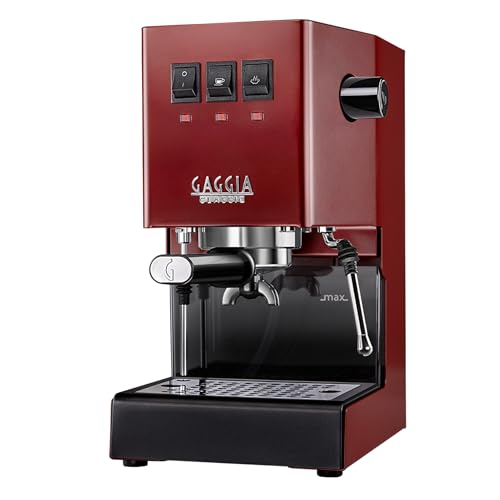
| Gaggia Classic Evo Pro | 58 mm portafilter, but no grinder and no PID | approx. €500 | 9.4 | you already own an espresso grinder and want to stay with the 58 mm format |
The prices are the guide values from the price boxes in our data sheets and are not up to the minute, and the rating is our editorial assessment based on manufacturer and catalogue data. The table says nothing about promotional prices or which colour is currently available.
When the Pro, when one of the others?
On budget, the situation is unusual. In our catalogue the Express is about €15 above the Pro. In our rating the Express, at 9.0, is narrowly ahead of the Pro at 8.9. Even with this gap we would take the Pro if you really use the 30 grind settings.
With milk the sums change. According to the price box, the Touch costs around €498 more than the Pro, and for that it steams the milk itself. If you need two cappuccinos in quick succession in the morning and do not want to adjust anything, you are better off there. If you want to learn the steam wand, you save the premium.
If a good espresso grinder already sits on the worktop, with the Pro you pay for a grinder you do not need. The Gaggia Classic Evo Pro is about €26 above the Barista Pro, has no grinder and works with 58 mm. That very size is the point for anyone upgrading: the Pro is fixed at 54 mm, and Sage draws a clear line on third-party accessories. The manual says you should use no accessories other than the supplied ones, and warns that accessories Sage neither sells nor recommends could cause fires, electric shocks or injuries. By that wording, bottomless portafilters and precision baskets from other suppliers are also included. Gaggia likewise prohibits accessories from other manufacturers in its safety booklet, but itself sells a bottomless portafilter and an IMS basket for the Classic. An explicit approval of these parts for the E24 generation, to which the Classic Evo Pro belongs, was not found on Gaggia’s accessories page.
For the footprint, the German product page gives 35.4 x 41 x 40.6 cm (width x depth x height), the British one 40.8 x 35 x 33.2 cm. The two official figures do not match. We would plan with the larger values and leave extra room above to take off the hopper lid. The water tank sits at the back, so you need access from behind or room to pull the machine forward, because according to the manual it must not be moved while it is in operation. The top is not suitable as a shelf for tins and jugs: apart from cups for warming, no objects are meant to stand there.
The manual is precise about setting up. The surface must be stable, heat and water resistant, level and dry, not at the edge of the worktop and not on or near a heat source such as a hob, oven or gas cooker. Three bans come on top: not on the drainer of a sink, not on wood or porous surfaces, and no operation in an enclosed space or cupboard. By the wording, a wooden worktop is therefore ruled out, and so is the appliance garage in a tall cabinet.
The manual is equally clear on water: “Do not use any liquid other than cold tap water.” Heavily filtered, demineralised or distilled water is not recommended, because according to Sage it can affect the taste of the coffee and the functioning of the espresso machine. According to the manual the tank holds 2 l, the product page says 1.9 l. The water in it should be changed daily, and the machine must not run with an empty tank.
FLUSH, DESCALE and the filter in the tank
The Barista Pro tells you on the display when it needs maintenance. The manual gives no fixed intervals for this, neither in weeks nor by water hardness. Maintenance runs through two separate alerts, and Sage stresses that the cleaning cycle and descaling are two different things.
At the FLUSH alert, the machine is back-flushed. The cleaning disc goes into the filter basket, with the cleaning powder on top, and then you lock the portafilter in firmly. Empty the drip tray, fill the tank to MAX, choose FLUSH in the menu with the GRIND AMOUNT dial and start with 1 CUP. The remaining time appears on the display, and the machine beeps at the end. If there is still powder on the disc, the programme runs a second time.
At the DESCALE alert, the machine is descaled. The water filter must come out of the tank first. Then you fill to the DESCALE line, add the descaler to the water and start the programme from the menu. It cleans in three phases, coffee, hot water and steam, and for the last two you turn the steam dial by hand as soon as the display asks for it. A rinse cycle follows, also in three phases, with fresh water up to MAX. Sage warns that hot steam can escape during descaling, and the drip tray must be empty and in place.
You should not put descaling off. The safety instructions state that limescale deposits or a blocked steam wand can cause the portafilter to turn or loosen. If that happens, hold the handle firmly and stop operation immediately, otherwise it can come loose under pressure.
You change the water filter after 3 months according to the manual, which makes four filters a year. Before inserting, it soaks for 5 minutes in cold water, and the holder is rinsed cold. You order replacements through the Sage website or customer service.
The grinder is freed from oil residues: empty the hopper, run the grinder empty, remove the hopper and upper burr, and brush out both burrs and the chute. The manual warns that the grinder is extremely sharp. Only if something has lodged between the grinder and the outlet is the extended cleaning added, for which you need a 10 mm socket to loosen the nut and a pair of needle-nose pliers.
You rinse baskets and portafilter under hot water straight after brewing. Blocked holes are opened with the cleaning pin, and stubborn cases soak for approx. 20 minutes in hot water with dissolved cleaning powder. You wipe out the group head and shower screen with a damp cloth and rinse them regularly with an empty basket by holding 1 CUP pressed.
For all parts the rule is hand washing in warm water with mild washing-up liquid, without abrasives, scouring pads or scratchy cloths. The manual states: “Do not clean any of the parts or accessories in the dishwasher.” The housing gets a soft, damp cloth and is buffed dry afterwards. Never immerse the mains cable, plug or the appliance itself in water or other liquids. More on the order of the care steps is in the guide to descaling and cleaning.
What Sage does not state, and where the sources contradict each other
The sources we checked were the German and British product pages, the 2026 edition of the EU manual, the spare parts page and the Amazon catalogue. The following details are missing throughout in the manufacturer sources: weight of the machine, steam temperature and time until steam is ready (the 3 seconds apply to the extraction temperature), noise level in decibels, the duration of the back-flush and descaling programmes, volume of the drip tray, pump type, material of the group head, heating element and portafilter handle, cable length, standby consumption and time until power-saving mode, the adjustment range of the upper burr as a number, the year of market launch, country of manufacture, prices of individual spare parts and consumables, and the length of spare parts availability. The spare parts page for the BES878 exists, but only loads its parts after you select the machine.
On power, the sources contradict each other: the manual gives 1380 to 1650 W at 220 to 240 V, the German product page 1650 W, the British one 1680 W. The Amazon catalogue lists around 44 x 41 x 40 cm and a weight of approx. 12.5 kg. These dimensions match no manufacturer figure and look like the shipping carton. Whether the 12.5 kg belongs to the machine or the carton is therefore open.
Who is it suited to?
For people who want to set up espresso themselves and are looking for grinder and machine in one housing, the Barista Pro is a good fit in our assessment. The other machines in this class sit side by side in our espresso machine comparison.
If there are children in the household, the rules of the safety instructions apply. Children from 8 years and persons with reduced physical, sensory or mental capabilities or without experience and knowledge may use the appliance only under supervision or if they have been instructed in its safe use and understand the hazards involved. Children may clean it only from 8 years and under adult supervision. The appliance and its mains cable belong out of the reach of children under 8 years.
It is wrong for anyone who wants to operate it outside the home or in the open air. The manual says: “This appliance is intended for household use only.” And further: “Do not use the appliance in moving vehicles or boats. Do not use the appliance outdoors.” A boat, a terrace and a motorhome on the move are therefore ruled out.
If you want coffee at the push of a button, without hitting the grind size, tamping pressure and brew time yourself, you are better off with a bean-to-cup machine. The coffee machine finder sorts by preparation and budget.