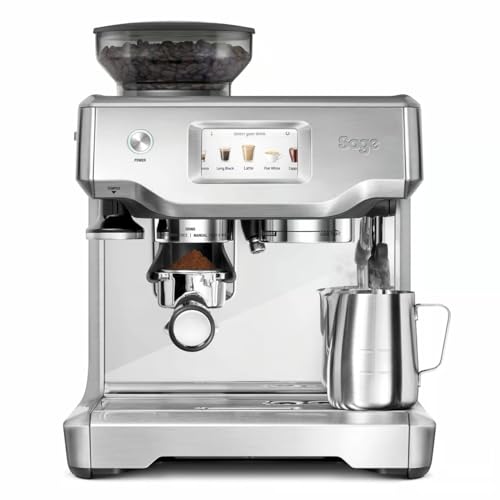
The Barista Touch is a portafilter espresso machine with a built-in conical burr grinder, in which a touchscreen replaces the buttons found on the Barista Pro. The manual lists it as BES880 or SES880. Behind our Amazon link is the variant SES880BSS4EEU1 in brushed stainless steel grey, part number 41008470, listed in the Amazon catalogue since 23.05.2018. Our price box stands at approx. €971.54 on Amazon.de (as of September 2026).
In the Sage shop, the same colour cost €1,049.90 on 25.09.2026 and was sold out. Of five colour variants, only Truffle Black was available that day (also €1,049.90). The product page carries the notice © Breville Pty Limited, and the Amazon catalogue names BRG Appliances as the manufacturer.
Grinder on top, group head in the middle, steam on the right
On top of the brushed stainless steel housing sits the 250 g bean hopper. Beneath it, a conical burr grinder grinds, which Sage describes as a European Baratza precision grinder made of hardened stainless steel. According to the manual, the burrs have a diameter of 40 mm, and the product page gives 30 grind steps.
The grounds fall straight into the portafilter. You place it in the grinder outlet, and then you have two options: either you tap Grind or press the portafilter in briefly, after which the automatic dose control ends grinding by itself. Or you hold the portafilter pressed in until the amount is enough for you.
The portafilter is made of stainless steel and measures 54 mm. Sage has attached the tamper magnetically to the machine; you take it off and press down yourself.
To the right of the group head (as the product photo shows) sits the frothing nozzle with a milk temperature sensor (part P in the manual), plus a separate hot water outlet (part M). The hot water outlet is limited to about 90 seconds and never runs at the same time as an espresso. The water tank holds 2 litres, is removable and, according to Sage, BPA-free; the manual extends that to all parts that come into contact with coffee, water or milk. At the bottom, the drip tray separates wet from dry coffee, and behind it there is a storage tray for accessories.
The manual counts 13 items in the box: a stainless steel milk jug, a cleaning disc, cleaning powder, dual wall and single wall baskets, each in the size for one cup and for two cups, a water filter holder with filter (a ClaroSwiss according to the product page), a cleaning brush, a Razor precision blade, a cleaning tool for the frothing nozzle, water hardness strips, descaling powder, the 54 mm Dosing Funnel and a drip tray cover, which only the coloured machines get. From the factory, the single wall basket for two cups is in the portafilter.
In detail: ThermoJet, PID and why bar appears twice
Sage calls the heating system ThermoJet and attaches two figures to it: 3 seconds to extraction temperature and up to 32 percent less energy than a thermoblock heating system. Sage bases the second figure on its own internal measurements from November 2022.
What the 3 seconds mean in practice: a machine with a large boiler first has to heat a whole volume of water before the first shot, which takes minutes. According to Sage, you hardly wait at all before the espresso here. How long it takes to reach steam readiness, however, is not stated in any Sage source, and for milk-based drinks that is the waiting time that counts.
A PID controller regulates the temperature. Such a controller continuously measures the actual value and continuously adjusts the heating power, instead of simply switching on and off like a basic thermostat. You can raise the brew temperature in the Settings menu; the manual mentions this as a remedy in its troubleshooting table.
On pressure, the product page gives two values. The Italian pump is stated as 15 bar, the extraction itself as 9 bar. Before that comes a pre-infusion at low pressure. The idea behind it: the coffee grounds are first moistened and swell before the full pressure arrives, so that the water does not find individual channels through the puck. The 15 bar is therefore the figure for the pump, while according to Sage the extraction runs at 9 bar. For comparing two machines, the extraction pressure is the better measure, and around 9 bar is the usual benchmark for espresso.
Does the touchscreen set everything, or do you have to do it yourself?
Not everything. You choose the drink, brew time, milk temperature and froth on the display, plus the grind amount, which the data sheet lists as an adjustable grind control. You turn the grind size on the GRIND SIZE dial (part D), and the screen only shows the selected step. Tamping remains manual work.
Sage speaks of a preprogrammed coffee menu with 5 Café Favourites. When you swipe, the on-screen graphic in the manual shows Americano, Café Crema, Latte, Flat White and Cappuccino, and the text additionally mentions the Long Black. Three sizes are stored for it, 180, 240 and 360 ml, with the hot water running into the cup first and then the espresso. For the Café Crema they are 120, 150 and 180 ml, and the display asks for the one-cup basket and a coarse grind setting.
Sage answers twice, differently, how many of your own drinks you can store. The data sheet on the German and the British site gives 6 individual coffee settings that you can select, save and name. The running text of the same German page and the Amazon listing speak of up to 8. The manual leaves open whether a saved drink also stores the grind step; because the grind size sits on a dial and not on the screen, we would not assume so.
You start the espresso with the Brew button and switch there between Single, Double and Custom. The brew time is preset and can be changed. If you hold Brew for about 2 seconds, the shot runs manually until you stop it.
For the actual setting up, the manual gives guide values. 8 to 11 g belong in the one-cup basket and 16 to 19 g in the two-cup basket; on the product page, Sage gives 18 g as the ideal dose. You tamp firmly with 10 to 15 kg, then level off with the Razor. According to Sage, the espresso is correctly extracted if the flow starts after 8 to 12 seconds. By the usual rule of thumb, an earlier flow points to grounds that are too coarse and a later one to grounds that are too fine, and you then correct on the dial. Our brew calculator works out which amount of grounds suits which amount of espresso.
Our assessment: the display saves you menu work and milk work. To keep to the gram figures, however, you need kitchen scales, and these are not among the 13 items in the box.
Auto MilQ: what the automatic system takes over
You tap Milk, the display shows the temperature while it warms up, and frothing ends by itself as soon as the set value is reached. You can set 40 to 75 °C, and the texture has 8 levels. Sage promises at least one million micro-bubbles per ml. If you lower the jug after frothing, the machine automatically flushes through the nozzle.
You can froth by hand too. In that case, according to the manual, automatic frothing and the auto-off are deactivated. In addition, according to the manual, the machine deactivates the steam function after 90 seconds of continuous steam output.
You should know two requirements of the manual word for word. The first: “Only use the supplied stainless steel milk jug for frothing milk. Frothing milk in glass or plastic containers can lead to dangerous conditions.” The milk must cover the ring on the jug, which carries a MIN/MAX marking. The British product page gives the jug as 480 ml, while the German one says “480mm” in the same place. The second requirement: “CAUTION: When making milk-based coffee, remove the portafilter from the group head before frothing the milk.” For a cappuccino, that means: espresso first, then portafilter out, then the milk.
What else is worth considering?
| Model | The difference | Price | Our rating | Choose this if |
|---|---|---|---|---|
| Sage Barista Touch (this one) | Touchscreen and Auto MilQ, the milk stops at the set temperature | approx. €971.54 | 8.7 | you mainly make milk-based drinks and do not want to learn frothing |
| Sage Barista Pro | same ThermoJet base and 30 grind settings, but buttons, LCD and steam via a dial | approx. €474.01 | 8.9 | you want to froth yourself or almost only drink espresso |
| De’Longhi La Specialista Touch EC9455 | also a touchscreen and automatic milk, but 15 grind settings | approx. €549.97 | 8.8 | you want a display and automatic milk and your budget is tighter |
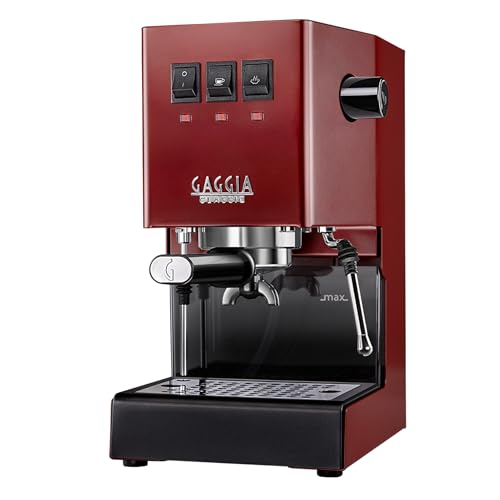
| Gaggia Classic Evo Pro | 58 mm portafilter and brass boiler, no grinder | approx. €499.52 | 9.4 | you already have an espresso grinder or want to buy one separately |
The prices are the guide values from our price boxes in September 2026 and change constantly. The rating is our editorial assessment from the data comparison; the table cannot say how good the espresso from any of these machines turns out.
When the Barista Touch, when one of the others?
The most important question is about milk. If almost every cup in your household is a cappuccino or flat white, Auto MilQ is the reason to buy this machine. If you mostly drink espresso, on the other hand, you pay around €498 more for the Barista Touch than for the Barista Pro in the table, mainly for the touchscreen and an automatic system you would hardly use. The Pro froths by hand only.
The De’Longhi La Specialista Touch is around €422 below the Barista Touch and also has a display and a steam wand with automatic function. In return, according to De’Longhi its grinder has 15 settings instead of 30, and for milk temperature the De’Longhi product page names 4 settings, where Sage gives a temperature range. For espresso we would prefer the 30 steps, although more steps only mean finer increments if the adjustment range is comparable. However, if you froth a lot of oat or soy milk, the De’Longhi has a milk selection in the menu that explicitly provides for plant-based drinks; Sage names such settings only for the Barista Touch Impress and the Oracle, and for the Barista Touch the manufacturer mentions none.
On a budget, a calculation including a grinder is worthwhile. The Gaggia Classic Evo Pro has no grinder. Together with the Sage Smart Grinder Pro (approx. €199, with a holder for 58 mm portafilters according to Sage) you reach approx. €698.52 and so stay below the Barista Touch. With the Gaggia, however, frothing is done entirely by hand.
On counter space, Sage helps little, because the dimensions contradict each other. The German site gives 32 x 32 x 41 cm (width, depth, height), the British one 40 x 31.9 x 31.4 cm (also width, depth, height there), and the Amazon catalogue 44.6 x 40.5 x 41 cm at 10.3 kg, without saying whether that is the packaging. We would plan with the largest values. The bean hopper sits on top of the housing, so under a wall cabinet you need clearance above the 41 cm to take off the lid and refill.
And the water: water hardness strips are included, and the manual is clear about hard water. “For water hardness readings of 4 or 5, the use of an alternative water source is strongly recommended.” The 4 and 5 refer to the scale of the included strips. If your tap water is that hard, factor bottled or filtered water into the running costs; how to classify your hardness is explained in our guide to water hardness. Above it there is also the Barista Touch Impress, whose differences are in the FAQ below. You will find all other models in the espresso machine comparison.
Care and running costs according to the manual
The manual states the basic principle as a notice, and it applies to every part: “All parts should be cleaned by hand with warm water and a mild detergent. Do not use abrasive cleaners, sponges or cloths. Do not wash any of the parts or accessories in the dishwasher.” The product page, by contrast, calls the Dosing Funnel dishwasher safe. We follow the manual.
After every use, you rinse the filter baskets and portafilter straight away under hot water to remove coffee oil. You wipe the frothing nozzle with a damp cloth after every frothing. You also wipe the inside of the group head and shower screen with a damp cloth to remove leftover grounds, and in between you let water run through briefly via Brew with an empty basket. Blocked holes in the nozzle tip can impair frothing performance; for this there is the item Steam wand cleaning under Settings, with instructions on the display. You clear blocked basket holes with the pin on the cleaning tool. If that does not help, you soak the basket and portafilter for approx. 20 minutes in hot water with dissolved cleaning powder and then rinse thoroughly.
The machine itself requests the cleaning cycle when it is due. It is a rinse cycle, separate from descaling, and you follow the instructions on the touchscreen.
You should descale when limescale builds up in the water tank, and even if you use the filter. You start it via Settings and Descale cycle. For descaling itself, the following applies: “Do not immerse the power cord, plug or appliance in water or other liquids. Do not remove the water tank during descaling or let it run completely empty.”
You replace the water filter after three months or 40 litres. The 40 litres is based on water hardness 4; at hardness 2 it lasts up to 60 litres. Before first insertion, it soaks for 5 minutes in cold water, then you rinse it under cold water and set the replacement reminder.
For the grinder, a separate cleaning run removes coffee oil residues from the burrs. The picture sequence in the manual shows how to empty the hopper, run the grinder empty, release the upper burr and clean both burrs and the chute with the brush. Handle the burrs carefully, as the manual warns that they are extremely sharp.
One passage is contradictory. The safety notices say: “All servicing other than cleaning must be carried out by an authorised Sage service centre.” Yet the same manual describes replacing the silicone seal on the shower screen in eight do-it-yourself steps, with a flat-head screwdriver, ribbed side of the new seal facing down. Replacement seals are available via Sage customer service or the website. You clean the outer housing and cup warming plate with a soft, damp cloth and polish them with a dry one, and you keep the touchscreen clean and dry so that it works properly.
On an ongoing basis you buy beans and water filters; the silicone seal only after a longer time. Sage sets freshness tightly: use beans within 5 to 20 days of roasting. After purchase and registration, according to the Amazon listing Sage includes 2 bags of beans, and the Sage site also mentions a 20 percent discount on further beans, under the terms and conditions there.
What Sage does not state, and where the sources differ
We evaluated the German and the British product page, the EU manual and the Amazon listing, retrieved on 07.09.2026 and 25.09.2026. None of these sources states:
- the weight of the machine without packaging
- the size of the touchscreen in inches
- the brew temperature in degrees and the number of temperature levels
- a fixed descaling interval in weeks or litres
- the noise level in decibels
- the maximum cup height under the spout (Sage only writes of room for tall mugs)
- the cable length
- standby consumption and the time until power-saving mode
- the country of manufacture; only the Italian pump and the European grinder are named
- the capacity of the drip tray
- the material of the drip tray, bean hopper and water tank beyond “BPA-free”
- how many milk-based drinks can be made in a row
- settings for oat, soy or almond milk on the BES880
- a readable spare parts list with prices, because the spare parts page only loads its parts in the browser
- prices for the water filter, seal, cleaning and descaling powder
In addition, there is a contradiction on power: the product page gives the power as 1680 W, the manual as 1380 to 1650 W at 220 to 240 V and 50 to 60 Hz.
Where, according to the manual, it does not belong
It is the wrong choice for office kitchens, and it does not belong on the move either. “This appliance is for household use only. Only use the appliance for its intended purpose. Do not use in moving vehicles or boats. Do not use outdoors. Misuse can cause injury.” That is what the safety notices say.
Sage also sets requirements for the place in the kitchen, spread over two notices. The first: “Place the appliance on a stable, heat-resistant and water-resistant, level, dry surface, not at the edge of the worktop, and do not use it on or near a heat source such as a hob, an oven or a gas cooker.” The second: “Do not use the appliance on a sink drainer or on wooden or porous surfaces.” If you have a solid wood worktop or were planning to put the machine next to the cooker, you should know this before buying.
If there are children in the household, this notice is worth a look: “CAUTION: RISK OF BURNS. Steam can still be released under pressure even after the machine has been switched off. Always supervise children.”