The Classic UP is Gaggia’s single-boiler machine with a 58 mm portafilter and two PID controllers. In our price box it stands at €950.89 on Amazon.de, as of July 2026. A cross-check against the Amazon catalogue was not possible in September: the price field of the listing was empty when it was retrieved on 7 September.
Gaggia presented the machine on its own blog on 27 February 2026. The German manual in revision 03 is dated 28.01.2026 and lists the appliance as EG2500 (SIN 047), and on Amazon the black version runs under the model number EG2500/10.
We have not had the Classic UP in our hands and have not drunk an espresso from it. What is written here comes from Gaggia’s German and English product pages, two blog posts by the manufacturer, the manual, the safety and warranty booklets and the Amazon catalogue. Its cheaper sister, the Classic Evo Pro, has its own page (see our review).
What Gaggia has added to the Classic
Gaggia positions the UP between the Classic and the new Classic GT. According to the timeline on the manufacturer’s site, the Classic itself came onto the market in 1991. In Gaggia’s words, the UP is intended for people who have already mastered the basics and want to work on technology and precision.
According to the launch post, the UP integrates a series of features that many users have tried to retrofit through their own modifications over the years. The equipment list names two PID controllers, a colour display with shot timer, an analogue pressure gauge for the brew pressure and a 3-level pre-infusion. According to the manual, a wake-up timer and a storable shot time are added.
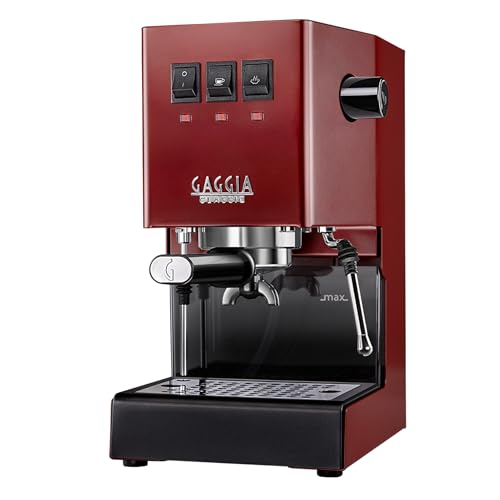
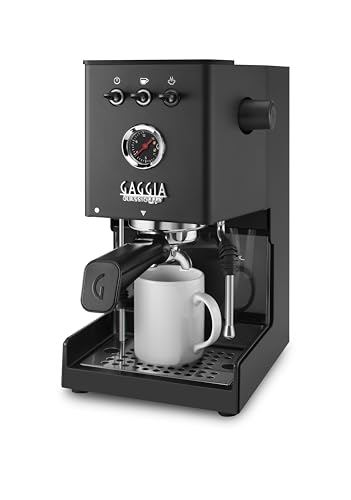
According to Gaggia, the machine is developed and built in Italy, at the Gaggio Montano plant near Bologna. It comes in stainless steel and in black stainless steel. The black version, which Amazon lists under this page’s ASIN, has a black-lacquered stainless steel housing with red details. According to a second blog post dated 29 May 2026, the light variant differs only in the housing.
Our assessment: the UP changes nothing about the basic principle of the Classic. It remains one boiler for coffee and steam, and what is new is the electronics around it.
Boiler, group, switches: the construction
The boiler holds 0.12 litres and is made of lead-free brass, and Gaggia calls the heating principle Quick Heat Up. The brew group is made of the same material. The 58 mm portafilter is stainless steel, and a solenoid valve is fitted according to the equipment list.
The UP is operated on two levels. At the top of the front there are three backlit toggle switches for on and off, coffee brewing and steam, with the pressure gauge directly beneath them in the product photo. Settings are made through a TFT colour display with four capacitive buttons: SETTINGS/BACK, one navigation button each for minus and plus, and OK. On the screen diagonal, Gaggia contradicts itself. The product page says 2 inches, the February blog post 2.4 inches.
The stainless steel steam wand has a nozzle with one hole and can be swivelled widely. Its tip, called Ogive by Gaggia, can be removed. You pull the water tank and drip tray out towards the front, and the tank holds 2.1 litres. On top there is a stainless steel cup tray, which the manual lists as a cup warmer. According to the equipment list, brewing two cups at the same time is also possible.
The dimensions also come in two official versions. The German product page gives 21.1 x 35.8 x 27.8 cm, the English one 20 x 36 x 27 cm, both in the order length, height, depth. Gaggia gives the weight as 8.1 kg. The Amazon catalogue works out at roughly 27 x 32 x 45 cm and 10.0 kg. We think these are the dimensions of the box, because both values are clearly above the manufacturer’s.
In detail: two PID controllers, a fixed pressure, three pre-infusion levels
A simple thermostat only knows on and off: it switches the heating on below a threshold and off above it, and the temperature swings back and forth in between. A PID controller measures continuously and doses the heating power according to the distance and trend relative to the target value. As a result, the temperature generally stays closer together. The UP has two such controllers, one for the brewing process, whose target value you set, and one for steam.
The manual describes exactly what the display shows: the temperature at the outlet of the brew group, rising until the set value is reached. You choose °C or °F as the unit.
On pressure, Gaggia distinguishes cleanly between 15 bar nominal, meaning what the pump can deliver, and 9 bar when brewing. The 9 bar is held by an overpressure valve (OPV) that is set at a fixed value. The analogue pressure gauge shows you what is applied during the shot. If you want to work with pressure profiles, the UP therefore gives you a display, but no way to change the pressure.
The pre-infusion runs automatically. In the menu you set it to MIN, MED or MAX or switch it off, and on the German product page the levels are called low, medium and high. There is no freely programmable duration for it. As a rule of thumb, Gaggia’s FAQ says lighter roasts usually need a longer pre-infusion and darker ones a shorter one. If you press the brew lever during the pre-infusion phase, it is cancelled and the actual shot begins.
What is programmable on the UP is something else, namely the shot time. For the PRESET function you hold the brew lever for a few seconds and press it again once the desired time is reached. The machine then stops the shot by itself, and a time is already stored from the factory. The manual stresses that PRESET stores the time and not the quantity. If you grind finer, less espresso therefore runs into the cup in the same time. During every shot the display counts the seconds.
The menu has six items: automatic pre-infusion, wake-up timer, standby, button tone, temperature unit and preset. It can only be reached while the steam lever is off.
Some values you would expect from a machine in this price class are missing from all the Gaggia documents we evaluated: the adjustment range of the brew temperature including step size and factory setting, the steam temperature and whether it can be adjusted, the duration of the three pre-infusion levels in seconds, the pump type, the noise level in decibels, the cable length, the material of the water tank, an annual electricity consumption, a descaling interval or a limit value for water hardness, approval of individual parts for the dishwasher, a recommended retail price and the duration of spare parts availability. Some retailers give a temperature range. Because it is missing from Gaggia itself, we do not adopt it.
How long does it take to the first espresso in the morning?
How many minutes the UP needs to reach brewing temperature is stated neither on the product page nor in the manual. For the morning there is the wake-up timer: you set a switch-on time in 15-minute steps, and the machine heats up by itself at that time. So set the switch-on time generously ahead of the time you get up.
The timer has a catch. After a power cut, or if the plug was pulled, the wake-up function is off and has to be activated again. On a switchable power strip that is turned off in the evening, it therefore does not work.
The manual advises leaving the clean portafilter inserted without tightening it hard, so that the whole brew group stays warm. Before the first espresso, a cup of water runs through the inserted portafilter to preheat it. After the shot you wait about 10 seconds and then turn it out slowly. According to the manual, a little water in the portafilter is normal.
Milk froth with a 0.12 litre boiler
On the UP, the same boiler supplies brewing water and steam. For steam it has to get much hotter than for brewing, and directly afterwards it is too hot for espresso. The manual therefore requires you to lower the boiler temperature before the next coffee. To do this, you place an empty cup under the group without the portafilter, press the brew lever, dispense a cup of water and repeat the step. According to Gaggia’s FAQ, you can also pull coffee while steam is active, but then you risk over-extraction, an uneven flow and splashes or bursts of steam.
The second limit concerns quantity. According to the manual, more than 2 minutes of steam, even split over several rounds, can empty the boiler completely.
Hot water comes through the same nozzle. You press the brew and steam levers at the same time and open the steam and hot water knob, which in the product photo sits on the right-hand side wall.
For a cappuccino in the morning, that is enough in our reading. If you make four milk drinks in a row at the weekend, you froth, cool down, brew and froth again, with the cooling step in between for every drink. Whether cooling with water resets the 2-minute limit is not stated in the manual.
What is in the box and what is not
In the box there are three baskets: a double basket for 18 g, a single basket for up to 11 g and a blind basket for backflushing. Gaggia describes the double and single baskets as traditional baskets, so a pressurised basket for pre-ground supermarket coffee is not included. The double basket is in the portafilter from the factory. In addition there is a stainless steel tamper with the Gaggia logo, whose black plastic handle can be removed and replaced, and a second, flatter drip tray.
The UP has no grinder. According to the technical overview, it processes ground coffee, and pods do not work. For the right grind size, Gaggia recommends its own MDF55 grinder in the manual. It is not in our catalogue. What matters in an espresso grinder is explained in our grinder guide.
On the German product page, under the safety documents, Gaggia does not link a booklet of its own for the UP, but one that Gaggia wrote for its bean-to-cup machines. According to it, accessories from other manufacturers are to be avoided, as are those that Gaggia does not expressly recommend. If you use them anyway, you lose the warranty. The same booklet prohibits modifications to the machine and mains cable. Whether portafilters, baskets or shower screens of the Classic E24 fit the UP is not addressed by Gaggia in any of the documents, despite the same 58 mm format. Before buying third-party parts it is therefore worth asking customer service.
Cleaning and descaling according to Gaggia’s instructions
The manual contains a cleaning table with fixed intervals. After every use it is the steam nozzle and shower screen, daily the baskets and portafilter as well as the grid and drip tray, weekly the water tank and monthly the brew group. Before cleaning, according to the safety booklet, you switch the machine off and pull the plug, and the same applies in the event of a fault and if you do not use it for a longer period.
You wipe the steam nozzle with a damp cloth after every frothing. It is more thorough if you unscrew the nozzle, wash it under running water, refit it and release steam briefly. After every shot you brush the coffee residue off the shower screen and run a cup of water through. Daily you take out the basket and wash the portafilter with lukewarm water, and for the baskets Gaggia additionally recommends its own cleaning tabs. If a shot runs badly, the baskets go into boiling water for 10 minutes. You may only change a basket once the portafilter has cooled down completely.
Monthly you backflush the brew group with the blind basket, using Gaggia’s Coffee oil remover cleaning tablets. The manual provides for quartering a tablet. The pump runs for 5 seconds, then you wait about 30 seconds. You repeat this at least 10 times, until clean water runs from the drain hose into the drip tray. The same round with clear water follows, and finally you brush the shower screen.
You wash the drip tray and grid under running water, and abrasive agents are ruled out. You clean the tank only with the machine switched off, and beforehand you take out the drip tray and drain hose. When putting it back, the silicone hoses must lie in the tank, neither twisted nor trapped. For the machine itself, the safety booklet provides a soft, damp cloth, never a scouring sponge, abrasive cleaner or aggressive liquids such as petrol or acetone. You never immerse the machine, plug or cable in water. On the portafilter, two Gaggia documents contradict each other. The safety booklet for Gaggia’s manual machines, which the product page links in other language versions, prohibits the dishwasher and washing-up and cleaning agents for the “pressurised filter holder” (Druckfilterhalter). The UP’s manual, on the other hand, recommends cleaning tabs for the baskets, and when backflushing the tablet lies in the blind basket, which sits in the portafilter. Whether the booklet means the UP’s portafilter by that term, Gaggia does not say. Neither of the two documents gives approval for the dishwasher. For tabs and tablets we would follow the manual, which dates from 2026 and is written for exactly this machine, while the booklet dates from 2020.
The UP has no descaling programme, and in the technical overview there is a dash against compatibility with water filters. Gaggia relies on prevention: water that is not too hard, and a water softener if needed. If that is not enough, an authorised service centre or the retailer is to descale. Prevention is worthwhile, because the warranty booklet excludes normal wear from the warranty and expressly names limescale in doing so. According to the safety booklet, warm, hot or mineral water also never belongs in the tank. How to find out the hardness of your tap water is explained in the guide Water hardness and coffee.
What else is worth considering?
| Model | The difference | Price | Our score | Pick this if |
|---|---|---|---|---|
| Gaggia Classic UP (this one) | Single boiler, 2 PID controllers, display, 3-level pre-infusion | €950.89 | 8.8 | you want to set temperature and pre-infusion according to the roast |
| Gaggia Classic Evo Pro | Thermostat instead of PID, rocker switches instead of display | €499.52 | 9.4 | you mostly brew the same bean and want to save about €450 |
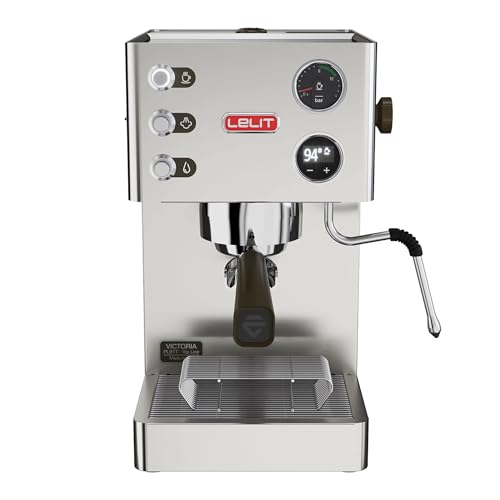
| Lelit Victoria | Single boiler, temperature adjustable on the LCC display, pre-infusion only on or off | €799 | 9.1 | an adjustable temperature is enough for you and you can do without pre-infusion levels |
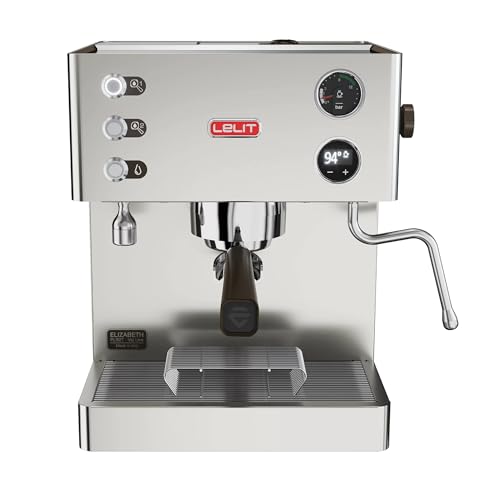
| Lelit Elizabeth | Dual boiler with its own 600 ml steam boiler, coffee and steam at the same time | €1,187.29 | 9.2 | you often make several milk drinks in a row |
All four prices come from our price boxes, and the shop shows the current price. For the UP the figure is as of July 2026, and for the Evo Pro, according to its review, as of September 2026. The score is our editorial assessment from the data comparison, and we did not measure anything on any of the machines. In it, the cheaper Evo Pro ranks above the UP.
When the Classic UP, when another machine?
In any case you need to budget for an espresso grinder as a second appliance. Here is a worked example with the Eureka Mignon Specialita from our catalogue, €431.90 according to the price box: together with the Classic UP you come to around €1,383. The Evo Pro with the same grinder costs around €931, so about as much as the UP on its own.
The Lelit Victoria is around €150 below the Classic UP and likewise has an adjustable temperature with a display. If you can do without graduated pre-infusion and the PRESET time, you save there.
Milk drinks are the point where a single boiler reaches its limit. If you regularly make several cappuccinos in a row, a dual boiler pays off: the Lelit Elizabeth costs around €240 more than the Classic UP and froths and brews at the same time. Gaggia’s own answer to this is the Classic GT, and the questions below say more about it.
For the space it needs, take the larger value from each of the two manufacturer figures: 21.1 x 36 x 27.8 cm, again as length, height and depth. Tank and drip tray come out at the front, so you do not have to pull the machine out from under the wall cupboard to refill. The safety booklet lists, among other things, these points: a level, stable surface on which the machine stands upright, also during transport; no place on a hot plate, directly next to a hot oven, a radiator or a similar heat source; no operation inside a cupboard; and no temperatures below 0 °C, because residual water in the heating system can freeze.
For an office it is the wrong machine. The safety booklet designates it for normal household use and expressly excludes staff kitchens, offices, agricultural businesses and commercial environments. If you want to pull espresso for a team, look in our portafilter machine comparison or in the espresso machine buying guide for a machine whose manufacturer permits that use.