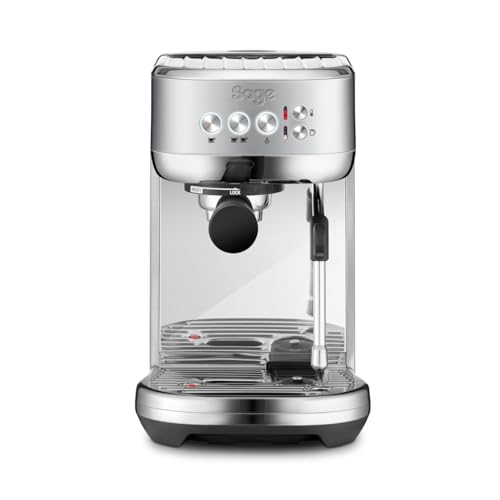
The Bambino Plus is Sage’s small espresso machine without a grinder, but with a steam wand that froths milk on its own. On the German manufacturer’s site it appears as the Bambino Plus under the product code BES500. The brushed stainless steel grey finish that Amazon also lists has the number SES500BSS4EEU1, and the Amazon catalogue gives BRG Appliances as the manufacturer. The Sage page itself carries the copyright notice of Breville Pty Limited.
Our reference price is approx. €480 according to our price box (on Amazon.de; exactly €479.90 there). In its own shop Sage asks €529.90 (retrieved on 1 October 2026), which is €50 more, and the same amount for all seven colour variants listed there; four of them were sold out at the time of retrieval. The colour names on the page include Black Truffle, Sea Salt and Damson Blue. The Amazon catalogue gives 16 February 2021 as the date for the listing.
Housing, dimensions, connection
Sage gives stainless steel as the material of construction without breaking it down by component. The 54 mm portafilter is expressly made of stainless steel.
The sources do not agree on the dimensions. Sage writes 30.3 x 18.8 x 36.2 cm and labels this as width, depth, height. The Amazon catalogue lists the machine at roughly 19.5 cm wide, 32.0 cm long and 31.0 cm high. The product photo shows it from the front, and there the front is clearly narrower than it is tall. That suggests the just under 19 cm face forwards and the good 30 cm run into the depth, but this cannot be confirmed from the manufacturer’s figures. We would therefore plan with 30.3 cm for the width, the larger Amazon value of 32.0 cm for the depth and Sage’s 36.2 cm for the height.
The removable water tank holds 1.9 litres and sits at the back; according to the manual it must sit flush against the rear wall. Underneath it, on the back, is the cleaning tool for the steam wand. At the front is the drip tray with a maximum fill indicator, the temperature sensor for the milk jug sits on it, and above the tray Sage promises extra room for tall cups.
Electrically the machine needs 220 to 240 V at 50 to 60 Hz and draws 1300 to 1600 W. At 230 V, 1600 W corresponds to just under 7 amps. As an additional protective measure the manual recommends a residual current device, ideally with a rated current of no more than 30 mA, and refers you to an electrician for advice. The Bambino Plus is switched off by pressing two buttons at the same time, the one-cup button and the steam button.
Sage makes maintenance clear-cut: apart from cleaning, all servicing should be carried out by an authorised Sage service centre, and anything the manual does not describe belongs in a service centre according to Sage. A damaged machine, cable or plug should not be used any further but sent there for inspection.
What Sage does not state
We went through the German product page including the data list behind an expandable section there, the current quick guide in version L25, the older version G22 and the Amazon catalogue entry. None of these sources contains:
- the brewing temperature in degrees and whether it can be adjusted
- the type of pump and whether a 3-way solenoid valve is fitted (Sage mentions it neither as present nor as absent)
- steam output, steam temperature and the time until steam is ready
- the noise level in decibels and the cable length
- the volume of the drip tray and the usable height for tall cups
- the material of the tamper, tank and drip tray
- the power consumption in kilowatt hours, per shot or per year, also not for the 32 % figure further down
- the power draw in power-saving mode and when it kicks in
- whether the water filter extends the descaling interval
- how many cleaning tablets and how much descaling powder are in the box
- the country of manufacture
A weight is missing from Sage as well. The Amazon catalogue lists 14.66 pounds, roughly 6.7 kg, without saying whether that is with or without packaging.
In detail: ThermoJet, PID and two pressure figures
ThermoJet is Sage’s name for its heating system, and according to the product page it reaches extraction temperature in 3 seconds. You do not heat a boiler in three seconds. The figure only makes sense if the water is heated on its way to the brew head, and the manual speaks of a heating coil, which fits. That is how we read the claim.
Sage does not name the system entirely consistently, though. In the heating system data field of the same product page it says advanced ThermoCoil, in the brewing system field and in the promotional text ThermoJet. The energy claim is tied to ThermoJet too: up to 32 % less energy than a thermoblock heating system, backed according to the disclaimer by internal benchmarks from November 2022. In the Amazon text this becomes a 32 % lower annual consumption compared with conventional systems, which is a different yardstick: a thermoblock is a specific design, whereas conventional systems can, depending on the reading, also include boiler machines that keep their water supply permanently hot.
The temperature is held by a PID controller. It adjusts the heating power to the target temperature instead of just switching the heater on and off. If the water really is heated as it flows through, this is exactly what helps two shots in a row pass through the grounds at a similar temperature. The manual also points out that the surface of the heating element still gives off residual heat after use and that the metal surfaces can become hot during operation.
For the pump, the product page gives two numbers: an Italian 15 bar pump and 9 bar for extraction. Technically the larger number describes the most the pump can build up, the smaller one the pressure that arrives at the coffee bed during operation. For comparing two machines, therefore, only the second is useful. Before full pressure there is a pre-infusion at low pressure that moistens the grounds. You decide how long it lasts if you want to: you hold the one-cup or two-cup button until the desired pre-infusion time is reached, and releasing it starts the extraction.
Do you need a separate grinder with the Bambino Plus?
For the single-wall baskets, yes. The machine has no grinder, and on the product page Sage calculates with 18 g of freshly ground coffee. Without a grinder you are left with the dual-wall baskets, which are intended for pre-ground coffee from the pack.
The box contains four basket inserts: two single-wall and two dual-wall, each for one and for two cups. As delivered, the single-wall basket for two cups is in the portafilter. For the dose the manual gives 8 to 11 g for one cup and 16 to 19 g for two, so the 18 g from the product page lie in the upper part of the large basket’s range. The dual-wall inserts regulate the pressure, independently of grind size, dose, tamping pressure or freshness. That makes them forgiving, but it takes away exactly the adjustments you want to work with when using fresh beans.
After filling you tamp with roughly 10 to 15 kg of pressure. That is what the current manual says, version L25, which Sage links on the German product page; an older version (G22) still asked for 15 to 20 kg. After that the supplied Razor dosing tool levels off excess grounds and brings the puck to the right height. The pour shows whether the grind size and amount are right: according to the manual the coffee starts to flow after 8 to 12 seconds and runs slowly like warm honey. If it comes noticeably sooner, the grind is usually too coarse; if it comes later, too fine. The brew calculator works out the ratio of grounds to cup for you.
As delivered, the machine stops at approx. 30 ml for one cup and approx. 60 ml for two. If you hold both cup buttons for two seconds, you teach it your own volume: start the shot at the press of a button, stop at the moment you want, and the machine stores the value. A further button combination with the machine switched off takes it back to the factory setting.
For this machine we would choose a grinder that grinds straight into the portafilter. From the same maker, our catalogue lists the Sage Dose Control Pro at approx. €153. According to Sage it comes with a portafilter insert for 50 to 54 mm, and it has 60 grind settings. Our grinder guide explains what else matters when choosing an espresso grinder. Together the two devices come to around €633.
Frothing milk with Auto MilQ
Auto MilQ is the Bambino Plus’s automatic milk system. You fill the supplied 480 ml stainless steel jug between the MIN and MAX marks, place it on the temperature sensor, lower the steam wand and start. Once the chosen temperature is reached, the machine stops by itself.
You choose in two rows of three levels each: Warm, Ideal or Hot for the temperature, and Low, Medium or High for the foam. Both settings stay saved until you change them. Sage promises microfoam with at least one million bubbles per millilitre.
The manual draws a clear line: only the supplied stainless steel milk jug should be used for frothing, and other containers can pose a risk according to Sage. If you need more milk than fits into this jug between MIN and MAX, you froth in several rounds. Besides the automatic mode, Sage also allows manual texturing; more on that in the questions below.
After frothing you lower the wand again, and it then cleans itself automatically with steam. If it stays up, a message appears via the indicator lights. Hot steam can escape when it is lowered, and the manual specifically warns about this. Straight after the steam function the machine also flushes water through, which ends up in the drip tray. A pumping noise while steam is being generated is part of normal operation according to Sage.
What else is worth considering?
| Model | The difference | Price | Our rating | Choose this one if |
|---|---|---|---|---|
| Sage Bambino Plus (this one) | ThermoJet with PID, automatic milk system on a temperature sensor, no grinder | approx. €480 | 8.4 | you want the machine to finish frothing the milk using the temperature sensor and you already have an espresso grinder or are buying one with it |
| Sage Barista Express | Built-in conical burr grinder with 16 settings, milk by hand with the steam wand | approx. €489 | 9.0 | you do not want to buy a separate grinder or plan a second spot on the worktop |
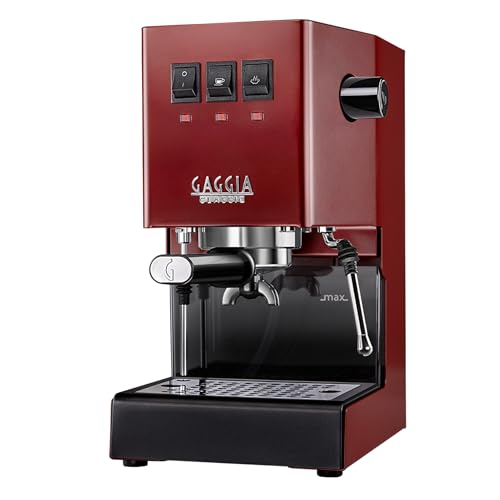
| Gaggia Classic Evo Pro | 58 mm portafilter, brass boiler, 3-way solenoid valve, steam wand by hand | approx. €500 | 9.4 | you want to froth milk yourself anyway and are looking for 58 mm accessories |
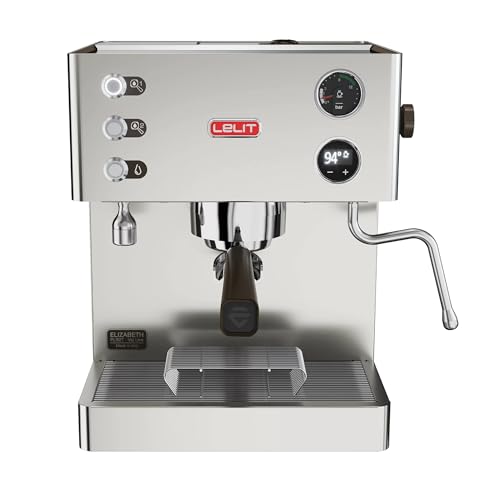
| Lelit Anna PL41TEM | Brass boiler with temperature adjustable on the PID display, brew pressure gauge | approx. €489 | 8.6 | you want to set the boiler temperature in degrees yourself and read the pressure during the shot |
The prices are the reference values from our data sheets, rounded to whole euros, and they do not all come from the same day. The rating is our editorial assessment based on manufacturer and catalogue data, not a measurement result. The table says nothing about availability and promotional prices.
When the Bambino Plus, when another machine?
The milk decides first. If you drink almost only cappuccino or latte and do not want to learn frothing first, the automatic system is the reason to buy this machine, and that is why it is our beginner’s pick in the espresso machine comparison. If you prefer to froth the milk yourself, you pay here for a function you will hardly use. Then the Gaggia Classic Evo Pro is the obvious alternative, at approx. €500 in our catalogue around €20 more than the Bambino Plus.
Then the grinder. If you do not have one in your kitchen yet and do not want to give up a second spot, weigh it against the Barista Express: approx. €489 in our catalogue, around €9 more than the Bambino Plus, but with a built-in grinder. The sum: the approx. €489 for the Barista Express compares with around €633 for the Bambino Plus and the Dose Control Pro, and those two need two places.
For the number of cups, the tank helps first. Sage does not say how many shots a 1.9 litre fill yields. In our assessment, more water leaves per double shot than the 60 ml in the cup, because the coffee puck absorbs some of it, and as soon as you froth milk, the steam and the flushing afterwards also draw from the same supply. What can be calculated is the cleaning cycle, which we describe below under care: at four shots a day it comes up roughly every 50 days.
For the location, the manual requires a stable, heat-resistant and water-resistant, level, dry surface, not at the edge of the worktop and not on or near a heat source such as a hob, an oven or a gas cooker. The machine should not stand on a draining board next to the sink, and it must not be operated in a cupboard or any other enclosed space. Under a wall cabinet you need more than Sage’s 36.2 cm of height, plus room at the back wall, because that is where you lift out the tank. According to the manual you unroll the cable fully before first use, and it must neither hang over the edge of the worktop nor touch hot surfaces.
The wrong choice is the Bambino Plus for the office kitchenette. The manual intends the machine for household use only and exclusively for its intended purpose, rules out operation in moving vehicles or boats and outdoors, and warns that misuse can lead to injury. According to the manual, children aged 8 and over may only use the machine under supervision or if they have been instructed in safe handling and understand the hazards; the same applies to people with reduced abilities or without experience. The machine and the mains cable belong out of reach of children under 8.
Hard water means descaling more often; the intervals are given further down. Distilled water is no shortcut here: Sage requires cold tap water and advises against heavily filtered, demineralised or distilled water, because it can affect the taste of the coffee and how the espresso machine works.
If you want to set a temperature in degrees yourself (see the list under housing and dimensions), take the Lelit Anna PL41TEM with its boiler temperature adjustable on the PID display. In our catalogue it is priced the same as the Barista Express at approx. €489. The coffee machine finder sorts by preparation method and budget, in case you are still torn between an espresso machine and a bean-to-cup machine.
What is in the box and running costs
According to the product page, the Bambino Plus comes with the 54 mm portafilter, a 54 mm tamper, the Razor dosing tool, a Claro water filter, the stainless steel milk jug, the four filter baskets, a cleaning tool and a cleaning disc. The manual also lists the water filter holder, cleaning tablets for espresso machines and descaling powder. For the first clean and the first descale you therefore need to buy nothing extra. Before the first coffee you fill the tank to MAX, place a 500 ml container under the portafilter and the steam wand and start the first rinse cycle with the one-cup button.
As extras, Sage sells the Knock Box 10 for €36.90 and the Distribution Duo 54mm for €79.90 on the same page. On other makers’ accessories the manual is strict. According to the manual you should only use the supplied accessories, and elsewhere it warns that accessories not sold or recommended by Sage can cause fires, electric shocks or injuries. Then there is the size: 54 mm is Sage’s format, 58 mm baskets and tampers do not fit. And preparing coffee in the portafilter without one of the supplied basket inserts is expressly called improper use by the manual, which can lead to injury or damage to the surfaces around the machine.
For running costs we calculate with frequencies here. The water filter is replaced four times a year. Descaling is due roughly four to six times a year depending on water hardness, and at two shots a day the cleaning cycle comes up just under four times. At 18 g per double espresso, one kilo of beans lasts for a good 55 shots. When buying in the Sage shop, Sage adds two bags of specialty beans according to the product page and then grants 20 % off beans without a subscription, subject to the terms and conditions; the Amazon text also advertises two bags after purchase and registration.
Cleaning, descaling, care
According to the manual, the basket inserts and portafilter should be rinsed under hot water straight after use so that no coffee oil residues remain. You wipe the inside of the brew head and the inner shower screen with a damp cloth. Regularly you run hot water through with the basket and portafilter inserted but without coffee grounds. You wipe the steam wand with a damp cloth immediately after frothing.
You empty the drip tray after every use or when the indicator in the grid rises; you clean the grid and tray in warm soapy water. You wipe the housing with a soft, damp cloth and polish it with a soft, dry one. Abrasive cleaners, scouring pads or cloths are out, because they can scratch the machine. The sentence from the manual applies without exception: “Do not clean any of the parts or accessories in the dishwasher.”
The machine notices a blocked steam wand itself during milk preparation. It then stops immediately, the light of the steam button goes out, and the milk temperature and foam buttons flash until the wand has been cleaned. First you lower the wand and hold the steam button for five seconds. If that does not help, you unscrew the tip with the cleaning tool, clean the holes with it, rinse the tip, wipe it with a clean, dry cloth, screw it back on and then clean the wand with steam. The same tool can also be used to clear blocked holes in the basket insert.
After 200 extractions since the last clean, the machine asks for the cleaning cycle, and the one-cup and two-cup buttons flash alternately. You place the cleaning disc in the basket insert, put a cleaning tablet on it, lock in the portafilter, empty the drip tray, place a 2 l container under the portafilter and the steam wand and fill the tank to MAX. Five seconds on both cup buttons open the cleaning mode, and a further press starts it. Whether this is backflushing in the sense of a blind basket flush, the manual leaves open; it simply speaks of the cleaning cycle. You start it early with the machine switched off by holding two cups and steam for five seconds.
According to the manual, limescale can affect the water flow, the brewing temperature, the machine’s performance and the taste of the espresso. Descaling is due when the one-cup, two-cup and steam buttons light up alternately for 15 seconds. Sage recommends descaling every 90 days at water hardness 4 and every 60 days at water hardness 6, and leaves open which unit these levels refer to. For the procedure you fill the tank to the DESCALE mark with hot tap water, dissolve the descaler in it, place a 2 l container under the brew head and the steam wand, switch the machine off and let it cool down completely. You control the rest with the one-cup and steam buttons, with a pause to refill to MAX once the descaler is used up.
Two warnings are expressly in the manual here: the mains cable, mains plug or the machine itself must never be immersed in water or other liquids, and during descaling the water tank must under no circumstances be removed or emptied completely. How often and with what an espresso machine is descaled in general is covered in our descaling guide.
Before cleaning, transporting or storing, the machine should be switched off, disconnected from the mains and cooled down. For storage you empty the tank and drip tray, let everything become clean and dry and stand the machine upright with nothing placed on top.