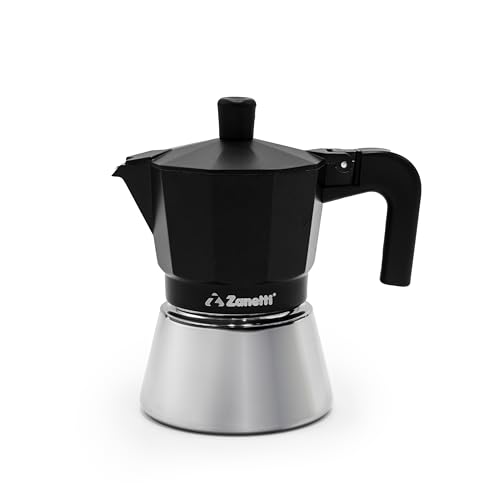
Zanetti describes itself as the largest manufacturer of steel cutlery in Europe. The company from Lumezzane in the province of Brescia began in 1953 with handcrafted household goods, and today its company site lists mainly cutlery, cookware and gift items made of stainless steel. Moka pots run alongside: the Caffettiere section has exactly four entries, two aluminium pots, a spare parts set and the Star Induction, which is the subject here.
Zanetti announced the pot as a novelty in a news post dated 15 September 2023. We list the three-cup pot, according to our price box, at approx. €22.90 on Amazon.de. In our comparison of moka pots it scores 8.2 out of 10 points.
Star, Star Induction, Mama: which pot you get
At the manufacturer the product is called STAR INDUCTION, and the 3-cup size has the article number 240315I. The same number appears in the Amazon catalogue as model and as part number. The assignment is therefore unambiguous.
It has to be, because in the same range a mix-up is easy to make. The MAMA with three cups carries the number 240315, the same digits without the appended I, and it is an aluminium pot with no induction statement. Its red sister runs as MAMA RED under 240315R. Anyone who looks for the Star at another retailer and only skims brand, size and number quickly ends up with an aluminium pot that does not heat up on an induction hob. Watch for the I at the end.
The short name is misleading too. On Zanetti’s website, the product page that is simply called Star belongs to a frying pan series. You find the moka pot there only under the full name with Induction.
Aluminium on top, stainless steel below
The title of this page speaks of stainless steel, and for the part of the pot that stands on the hob that is correct. Zanetti’s product text, however, begins with a different sentence: “Caffettiera Moka in alluminio per induzione”, a moka pot made of aluminium for induction. The manufacturer then lists six features, and this is the complete list: a funnel made of steel, a boiler made of stainless steel with an inner anti-limescale treatment, a nickel-plated valve, a non-slip base, a spout with drip guard and a silicone seal, which Zanetti describes as hygienic, durable and hermetically sealing.
Two subtleties lie in the choice of words. For the boiler it says “acciaio INOX”, that is, stainless steel. For the funnel it says only “acciaio”, steel without that addition.
The second subtlety concerns the seal. Silicone instead of rubber matters when you buy a replacement, because replacement rings for moka pots are sold in both materials and you want to fit the same kind again.
What is left for the aluminium, then? Boiler and funnel are stated as steel, so only the top section can be meant, in which the finished coffee collects. The split is easy to see in the product photo. On top sits a black top section with vertical edges, plus a black handle and a black lid knob. A narrow black ring with the Zanetti lettering separates it from the silver boiler, which widens towards the base.
The dimensions come from the Amazon catalogue: 16.0 centimetres high, 15.0 long, 10.0 wide, plus around 430 grams. Judging by the photo, the 15 centimetres probably run from the spout to the end of the handle. These are envelope dimensions; they say nothing about the body or the contact area at the base.
In detail: why the steel sits only at the bottom
An induction hob itself hardly gets warm. Under the glass ceramic lies a coil that builds up an alternating magnetic field, and this field generates eddy currents in the base of the cookware, which heat the metal from within. For this to happen to any appreciable degree, the base must be ferromagnetic. Aluminium is not. A pure aluminium pot like the MAMA therefore does not heat up on the hob unless a steel adapter plate lies beneath it.
Stainless steel does not solve the problem automatically. The common chromium-nickel steels, in the household usually called 18/10, have an austenitic structure and barely react to a magnet. Induction-suitable cookware therefore relies on ferritic steel in the base or on an inlaid magnetic disc. That the Star heats up on the hob thus remains a manufacturer’s assurance, which we pass on: according to the product page it is suitable “per ogni tipo di piano cottura”, for every type of hob, and Amazon’s catalogue text says the same in German, all types of hob including induction.
Why not make the whole pot of steel, then? The hob acts only on the base. For the top section and lid it makes no difference whether they are magnetic, and at around 2.7 grams per cubic centimetre aluminium has roughly a third of the density of steel. An aluminium top section keeps the pot light. Bialetti builds the Moka Induction on the same pattern, aluminium on top and steel where the field arrives, though with a two-layer boiler that is aluminium again on the inside.
How much coffee comes out of three cups?
The catalogue text at Amazon says so itself: the coffee is measured in cups. We do not calculate a millilitre figure from it, because the cup is not a standardised unit.
How little the cup count fixes is shown by the figures of another manufacturer. Bialetti’s catalogue text for the Moka Express gives 90 millilitres for two cups, 130 for three and 185 for four. The Venus from the same house also has four cups, but according to Bialetti’s US site 5.7 ounces, converted around 169 millilitres: one brand, same cup count, 16 millilitres apart. Even for one and the same pot the figures diverge: for the Moka Induction with two cups, 90 millilitres appear on one manufacturer page and 100 in the Amazon title. None of these figures can be transferred to Zanetti.
Even so, the size is the most important buying decision with the Star, because whether a reducer insert for smaller amounts is included, Zanetti leaves open. Water to just below the valve, funnel full, screw shut, put on the hob: the pot has no more operation than that, and the ratio of water to ground coffee is fixed by boiler and funnel. Anyone who wants less needs a smaller pot or one with a reducer filter, anyone who wants more a bigger one. Zanetti also offers the Star Induction with six cups; a step in between is missing.
Once you have measured the amount, the brew calculator gives you the matching number of grams of ground coffee.
What else is worth considering?
| Model | The difference | Price | Our score | Pick this if |
|---|---|---|---|---|
| Zanetti Star (this one) | Stainless steel boiler under aluminium top section, 3 cups | approx. €22.90 | 8.2 | the two of you brew on induction and two cups are too tight |
| Bialetti Moka Induction | Two-layer boiler, steel outside and aluminium inside, 2 cups | approx. €26.14 | 8.7 | you drink alone and want a manufacturer’s instruction manual |
| Bialetti Venus | According to Bialetti stainless steel 18/10 instead of an aluminium top section, 4 cups | approx. €28.00 | 8.8 | the finished coffee should touch no aluminium |
| Bialetti Moka Express | Pure aluminium, 6 cups, on induction only with Bialetti’s adapter plate | approx. €28.87 | 9.4 | you cook on gas, electric or ceramic |
The prices are the guide values from the price boxes of the respective reviews and move constantly; the score is our editorial rating. Which of the four pots makes the better coffee, the table does not answer; for that we would have had to brew all four side by side. More models are in the best moka pots list.
When the Star fits and when another pot
First the hob. On gas, electric or ceramic you do not need the steel boiler. The Moka Express costs around €6 more in the 6-cup size of our comparison, is the comparison winner in our category, and Bialetti supplies an instruction manual for it with care and descaling guidance. On induction the calculation turns: the Moka Express runs there only on Bialetti’s adapter plate, which you put underneath at every coffee, while the Star stands directly on the hob.
Then the amount. If you drink alone, the smaller Moka Induction with two cups is enough, and it costs a good €3 more. In the three-cup size our catalogue lists no other pot besides the Star. Three cups from a larger pot are managed, according to the manufacturer, by the Nevo with six cups with its included reducer filter, but at approx. €44.99 it costs almost double. On gas or ceramic the Moka Express comes in, which Bialetti also makes with three cups. If you regularly brew for three or four, the 6-cup version of the Star is the obvious choice, even though we do not review it separately.
The third point is the aluminium. If the finished coffee should touch none, the Bialetti Venus is an alternative from our comparison: according to Bialetti with a body of stainless steel 18/10 and without aluminium in the material information, for €5.10 more and with four instead of three cups.
Fourth point, the paperwork. If you want care instructions and warranty terms in writing, we would choose one of the Bialetti pots despite the surcharge, because for all three there is an instruction manual in which the warranty is also stated.
That leaves the ground coffee. Moka pots need a grind between espresso and filter, coarser than for the espresso machine. A grinder set to espresso you adjust before every pot, or you buy coffee already ground for moka. Where this setting lies on the scale is explained in the guide to grind size.
What Zanetti leaves open
Besides the fill volume, several details that matter when buying are missing. Open are the steel grade of boiler and funnel, the material of handle and lid knob, and the type of the black surface on the top section, whether painted, anodised or coated. Which base diameter rests on the hob is stated nowhere, even though many induction hobs recognise cookware only from a minimum size. A brewing time is missing, as is the scope of delivery. Dimensions, weight and the colour black are given by the Amazon catalogue alone; on Zanetti’s page the colour is visible only in the photo.
For everyday life with the pot, more is missing. The manufacturer sets no intervals for changing the seal or for descaling. The type of anti-limescale treatment in the boiler also remains unexplained. The product page names no country of manufacture, and for the universal set of filter and seals the assignment to the Star Induction is missing.
Care, descaling, spare parts
An instruction manual for the Star Induction could be found neither on zanetti.it nor via a web search, and the product page contains not a single care instruction. What follows here are therefore our recommendations, derived from the materials.
For the top section the material decides: aluminium tolerates the strongly alkaline detergents of dishwashers poorly; it tarnishes or becomes blotchy. We would wash the pot only by hand, with warm water and without scouring agents.
In the boiler the matter is different. It is stainless steel and, according to Zanetti, treated against lime on the inside, “interno trattamento anti calcare”. In our assessment this treatment does not replace descaling: lime precipitates when hard water is heated, no surface can prevent that, it can at most influence how firmly it adheres. Bialetti prescribes a simple procedure for its pots: fill the boiler as usual, add two teaspoons of citric acid or vinegar, run one cycle without coffee powder and pour the liquid away. Whether the interior treatment tolerates citric acid or vinegar, we would ask Zanetti before the first descaling. How often lime becomes an issue for you at all is covered by the guide to water hardness, and the steps are under descaling and cleaning.
The wearing part is the silicone seal between boiler and top section. In its instructions Bialetti demands a replacement when worn, but at least once a year, which serves as a guide.
You get the seal from Zanetti in the universal set for moka pots; what is in it is in the FAQ. The pot needs neither filter paper nor capsules, so apart from the coffee its running cost is just this seal.


