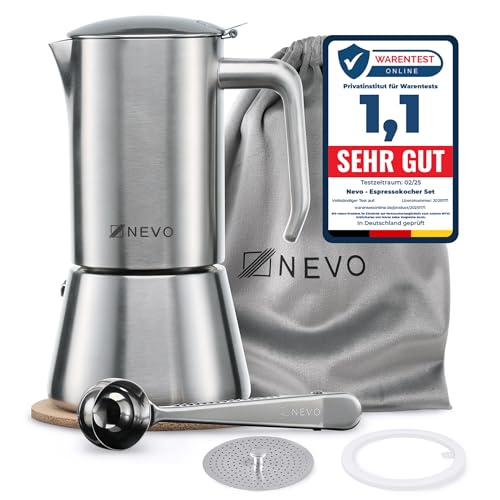
A stainless steel stovetop pot for 300 millilitres, sold as a set with a reducer filter and four further accessories: that is the moka pot from Nevo, a brand of Betanai Brands in Hamburg. On Amazon.de it costs approx. €44.99 (as of September 2026), and of the 17 moka pots in our catalogue only two are more expensive. For this text we had the following from the Nevo shop: the product page, the homepage with its FAQ, the “About Nevo” and “Instructions” pages, the terms and conditions, the legal notice and a care article from the blog, plus the instruction manual as a 36-page PDF and the Amazon catalogue. These sources say different things in several places, and where that affects a purchase, the versions are set side by side below.
Six parts according to the instructions, five in two FAQs
On page 2 of the instructions the box contents are listed in six numbered items: pot, spoon, pouch, coaster, reducer filter, spare gasket. The product page uses more precise names, namely stainless steel measuring spoon, cork coaster, storage pouch and spare gasket made of BPA-free silicone. The Amazon text mentions the same accessories again.
The two FAQs count differently. On the homepage the “Premium Set” explicitly has five parts, and in the FAQ of the product page the answer to the question about contents likewise lists only moka pot, filter insert, spare gasket, spoon and cork coaster. The storage pouch is missing both times. Three lists against two: we count six parts. On the homepage Nevo also states a higher individual value for the parts, a calculation the manufacturer drew up itself.
Stainless steel yes, but which? Material, dimensions, standards
On the material Nevo has two versions. The product page says, across the board, 18/8 stainless steel to AISI 304 with “0% aluminium”. The “About Nevo” page divides it more precisely: top part and filter tube in 18/10 stainless steel, bottom part and filter basket in 18/0 stainless steel.
There is little between 18/8 and 18/10. Both pairs of figures stand for roughly 18 per cent chromium and 8 or 10 per cent nickel, and the material standard for AISI 304 allows nickel contents of 8 to 10.5 per cent. 18/0, by contrast, belongs to a different steel group, with practically no nickel, and is magnetic. If the bottom part is made of it, the blanket statement on the product page describes the pot only in part.
On size, Nevo gives a height of 19.5 centimetres and a weight of 580 grams. The Amazon catalogue gives 22.0 by 11.0 by 11.0 centimetres and, converted, around 815 grams. There, length and width are the same even though the handle sticks out to the side, and every catalogue value is above the manufacturer’s. We therefore read the Amazon figures as a measurement including packaging and stick with Nevo.
Under “Certifications” the product page lists three abbreviations. The LFGB is the German Food, Commodities and Feed Code, which also regulates items that come into contact with food. REACH is the EU chemicals regulation. EN 12875-1 describes the procedure for checking the resistance of household items to machine washing, and so belongs with the dishwasher approval further below.
What none of these sources state, collected in one place: brewing temperature, pressure in bar, heating and brewing time, a number of grams for the ground coffee (neither for the full pot nor with the reducer filter), a grind size more precise than “medium-fine”, the material of the handle and lid knob and whether both are heat-insulated, the material of the filter disc, the construction of the 3-layer base, the wall thickness, the capacity of the bottom part up to the valve in millilitres, the recycled share of the steel, the testing body and certificate numbers for the three standards, the manufacturing plant, the year of market launch and the temperature limit behind the recommended cold or eco cycle. Whether the cork coaster and pouch may go in the dishwasher also remains open.
In detail: how an induction hob detects the base
An induction hob does not heat by itself. Under the glass there is a coil that builds up an alternating magnetic field, and only the base of the pan, in which this field generates eddy currents, becomes warm. This works well with ferromagnetic steel. Aluminium and nickel-containing grades such as 18/8 or 18/10 barely respond, which is why a classic aluminium pot stays cold on induction. The bottom part in 18/0 steel that the “About Nevo” page mentions is exactly the kind a hob responds to.
The homepage FAQ describes the base differently: “The ferromagnetic 18/8 stainless steel base is heated directly by the induction field.” Technically that does not add up, because 18/8 is precisely one of the nickel-containing grades that are barely magnetic. Nevo also speaks of a 3-layer base for gas, electric, ceramic and induction. The question about the three layers is justified: in cookware an aluminium core is often sandwiched between two steel layers, whereas the product page states 0 per cent aluminium.
For the purchase the diameter matters more. An induction hob only switches on once it detects a pan, and for that many hobs require, according to Nevo, depending on the model, about 10 to 12 centimetres. The Nevo measures around 10 centimetres on the outside and is therefore at the lower limit. Nevo advises using the smallest cooking zone and placing the pot in the centre. If the hob still does not detect it, support wants to know the hob model by email. The PDF instructions put it more generally: the zone should match the diameter of the pot base, and no adapter or heat diffuser plate is needed.
For comparison: Morgenheld gives a base diameter of 11.0 centimetres for the FLOW with 300 millilitres, and Groenenberg gives an induction hob from 10.5 centimetres for its 6-cup pot. Before buying, check your hob’s manual to see from what pan diameter the smallest zone switches on.
On the power setting, the homepage differs from the two sets of instructions. It recommends level 6 to 7 out of 9. The instructions page in the shop and the PDF both say “over low to medium heat”, and the shop page adds for induction “do not use boost”. Six to seven out of nine is rather above the middle. On induction we would start lower and only turn up if the coffee does not rise.
Are six cups enough, and how much water goes with the reducer filter?
For two to three people with small espresso cups, our calculation says that is enough; for mugs it is not. Nevo counts the 300 millilitres as six cups of 50 millilitres each and makes clear that this does not mean coffee mug volume. With the reducer filter, according to the product page, it becomes three cups.
How the filter is inserted is described in step 3 of the instructions: it goes into the filter funnel until it sits securely, and the ground coffee goes only above it. This is said to give an even coffee bed with stable flow, it continues, and directly afterwards: “The water level stays the same.” The product page says the opposite: fill in about half the amount of water, and the safety valve stays clear. The FAQ on the same page also calls the filter insert a reducer “for half filling”.
By calculation, more speaks for the product page. What arrives at the top of the pot is essentially the water that the steam pressure forces from the boiler through the grounds. If the boiler stays full, roughly the amount for six cups runs through the grounds for three, and the coffee becomes correspondingly thinner. We would start with a half filling and send the question by email to Nevo support until the two texts agree.
How much ground coffee suits your amount of water is worked out for you as a starting value by the brew calculator, also for the moka pot.
Nevo, FLOW, Barista Royal or Moka Express?
| Model | The difference | Price | Our score | Choose this one if |
|---|---|---|---|---|
| Nevo Moka Pot 6 Cups (this one) | Reducer filter for three cups in the set | approx. €44.99 | 8.3 | you sometimes brew three cups, sometimes six |
| Morgenheld FLOW 6 Cups | Wider base according to Morgenheld, handle made of ABS plastic | approx. €39.95 | 8.2 | you always brew the full pot and need no accessories |
| Barista Royal Moka Pot | No reducer filter, neither in the box nor in the manufacturer’s shop | approx. €44.99 | 8.5 | you brew six cups in one go every morning |
| Bialetti Moka Express | Aluminium, on induction only with the Bialetti plate, not dishwasher-safe | approx. €28.87 | 9.4 | you cook without an induction hob and do not mind hand washing |
Prices and scores come from our data sheets as of September 2026; the score is an editorial assessment and not a measured value. On its own product page Morgenheld lists the FLOW, like the Nevo, as dishwasher-safe, explicitly including the handle made of ABS plastic.
Brewing by the instructions, until it gurgles
The PDF instructions are version 1.0 with a revision date of 24 February 2026; the German version is on page 6. Before first use, according to the instructions, you clean all parts with warm water and mild washing-up liquid, rinse them well and run one brew with water only, which is then poured away.
After that the instructions number five steps; step 3 applies only with the reducer filter and is described above. The bottom part gets fresh water up to just below the lower edge of the safety valve, and the valve itself must not stand in the water. Medium-fine ground coffee goes into the filter funnel, the surface is levelled and not pressed down. Before closing, you check that the gasket and filter disc are seated correctly, then the top part is screwed on firmly. Heating is over low to medium heat, and as soon as the distinct gurgling begins, you take the pot off the hob.
Why gurgling, of all things: as long as the tube under the funnel dips into the water, the steam pushes water upwards. If the water level falls below the opening, steam breaks through as well, and that makes noise. Anyone who keeps heating then mainly sends hot steam through a coffee bed that is hardly getting any water.
Dishwasher allowed, gasket disputed
The PDF instructions keep it short: let cool, take apart, remove the grounds, rinse all parts, no abrasive pads. Below that it says “dishwasher-safe”, followed by the recommendation to wash by hand for a lasting appearance and long service life. The English care section on page 34 adds that scouring sponges, steel wool and harsh chemicals should never be used, that the pot must cool down completely before being touched or cleaned, and that all parts must be dried thoroughly before assembly or storage.
The product page also calls the dishwasher suitable and recommends a cold or eco cycle for it. Its own FAQ sounds different again: unscrew, rinse with warm water, let dry, washing-up liquid is not needed at all. Finally, the homepage FAQ takes one part out entirely. The silicone gasket should be cleaned by hand only, because the heat of the dishwasher can make the material brittle over time.
Hence our advice for the gasket: take it out before every machine cycle and clean it by hand only, as the strictest of the four versions demands. According to the instructions page in the shop, you use the cork coaster only on the work surface, not on the hot cooking zone.
The instruction manual names neither a product nor an interval for descaling; a post on the Nevo blog dated 12 August 2026, which the product page links to, is more specific. According to it you should descale not on a fixed calendar but by water hardness and visible need; as signs the post names white deposits, slower flow and limescale around the valve. The procedure: check that the gasket and filter disc are clean, undamaged and correctly inserted (the pot must be sealed for the run-through), fill the bottom part with water to just below the safety valve, add two teaspoons of food-grade citric acid, insert the empty funnel without coffee powder, screw shut and let the solution run through over low to medium heat as when brewing. Then switch off the heat, let everything cool down completely, pour away the solution, rinse all parts thoroughly with clear water and do one run with water only, which is also poured away. The citric acid should be used on its own and should stay in the pot for this one run only. For the dosage the post refers to Bialetti. How water hardness shifts the interval is explained in our guide Descaling and Cleaning.
Wear parts, according to the product page, are the gasket and the reducer filter, and on page 33 the instructions require that the gasket be checked regularly and replaced when worn. The blog post is more concrete: replace immediately in the event of cracks, hardness, deformation or leaks, check at least annually, more often with frequent use. After the included spare gasket, everything else goes through support by email; according to Nevo, an order number and a short photo are enough. You should not keep using a damaged reducer filter; here too support helps with a replacement. Groenenberg, by contrast, sells gaskets in packs of three and reducer filters as separate spare parts in its online shop.
When the Nevo fits and when another pot
The hob decides most of it. Without induction, the aluminium Moka Express is the cheaper pot; on induction the sums tip: it needs the steel plate there, which Bialetti sells in its own shop for €19.90, and together you end up at €48.77, that is €3.78 above the Nevo.
The second question is quantity. Barista Royal writes in its brewing guide that a moka pot must always be filled with water up to below the valve and the filter filled completely with ground coffee. A reducer filter is absent from its range, so with this pot it stays with the full filling. With the Nevo, the filter lets you go smaller, only the water level for it is unresolved.
That leaves the washing-up. The dishwasher approval is not exclusive to the Nevo: Barista Royal and Morgenheld also list their stainless steel pots as dishwasher-safe, and Groenenberg excepts only its reducer filter. Among the pots in the table, it therefore counts as a reason to buy only against the Moka Express.
Who is it suited to?
According to the homepage the set comes in a gift box, and according to the product page the recipient can reach the instructions by QR code in 24 languages, even if German is not their language. As a gift we therefore consider the Nevo a reasonable choice. Which type of hob is in the recipient’s kitchen is secondary thanks to the broad approval. One caveat remains: if the smallest zone on their induction hob only switches on from 11 or 12 centimetres, it may not detect the pot with its roughly 10 centimetres on the outside.
The Nevo is wrong for anyone who wants a single small cup in the morning. With the reducer filter it still makes three cups, and a smaller Nevo with 4 cups, like a larger one with 9 cups, is only in development according to the homepage. For one or two cups, our catalogue offers, for example, the Bialetti Moka Induction 2 Cups for approx. €26.14, which according to Bialetti also runs on induction.


