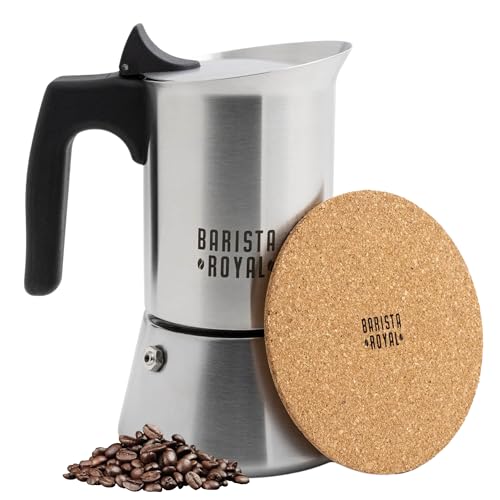
Two questions decide almost everything when buying a moka pot: which hob it will sit on and who washes it afterwards. Barista Royal has a written answer to both. The stainless steel pot is approved on the product page for all four hob types including induction, and the same page declares it dishwasher-safe. On Amazon.de it costs approx. €44.99 (as of September 2026), and in the manufacturer’s shop the 6-cup version costs €42.99 (as of 8 September 2026).
Stainless steel, cork and a spare ring: what is in the box
Moka pot and trivet are listed in all three places where the contents appear, the gift packaging only at the manufacturer. One bullet point on the product page is more precise and names a cork trivet including a spare sealing ring, the category page confirms the cork trivet, and the Amazon text lists the same parts. According to the manufacturer it is packed without plastic, and the Amazon text additionally calls the packaging recyclable. In the shop the pot is called “Premium Espressokocher aus elegantem Edelstahl inkl. Untersetzer” (premium moka pot made of elegant stainless steel including trivet), so the accessory is already in the name.
The product photo shows a smooth, round body without the eight facets of the Italian classic, plus a pouring spout, a black handle and a black knob on the lid. The safety valve sits on the lower boiler section. The trivet is a round cork disc with the brand name.
The Amazon catalogue lists the colour as silver and the model and part number as 4262386371662. It differs in the last two digits from the GTIN 4262386371655 that the manufacturer gives in its structured data for the standard four-cup variant. If you want to check the size when ordering, that gives you a feature that does not always appear cleanly in the listing title.
Gas, hob plate, ceramic, induction: the approval in the manufacturer’s words
Once as a blanket statement, once individually. The product page says “für alle gängigen Herde geeignet” (suitable for all common hobs), and the section “Geeignet für” (suitable for) follows with the list: gas hob, hotplates, glass-ceramic hobs, induction. Four items, no reservation next to them.
Why this is a selling point at all is explained by Barista Royal on its own induction category page: aluminium is not magnetic, so an induction field does not couple with a classic aluminium pot. Behind this is plain physics. The coil under the glass builds up an alternating field, and only the base, which converts this field into eddy currents, gets warm. With Bialetti this detour costs money: the Moka Express runs on induction only via the manufacturer’s steel plate, and that costs €19.90 in the Bialetti shop. Pot plus plate end up at around €49, so above the price of the Barista Royal.
In detail: how pressure builds up in the boiler
Water at the bottom, ground coffee in the funnel in the middle, the empty pot on top. As the boiler heats up, the vapour pressure in it rises and pushes the water from below through the grounds and up the riser tube. Barista Royal lists exactly these three components on the category page: funnel insert, riser tube, sealed lower section. There is not much more technology in a stovetop pot.
The valve on the boiler has two jobs. It blows off if the pressure rises above the permitted value, for example because the filter is blocked. And it is also the fill mark, whose height the manufacturer’s preparation instructions state. This fits the care instruction from its text on the stainless steel material class, to keep the valve free of coffee residue at all times.
How much pressure builds up depends on the temperature in the boiler and on the resistance the ground coffee offers the water. No pump is involved, and the safety valve only limits the pressure upwards; in normal operation it does not open at all. Stovetop pots therefore stay far below what an espresso machine builds up with around 9 bar at the filter. This design does not produce espresso with stable crema, but a dense, strong coffee.
One more word on heat, because there is a lot of half-knowledge about it. On its category page, Barista Royal advertises stainless steel moka pots with the claim that the material distributes heat evenly. That refers to the whole material class; nobody has measured it on this pot. Materials science, on the other hand, tells us that aluminium conducts heat many times better than stainless steel. On the same hob setting it therefore takes longer here until the pressure triggers the rise. How much longer depends on your hob, and if it heats strongly you will notice little of it.
Gathered in one place so that it is not scattered across the whole text: for this moka pot, Barista Royal gives no dimensions, no weight, no alloy of the stainless steel, no construction of the base, no pressure value in bar, no heating or brewing time, no brewing temperature, no gram figure for the amount of coffee, no gasket material or replacement interval, no PDF instruction manual and no note on descaling. Nothing about the dishwasher programme or a temperature limit for the machine is stated on any of the manufacturer’s pages either. For a stovetop pot without electronics this is a normal level of data, you should just know it before you look for one of these figures.
The only values for size and weight come from the Amazon catalogue and are 30.0 by 10.0 by 10.0 centimetres at 0.86 kilograms. Thirty centimetres of height would be absurd for a 6-cup moka pot; this is clearly the shipping size, and we therefore do not list it as the dimensions of the device. The instructions used are the four preparation steps on the product page and a blog post by the manufacturer on preparation, which also lists the four most common usage errors.
How many cups really come out?
Six small espresso cups, and only six. The product page says “für bis zu 6 Tassen” (for up to 6 cups). The 300 millilitres quoted everywhere come from the Amazon catalogue, where they appear in the title and in the “size” field.
By calculation, 300 millilitres across six cups is exactly the usual moka measure of 50 millilitres, and this amount suits two to three people at the breakfast table. The Amazon text accordingly promotes the moka pot as a pot for families.
Filling it halfway is not an option. Too small a fill quantity is explicitly listed by the manufacturer among the usage errors: water up to just below the valve, filter completely filled. If you brew varying quantities, you therefore need a second, smaller pot or a model with a reducer straight away. Such a reducer is placed additionally into the funnel filter and reduces the usable volume: with the Groenenberg moka pot, which comes with one, 4 cups become 2 and 6 cups become 4 according to the manufacturer. In our catalogue it is listed in the 4-cup size with 200 millilitres.
What else is worth considering?
| Model | The difference | Price | Our score | Pick this one if |
|---|---|---|---|---|
| Barista Royal moka pot (this one) | Stainless steel with explicit approval for induction and dishwasher, cork trivet and spare ring in the box | approx. €44.99 | 8.5 | your hob is induction and the pot should go into the machine afterwards |
| Nevo moka pot 6 cups | Same price, same design, set additionally includes a reducer for three cups and a dosing spoon | approx. €44.99 | 8.3 | you brew three cups some days and six on others |
| Groenenberg moka pot | Reducer in the box, so the 4-cup pot can be brought down to 2 cups | approx. €32.99 | 8.5 | you need two cups some days and four on others |
| Bialetti Moka Express | Aluminium instead of stainless steel, induction only with a steel plate, but a regular spare parts set for this size | approx. €28.87 | 9.4 | you cook on gas or electric and want to be able to buy wear parts |
The prices are guide values from our catalogue as of September 2026 and change daily in the shops. The score is our editorial assessment based on build quality, performance, handling and value for money, not a measurement result.
Grind size, hot water and the moment at the hob
The manufacturer specifies four steps, and the first is the one that is easiest to overlook: the water is preheated before it goes into the boiler. The preparation blog also says why. Otherwise the metal heats up too much, the coffee turns bitter and gets a metallic aftertaste. Barista Royal accordingly lists cold water as one of four common usage errors, together with grounds that are too coarse, pre-ground coffee and too small a fill quantity.
For grind size it gives a range: 3 to 5 on a scale of 1 to 12, so between espresso and pour-over. The grounds go loosely into the filter and are filled to the top; nothing is pressed down, and the instructions explicitly rule out a tamper. How many grams that means for six cups is worked out for you by our brew calculator.
On the hob you stay at medium heat. As soon as it bubbles, you take the pot off, and the residual heat pushes the remaining water up. This is manual work, and it is exactly at this point that a stovetop pot differs from an electric moka pot such as the Rommelsbacher EKO 364/E, which has automatic switch-off.
Cleaning, gasket and the question of spare parts
The dishwasher approval stands on the product page without restriction. In its care text for stainless steel moka pots, Barista Royal recommends something quite different alongside it: let it cool down completely first, then take it apart into individual parts and rinse under warm water, with no washing-up liquid needed in most cases. The valve should always stay free of coffee residue, and the gasket between the upper and lower sections should be checked regularly and replaced if necessary. Then dry all parts thoroughly, and when storing, do not screw the individual parts on fully so that moisture can escape. The reason given for easy cleaning is the smooth, non-porous surface of the stainless steel.
Whether the gasket survives a complete wash cycle at all, the manufacturer makes no statement. We would therefore take the ring out before every dishwasher cycle and rinse it under warm water. Our assessment behind that: heat and alkaline detergent are the harsher load for elastomers, and the ring is the part that ages first anyway. If such a ring gets hard and brittle, the thread between boiler and pot no longer closes cleanly, and then the steam escapes at the top instead of pushing the water upwards.
A spare sealing ring is included, which covers the first replacement. After that it gets thin: a search in the Barista Royal shop for a replacement gasket and reducer returned no results on 8 September 2026. With Bialetti it looks different. For the 6-cup size of the Moka Express the manufacturer sells a set of silicone gasket and stainless steel filter for €7.99, and the instruction manual there prescribes replacement at least once a year and explicitly requires original spare parts of the respective model. Universal gaskets from the accessories trade are therefore ruled out at Bialetti, but there you know every year what you are ordering and what it costs. With the Barista Royal the question of the original part does not even arise: after the ring in the box, what remains is the open market for gaskets in a matching size, and you then have to measure it yourself.
When this pot fits and when another one does
Start with the hob. On induction the Barista Royal has an explicit manufacturer approval, and that is not unusual in this field: of the 17 moka pots in our comparison, twelve explicitly state induction. The combination with the dishwasher is not unique either: according to the manufacturer, the Nevo, the Easyworkz Diego and the Groenenberg moka pot, among others, are also approved for both, in the case of the Groenenberg with the exception of the reducer. If you cook on gas or on an electric plate, you are paying for an advantage you will never use.
The second question is your washing-up routine. If you rinse the pot by hand every morning anyway, you lose the second argument. Then the Groenenberg moka pot at approx. €32.99 stands next to it, twelve euros cheaper, also made of stainless steel and also suitable for induction, with a reducer and a spare gasket in the box. The twelve-euro gap, however, applies to the 4-cup size with 200 millilitres.
The third point is about quantity. Six cups are six cups, every time, and below two cups in the morning the pot becomes a compromise: either you fill it too sparsely against the manufacturer’s specification, or coffee is left standing.
Fourth question: the grinder. Pre-ground coffee is on Barista Royal’s list of errors, and grinding should be done shortly before preparation. With this moka pot, a grinder is part of the purchase price.
The fifth point is your water. From about 14 °dH (German degrees of hardness), tap water counts as hard under the German Detergents and Cleaning Agents Act (Wasch- und Reinigungsmittelgesetz), and then limescale can remain in the boiler. Which intervals manufacturers give for which water hardness and what the sources say about citric acid and vinegar can be found in our guide Descaling and Cleaning.
Who is it for?
One buyer does not appear in the five questions above, because he does not use the pot himself: according to the product page, Barista Royal supplies it in gift packaging and includes the cork trivet. Whoever gives a gift rarely knows the recipient’s kitchen in detail, and that is exactly where a moka pot helps for which the manufacturer approves every hob type and the dishwasher in writing.
The pot is wrong for anyone who wants to run a moka pot for ten or fifteen years. A few millimetres of elastomer eventually decide whether the whole pot keeps working, and you have to put together a suitable replacement yourself. If you see a stovetop pot as a purchase for half a lifetime, you are better off looking in our field of moka pots at a brand that keeps gaskets in its own range.
That leaves the case in which you wash by hand and still want stainless steel on induction. Then the price decides, and the alternative to it stands further up. The Groenenberg is also dishwasher-safe according to the manufacturer, only the reducer is excluded. At the identical price of approx. €44.99 there is also the Easyworkz Diego, also stainless steel, six cups, 300 millilitres, suitable for induction. According to the manufacturer it is likewise dishwasher-proof. One documented difference lies in the accessories: the Diego comes with a reducer piece, while Easyworkz does not list a trivet or a spare gasket; with the Barista Royal it is exactly the other way round.


