Grønenberg builds its moka pot from stainless steel instead of aluminium, puts a reducer filter and a spare gasket in the box, and asks approx. €32.99 on Amazon.de for it (as of September 2026). The Amazon catalogue lists it under this ASIN as a 4-cup size with 200 millilitres. In our comparison of moka pots it scores 8.5 out of 10.
Behind the brand is Grønenberg GmbH, Zum Hasenberg 7 in 55481 Todenroth in the Hunsrück, registered at the Amtsgericht Bad Kreuznach (local court) under HRB 22538, with Peter Meurer as managing director. The company explains the name in its own FAQ: Grøn(n) is Norwegian for green, and the Berg is the Hasenberg in front of the office. According to the company, its coffee equipment is made in China, with direct contact to production; the team was last on site in October 2019.
430 stainless steel, a valve from Italy and 400 grams
On the material, the company’s own pages differ slightly. The product page of the second Groenenberg model speaks of 304 and 430 stainless steel, heat resistant, and the manufacturer FAQ names both grades too. The online instructions for use list only 430, induction-compatible stainless steel for the moka pot. The difference matters: 430 is a ferritic steel and therefore magnetic, while 304 is austenitic and not magnetic in its normal state. That the instructions name 430 fits the ferromagnetic base, which is what makes the pot work on an induction hob in the first place.
On rust, the two sources are also not equally bold: the FAQ says both grades are absolutely rustproof, while the instructions say the steel already has very good rust resistance but that it cannot be guaranteed to remain 100 per cent rust-free with incorrect care. We go by the online instructions for use, because they set out the care in their own wording and are more cautiously phrased. According to the Amazon catalogue, only a short version is included in the box in print.
According to the product page, the pot and filter basket are free of aluminium, and the water tank there is made of pure, uncoated stainless steel. The manufacturer compares its pot with many other moka pots, without saying which ones it means or how it measures them. Lid and spout do not appear in its list, so three components are documented.
In the base of the boiler sits a safety valve by Albertinari, made in Italy according to the manufacturer and developed specifically for use on induction hobs. According to the manufacturer it has an inner profile with a particularly large passage and, in the event of sudden overpressure, lets up to 50 per cent more steam escape than standard valves. The conclusion also comes from Grønenberg itself: an even brewing pressure is good for extracting the aromas. According to the same source, if you permanently overheat the valve, you must expect its quality to decline and it to remain damaged.
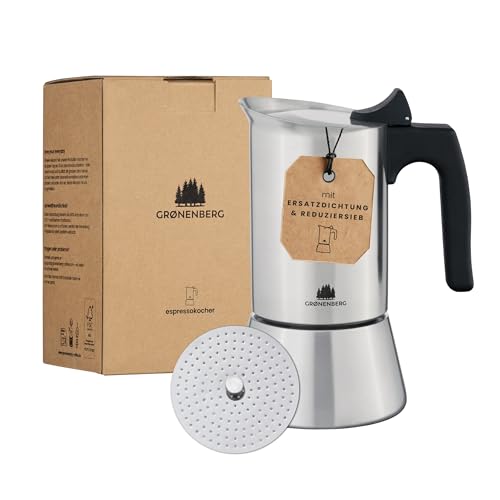
Dimensions and weight come only from the Amazon catalogue: 13.6 centimetres high, 11.4 by 8.1 centimetres wide, around 400 grams. These are overall dimensions, with handle and spout included. In the catalogue photo for this ASIN, the body is round and flares slightly towards the bottom, a black handle sits on the upper part, the lid is bare steel and attached to the handle by a black hinge piece, and in front lies the reducer filter as a flat perforated disc with the pin in the middle. The black handle points more towards the plastic version from the spare parts catalogue. In the catalogue the item carries part number GR-012 and model number EK2025FR, the manufacturer’s page gives the EAN 4262408642145 and promises 100 per cent plastic-free packaging along with climate-neutral shipping.
In detail: 1.5 bar, and what follows for the grind size
A moka pot builds up around 1.5 bar of pressure, whereas an espresso machine with a portafilter builds up about 9 bar. This comparison comes from the Grønenberg FAQ and applies to the design, not to this one model. It still explains half of the instruction manual. At 1.5 bar the steam pushes the water through the coffee bed only slowly, and coffee ground too fine puts up so much resistance that nothing arrives at the top.
That is why the FAQ calls for a coarser grind, about 4 to 5 on a scale from 1 (very fine) to 10 (very coarse), and explicitly rules out portafilter grind. The filter is filled level to the rim, and the grounds must on no account be tamped or pressed down. The table in the guide to coffee grind size translates such scale values into textures, so you can find them again on your own grinder.
The water should go into the boiler preheated, and the FAQ gives 70 to 80 degrees Celsius for that. The shorter the pot stands on the hob, the less time the grounds in the funnel have to heat through. For beans, the company recommends a slightly lighter espresso roast, freshly ground. That is the manufacturer’s recommendation and not a tasting by us.
The instructions themselves manage with four steps: unscrew the moka pot, fill the boiler with preheated water to just below the valve, insert the filter and fill it with coffee grounds, and put it on the hob until the coffee bubbles out of the riser tube. Our moka pot guide sets out the same sequence in more detail, with the handling steps that are the same for every stovetop pot.
Four cups or six? The information differs
Short answer: both sizes exist, and you have to look when ordering. Grønenberg builds the pot with 200 millilitres for up to 4 cups and with 300 millilitres for up to 6 cups. The Amazon catalogue lists the item under this ASIN as 4 cups (200 ml), and the price of €32.99 that we use here belongs to that size.
The trail runs through the part number. On Amazon it says GR-012, and in the manufacturer’s online shop precisely the 4-cup variant with 200 millilitres carries the SKU GR012FBM at a price of €32.99, while the 6-cup variant GR050FBM is listed there as an offer at €37.99 and regularly at €39.99. If you want to be sure of having 300 millilitres in the cupboard, check the size you have chosen before submitting the order.
With the 4-cup pot, the reducer filter halves the quantity. The manufacturer describes it for both sizes: 4 cups become 2, 6 cups become 4. The Amazon text only knows the second case. The filter is a flat disc, for the 4-cup pot 4.7 centimetres inside and 6.5 centimetres outside at a height of 0.35 centimetres, for the 6-cup pot 5.5 and 7.4 centimetres at 0.4 centimetres.
It is used like this: you fill the funnel filter with coffee grounds only up to the mark in the middle, put correspondingly less water in the boiler, and then place the reducer filter on the grounds with the small pin pointing upwards. The dose is therefore controlled by the volume of the funnel filter.
What to watch for at the hob
Grønenberg lists ten safety notes, all ten here: Fill the boiler only to just below the valve. The lower chamber may only be filled with water. Never put the moka pot on the hob without water in the boiler. Use only ground coffee, because other additions such as tea or cocoa can clog the filter. Make sure the pot is properly closed before use and the thread is screwed tight.
The second half of the list is about heat and supervision. On induction and other hob plates, never set the highest heat level, always a medium one. Supervise the appliance while it is in use and keep it away from children. Take the pot off the hob straight after brewing. On a gas hob the flame must not extend beyond the boiler. And finally: handle and lid can become hot with very high or overly long heat input, which is why the manufacturer advises using a towel when you take the pot off the hob.
The online instructions for use add two handling points. When screwing it together, the handle should not serve as a lever. And on a gas hob the heat from outside can warm the handle, depending on flame size, which is why a smaller flame is recommended there.
The same instructions explain why the pot must come off the hob at once: after brewing only a small amount of water remains in the lower chamber, and with further heat input an overpressure builds up which in the worst case can lead to an explosion. There is also a material note that matters on induction: stainless steel can deform if it is heated too quickly or too strongly. Heating too quickly affects the coffee anyway; the instructions say it becomes bitter and undrinkable.
What hob the pot may stand on is decided by the base. Grønenberg gives it as ferromagnetic and states a minimum size for induction: a hob zone of 9.5 centimetres diameter or more for the 4-cup pot, 10.5 centimetres or more for the 6-cup pot. Gas, electric and ceramic are listed without restriction.
Cleaning, descaling, reordering
The manufacturer describes two ways, and they are not on the same level. The product page says you can clean the moka pot in the dishwasher, except for the reducer filter. The instructions for use put it more generously: all parts of the pot may go into the machine without concern, but in the same section they name the gentlest way: by hand only and with hot water, without washing-up liquid or scouring agents. We would stick with washing by hand.
All parts are dried thoroughly after cleaning, because water residues remain in the safety valve and the funnel insert, and over time they turn into limescale deposits that clog valve and insert. The manufacturer also advises blowing out both with your mouth. The pot is only put together once all the individual parts are well dried, about 4 to 5 hours after cleaning, and for storage it is expressly not screwed together too tightly. Too much water in the boiler has the same effect: if it stands above the valve edge, the valve can, according to the instructions, clog up with limescale deposits after some time.
To descale, you fill the boiler with water to just below the valve, add two teaspoons of citric acid or vinegar, assemble the pot and brew an espresso without coffee grounds, then discard the liquid. For ongoing care the product page recommends citric acid or vinegar essence. How often this is needed depends on the hardness of your tap water, which your water supplier publishes. You check the valve, funnel insert and filter plate periodically for blocked holes, which a soft brush or the tip of a needle can clear again.
Wear on the pot is mainly at the gasket. The instructions require you to check its condition regularly and to replace the ring with the enclosed spare gasket when it is worn or damaged. For the 200 millilitre size it measures 50 millimetres inside, 63 millimetres outside and 3.2 millimetres high, for the 300 millilitre size 55, 70 and again 3.2 millimetres.
Reordering works part by part, for every part that can wear out on this pot. The online shop lists six individual parts per size: upper part with handle and lid, filter plate, funnel filter, sealing ring in a set of three, water boiler and reducer filter. We take the prices from the spare parts page for the version with a stainless steel handle. For the 200 millilitre pot they cost, in order, €11.99, €3.99, €4.99, €5.99, €11.99 and €4.99, for the 300 millilitre pot €12.99, €3.99, €5.99, €6.99, €12.99 and €5.99. The company puts the delivery time for spare parts at 7 days at most, an ordinary order arrives in one to three working days according to its own statement, and shipping within Germany costs €4.99, free from €60 of goods value. The manufacturer gives no replacement interval for the gasket; the instructions tie the replacement to its visible condition. If you work on the three rings from one set lasting five years, you arrive at €32.99 for the pot on Amazon and €5.99 for the set in the manufacturer’s shop, plus the €4.99 shipping that applies to a single reorder: that makes €43.97, or just under €8.80 a year.
What the manufacturer does not state
A few details are stated nowhere, and because they would otherwise be scattered across the text, they are gathered here. Dimensions and weight come only from the Amazon catalogue; the manufacturer’s page gives no measurements for the pot itself, only those of the reducer filter and the sealing ring, so the base diameter and the wall thickness of the boiler are missing too. What material the gasket is made of, silicone or rubber, remains open. The dishwasher is not mentioned specifically for it: the product page excludes only the reducer filter, the instructions for use clear all parts of the pot and thereby, going by the wording, include the gasket. Which handle version the item listed on Amazon has is the second open point: the spare parts catalogue distinguishes between moka pots with a stainless steel handle and those with a plastic handle, and none of the pages says which variant is in the box here.
On performance, practically everything that could be measured is missing: heat-up time and brewing time in minutes, the temperature of the finished coffee, the noise level and the operating pressure of this exact model. A gram recommendation for the coffee grounds is also nowhere to be found. About the company itself, the year of founding and the market launch of this model remain open, as does where the stainless steel used comes from.
What else is worth considering?
Three pots from our catalogue face the same question, and for all three it comes down to two things: which material stands on the hob, and how many cups come out at the end.
| Model | The difference | Price | Our score | Pick this one if |
|---|---|---|---|---|
| Groenenberg moka pot (this one) | Reducer filter in the box, the same pot covers two fill quantities | approx. €32.99 | 8.5 | you need two cups one day and four another |
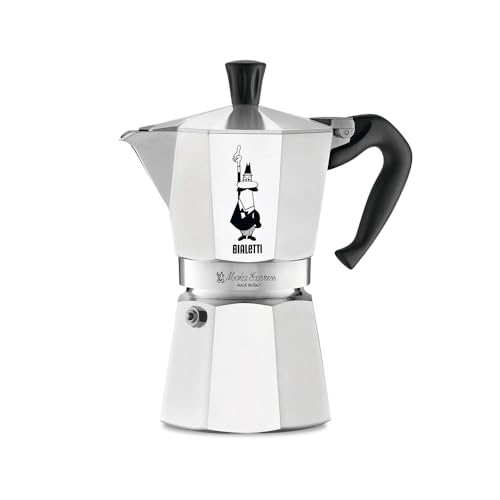
| Bialetti Moka Express | Aluminium boiler, on induction only with the manufacturer’s steel plate | approx. €28.87 | 9.4 | you cook on gas or electric and accept an aluminium pot |
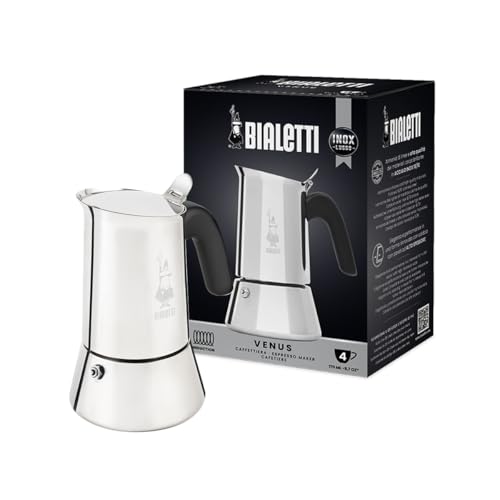
| Bialetti Venus | Stainless steel 18/10, spare part sets by cup count, fixed quantity | approx. €28.00 | 8.8 | you always brew the same quantity |
| Coffee Fox Espressokocher | Stainless steel, according to the manual for gas, electric, induction and outdoor use, base diameter not stated | approx. €17.95 | 8.0 | you want a stainless steel pot under €20 |
The prices are the catalogue values of the respective reviews as of September 2026 and change daily, the score is our editorial rating. What the table cannot do: tell you which coffee tastes better to you. For that, the four pots would have to stand side by side and be brewed. More models are in the best moka pots list.
When this pot fits and when another does
The hob decides first, and it decides on one number: from a hob diameter of 9.5 centimetres, Grønenberg approves the 4-cup pot for induction, below that it only runs with an adapter. Measure your smallest hob zone before you order; it is the only hard yes-or-no threshold on this appliance. If you cook on gas, electric or ceramic, on the other hand, stainless steel solves no problem during brewing that an aluminium pot does not solve just as well, and there the Bialetti Moka Express at €4.12 less is the more obvious choice. Nothing has been said yet about the material as such; that comes as the third point.
The second point is quantity, and with a moka pot it is awkward: the boiler is filled to the valve edge or not at all, and half portions are not provided for by the design. That is exactly where the reducer filter comes in, and it is the reason we would prefer this pot to a Bialetti Venus, which at €28.00 instead of €32.99 stays fixed to its set fill quantity.
The third point is aluminium. If you want to avoid the material in food contact, you get an explicit assurance from the manufacturer here for three components, whereas the boiler of the Moka Express is made of aluminium. How far this assurance goes and where it stops is set out above in the section on the material. For everyone else it is no reason to buy: the design is the same in both cases, and we have no verdict on taste, because we have not brewed with either pot.
Two further questions have less to do with the pot than with your household. One is the grinder: without a grinder that hits the 4 to 5 setting the manufacturer names, you buy ready-ground coffee, and the kind from the portafilter shelf is ruled out. The other is the drying time of four to five hours. If you wash the pot at midday and need it again in the evening, you will find it in pieces on the rack. This waiting time is stated in Grønenberg’s online instructions for use and is therefore this company’s requirement. If you take it seriously, you do the thorough clean in the evening.
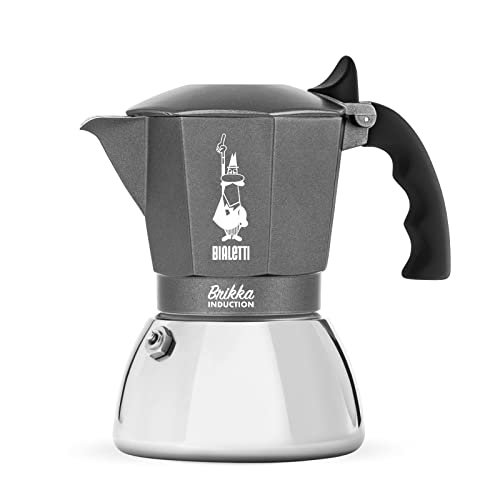
For two groups the pot is the wrong choice. If you expect a crema on the coffee, you will find no component for it on this pot. For that there are pots with a membrane in the riser tube such as the Bialetti Brikka; the safety valve in the base of the boiler is something different, it regulates the pressure and does not make foam. And if you watch the clock in the morning, you should know that nothing happens by itself here: medium heat, and someone has to stand next to it. An electric moka pot switches off, this one waits for you. Which method suits your morning in the first place is something the coffee finder can help with.
Our assessment: the reducer filter and the six individual parts per size, which according to the manufacturer are all in stock, are the two reasons to reach for this pot. If you need neither, the Italian classics work out cheaper.