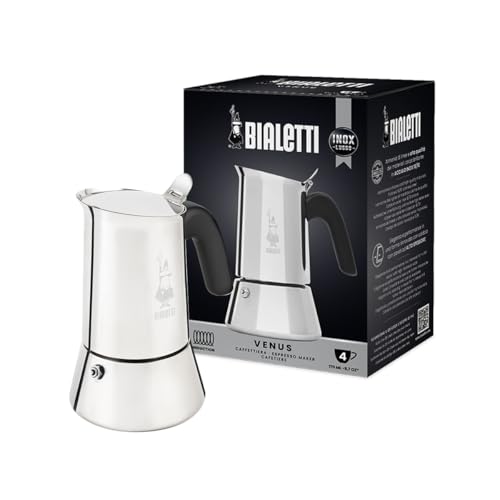
Bialetti makes the Venus from 18/10 stainless steel, and this one material decides which hob the pot may stand on. The version covered here holds four espresso cups and carries model number 0007254/SVFB, in the Amazon catalogue under part number 0007254/CN.
In our comparison of moka pots it scores 8.8 out of 10. What it costs depends on the day: on Amazon.de the price on 6 September 2026 was €28.00, and that is the date we based our data sheet on. You cannot currently get it from the manufacturer itself, as the German Bialetti site was set to not available on the same day. Behind the name stands Bialetti Industrie SpA from Coccaglio in the province of Brescia, and the instruction manual itself draws the link to the company’s history: the Moka Express arrived in 1933, and the Venus takes over its construction principle.
18/10 stainless steel, a thicker boiler wall and a thermoplastic handle
The material reads the same in every country version of the data sheet, as Acciaio inox 18/10 on the Italian page and as Edelstahl 18/10 on the German one. The two numbers name the alloy: 18 per cent chromium, 10 per cent nickel. The chromium forms a thin passive layer on the surface that protects the steel from rust under kitchen conditions. This explanation comes from materials science, and the word stainless appears nowhere on the Bialetti pages.
For the boiler there is a claim you rarely read otherwise: the wall thickness has increased by 20 per cent, and this gives the pot performance and robustness even after long use. The reference is missing, though. Thicker than which model, measured against which starting value? That makes the figure of little use for comparison, but it does indicate the design intent.
According to the Italian data sheet the handle is made of thermoplastic. The boiler contains a patented safety valve, which Bialetti describes as easy to clean and lists in the data sheet under the name Easy-clean. The pot is assembled from valve, funnel, gasket, filter plate, boiler, upper chamber and handle, and before every use the manual asks you to check that these parts are all in place.
The manufacturer gives the capacity in ounces: 5.7 oz for the 4-cup size, which converts to about 169 ml. The 170 ml from the Amazon catalogue title is a close match. Amazon has listed the same ASIN since 25 May 2016. The date says when the catalogue entry was created, not when the product launched. It does show, however, that a long production run stands behind the Venus.
In detail: what an induction hob demands of the boiler
The difference from the Moka Express lies in the material of the boiler. An induction hob heats through an alternating magnetic field, and it only couples effectively with a magnetisable base. Many hobs do not even detect a pan without such a base. Aluminium is not magnetisable, which is why an aluminium pot stays cold, and why Bialetti sells a separate steel plate for the Moka Express that goes between hob and pot.
That does not apply to the Venus. Bialetti approves it for all hobs including induction, and on the US page it phrases it as working on gas, electric and induction without an adapter. In the Amazon catalogue the same manufacturer lists it as the original coffee maker for induction, an advertising line that the technical description never backs up.
How the base of the Venus couples here remains open, and that is the more uncomfortable gap. Austenitic steels with 18 per cent chromium and 10 per cent nickel are barely magnetisable by nature, and only cold forming makes them partly magnetic. Whether the boiler base is alloyed differently from the body or whether an additional layer sits there is not stated in any of the sources checked. Only the result is documented, namely the manufacturer’s approval.
There is one exception, and it matters before you choose a size. The English product page excludes the 2-cup version from the induction approval. The instruction manual says the same from the other side: its note on the induction plate applies to the 4, 6 and 10 cup versions. The large 10-cup pot is therefore expressly included, contrary to what our earlier version of this page claimed. Bialetti gives no reason for excluding the smallest size. The common explanation that the base is simply too small comes from the retail trade, not from the manufacturer.
Can the Venus go in the dishwasher?
According to the instruction manual yes, according to the catalogue text from the same company no. We go by the manual because it is dated, specific to the model and supplied with the product, and we still recommend washing by hand, because both sources agree on this point.
The manual is the 01/2021 edition and, going by the file name, applies to the Venus in 4, 6 and 10 cups. In its German section it states that the product is dishwasher safe, but in the same sentence advises washing by hand without washing-up liquid so that the taste of the coffee does not change. The catalogue text on Amazon, also from Bialetti, lists the same pot as not dishwasher safe: you should use no cleaning agent and not put it in the machine, because that harms the product and the taste of the coffee. The US product page sits in between and phrases it as a waiver rather than a ban: after use plain water is enough, and washing-up liquid and machine are not necessary.
In the kitchen this comes down to washing by hand. The manual rules out washing-up liquid and scouring agents for cleaning, and the machine approval does not change that, since a dishwasher works with exactly these. Anyone who puts the Venus in follows one sentence of the manual and breaks the next. For the gasket the question does not arise anyway: it is cleaned by hand, and if you look it over for cracks while doing so, you notice sooner when it is due. This crack check is our advice; the manual only prescribes replacement when worn.
Cold water, medium heat, lid closed
The most widespread advice for moka pots, filling with hot water from the kettle so that the pot spends less time on the hob, runs against the manufacturer’s instructions. Bialetti prescribes cold water, filled up to the lower edge of the safety valve.
The funnel takes coffee ground for moka pots, filled loosely and expressly without tamping. Where this grind sits on the scale is explained in the guide to grind size: our starting point there lies between espresso and filter, and in the Moka Express manual Bialetti only says not to use finely ground coffee. Bialetti gives no gram figure for the 4-cup size, and you can work out guide values for coffee and water in the brew calculator.
On the hob the manual sets a condition that it words identically for induction, electric and glass-ceramic: never the highest heat setting, always a medium one. The lid stays closed meanwhile. You take the pot off the hob as soon as the upper chamber is full of coffee, then you pour. The catalogue text on Amazon says something different at the same point, namely to switch the heating off as soon as the pot starts to boil. On a glass-ceramic plate that is too little, because the plate keeps giving off heat for minutes afterwards.
The steps in order are in our guide to moka pots. Three points differ there, and the guide names them itself: it advises preheated water, an open rather than closed lid, and removing the pot at the first gurgle rather than when the upper chamber is full. Taste stands behind the first two, concern about the bitter final phase behind the third. For the Venus, however, what Bialetti wrote in the manual applies on all three points.
What else is worth considering?
Three pots from our catalogue really stand in the Venus’s way, and all three come down to the same two questions: how does the heat get into the boiler, and how much coffee ends up on the table.
| Model | The difference | Price | Our score | Choose this one if |
|---|---|---|---|---|
| Bialetti Venus (this one) | 18/10 stainless steel, induction without adapter plate, 4 cups | approx. €28 | 8.8 | you cook on induction and want no aluminium in contact with your coffee |
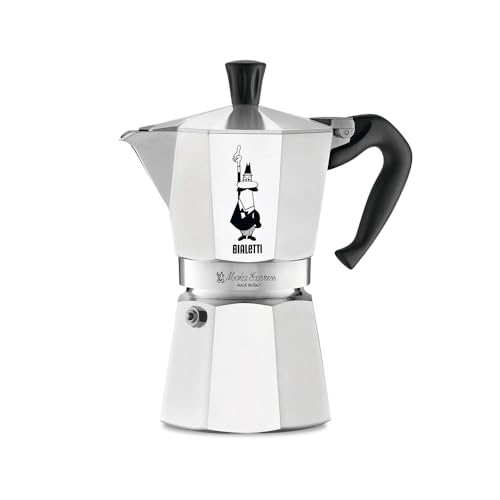
| Bialetti Moka Express | Aluminium boiler, on induction only with the manufacturer’s steel plate, 6 cups | approx. €29 | 9.4 | you cook on gas or electric and need six small cups in one go |
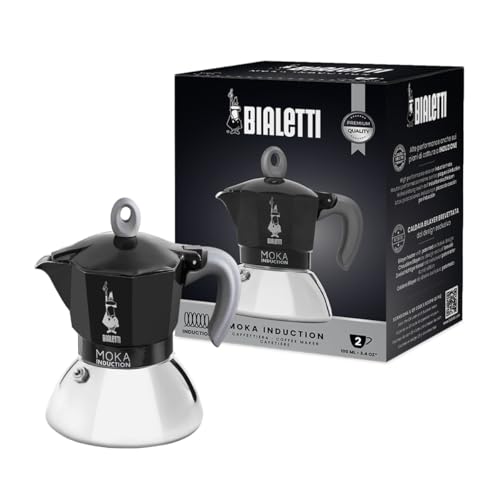
| Bialetti Moka Induction | Bi-layer boiler with aluminium on the inside, 2 cups | approx. €26 | 8.7 | you drink alone and like the octagonal Bialetti outline |
| Groenenberg Espressokocher | Reducer insert included, one pot covers 2 and 4 cups | approx. €33 | 8.5 | you need two cups some days and four on others |
The prices are the catalogue values from the respective reviews and move daily, and the score is our editorial rating. What no column can do is tell you which coffee tastes better to you. For that we would have to brew the four pots side by side. More models are in the best moka pots list.
When the Venus suits and when another pot does
The hob decides first. On induction the Venus is the pot that manages without an intermediate plate, and that is its real argument. If you cook on gas, electric or glass-ceramic, it solves no problem that an aluminium pot does not solve just as well.
Next comes quantity, and with a moka pot that is fixed. The boiler is filled to the valve edge or not at all, and the design does not provide for half portions. None of these four pots is built for a single espresso during the week. If your needs switch between two and four cups, however, the reducer insert of the Groenenberg Espressokocher converts the same pot between those two sizes.
The third point is the aluminium itself. Bialetti names 18/10 stainless steel for the Venus and nowhere lists aluminium. How far the steel extends inside is, however, documented only for the body and for the filter plate of the spare-part set. For the funnel it stays with the general material statement. The Moka Induction answers the induction question differently, with a bi-layer boiler that has steel on the outside and keeps aluminium on the inside. Contact between aluminium and coffee therefore remains there.
On money the gap is smaller than many expect. In our catalogue the Moka Express stands at €28.87 and the Moka Induction at €26.14. Between the Venus at €28.00 and the Moka Express there are therefore 87 cents, even though the Venus brings the more elaborate material.
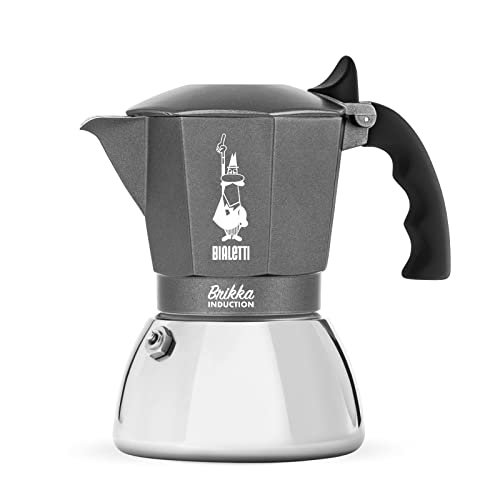
And then the crema. If you expect a layer of foam on the coffee, you end up at the Brikka with its silicone membrane in the riser tube, which stands at €52.25 in our catalogue.
That leaves the question of how much attention you have left in the morning. Medium heat and taking the pot off the hob in time: nobody does that for you. An electric moka pot switches itself off, the Venus does not.
Gasket, filter plate and what five years cost
After every use you rinse the pot with lukewarm water and store it taken apart so that every single part can dry. Both are in the manual, and the second part is the more important: a pot screwed together with residual moisture never dries properly inside. In the Amazon catalogue Bialetti turns this routine into a selling point and calls the preparation 100 per cent sustainable, because no waste arises and it is rinsed without cleaning agents. It is true that no waste arises, neither capsule nor filter paper, but the percentage figure is still advertising.
Bialetti demands no special effort against limescale in the safety valve. It is enough to move the piston that protrudes from the valve along its axis during normal rinsing. To descale, you fill the boiler as usual, add two teaspoons of citric acid or vinegar, assemble the pot completely and run one cycle without coffee powder. The liquid is discarded. How often this is due depends on your tap water, and how to classify your water hardness is explained in the guide to descaling and cleaning.
The pot has wear in two places. You replace the gasket once it is worn, but at least once a year. That is what the manual says word for word. Bialetti requires original parts that fit the model used for this, and sorts them in its own shop by cup size within the stainless steel range. For 4 cups the set of three gaskets and one filter plate costs €4.90, article number 0800401.
Both sets are so far only in the Italian Bialetti shop, and a German price and whether they can be ordered here remain open. You can still do the sums. Over five years: €28.00 plus two sets at €4.90 come to €37.80, so a good €7.50 per year. The three gaskets from the first set cover the first three years.
What Bialetti does not state
The dimensions are missing entirely, and that is the most annoying gap, because it leaves open precisely the question that matters before an induction order. Height, base diameter and weight of the 4-cup Venus appear neither on the product pages checked nor in the manual. The values in the Amazon catalogue are recognisable as placeholders: 2.94 inches of height would be 7.5 cm, which cannot possibly be right for a pot of this size, and the 0.481 pounds, so 218 g, fit the same picture. The figures in retail help little too, varying between 17.0 and 17.5 cm in height with 9.5 to 10 cm base diameter. We therefore give no centimetre figure.
On induction, besides the coupling question above, a second figure is missing: the minimum diameter your hob has to detect. Neither the product pages nor the manual put a number on it. For choosing a size, only the one documented statement remains: 4, 6 and 10 cups are approved, 2 cups are not.
The operating values are similarly thin. Brewing temperature and brewing pressure remain open, heat-up time and brew time likewise, a descaling interval is missing, and you look in vain for the amount of ground coffee in grams. Whether stainless steel heats up more slowly than an aluminium pot of the same size can therefore not be documented either, neither with a manufacturer statement nor with a measured value. Which material the funnel, lid and lid knob are made of is not listed in any data sheet; documented are the body as 18/10 stainless steel, the handle as thermoplastic and the filter plate of the spare-part set as steel. Whether the gasket fitted at the factory is silicone like the spare part in the shop also remains open. For the boiler wall the 20 per cent increase is stated, but no millimetre value anywhere. And no made-in notice appears on any of the pages checked, only the company seat in Coccaglio is documented.
On crema, Bialetti says nothing at any point for the Venus, neither promising nor dismissing it. It also remains open what the manufacturer itself knows about the machine that its own manual allows: a programme, a temperature limit, or a note on whether repeated washing dulls the surface. On the scope of delivery, that is whether a spare gasket is included, no source says anything. Spare handle, spare funnel and spare valve as individually orderable parts could not be found in the Bialetti shop; only the sets of gasket and filter plate can be ordered there, and how long the manufacturer keeps these sets available after purchase is stated nowhere. The warranty field in the Amazon catalogue simply says manufacturer warranty, without writing a duration.
Who is it suitable for?
Bialetti describes the coffee from the Venus as full-bodied but smooth. That is what the German product page says. We have not checked any of this, and the wording names an intention rather than a result: how a moka coffee tastes depends on the bean and the grind size.
The pot suits a household with an induction hob where someone stays at the hob and espresso is drunk from small cups. Bialetti itself draws a limit here, and it is easy to overlook among the safety notes: the product is intended for household use only. For the office kitchen where ten people brew one after another, the Venus is therefore not intended, regardless of whether it would hold up. It also needs space in the cupboard, because stored taken apart, boiler, funnel and upper chamber lie around separately.
It is wrong for two groups. The first puts dishes in the machine as a matter of principle. It may do so here, as the manual expressly allows it, but it thereby acts against the second manufacturer text and against the advice of the manual itself. Anyone who does not want to put up with this contradiction is better off buying a pot whose manufacturer commits to one answer. The second group has a very small cooking zone or a hob that only starts above a certain pan diameter. For them the base diameter counts, and they have to find it out themselves: measure the cooking zone and ask the retailer for the base area of the pot before you pay.