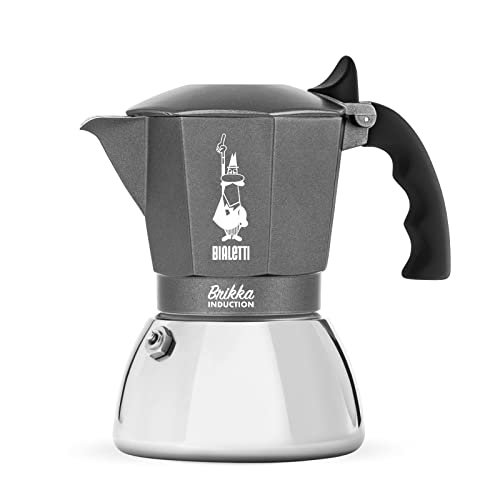
Bialetti sells two different pots under the name Brikka, and the distinction decides almost everything here. The version sold under this ASIN is the Brikka Induction: manufacturer SKU 0007317, listed in the Amazon catalogue as model 7317 with part number 0007317. According to Bialetti, its boiler is made of aluminium and steel, in two layers one on top of the other. The all-aluminium Brikka is still available, but it is a different product with a different article number.
The company has existed since 1919 and describes itself as the inventor of the moka pot. The Brikka takes its shape from the first Moka Express of 1933, but adds a component the Moka Express lacks: a riser column with a silicone membrane.
In our catalogue it is listed at approx. €52.25 on Amazon.de (as of September 2026), in the German Bialetti shop at €52.90 and in the Italian one at €69.90. The German manufacturer price is therefore practically the same as the Amazon price, so presenting it as a bargain would be wrong. In our comparison of moka pots, the Brikka scores 8.9 out of 10 points.
Two-layer boiler, silicone handle and three figures for the same capacity
The double-layer boiler is the real difference from the aluminium version. Bialetti gives the material as aluminium+steel and explains the construction by saying the double layer distributes heat evenly. According to the manufacturer, the handle is made of silicone and is described as soft-touch, while the knob on the lid is made of thermoplastic. A measuring cup is included; the instructions refer to it expressly every time you fill the pot.
On colour, the sources contradict each other. Bialetti describes the pot as anthracite with a soft-touch handle, while the Amazon catalogue lists it as silver. Both statements are attached to the same part number 0007317.
Capacity is less clear. The Italian manufacturer page gives 180 ml for the 4-cup size, the catalogue text on Amazon gives 170 ml of coffee plus crema, and the US page gives 5.4 oz of coffee plus crema, so around 160 ml. Same pot, three figures, a spread of 20 millilitres. There is also a note on the US page for the aluminium Brikka that puts expectations straight: a moka cup means around 2 oz of espresso, not a mug. Scaled up to four cups, that would come to around 240 ml, above any of the three capacity figures. For Bialetti, four cups means four espresso servings.
In detail: the membrane in the riser and the valve on the boiler
Two components are often lumped into one, and that creates false expectations. Bialetti describes them separately.
According to the manufacturer, the riser column with silicone membrane was developed to increase the creaminess of the coffee. That is Bialetti’s entire statement on its effect, and it comes without a figure. Structurally, the membrane sits in the path of the rising coffee, and it seems likely that it lets the coffee through only at sufficient steam pressure: the coffee then emerges suddenly rather than evenly, draws in air, and that is what the foam layer is based on. This explanation is our own inference from the design.
The patented valve sits elsewhere, on the boiler, and has a different job. The instruction manual lists it purely as a safety component: the Bialetti valve was patented and designed to guarantee that the espresso pot can be used in complete safety. The catalogue text on Amazon adds that it can be checked and cleaned easily. The patent therefore belongs to the valve on the boiler; Bialetti lists the membrane in the riser without this addition.
In a pump machine, the pressure is applied at a fixed basket. When it drops at the outlet, dissolved carbon dioxide escapes and carries emulsified oils with it, which gives the crema you know from a coffee bar. In the boiler of a stovetop pot, by contrast, the pressure comes from steam, and it only rises while the hob is heating. The membrane intervenes in this process at a single point: the moment the coffee emerges.
Does the Brikka work on an induction hob?
Yes. Bialetti approves it for all induction hobs and gives the two-layer boiler as the reason. The US page lists induction, gas and electric, and the German Amazon title words it as suitable for all hob types.
The reason lies in the material. An induction hob transfers its energy only into ferromagnetic material, and aluminium is not one. In this boiler the steel layer takes over the coupling with the hob, while the aluminium above it spreads the heat. That is exactly why the all-aluminium Brikka needs the adapter plate that Bialetti sells separately on the same hob, whereas this version is simply placed on it.
The instruction manual makes two restrictions. The first concerns the heat setting: on induction, electric and glass-ceramic hobs, never the highest, always a medium one, and the boost function must never be used on induction. If you use it anyway, the manual names exactly that as one of the causes of air escaping at the safety valve.
The second concerns the diameter. Before using it on an induction hob, you should check whether the boiler diameter matches the technical characteristics of your hob. For hobs with a high minimum diameter, this is the question to settle before ordering.
For gas hobs the sources are inconsistent: the US page names gas expressly, the Italian product page speaks only of induction, and the instruction manual describes use with a flame. We read that as approval. For the flame itself, the manual asks for the same restraint as for the induction setting: it must not reach beyond the edge of the boiler.
Brewing according to Bialetti’s instructions
Before first use, the instructions call for a completeness check: safety valve, filter and funnel, gasket and filter plate must all be in place. Then cold water goes into the boiler, always using the supplied measuring cup. The common advice to fill with hot water from a kettle so that the pot spends less time on the hob contradicts this instruction. As the fill-level mark, the catalogue text on Amazon names the safety valve: for particularly creamy coffee, the boiler should be filled up to there.
Ground coffee for moka pots goes into the funnel, and here the instructions are unusually clear: expressly no finely ground coffee, and do not press. Espresso grounds from a portafilter machine compact into a cake in the funnel that steam pressure can hardly get through. You wipe coffee residue off the rim of the boiler before screwing the pot shut. The instructions also list what does not belong in the funnel at all: malt coffee, cocoa, extracts and filter coffee.
After that the Brikka works on its own until a sound announces itself. The instructions describe it as a characteristic bubbling, hissing sound that signals the start of crema formation. From then on the pot should not stay on the hob for long: if you leave it on the heat source after the brew, the crema can disappear, as the manual puts it. The catalogue text on Amazon says only to switch the hob off. On an electric or glass-ceramic hob that is not enough, because the plate stays hot; the instructions require the pot to be taken off.
If no crema appears at all, the instructions name the water level and the measuring cup that must be used for it as the first thing to check. Guideline amounts of ground coffee are in the brew calculator, and the individual steps in order are in our moka pot guide. How manufacturers classify the moka grind is covered in the guide to grind size: almost all place it between espresso and filter, while the figures differ on exactly how fine.
What else is worth considering?
Four pots from the same maker, because the Brikka has its closest relatives there: the same design, the same spare-parts system by number of cups. What separates them is the boiler and the membrane.
| Model | The difference | Price | Our score | Pick this if |
|---|---|---|---|---|
| Bialetti Brikka Induction (this one) | Riser column with silicone membrane, boiler made of aluminium and steel, 4 cups | approx. €52 | 8.9 | you cook on induction and want a foam layer on your moka coffee |
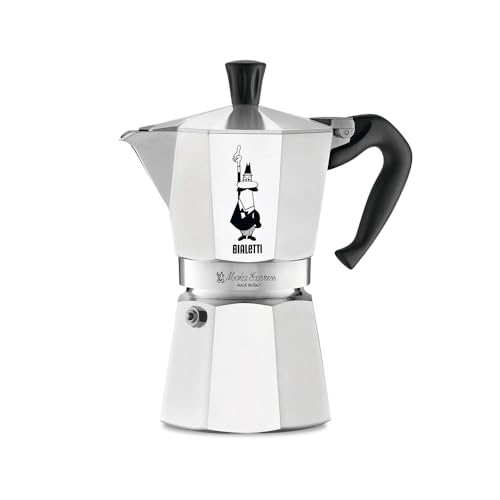
| Bialetti Moka Express | no membrane, pure aluminium boiler without a steel layer, 6 cups | approx. €29 | 9.4 | you cook on gas or electric and need six small cups at once |
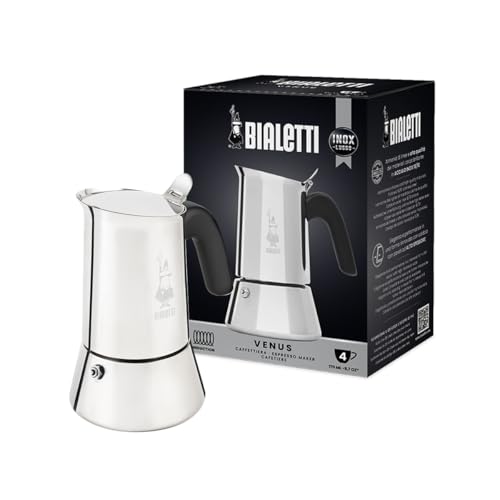
| Bialetti Venus | 18/10 stainless steel body instead of a composite boiler, induction compatible, no membrane | approx. €28 | 8.8 | you have induction and want stainless steel instead of aluminium in the boiler |
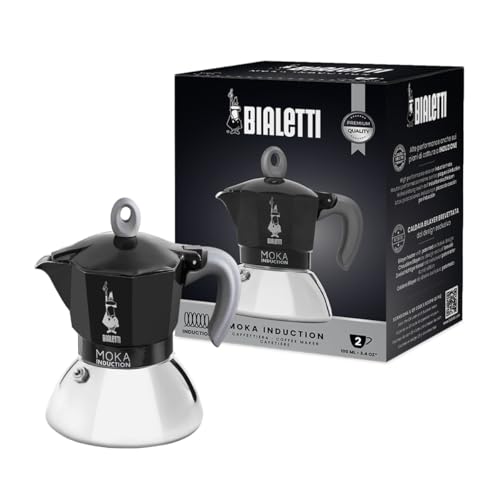
| Bialetti Moka Induction | same bi-layer principle of steel and aluminium, no membrane, only 2 cups | approx. €26 | 8.7 | you drink alone and want to stay under €35 |
Prices are as of September 2026 and move daily; the score is our editorial rating. What ends up in the cup is in no column: for that we would have to brew the four pots against each other. More models are listed in the best moka pots list.
When the Brikka fits and when another pot does
The hob decides first, in both directions. On induction, this version is the only Brikka that works without an intermediate plate. If you cook on gas or ceramic, you pay for the steel layer without getting anything from it; in that case the all-aluminium Brikka is enough, and if you do without the foam layer entirely, the Moka Express works out cheaper.
Next comes quantity. One run fills four moka cups, in total the 160 to 180 ml on which the manufacturer pages above disagree. For two people with one espresso each, that is enough. For a mug of milky coffee it is not, and there is no larger Brikka than the 4-cup one.
That leaves the budget. The Brikka at €52.25 is up against the Venus at €28.00, the same 4-cup class, also on induction. The difference of a good €24 cannot be put down to the membrane in the riser alone, because the two pots also differ in the boiler (aluminium and steel against 18/10 stainless steel) and in the handle (silicone against thermoplastic). Whether the foam layer is worth it to you is, in our assessment, the only question that really carries this purchase decision.
Care, descaling and what five years cost
After every use you rinse the pot with lukewarm water, without detergent and without abrasive cleaners. While rinsing, you move the piston that protrudes from the safety valve along its axis. According to Bialetti, that is all that is needed against limescale deposits in the valve. The catalogue text on Amazon describes the same action differently, speaking of removing the small piston. We stick to the instructions: move it, do not remove it.
To descale, you fill the boiler as usual, add two teaspoons of citric acid or vinegar, assemble the pot completely and run one cycle without ground coffee. The liquid is discarded. How often this is necessary depends on your tap water; how to classify your water hardness is covered in the guide to descaling and cleaning. Limescale is not a cosmetic issue here: Bialetti expressly excludes damage caused by limescale deposits from the product guarantee, which according to the instruction manual runs for two years from the date of purchase, provided the pot is used under the operating conditions stated there. The replaceable parts filter, funnel insert and gasket are also excluded, unless it is a manufacturing defect.
Two parts wear out. You replace the gasket when it is worn, but at least once a year, as the instructions require. You check the filter plate regularly for blocked holes and clear them with a soft brush or the tip of a needle. Bialetti prescribes original spare parts for the model for both, which rules out universal parts from the accessories trade.
In the manufacturer’s spare-parts shop, these parts are sorted by number of cups, not by model name. The silicone membrane from the riser is not listed there as an individual part at all; what can be ordered for the Brikka is the set for the 4-cup size: three gaskets and one filter plate for €4.90.
Over five years: €52.25 purchase plus two sets at €4.90 comes to €62.05, so a good €12 per year. The three gaskets from the first set cover the first three years.
What Bialetti does not state
The very value that the instructions themselves make a check criterion is missing: you look for the boiler diameter in vain on every country page, as well as a minimum diameter or a minimum power at which an induction hob recognises the pot. Dimensions and weight appear only in the Amazon catalogue, and the values there are unusable: 0.22 pounds, so around 100 grams, for a pot made of aluminium and steel, plus around 22.3 x 24.6 x 26.0 cm for a 4-cup moka pot. The wall thickness of the two boiler layers and the grade of steel used also remain open.
When it comes to brewing, the situation is no better. The manufacturer gives an amount of ground coffee in grams for neither of the two sizes, and the water quantity table exists in the instructions PDF only as a graphic, not as machine-readable text. Heat-up time, brew time and brewing temperature are missing, as are a descaling interval and a service life for the silicone membrane; Bialetti gives a replacement interval only for the gasket. Also open are the year the Brikka was introduced and the country of production of this induction version: Made in Europe is expressly stated by Bialetti only for the aluminium Brikka.
Who is it for?
Bialetti sells the Brikka with the promise that it delivers the experience of a real Italian espresso as at the bar. That is the manufacturer’s wording, and it names a goal, not a design: at the bar a pump pushes water through a fixed basket, here steam lifts it through a funnel. If you bring the bar espresso as your yardstick, what you are buying here is an approximation.
The pot suits a household with an induction hob where someone stays at the stove: medium heat, no boost, pot off as soon as the coffee has run through. Anyone who instead switches the hob on and walks into the hallway wastes exactly the component they paid for. If the only coffee in the cupboard is ground to espresso fineness, you need different powder or a grinder that can go coarser; the amount of water cannot make up for it.
It is the wrong choice in a household where the breakfast crockery goes entirely through the dishwasher: there is one item left over every morning that has to be washed by hand. And it costs more than any other stovetop pot in our catalogue, while demanding the most attention of the four Bialetti pots here. That is reflected in our score for handling: 8.3 points, against 8.6 for the Venus and 9.0 each for the two Mokas. If that is too much of a morning routine, go for the Moka Induction: also induction, but with only half the output and no component whose effect you can miss.