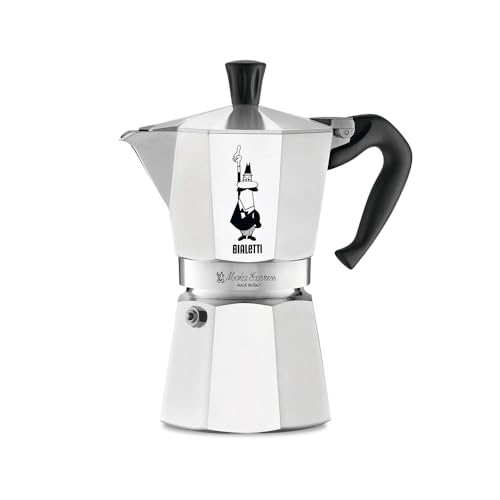
Alfonso Bialetti opened a workshop for semi-finished aluminium products in Crusinallo near Omegna in 1919. Fourteen years later the Moka Express was in the range, and the manufacturer still advertises with the line “Only and original since 1933”. Aluminium was the modern material back then, and Bialetti itself describes it as a light, resilient material that stood for modernity. According to Bialetti, the octagonal shape goes back to the silhouette of Alfonso Bialetti’s wife, and the little man with the moustache to the illustrator Paul Campani, who took Renato Bialetti as his model; the figure was popularised by the television programme Carosello. According to the manufacturer, the pot is now part of the permanent collection of the Triennale in Milan and of MoMA in New York.
In our catalogue the 6-cup version is listed at €28.87 on Amazon.de, as of September 2026. At the time of our research the European Bialetti shop quotes €26.90, and in the manufacturer’s German shop the pot was listed as not available. In our comparison of moka pots it leads with 9.4 out of 10 points.
This is not an espresso machine. The instruction manual even expressly rules out coffee for professional espresso machines as a filling.
Nine parts: valve, boiler, funnel, gasket, filter
The instruction manual numbers the pot part by part: safety valve, boiler, filter funnel, gasket, filter plate, upper part, handle, knob, lid. The boiler is made of aluminium, and the handle and knob are thermoplastic according to the Italian product page. Bialetti never mentions Bakelite, which turns up in many descriptions of the handle. The manufacturer’s Amazon catalogue text describes the material as double-turned aluminium and the handle as ergonomic.
The safety valve sits on the boiler, and its lower edge is also the fill mark for the water. Bialetti calls it patented and easy to clean. One of the two maintenance steps the instructions require hangs on it: when rinsing, you move the plunger that sticks out of the valve along its axis so that no limescale settles. The manufacturer says to repeat this regularly, so at every rinse. The second maintenance step concerns the filter plate and is described further below.
According to the manufacturer the aluminium is 100 per cent recyclable, and according to the catalogue text production takes place in Italy. On the US site Bialetti lists the 6-cup version under the SKU 0004943/SV, but in red; the version discussed here is silver according to the Amazon catalogue. In the Amazon catalogue the model is simply called Moka Pot, the ASIN is B00004RFRU and the part number is part_B01LEKPVCQ.
How the pressure pushes the coffee up
The boiler holds cold water up to the lower edge of the safety valve, as the instructions prescribe. When heated, steam pressure builds up in the closed lower part and pushes the water through the filter funnel with the ground coffee and on through the riser tube into the upper part. No more mechanics are involved. The instructions state that the product needs heat and generates overpressure inside, and warn that ignoring the rules can lead to scalding or cause the pot to burst.
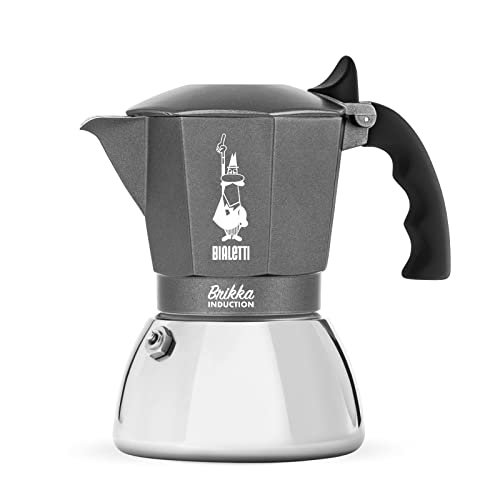
For comparison, a portafilter basket sees about 9 bar. When the pressure drops at the outlet, the dissolved carbon dioxide escapes and carries emulsified oils with it, and that is the crema layer known from the café bar. A stovetop pot works with a fraction of that pressure. The Brikka from the same maker has a silicone membrane in the riser tube for this purpose, which according to Bialetti is meant to increase the creaminess of the coffee. The Moka Express lacks this part, and Bialetti has built it without since 1933.
On grind size the instructions are unusually clear: ground coffee for moka, expressly not finely ground coffee. Too fine means a filter cake that the steam pressure can hardly get through. Fill the filter funnel loosely without pressing, and wipe coffee grounds off its rim. You will find guide values for the amount in the brew calculator and in the moka pot guide.
On the hob: the gas flame must not reach beyond the boiler, and on electric and glass-ceramic hobs Bialetti prescribes a medium heat setting, never the highest. Take the pot off the heat as soon as the upper part is full of coffee.
What Bialetti does not state
For a product that has been built since 1933, the data sheet is thin, and we would rather present the gaps together than scatter them through the text. Bialetti states dimensions and weight on none of the pages we checked. The Amazon catalogue does list values, but they are unusable: 2 inches each for height, length and width, plus a weight of 2.20462262 pounds, which is exactly one kilogram. These are conversion placeholders, not measurements.
Likewise missing are a pressure value in bar, a brewing temperature and a brewing time, and the amount of ground coffee for each pot size exists in the PDF of the instructions only as a graphic, not as readable text. For the capacity of the 6-cup version there is no German manufacturer figure, and for the factory-fitted gasket and the filter plate there is no material specification. No sales figure appears on any manufacturer page, neither as a unit count nor as a statement about the market ranking, and there is no current German manufacturer price either, because the German shop lists the pot as not available. Several retailer pages give dimensions and weight. We do not adopt them because they do not come from the manufacturer.
Does the Moka Express work on an induction hob?
Only with an accessory. Bialetti specifies gas and electric hobs and names induction solely in connection with its own induction plate, because aluminium is not magnetic and does not couple with the field.
This plate is made entirely of steel and costs €19.90 at the time of our research. It couples with the field itself and passes the heat on to the boiler by contact. According to the manufacturer it fits moka pots from 1 to 9 cups, so it does not cover the two largest pots in the range. Together with the pot you end up at around €49.
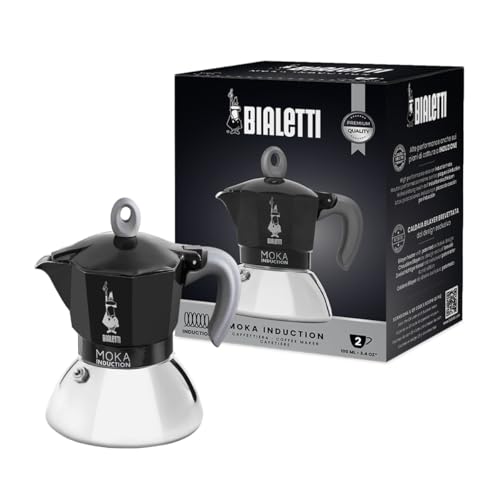
The alternative from the same maker is the Moka Induction, which Bialetti lists as its own range for induction hobs. In our catalogue it stands at approx. €26.14 and 8.7 points, but only in the 2-cup size. That does not suffice for six cups in one go.
What else is worth considering?
| Model | The difference | Price | Our score | Pick this one if |
|---|---|---|---|---|
| Bialetti Moka Express (this one) | Aluminium, 6 cups, no membrane in the riser tube, its own replacement set for this size | approx. €29 | 9.4 | you cook on gas or electric and need six cups per run |
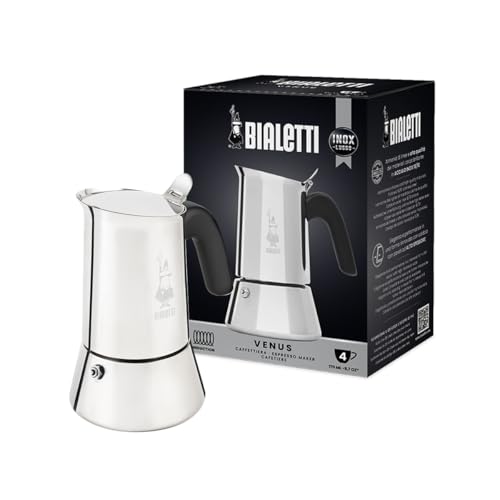
| Bialetti Venus | 18/10 stainless steel body, induction-compatible, rustproof, 4 cups with about 170 ml | approx. €28 | 8.8 | you have an induction hob and want stainless steel instead of aluminium |
| Bialetti Brikka | Silicone membrane in the riser tube, according to Bialetti for more creaminess, boiler of aluminium and steel, 4 cups | approx. €52 | 8.9 | you are used to café espresso and can manage with 4 cups; the €23 premium does not buy a bigger pot |
| Florina Grande Aluminium 6 cups | Same design and size, but no dedicated spare parts range | approx. €18 | 7.8 | you are starting on the smallest budget and would rather replace the pot than repair it |
Prices are as of September 2026, and the score is our editorial rating. What ends up in the cup is not in the table; for that we would have to brew the four pots against each other. More candidates are in the list of the best moka pots.
When this pot suits and when another does
The hob type decides first. On gas and on electric plates the Moka Express runs without accessories, on induction only with the steel plate from the section above. Without this intermediate piece you need a magnetic pot base, and Bialetti makes those in stainless steel.
The quantity per run determines the size. According to the manufacturer’s catalogue text, the range comes in 1, 2, 3, 4, 6, 9, 12 and 18 cups with 60, 90, 130, 185, 250, 410, 595 and 800 millilitres. Work through the series and one cup comes to 42 to 50 millilitres, with only the smallest pot falling outside at 60 millilitres. Because you fill the water up to the lower edge of the valve, a large pot cannot sensibly be run half full: up to three small cups in a row are covered by the 3-cup size with 130 millilitres, four cups by the 4-cup size with 185 millilitres, and from five upwards by the 6-cup version with 250 millilitres.
This pot stays the exception if the rest of your breakfast crockery otherwise goes into the dishwasher. The section on cleaning below explains why.
Limescale is the valve’s enemy. The “hard” water range begins at 14 °dH (German degrees of hardness), and from there an occasional care task becomes a fixed habit. You get your value from your local water supplier, and most publish it online as a drinking water analysis.
Finally, the grounds. If you only have espresso grind for a portafilter machine in the cupboard, you need a different powder or a grinder that can go coarser. Pot size cannot make up for it, because grind size decides.
Spare parts, accessories and what running it costs
The gasket is the wear part. Bialetti requires replacement when it is worn, but at least once a year, and prescribes using original spare parts for the respective model. Universal gaskets from the accessories trade are therefore not approved. The set of one silicone gasket and one stainless steel filter for the 6-cup size is listed in the German Bialetti shop at €7.99, as of our research.
Work that out over five years: €28.87 purchase plus five sets at €7.99 comes to about €69, so just under €14 a year for a pot whose design, according to Bialetti, is conceived to last practically a lifetime.
The guarantee does not help with wear. In the instruction manual the manufacturer gives two years from the date of purchase, tied to the operating conditions described there, and expressly excludes the replaceable parts: filter, funnel insert, gasket and handle, unless there is a manufacturing defect. Damage from impact, dropping and limescale deposits is also excluded. The last point explains why the plunger in the valve needs to be moved at every rinse: Bialetti does not cover limescale damage.
The German spare parts page lists gaskets, filters and one filter funnel, nothing more: neither a spare valve nor a spare handle, and for the common claim that spare parts for the Moka Express are available everywhere there is no basis at the manufacturer. During our research, several spare parts sets in the Bialetti shop itself were marked as not available.
Cleaning, descaling and what Bialetti says about patina
The instructions require hand washing after every use, with lukewarm water, without detergent and without abrasives. The German product page is somewhat more relaxed: there, hot water without soap or washing-up liquid is enough. The dishwasher is expressly ruled out.
To descale, fill the boiler as usual to just below the valve, add two teaspoons of citric acid or vinegar, assemble the pot completely and run one cycle without coffee grounds. You pour the liquid away. How often this is necessary depends on your tap water; how to classify your water hardness is covered in the guide to descaling and cleaning.
The second regular maintenance step from the instructions is the filter plate. Check it for blocked holes and clear them with a soft brush or a needle tip. Do not knock out the funnel insert to get the coffee grounds out: according to the instructions it can be damaged or warp. Store the pot taken apart and completely dry, not screwed together. The oven and microwave are off limits, and Bialetti approves the product for household use only.
On the subject of patina, only the care rule is documented: Bialetti requires rinsing without detergent and justifies this with preserving the properties over a long time. The word patina appears nowhere at Bialetti, neither on the product page nor in the instructions. That the dark layer inside improves the flavour is what the community says, not the manufacturer.
Who is it for?
The Moka Express is the right pot for a household with a gas or electric hob that drinks its espresso in small cups and fills the pot each time. Our score is made up of four individual marks; the strongest is value for money at 9.6, the weakest handling at 9.0.
Anyone who expects a crema layer because they know it from the café bar will not get it here, by design, and is better served by the Brikka or straight away by a portafilter machine. And if you have to leave the house in the morning while the coffee is running, do not buy a device whose instructions require taking it off at the right moment: an electric model with automatic switch-off is the better purchase for that morning.