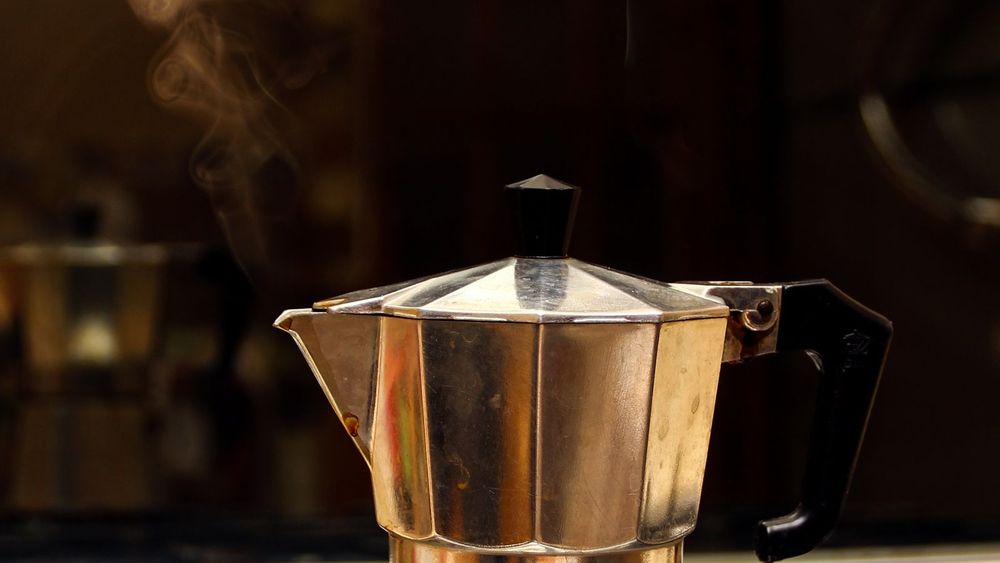
Seventeen products in the catalogue, eight on this list
Our moka pots category lists exactly 17 products on 15 September 2026. The eight with the highest overall score make this list, from 9.4 to 8.3 points. A ninth product is also at 8.3; why it is missing is explained in the last section. There is no price band or brand quota, and so four of the eight places go to Bialetti.
The basis of every statement about a product is its own review. We revised all eight reviews in September 2026, based on the manufacturer pages, the instructions and the Amazon catalogue data. For Barista Royal, the review relies on the preparation steps on the product page and a blog post by the manufacturer, since no instructions are available as a PDF; for the Diego it relies on two blocks of notes on the product page, because Easyworkz has no download area. We have not had any of the pots in our hands and have not drunk from any of them. This page compares data.
The score is our editorial assessment, made up of four individual scores for build quality, performance, handling and value for money. Where two products are level, the ranking says how their reviews differ; we do not claim a formula behind the overall score. The guide prices (from our catalogue, on Amazon.de) range from approx. €26.14 to approx. €64.46.
Heat source first, then the base of the boiler
Seven of the eight products are stovetop pots, and they work in the same sequence: the water heats up in the closed lower chamber, the steam pressure pushes it through the coffee grounds in the funnel and on through the riser tube into the upper chamber. The Rommelsbacher EKO 364/E follows the same principle, but brings a concealed heating element with 365 watts rated power consumption, stands on its own central base and switches itself off at the end. It is the only appliance on this list for which the question of the hob does not arise.
For the other seven, the base decides whether an induction hob heats them at all. The coil under the glass effectively heats only ferromagnetic metal, and aluminium is not one. The list contains three answers to this.
The Moka Express gets round the problem with an accessory. Its boiler is aluminium, Bialetti approves it for gas and electric and for induction only together with its own induction plate. This plate is made of steel, sits between the hob and the pot and, according to the manufacturer, suits pots from 1 to 9 cups.
Brikka and Moka Induction solve it with two metals in the boiler. For the Brikka, Bialetti describes a construction of aluminium and steel in two layers; for the Moka Induction there is steel on the outside for contact with the hob and aluminium on the inside, which spreads the heat. The upper part of the Moka Induction, where the finished coffee arrives, is aluminium.
Venus, Barista Royal, Groenenberg and Diego rely on stainless steel, and here the grade is worth a look. For the Venus, Bialetti names 18/10 stainless steel. This alloy is barely magnetic by nature, and how the base of the Venus nonetheless couples with the hob is not answered by any of the sources of its review; only the approval is documented. For the Diego, Easyworkz describes two materials, 18/8 for the body and specially magnetic stainless steel for the base. Grønenberg, which is how the manufacturer of the Groenenberg writes its name, lists 430 steel in its online instructions for use, a ferritic and therefore magnetic grade; its FAQ also mentions 304. Barista Royal writes stainless steel without stating the grade and lists induction among four approved hob types.
The second hurdle is the surface area. Many hobs recognise cookware only from a minimum diameter, and the base of a moka pot is narrow. Among the seven stovetop pots, only Grønenberg quantifies what its pot needs: a cooking zone of 9.5 centimetres or more for the 4-cup size, 10.5 centimetres or more for the 6-cup size, and below that an induction adapter. Bialetti leaves the check of the boiler diameter for Brikka and Moka Induction to the buyer via the instructions without publishing the dimension, and excludes the smallest 2-cup size of the Venus entirely from the induction approval. For the Moka Induction there is also the shape: its boiler tapers towards the bottom, so what rests on the glass is narrower than the widest point of the pot.
The heat setting is not freely selectable either. On electric, glass-ceramic and induction hobs, Bialetti requires a medium setting and prohibits the highest; Grønenberg prescribes the same and additionally warns that stainless steel can deform if heated too fast or too strongly. Easyworkz ties the rust resistance of the Diego expressly to medium heat without overheating.
The ranking, place by place
Place 1: Bialetti Moka Express, 9.4 points
In our assessment, value for money is decisive here, at 9.6 the highest of its four individual scores. For approx. €28.87 you get a design that Bialetti has offered since 1933, in eight sizes from 1 to 18 cups, and for exactly this 6-cup version a spare-parts set of its own from the manufacturer rather than universal goods. With 9.4 points it is the comparison winner of this list. This calculation can only work out, though, where the aluminium boiler heats without an accessory, that is, on a gas or electric hob; on induction, the steel plate from the price section comes on top. This design does not deliver a layer of foam; on this list, only the Brikka has an additional component for it.
Place 2: Bialetti Brikka 4 cups, 8.9 points
The Brikka is the only pot on the list for which its manufacturer describes a component for foam formation: a silicone membrane in the riser column, which according to Bialetti is meant to increase the creaminess of the coffee. In our assessment this component carries its place, together with the two-layer boiler that puts it directly on induction. Its weakest individual scores are value for money at 8.2 and handling at 8.3, the lowest handling score on the list. According to the instructions, the crema can dissipate if the pot is left on the heat source after the run. So only someone who stays in the kitchen while brewing and takes the pot off in time gets something from the membrane. At approx. €52.25 it costs €24.25 more than the Venus, which in the same 4-cup size also runs on induction.
Place 3: Bialetti Venus, 8.8 points
The Venus brings 18/10 stainless steel onto the induction hob without a plate, and does so for approx. €28.00, 87 cents below the guide price of the Moka Express. Therein lies its argument, and it applies only to people with induction: anyone cooking on gas or electric gets nothing from the steel during heating that the aluminium pot does not also deliver. The quantity is fixed, 5.7 ounces according to the US manufacturer page for four espresso cups, converted around 169 millilitres. Bialetti does not publish dimensions or base diameter for this size. On the dishwasher, two texts from the manufacturer say opposite things; more on this in the section on cleaning.
Places 4 and 5, level on 8.7: Bialetti Moka Induction 2 cups and Rommelsbacher EKO 364/E
Two products with the same overall score that have hardly anything in common. At approx. €26.14 the Moka Induction is the cheapest of the eight and holds two espresso cups: around 90 millilitres according to the Bialetti page of the decorated version, 100 millilitres according to the Amazon title. That is enough for one person or for two small portions, and its instructions do not provide for half fills.
The Rommelsbacher stands at approx. €64.46 according to our price box and is thus the most expensive of the 17 products in the category; the Amazon catalogue showed €60.89 on 7 September 2026. It suits you if no suitable hob is available or you do not want to time the moment when a stovetop pot has to come off the hob yourself. According to the instructions, the pot must not be taken off its base while cooking; at the end the switch springs back and the indicator lamp goes out. A filling holds at most 250 millilitres of water, with filter inserts for two or four moka cups, and before the next run Rommelsbacher requires a cooling pause.
What separates the two is shown by the individual scores: the Rommelsbacher is ahead on handling, 9.3 against 9.0, the Moka Induction on value for money, 8.3 against 8.0.
Places 6 and 7, level on 8.5: Barista Royal Espresso Maker 6 cups and Groenenberg Induction Moka Pot
Barista Royal includes a cork coaster and a spare sealing ring with its pot for six cups (300 millilitres according to the Amazon catalogue). A reducer strainer is not included, and the manufacturer requires water up to just below the valve and a completely filled filter.
The Groenenberg is at approx. €32.99. Under this ASIN it is the 4-cup size with 200 millilitres, and the enclosed reducer strainer halves the quantity to two cups. Grønenberg also sells six individual parts per size as replacements, from the upper part with handle to the water boiler. Against this stands a requirement from the instructions for use: the pot is assembled only once all parts have dried, about 4 to 5 hours after cleaning.
On three of the four individual scores Barista Royal is ahead, the Groenenberg by contrast clearly on value for money, 8.9 against 7.8. In our assessment, what decides between the two is your quantity: Barista Royal if you need the full pot every morning, the Groenenberg if it is sometimes four and sometimes two cups.
Place 8: Easyworkz Diego, 8.3 points
The Diego holds 300 millilitres for six cups. Its review sees the reason to buy in the magnetic base under the high-gloss polished 18/8 body, together with the manufacturer’s express induction approval. That makes it a candidate for a household with an induction hob that mostly brews six cups and occasionally fewer: for the smaller quantity a reducer piece is included, and Easyworkz advises filling the boiler then only halfway to the safety valve; to how many cups the quantity falls, the manufacturer does not say. For the full pot it recommends 25 grams of coffee. Easyworkz lists wear parts only in its English-language own shop in US dollars, and shipping to Germany is not stated there. Its weakest individual score is value for money at 7.8. The review also sets the Groenenberg against it, which costs €12 less, is also made of stainless steel and comes with a spare gasket, and at the same guide price of approx. €44.99 Barista Royal stands on the list with 8.5 points.
The one difference per pot
| Model | The difference | Price | Our score | Pick this if |
|---|---|---|---|---|
| Bialetti Moka Express | Aluminium boiler for 6 cups, on induction only with a steel plate | approx. €28.87 | 9.4 | you need six cups in one go and wash the pot by hand |
| Bialetti Brikka 4 cups | Silicone membrane in the riser column, boiler of aluminium and steel | approx. €52.25 | 8.9 | you want a crema on induction and four cups per run are enough for you |
| Bialetti Venus | 18/10 stainless steel without a plate on induction | approx. €28.00 | 8.8 | you brew the same four espresso cups every day on induction |
| Bialetti Moka Induction 2 cups | Steel outside, aluminium inside and in the upper part | approx. €26.14 | 8.7 | two espresso cups per run are enough for you on induction |
| Rommelsbacher EKO 364/E | Own heating element with 365 W and cut-off, at most 250 ml water | approx. €64.46 | 8.7 | you want to brew without a hob and need at most four moka cups |
| Barista Royal Espresso Maker 6 cups | Cork coaster and spare ring in the box, no reducer strainer | approx. €44.99 | 8.5 | you need the full pot every morning and no half fill |
| Groenenberg Induction Moka Pot | Reducer strainer from 4 to 2 cups, six individual parts in the manufacturer shop | approx. €32.99 | 8.5 | you want to buy parts such as the boiler or upper part separately |
| Easyworkz Diego | Reducer piece in the box | approx. €44.99 | 8.3 | you brew six cups on induction and want to clarify in advance how to buy gaskets again |
Prices and scores were taken by us on 15 September 2026 from the data sheets of the eight reviews. The guide prices themselves are older. Seven reviews give their price as of September 2026; for the Rommelsbacher our guide value is an earlier state from the Amazon catalogue; what the catalogue showed on 7 September is stated above in the ranking. The table says nothing about the coffee from these pots; we have brewed with none of them.
Three price tiers: under €30, up to €45, above
Under €30 on 15 September 2026 are eight of the 17 products in our category, three of them on this list and all three from Bialetti: the Moka Induction for approx. €26.14, the Venus for approx. €28.00 and the Moka Express for approx. €28.87. Between the cheapest and the most expensive of the three there are €2.73, and each gives a different answer to the hob: aluminium for gas and electric, stainless steel for induction, two metals for induction in a small format.
Between €30 and €45, the list has the Groenenberg for approx. €32.99 as well as Barista Royal and Diego at approx. €44.99 each. All three are stainless steel pots for induction, and none brews on a different principle from the Bialettis below them. The extra cost buys equipment. For the Groenenberg, which is €4.99 above the Venus, that is the reducer strainer and a spare gasket in the box (whether one comes with the Venus, no source says), plus individual parts in the manufacturer shop, where for the Venus there are only sets of gasket and filter plate. For Barista Royal and Diego it is above all the larger pot with 300 millilitres, plus a reducer piece for the Diego and a cork coaster and spare ring for Barista Royal.
One more calculation belongs in this tier. Anyone who wants to run the Moka Express on induction adds the induction plate from Bialetti for €19.90 and ends up at €48.77 together, so above each of the three stainless steel pots.
Above €45, only two products in the whole category cost: the Brikka at approx. €52.25 and the Rommelsbacher at approx. €64.46. Only here does the extra cost change how the appliance works: for the Brikka, the membrane in the riser tube intervenes, by the deduction in its review from the design, at the moment the coffee emerges; for the Rommelsbacher, the own heating element replaces the hob. In our assessment, the step from around 29 to 33 to 45 euros buys mainly accessories, for the Groenenberg plus individual parts in the manufacturer shop and for Barista Royal and Diego the larger pot. Gaskets are not easier to buy again everywhere as a result: for Barista Royal, the manufacturer shop lists no wear parts beyond the enclosed spare ring. At the top you pay for a function, and whether you need it depends on your morning.
Dishwasher or hand wash: what the manufacturers approve
For Moka Express, Brikka and Moka Induction, Bialetti expressly rules out the dishwasher; according to the instructions, they are rinsed with lukewarm water without detergent or scouring agents. The Rommelsbacher also must not go in the machine, and according to the instructions the water container and central base must be neither immersed nor held under running water.
For the Venus, two texts from Bialetti itself contradict each other. The operating instructions in the 01/2021 edition call the pot dishwasher-safe and in the same sentence advise hand washing without washing-up liquid; the catalogue text on Amazon rules out the machine. We would wash the Venus by hand.
Three further suppliers approve their stainless steel pot for the machine, each with a qualifying clause of its own. Barista Royal allows it on the product page without restriction, but in its own care text for stainless steel moka pots describes taking apart and rinsing under warm water. On the product page, Grønenberg excludes the reducer strainer; the instructions for use allow all parts and still call hand washing with hot water the gentlest way. Easyworkz approves the Diego and in its usage notes recommends hand washing for the best result.
The sealing ring is expressly named for none of the three, so we would take it out before any run in the machine.
Which pot suits which household
You cook on gas or electric and need fewer than six cups: according to the catalogue text, Bialetti also builds the shape of the Moka Express with 3 cups and 130 millilitres or with 4 cups and 185 millilitres. Because the boiler is filled to the lower edge of the valve, the smaller pot is the more sensible route than a half-filled large one. On a gas hob, Bialetti and Grønenberg draw the same line: the flame must not reach beyond the boiler. Grønenberg also advises a smaller flame there, because the heat from outside would otherwise warm the handle.
You cook on induction and want to avoid aluminium in the boiler. Then, of the stovetop pots on the list, only the four made of stainless steel come into question, because the boilers of Moka Express, Brikka and Moka Induction contain aluminium. According to the product page, Grønenberg expressly names the stovetop pot and the sieve insert as free of aluminium, and the manufacturer describes the water container as pure, uncoated stainless steel. For the Venus, Bialetti lists 18/10 stainless steel and nowhere aluminium; the steel is documented there for the body and the filter plate of the spare-parts set. For the Diego, Easyworkz names 18/8 in the body and magnetic stainless steel in the base, and Barista Royal names stainless steel without stating the grade.
Together you drink six cups or more in the morning. On the list, the Moka Express, Barista Royal and the Diego have this size, and the product lines go further than the list shows: Easyworkz also builds the Diego with 520 millilitres for 12 cups, Bialetti the Venus with 10 cups and the Moka Express up to 18 cups, although Bialetti’s induction plate covers only pots up to 9 cups. For the Brikka, four cups is the limit. For the Rommelsbacher, the version for three or six cups is a model of its own, the EKO 366/E with 350 millilitres.
You brew not at home but in a staff kitchen, a guesthouse or a camper van. For the first two cases, the Rommelsbacher instructions provide a basis: the appliance is intended for household and similar uses, namely staff kitchens in shops, offices and other commercial settings, agricultural holdings, use by customers in hotels, motels and similar residential environments, and bed and breakfast accommodation. A few lines further on, the same instructions rule out commercial use without defining it. Bialetti, by contrast, approves Moka Express and Venus exclusively for domestic use. In a camper van a different limit applies: Rommelsbacher does list the appliance in its Camping product category, but without 230 volt mains power it stays cold.
The pot is a gift, and you do not know the recipient’s hob: according to their manufacturers, Barista Royal, Groenenberg and Diego are approved for gas, electric, ceramic and induction, the Groenenberg on induction from a zone diameter of 9.5 centimetres. The Amazon text lacks the gift packaging that Barista Royal mentions on its own product page.
What is not on the list and why
Nine of the 17 products are missing here. It is tightest with the Nevo Moka Pot 6 cups Induction: the same overall score of 8.3 as the Diego, the same guide price of approx. €44.99. Place eight went to the Diego because our list orders equally scored products alphabetically by their page address, and easyworkz-diego comes before nevo-espressokocher-6-tassen. No judgement on content lies in this order. According to its review, Nevo puts a reducer strainer for three instead of six cups, a spare gasket, a measuring spoon, a cork coaster and a bag in the box. Further gaskets are available there only through support by email, and the Nevo texts contradict each other, among other things on the water level with the reducer strainer.
The other eight are below 8.3 points. Their reviews have not yet been revised, so for them we give only name, score and guide price and take no sentence from their texts:
- Lambda Coffee Induction Moka Pot 5 to 6 cups, 8.2 points, approx. €43.48
- Morgenheld FLOW 6 cups, 8.2 points, approx. €39.95
- Zanetti Star 3 cups, 8.2 points, approx. €22.90
- Waldwerk Moka Pot Wooden Handle, 8.1 points, approx. €39.99
- Coffee Fox Moka Pot 4 cups, 8.0 points, approx. €17.95
- Orbegozo KF 200, 8.0 points, approx. €11.37
- Milu Moka Pot 2 cups, 7.9 points, approx. €25.45
- Florina Grande Aluminium 6 cups, 7.8 points, approx. €17.90
Anyone who wants to stay under €20 therefore finds nothing on this list. In the category, three products lie below it, the Orbegozo KF 200, the Florina Grande and the Coffee Fox, and about none of them do we say more here than price and score. Anyone looking for espresso with pump pressure is in the wrong category and will find the suitable appliances in the best espresso machines list.
All products on the list side by side
| Product | Type | Rating | Price | |
|---|---|---|---|---|
| Moka Express | Moka pots | ★★★★★ 4.7 | approx. €28.87 | View on Amazon → |
| Brikka 4 Tassen | Moka pots | ★★★★★ 4.5 | approx. €52.25 | View on Amazon → |
| Venus | Moka pots | ★★★★☆ 4.4 | approx. €28.00 | View on Amazon → |
| Moka Induction 2 Cups | Moka pots | ★★★★☆ 4.4 | approx. €26.14 | View on Amazon → |
| EKO 364/E | Moka pots | ★★★★☆ 4.4 | approx. €64.46 | View on Amazon → |
| Espressokocher 6 Tassen | Moka pots | ★★★★☆ 4.3 | approx. €44.99 | View on Amazon → |
| Espressokocher Induktion | Moka pots | ★★★★☆ 4.3 | approx. €32.99 | View on Amazon → |
| Diego | Moka pots | ★★★★☆ 4.2 | approx. €44.99 | View on Amazon → |
The prices are guide values from our price boxes and change with the retailer. Prices are in euros from Amazon.de and may differ in your country. You will find the current status for each product on the linked product pages, and all products side by side in the comparison table.