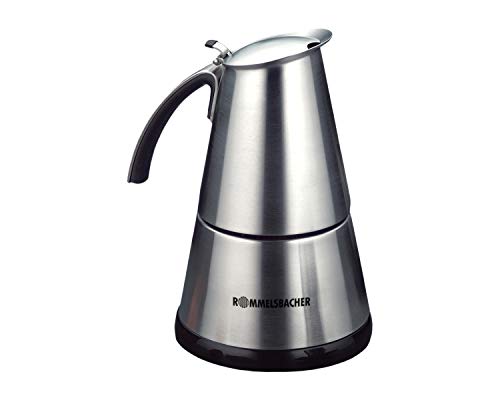
Sixteen pots sit next to this appliance in our moka pot category, and all sixteen need a hob. The Rommelsbacher EKO 364/E needs a socket. It brings its own heat source, heats with 365 watts and sits on a base of its own like a kettle. That does not change the cup, it changes the use case, and it explains the price: at approx. €64.46 according to our price box (on Amazon.de) it is the most expensive pot in the category; on 7 September 2026 it stood at €60.89 in the Amazon catalogue. In our rating it scores 8.7 out of 10.
Stainless steel pot, central base, 780 grams
From the outside it is a classic mocha pot: the water tank at the bottom, the coffee chamber above it, and in between the filter funnel, seal and filter plate. A stainless steel riser tube carries the finished espresso upwards. In the product photo this double cone sits on a black base ring, the handle sticks out to the side and a lid with a small knob sits on top. The parts overview in the manual lists twelve items, from the top section and lid through the seal set to the switch, the heat-insulated base and the central base. To clean it you take apart an appliance, not just a pot.
Rommelsbacher gives the housing as stainless steel, the weight as 780 grams and the dimensions as 16.00 x 12.00 x 19.00 centimetres for width, depth and height. These are envelope dimensions. The protruding handle and the lid knob are included, the round body itself measures less.
The base is what sets it apart from a stovetop pot. Rommelsbacher describes it as a compact 360-degree central base that can be placed from any side and is therefore meant for right-handers and left-handers alike. You lift the pot off in any position and carry it to the table without a cable. The mains cable is fixed to the base and cannot be detached; according to the manual it is wound up on the underside, and you decide the free length yourself. The on/off switch is illuminated, and the handle is ergonomically shaped and heat-insulated according to the manufacturer.
In detail: 365 watts instead of a hob, 3.5 bar at the valve
Electricity does not change the principle. In the closed water tank, steam pressure builds up as it heats, driving the water up through the ground coffee. Only the heat does not come from a plate here.
For the EKO 364/E type the manual gives 230 volts at 50 hertz and a rated input of approx. 365 watts. The heating element is concealed, so it does not sit exposed in the water tank. When wiping out, that is the difference between a smooth wall and a heating rod you would have to brush around.
Two components protect the appliance. The overheating and dry-running protection is a self-resetting temperature limiter that acts when the appliance runs without water. According to the manual the safety valve responds from 3.5 bar and on this model has a pin. The 3.5 bar is the threshold at which the valve opens, so an upper limit and not the value at which you brew. The same valve is one of the parts Rommelsbacher wants checked regularly for blockage.
At the end the appliance switches itself off, and the manual describes how you can tell: the on/off switch returns to its starting position and the indicator lamp goes out. Until then the pot stays where it is. Rommelsbacher expressly forbids lifting it off the central base during the brewing process. After brewing the manual asks for two more steps: pull the mains plug, and do not leave the empty pot standing on the connected central base.
How much fits in one fill?
250 millilitres of water, and the stainless steel filter insert is designed for either 2 or 4 cups. More does not fit: this is the maximum fill quantity from the technical data for the EKO 364/E, and the product page gives the same figure as the capacity.
The figure describes what you pour in. Because Rommelsbacher gives no yield in millilitres for this model, you plan your purchase around the fill quantity. Less arrives at the top of the pot: part of the water remains in the kettle below the filter funnel, another part in the grounds.
Four cups means four mocha cups, not mugs. Divide the 250 millilitres by four and that is a good 60 millilitres of water per cup, and correspondingly less lands in the cup. That is our calculation; the manufacturer instead works with the two markings 2 and 4 in the water tank.
For the smaller quantity the manual describes a separate procedure. You fill water only to the 2 mark and place the 2-cup filter insert in the 4-cup filter funnel as well. If you instead simply use less water and leave the large funnel half full, you get a shallow bed of grounds that the steam breaks through more easily than a full one.
What goes into the filter funnel
Espresso grind, not ordinary ground coffee: Rommelsbacher puts this sentence in the manual with an exclamation mark. You fill it to the brim, but loosely, and only level the surface. Tamping is prohibited. For guide values for the amount of coffee see the brew calculator, and for adjusting the grinder see the guide How to set your grind size. A compacted bed of grounds withstands the steam pressure instead of letting it through, and then the valve works instead of the pot.
Before switching on, the manual asks for a step that appears in hardly any product description: you are to move the pin in the middle of the safety valve back and forth with your finger several times before every use, especially after a long break. The order of the remaining steps is in our moka pot guide. A stuck pin is a valve that jams when it matters.
What else comes into question?
Three pots that a buyer would really weigh against this appliance. What separates them is the heat source or the capacity, not the design.
| Model | The difference | Price | Our rating | Choose this one if |
|---|---|---|---|---|
| Rommelsbacher EKO 364/E (this one) | Heats itself with 365 W, 250 ml, needs a socket | approx. €64 | 8.7 | there is no cooking surface in your kitchen on which a mocha pot will run |
| Bialetti Moka Express | Aluminium, 6 cups, according to Bialetti for gas and electric, induction only with an additional plate | approx. €29 | 9.4 | you have a hob and want to stay under €30 |
| Bialetti Brikka | Silicone membrane in the riser tube for a layer of foam, 180 ml instead of 250 according to Bialetti | approx. €52 | 8.9 | the layer of foam matters more to you than independence from the hob |
| Barista Royal moka pot | 300 ml for 6 cups, stainless steel, dishwasher safe according to the manufacturer | approx. €45 | 8.5 | more than two people regularly join in and the parts should go in the machine |
The prices come from the data sheets in our catalogue and move daily; for the EKO 364/E our reference value differs from the catalogue price of 7 September 2026, for the Brikka and Barista Royal both values agree, and for the Moka Express the catalogue listed no price at all that day. The assessment of this is in the price section further down. The score beside it is our editorial rating. How the coffee from the four pots tastes is in no column: for that we would have to brew them side by side. You can find more models in the category in the best moka pots list.
When the EKO 364/E fits and when a stovetop pot does
The first question decides almost everything: is there a hob in your kitchen on which a mocha pot runs? If so, here you are buying convenience, not a better cup. The cheapest stainless steel pot in our catalogue costs approx. €17.95, brews by the same physics and also works on a gas burner.
If not, the picture changes. A student room with a single plate, a holiday flat with an unknown hob, an induction hob and no desire to deal with the question of the pot base: then the electric drive is the condition for mocha coming out at all.
Second, the quantity. According to the filter insert, one fill is meant for two or four mocha cups, so it covers one to two people at the table. Four people on a Sunday morning are better served by a 6-cup pot, not least because it finishes in one run.
Then the space. The base stands permanently and occupies a socket. Under a wall cupboard the 19 centimetres of height are uncritical, but on a full worktop the base is one more place to put down, because unlike a stovetop pot you cannot put it away and still brew. The manual sets its own conditions for the location, and it lists six: a heat-resistant, stable and level work surface without lacquered surfaces and without a tablecloth; never on electric hotplates or gas flames; out of the reach of children; sufficient ventilation clearance all round against heat and steam, so that the air circulates unhindered; not near heat sources such as a cooker or gas flame and not in an explosive environment; and not in a cupboard during use.
Rommelsbacher lists the EKO 364/E in its own product category Camping. That applies with mains hook-up, because 230 volts from a socket is a condition. On a gas burner, at a campfire and on any pitch without a connection the pot stays cold, and that is the point at which it falls behind almost every other pot in this category. The technical data also state alternating current, 230 volts at 50 hertz. Anyone going through an inverter in a motorhome must therefore trust it with 365 watts, for the whole brewing time.
The price needs some context, because it moves. The price box above shows our reference value of approx. €64.46, an earlier reading from the Amazon catalogue. When retrieved on 7 September 2026 the appliance stood there at €60.89, in the manufacturer’s shop at €82.99 and, according to its status line, was available immediately. On that day there is a good €22 between the catalogue price and the manufacturer’s shop, which is more than the seal set and both filter inserts cost together. Comparing several sources is therefore worth more here than with a pot costing €20.
Our assessment: the extra of around €36 over the Moka Express pays for the automatic switch-off and independence from the cooking surface. If you have a working hob and keep an eye on the brewing process anyway, we would advise against it.
Cleaning, descaling and what five years cost
Do not put it in the dishwasher, writes Rommelsbacher, with no exception for individual parts. You clean the accessories in hot water, the manual expressly mentions a small soft bottle brush for this, while abrasives are taboo. You may neither immerse the water tank and central base nor hold them under running water, which surprises nobody for a component with a heating element and mains connection.
Depending on water hardness, limescale collects in the water tank, which is why the manual calls for regular descaling. Rommelsbacher advises citric acid or vinegar in hot water, not a dedicated product from the accessory range. How often that is due depends on your tap water; how to classify your hardness is in the guide on descaling and cleaning.
Two parts wear out in use. According to the manual the filter plate and rubber seal must be kept clean and replaced regularly. Both are in the seal set RF1314, which the manufacturer’s shop lists with three sealing rings and one filter plate for €5.00. A replacement pot, lid and base are not listed there. Besides the seal set the shop lists only the two filter inserts, CH0520 for 2 cups at €5.00 and CH0506 for 4 cups at €5.50.
Calculated over five years: €64.46 purchase plus two seal sets at €5.00 makes €74.46, just under €15 a year. The two sets are our assumption, they stand for six seal changes in these five years, because one set brings three rings and a filter plate. How often a change is really due depends on your use, and the calculation comes out differently if you replace them less or more often.
What Rommelsbacher leaves open
With this appliance the gaps are all in the same place, namely in the brewing process: heating time, brewing time, temperature of the finished espresso and working pressure are stated neither on the product page nor in the manual. The same goes for the noise level, the length of the mains cable, the amount of coffee in grams, a cup size in millilitres, a descaling interval in weeks, the replacement interval for seal and filter plate and the cooling time between two runs. The power consumption per brew also remains open, only the rated input and the standby value are given. On the water itself the manual requires only that it be cold and clear; whether filtered or softened water would be better remains open. Only the stainless steel version is listed, the manufacturer lists no other colours for this model, and what material is behind the lid, knob and heat-insulated handle shell is as unstated as the material of the rubber seal and the filter plate. Rommelsbacher also says nothing at any point about how long spare parts remain available. On the country of manufacture the situation is more delicate: the company website advertises Made in Germany in general terms, but we found no statement of origin for the EKO 364/E itself, either in the data sheet or in the manual, and we therefore do not supply one.
Who is it suitable for?
Rommelsbacher defines the intended use in the manual itself, and this list helps with a purchase more than any recommendation from us. The appliance is intended for the household and similar applications, and the manual lists four of them: staff kitchens in shops, offices and other commercial areas, farm houses, use by customers in hotels, motels and other similar residential environments, and bed and breakfast establishments. A department’s tea kitchen and a guest room in a guest house are therefore within the intended scope.
A few lines further on the same manufacturer draws the line: the appliance is not intended for commercial use. Both sentences appear like this in the same manual. We read them as meaning that the four listed cases are covered and that the exclusion goes beyond them; what Rommelsbacher means by commercial use is not defined in the booklet. The term appears a second time in the warranty terms: there the warranty lapses for commercial use if the defect is due to improper or abusive treatment, the use of force, unauthorised repair attempts or normal wear and tear.
Anyone buying an electrical appliance also buys a repair chain. Rommelsbacher states that it was founded in 1928 by Dipl.-Ing. Gustav Rommelsbacher, has been run as a family business in the third generation since 1991 and today employs 110 people. Customer service and spare parts are handled from the company headquarters at Rudolf-Schmidt-Straße 18 in 91550 Dinkelsbühl.


