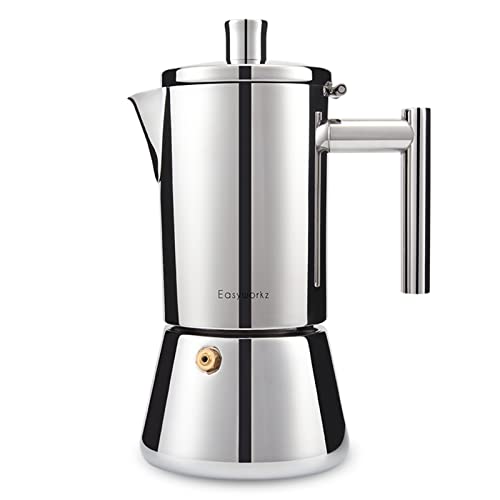
Moka pots are traditionally an aluminium affair, and aluminium is not magnetic. If you cook on an induction hob, that gives you a material problem: the classic pot stays cold no matter how far you turn it up. The Easyworkz Diego gets round this in the most direct way and replaces the aluminium with stainless steel. It costs approx. €44.99 on Amazon.de (as of September 2026); our catalogue retrieved this value on 7 September 2026.
The match to the manufacturer’s page is clear-cut for this model: the Amazon model number EZ-CP100 stands in the manufacturer shop’s data record for the Chrome / 10 fl oz variant, that is, for exactly this pot in silver.
18/8 stainless steel, magnetic base, Italian valve
For the body, Easyworkz specifies 18/8 stainless steel, high-gloss polished. The two numbers stand for the percentage of chromium and nickel; it is the alloy that goes across the shop counter as stainless steel in the household. For the base, the manufacturer explicitly names a different material, robust magnetic stainless steel, in the English version heavy gauge Magnetic stainless steel. This one sentence carries the entire reason to buy.
Easyworkz describes the lid and handle as heat-resistant and hollow-insulated. The product photo also shows a tubular handle and a hollow knob on the hinged lid, both in a metal look. At the front of the boiler sits the safety valve, which the manufacturer lists in its key features as an Italian safety valve.
Easyworkz gives no dimensions. What exists is in the Amazon catalogue and converted from inches: around 21.5 centimetres high, 15.0 wide, 10.5 deep, plus around 907 grams. The product photo puts these numbers in context. The body is round, a smooth cylinder at the top and a boiler that widens towards the bottom. The 15.0 centimetres is therefore not a diameter but the overall dimension across spout and handle, while the 10.5 centimetre value lies across it and comes closer to the body. If you are looking for space under a wall cabinet, work with the 21.5 centimetres and add the lid, which opens upwards. The pot is filled via the unscrewed top section anyway, as with any moka pot.
In detail: why an induction hob needs iron
An induction hob does not heat the plate, it heats the pot. Under the glass ceramic there is a coil through which alternating current flows. Its magnetic field changes direction many tens of thousands of times per second and generates eddy currents in the base of the cookware, and where this current meets electrical resistance, heat is produced. For that, the base must be ferromagnetic.
Aluminium is not, which is why any pure aluminium pot stays cold on induction. The second part of the explanation is less well known: 18/8 is an austenitic alloy and by nature not ferromagnetic either. A boiler consisting only of the body material would respond just as little on the hob. That is exactly why Easyworkz lists a separate, magnetic stainless steel material for the base. So the hob detects the base, and from there the heat travels upwards into the boiler.
On the types of hob, the manufacturer is unambiguous. The German catalogue text says the pot is suitable for all types of hob and lists gas, induction hob and electric hob; the key features on the product page add ceramic. What is missing is the base diameter. Many induction hobs only recognise cookware from a minimum diameter, and without this figure it is hard to judge before buying whether your large zone will respond to such a narrow pot at all. On a small zone the question does not arise.
300 millilitres, 25 grams and the full pot
Six full espresso cups, 300 millilitres: this statement appears word for word in the German catalogue text and on the manufacturer’s page, there additionally as 10 fl.oz. That is around 50 millilitres per cup, and it is enough for two to three people at the breakfast table.
Easyworkz also recommends 25 grams of finely ground coffee. For 300 millilitres of finished drink that is a ratio of around 1 to 12, dosed considerably more densely than filter coffee. Which amount of water goes with which pot size is in our moka pot guide. The manufacturer gives the brewing time as less than five minutes on the heat.
A reducer is included. Easyworkz lists it together with the safety valve in the scope of delivery, in the German text as reducer and safety valve included. This removes the usual objection to the large pot, that a moka pot does not work cleanly when half filled. We have written down the whole procedure in the moka pot guide; without a reducer the old rule applies there: water up to just below the valve, funnel filled to the brim, nothing in between and nothing pressed.
The range: 200, 300 and 520 millilitres
Easyworkz makes the Diego in three sizes, and the dosing recommendation grows with them: 4 cups at 6.8 fl.oz or 200 millilitres with 16 grams of coffee, the 6 cups discussed here at 10 fl.oz and 300 millilitres with 25 grams, and 12 cups at 17.5 fl.oz or 520 millilitres with 40 grams. Recalculate the three pairs and you land every time between 1 to 12 and 1 to 13. The manufacturer simply scales along, so if you later buy a second size, you can carry over your usual dose. By cups, the large pot is exactly twice the size of the one discussed here, by millilitres it is not: for 4 and 6 cups the manufacturer’s figures give 50 millilitres per cup, for 12 cups around 43.
There are also three colours, Chrome, Black and Matte Black. The manufacturer shop charges a premium of US$5 to US$10 over Chrome for the black versions, depending on size, and the range across all nine variants there runs from US$39.99 to US$74.99. A euro price from the manufacturer does not exist, as the site works in dollars, which is why we deliberately set these figures next to our catalogue price and not against it. The silver 300-millilitre pot is the one listed on Amazon in our catalogue.
What Easyworkz otherwise promises on its own product page, we leave standing as manufacturer advertising and do not adopt in our own voice: the coffee is supposed to be extra strong, full-bodied and aromatic, the Diego itself the moka pot for life. Added to that are an elegant, timeless stainless steel design and the assurance of being made to the highest standards in the industry. These are the manufacturer’s statements about its own product, and none of them can be checked.
Is the Diego dishwasher safe, and what else does care require?
Yes, Easyworkz approves the pot for the machine and still advises hand washing in the same text. Both sentences are there in writing, and anyone who knows only one of them will be surprised by the other afterwards.
The product page says: Easy to clean and disassemble. Dishwasher safe. The German catalogue text ends with the sentence: Leicht zu reinigen und zu zerlegen. Spülmaschinenfest. A few lines further down, in the usage notes, it then says: For the best results, always wash your espresso maker by hand. Our assessment of this: we would wash by hand and treat the approval as reassurance for the day when everything ends up in the machine after all.
For rust resistance, Easyworkz sets three conditions, and it expressly presents them as a requirement. First, medium heat when brewing, expressly without overheating. Second, cleaning the boiler after every use. Third, drying it completely, with a soft cloth or in the air. The boiler is fundamentally rustproof, the manufacturer writes, and these three points are the prerequisite.
The first condition has a consequence that counts in everyday use. Stainless steel conducts heat less well than aluminium; that is materials science and applies to every pot of this design. The obvious compensation would be a higher hob setting, and Easyworkz rules out exactly that. If you are in a hurry in the morning, an aluminium pot gives you the faster hob, not the better brewer.
Before opening it for washing, the pot should cool down; that, too, is in the notes. According to the manufacturer it can be taken apart and reassembled easily. How to remove limescale from a stovetop pot is explained in our guide to descaling and cleaning, because the water hardness where you live decides how often that becomes necessary.
Spare parts, wear and the question of shipping
The gasket is the part of any moka pot that goes hard first and eventually spits at the seam. For this, Easyworkz keeps its own spare parts collection, graded from 4 to 12 cups. In the 6-cup size, the manufacturer shop lists a set of silicone gaskets and filter sieve for US$8.99, a funnel filter for US$11.99, a reducer for US$11.99 and both together for US$15.99. The pressure valve sits alongside and is the only part sorted by thread size rather than cup count: 8 mm or M8 for US$13.99, made in Italy according to the item title.
The catch hangs on the same page: the shop works in US dollars, and whether Easyworkz ships to Germany is stated nowhere there. Anyone who wants to reorder wear parts reliably from Germany had better clarify that before buying. For comparison from our own catalogue: for the Barista Royal moka pot, according to our review the manufacturer shop carries no wear parts at all beyond the enclosed spare ring.
What Easyworkz does not state
For a stovetop pot the list of open points is shorter than for a bean-to-cup machine, but some of it touches the buying decision. On the brewing temperature and the heat-up time until the first rise, the product page says nothing; only the total duration of under five minutes is documented. The wall thickness of the boiler remains open, as does the question of whether the base has a multi-layer construction. A descaling guide and a note on water hardness are missing. Material certificates for the pot, such as LFGB or FDA, and a statement on nickel-free construction cannot be found on the product page. How many gaskets are fitted at the factory and whether a spare gasket is in the box, the manufacturer also states nowhere. And Easyworkz has not issued an approval for camping stoves or for adapter plates on a ceramic hob, which does not mean it would not work, only that nobody stands behind it.
What else comes into question?
| Model | The difference | Price | Our rating | Choose this if |
|---|---|---|---|---|
| Easyworkz Diego (this one) | Stainless steel with its own magnetic base, reducer included | approx. €44.99 | 8.3 | you cook on induction and also want to brew fewer than six cups now and then |
| Bialetti Moka Express | Aluminium, on induction only with the manufacturer’s steel plate | approx. €28.87 | 9.4 | your hob runs on gas or electricity |
| Groenenberg moka pot | Stainless steel, reducer sieve and spare gasket in the box | approx. €32.99 | 8.5 | you want the first wear part supplied straight away |
| Barista Royal moka pot | Same price, same size, without a reducer | approx. €44.99 | 8.5 | you always put the full pot on anyway |
The table compares prices as of September 2026, and the rating is our editorial assessment from the comparison, not a measurement result. What it is not good for: it says nothing about how the coffee from these four pots tastes, because we have not drunk from any of them.
When the Diego fits and when one of the alternatives does
First the type of hob, because it decides whether the premium buys anything at all. If you cook on gas or electric, the magnetic base is of no use to you, and then the Bialetti Moka Express for approx. €28.87 is the more obvious pot.
On induction the sum turns around. According to our review, the Moka Express runs there only with the manufacturer’s steel plate, and that costs €19.90 there. €28.87 plus €19.90 makes €48.77. The detour via the plate is therefore more expensive than the Diego, and you have two parts on the hob instead of one.
The second question is portion size. 300 millilitres is six cups, and a stovetop pot only works cleanly at the right fill level. If you drink a single cup a day, this size is wrong for you, and you will find smaller pots in the moka pot comparison. If you do not always need the full pot, reach for the enclosed reducer. Easyworkz gives the fill level for it: water only halfway to the safety valve. The manufacturer does not say how many cups the quantity drops to. The first run will show you, and after that it is a routine step like any other.
On budget, things get tight for the Diego. The Groenenberg moka pot costs approx. €32.99, that is €12 less, albeit in the 4-cup size with 200 millilitres. It is also made of stainless steel and also induction-compatible, and besides the reducer sieve it puts a spare gasket in the box. A repurchase takes you, with the Diego, to a shop that charges in dollars, with the Groenenberg to a spare parts shop in euros. If you can make do with four cups, the Groenenberg therefore gives you both, the first wear part in the box and resupply in euros.
That leaves the question of whether you will follow the manufacturer’s requirement. Medium heat and no overheating are not a recommendation here but the condition under which Easyworkz guarantees rust resistance. Anyone who likes to leave the pot on full flame because they are used to that from the aluminium pot is working against this requirement. For them the Diego is the wrong purchase, even with an induction hob.


