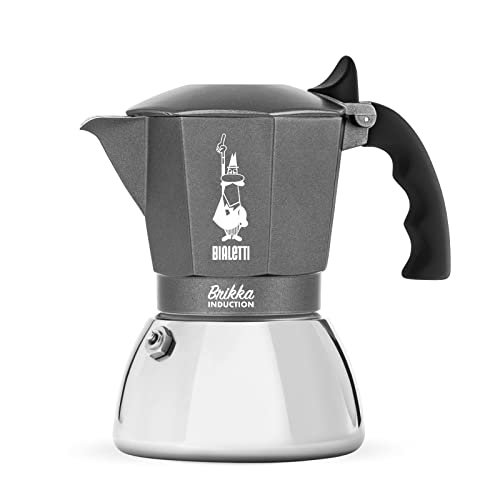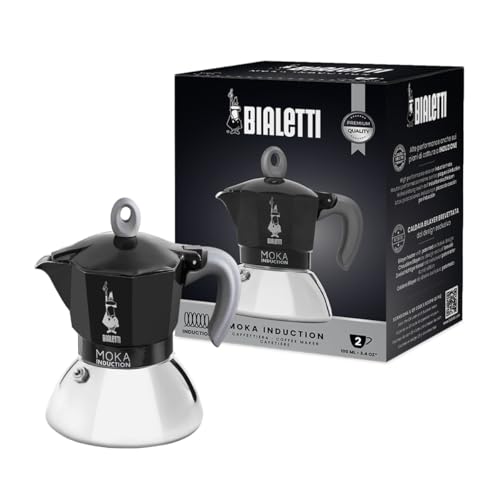
On its own product page, Bialetti calls the Moka Induction the first moka pot for induction plates. That sentence comes from the manufacturer, we have not checked the claim, and it describes no market position anyway, only a design decision: the boiler of this pot is made of two layers of metal. In our comparison of moka pots the black 2-cup version scores 8.7 out of 10 points, at approx. €26.14 on Amazon.de (as of September 2026).
Directly from the manufacturer you cannot currently get it in Germany at all. The German Bialetti site had set the model to not available on 7 September 2026, while the Italian shop of the same company sells the same black pot for €59.90. Behind both stands the same company, based in Coccaglio in the province of Brescia, which dates itself to the year 1919. The item number of the black 2-cup version is 0006932/NP; in the Amazon catalogue it runs as model 0006932 with part number 6932.
Two metal layers in the boiler, aluminium in the top
The name Bi-Layer sounds like two layers under the pot. Bialetti describes it differently. The two-layer technology concerns the boiler, that is, the whole lower part in which the water sits: a steel layer on the outside that makes operation on induction plates possible, an aluminium layer on the inside. The instruction manual assigns the roles even more clearly: steel for contact with the hob, aluminium alloy for contact with food.
How thick this double layer is, is stated somewhere you would not look for it: on the page of the version of the same Moka Induction decorated by Dolce and Gabbana. There it is 3.5 millimetres. The dimensions also come from that page, 10.5 by 16 by 12.5 centimetres for the 2-cup size. The values in the Amazon catalogue are no use as a substitute: 10 inches in length at 5 inches each in height and width would be 25.4 by 12.7 by 12.7 centimetres, a recognisable placeholder for a pot that yields two espresso cups.
The top, where the coffee ends up, is aluminium and has the octagonal shape that Bialetti, in its own description, presents as continuity with the historic Moka Express. The boiler below does not continue these edges: in the product photo it is a smooth, polished cone that tapers towards the base. According to the manual, handle and knob are made of thermoplastic material; the Italian data sheet is more precise and names PA66 with a soft-touch coating. On the side of the boiler sits the safety valve, from which a small piston protrudes.
What an induction hob demands of the boiler
An induction hob does not heat the plate but the cookware. Under the glass ceramic lies a coil that builds up an alternating magnetic field; in the metal above it this creates eddy currents, and these heat the metal from within. For this the base must be ferromagnetic. Aluminium is not, which is why a classic aluminium pot simply stays cold on the hob. The steel layer on the outside of the boiler fixes exactly that, and the aluminium layer on the inside stays because aluminium spreads heat across a surface faster than steel.
The second hurdle is the surface area. Many hobs only recognise cookware from a certain diameter and do not switch on at all below it. The fact that the boiler tapers into a cone does not help here: what rests on the glass is considerably narrower than the widest point of the pot. Bialetti knows about the issue and passes the check on to you: when using it on induction hobs, you are to check, according to the manual, that the diameter of the boiler is compatible with the technical characteristics of your hob. The manufacturer gives no millimetre value for this diameter in any of its documents, so the route goes the other way round: your hob’s manual states from which pan diameter the pan detection kicks in. If this value is large, a pot for two espresso cups is a borderline case, and you are better off clarifying that before the order than after.
On the plate, one rule then applies that is the same for induction, electric and glass ceramic: never the highest heat setting, always a medium one. For the induction hob there is an explicit prohibition on top: the boost function must never be used. Boost means that a cooking zone briefly draws more power than its regular top setting, on many hobs at the expense of the neighbouring zone. Both rules have the same background. In a moka pot, steam from the boiler pushes the water up through the coffee grounds, and the more steeply the heat rises, the higher the pressure climbs before anything arrives at the top.
One misunderstanding we will clear up right away. The two-layer boiler is not a special solution for the smallest size. Bialetti uses the design across the whole range, in its own shop with 2, 4 and 6 cups.
How much coffee comes out with two cups?
Around 90 millilitres, so two espresso cups and not two mugs. At Bialetti, however, this figure appears only on the page of the decorated version; the Amazon catalogue title of the same black pot speaks of 100 millilitres. Ten millilitres sounds like little and, at this quantity, is a good tenth.
The figure also describes what arrives at the top, not what you pour in at the bottom: some water stays behind in the boiler, and another part is then held in the wet coffee grounds. For the 4-cup size of the same range, Bialetti states 190 millilitres, again on the page of the decorated version. An intermediate step between 2 and 4 cups is missing from the range, and a moka pot does not grow with you: boiler, funnel and top belong to one size, so more quantity means a second pot.
On the hob: cold water, medium heat, no tamping
A common piece of advice for the moka pot is to fill it with hot water so that it spends less time on the plate. The instruction manual says something different: cold water, filled up to the lower edge of the safety valve. We stick to the manual because it is dated and applies to exactly this pot.
The rest of the procedure is given in the same order in the manufacturer’s Amazon catalogue text: fill the boiler up to the safety valve, fill the funnel with ground coffee, screw the pot together, put it on the hob. The whole thing has no more controls than that; the hob switch is the only one.
Ground coffee for moka goes into the funnel. The manual explicitly rules out finely ground coffee and wants the funnel filled without pressing. The reason lies in how the pressure builds up: a moka pot works with the steam pressure from the boiler and not with a pump. A tamped, too fine puck puts up more resistance to this pressure than it can muster, and then the water stays in the boiler instead of rising. What arrives at the top is therefore not an espresso in the sense of the portafilter definition but moka, even if Bialetti calls the device an espresso pot. Where the moka grind size sits on the scale is explained in the guide to grind size, and the steps in order in our moka pot guide.
How many grams go into the funnel, you work out in the brew calculator, starting from the amount that should be in the cup at the end.
What else comes into question?
| Model | The difference | Price | Our score | Choose this one if |
|---|---|---|---|---|
| Bialetti Moka Induction (this one) | Two-layer boiler with steel on the outside, 2 cups, no accessory needed for the induction hob | approx. €26.14 | 8.7 | a small pot should stand directly on your induction hob |
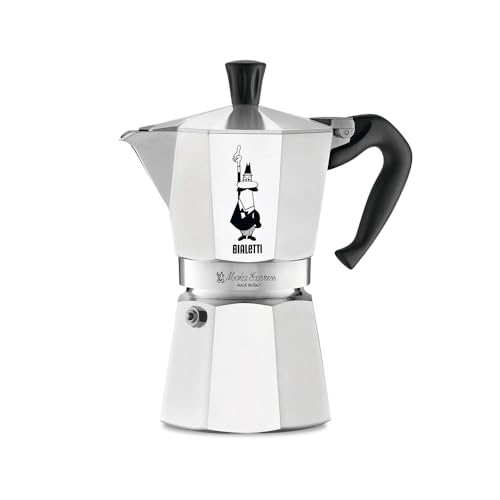
| Bialetti Moka Express | Pure aluminium, on induction only with the manufacturer’s steel plate for €19.90, 6 cups | approx. €28.87 | 9.4 | you cook on gas, electric or ceramic and need more quantity |
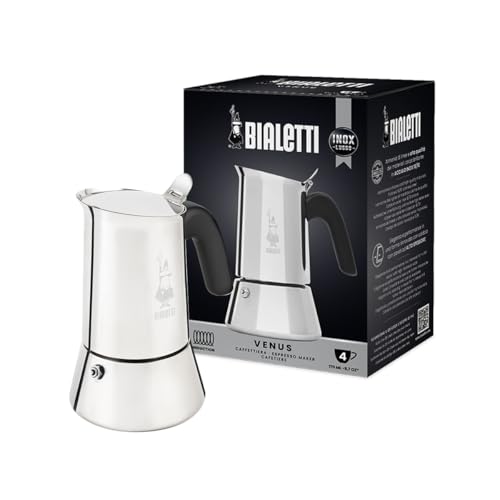
| Bialetti Venus | According to the manufacturer 18/10 stainless steel instead of aluminium in the top, 4 cups | approx. €28.00 | 8.8 | the finished coffee should not touch aluminium |
| Zanetti Star | Also induction compatible, 3 instead of 2 cups, a different brand with the same design principle | approx. €22.90 | 8.2 | two cups are too tight for you and the missing capacity figure does not bother you |
The prices are the catalogue values of the respective reviews as of September 2026 and move daily; the score is our editorial rating. What the table cannot do: say which of the four pots makes the better coffee. For that we would have to brew and taste them side by side. More models are in the best moka pots list.
When this pot fits and when another one does
The hob decides first. If it is gas, electric or ceramic, you do not need the steel on the outside at all. The Moka Express then makes six instead of two cups for similar money.
Then the quantity. 90 millilitres is a strong cup for one person or two small portions when you have a guest. You fill up to the valve edge or not at all; half loads do not exist in the manual. For two breakfast portions the 4-cup size is the smallest sensible step, and in between there is only the Zanetti Star with three cups.
The third point is the aluminium. The finished coffee collects at the top, and at the top is aluminium. If that bothers you, the way leads to the Bialetti Venus, which Bialetti lists as 18/10 stainless steel.
On money, it is worth looking at two different figures. In our catalogue there are not even three euros between the Moka Induction and the Moka Express. In the Bialetti shop itself it looks different: there, the €59.90 for the small Moka Induction face €33.90 for the Moka Express of the same size. This €26 premium buys nothing but induction compatibility. The colour costs nothing extra there; the manufacturer’s shop lists Nera and Rossa at the same price. Next to both stands the Bialetti induction plate for €19.90: it makes an existing aluminium pot induction compatible and has to be put on for every brew.
That leaves the grinder. Coffee ground for moka is coarser than espresso grounds. A grinder set for the portafilter therefore has to be readjusted before every pot, or you buy ready-ground moka coffee.
Care, spare parts and what a year costs
You rinse after every use with lukewarm water, without cleaning agents and without abrasives. That is what the manual says, the Italian data sheet is even shorter and only notes that the pot does not belong in the dishwasher, and the manufacturer’s Amazon catalogue text repeats both in its own words. For this product, such agreement between three sources is not a given.
Descaling works without special agents: fill the boiler as usual, add two teaspoons of citric acid or vinegar, assemble the pot, run one cycle without coffee grounds, pour the liquid away. Both additives are acids, and they dissolve the deposit because calcium carbonate turns into a water-soluble salt in an acidic environment. How often this is due depends on your tap water, more precisely on the carbonate hardness. How you classify it is explained in the guide to descaling and cleaning.
One reason not to let limescale build up is in the warranty section of the same manual. Bialetti promises two years from the date of purchase there, but explicitly excludes the parts that wear out: filter, funnel insert, gasket and handle, provided there is no manufacturing defect. Also excluded are damage from impact, falls and, indeed, limescale deposits.
The pot wears mainly at the gasket. It sits between the boiler and the top, gets hot and damp on every run and over time loses its elasticity. Bialetti requires replacement when worn, but at least once a year, and insists on using original spare parts of the model for it. Which set that is meant to be for the Moka Induction, the shop does not say anywhere. One possibility is a set of silicone gasket and steel filter plate for 1 and 2 cups, €4.99, item number 0800410/CN, listed for pots made of steel.
You can still do the sums if you assume this set is the right one. Over five years that would be the pot at €26.14 plus five sets, together €51.09, or a good ten euros a year. The assumption is built into the calculation; only the price of the set is documented.
What Bialetti does not state
Besides the missing boiler diameter from the induction section there are the basic data: dimensions and weight of the black standard version 0006932 are stated nowhere, the centimetres that exist belong to the decorated variant, and the 0.56 kilograms from the Amazon catalogue come from the same corner as the inch dimensions, from a field that somebody had to fill in.
A millilitre amount for exactly this item number has never been published by Bialetti, nor has the capacity of the water boiler. The amount that goes up to just below the valve edge you can only find out with a measuring jug.
For the materials, the evidence ends at the boiler, the top and the handle. What the gasket is made of remains open; silicone is listed only for the set for the steel pots. The material of the filter plate is also missing. A spare handle, a spare knob or a spare valve for the Moka Induction could not be found in the manufacturer’s shop, and how long Bialetti keeps parts for this model available remains without a commitment.
On operating values the manufacturer is entirely silent. Brewing temperature, heat-up time and the duration of a run are in neither the manual nor on any product page, and whether the two-layer boiler gets hot faster than a pure aluminium pot is not stated in any document either. A year of market launch is missing just the same, and the German page currently shows no German price or recommended retail price. What the Amazon catalogue offers on this is 25 May 2016, a catalogue date and not a documented market launch.
Who is it suitable for?
The pot is wrong for two groups. The first puts dishes in the dishwasher as a matter of course. Against that stands here no convenience argument but an explicit prohibition by the manufacturer. The second puts the pot on and then leaves the kitchen. A stovetop pot has no shut-off, nobody does it for you, and the medium heat setting lengthens the time you spend standing next to it.
On the hob, the purchase does not tie you down. The manual approves the pot for all hobs, so a move to a gas cooker does not make it redundant.
One sentence from the Amazon catalogue text still needs putting in context. There, Bialetti advertises that the pot produces no waste, is cleaned without detergent and lasts a lifetime. The first part is true: there is neither a capsule nor a filter paper. The second matches the manual. The third is advertising: the part that keeps the pot sealed is due every year according to the same manual.