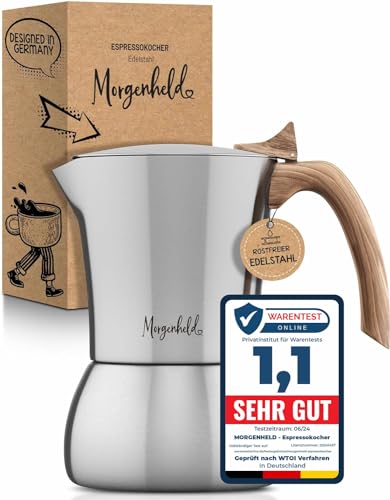
Morgenheld sells two lines of stovetop pots, FLOW and STYLE, and describes the FLOW as the more modern one. Its body is round and smooth, without the eight facets of the Italian design. In the product photo a handle in a wood look sticks out to the right, above it on the lid hinge sits an attachment in the same look, and the spout is on the left. On Amazon.de the device is listed as Morgenheld FLOW Espressokocher Edelstahl 6 Tassen (300 ml) and costs approx. €39.95 (as of September 2026). On the manufacturer’s product page the same pot is called Edelstahl FLOW Espressokocher Premium, carries the article number MHE_007 and the GTIN 4053599149236, and on 24.09.2026 was in the shop at the same price. Through the article number, the price and the 300 millilitres the match is clear, only the word Premium is missing from the Amazon title.
304/430 stainless steel, double-walled and uncoated
The component drawing in the operating instructions labels six items: upper pot, fine filter, sealing ring, safety valve, stainless steel funnel insert and water boiler. As the material Morgenheld names 304/430 stainless steel, double-walled, and the manufacturer FAQ adds that the pot consists of this material through and through, without coating. To the question about aluminium the same FAQ answers 100 per cent rust-free and aluminium-free. The safety valve on the boiler is also made of stainless steel.
The handle is made of ABS plastic. Morgenheld writes that it deliberately chose robust plastic in a wood design instead of wooden handles, and elsewhere justifies the dishwasher suitability with the ABS. The Amazon listing also calls the handle heat-insulated.
The manufacturer’s only dimension is the base diameter, 11.0 centimetres for the 6-cup pot. Height, width and weight, on the other hand, come solely from the Amazon catalogue: converted 18.0 by 17.0 by 10.0 centimetres at around 670 grams. The 17 centimetres of length are evidently an envelope measurement across handle and spout, because in the photo the body is round. And the 10.0 centimetres of width even contradict the base: a round housing cannot be narrower than its own footprint of 11.0 centimetres. We would therefore not use these catalogue values to measure up a wall cupboard.
What Morgenheld does not publish for this pot, at a glance: overall dimensions and weight, the wall thickness, which component is made of 304 and which of 430 steel, a country of production, a gram figure for the ground coffee, a measured brewing temperature, a heat-up time, any statement on noise, a packed size, a detachable handle, a list of contents, warranty terms, and the hob zone size from which an induction hob detects the pot at all. The Amazon listing fills one of these gaps with a figure of its own, under 5 minutes heat-up time, with no counterpart from the manufacturer. And where you would expect a warranty, the FAQ describes the statutory right of withdrawal and the procedure in case of a defect.
In detail: why the base decides on the hob
An induction hob does not heat by itself. Under the glass plate sits a coil that builds up an alternating magnetic field, and only a base that converts this field into eddy currents gets warm. Aluminium is not ferromagnetic and couples too weakly on a typical induction hob to get hot; ferritic steel couples. That is why the FLOW product page lists five hob types, electric, ceramic glass, ceramic, induction and gas, and the operating instructions repeat the same list. Bialetti approves the aluminium Bialetti Moka Express for induction only together with its own induction plate, a steel disc that is placed under the pot.
Why this works out for the FLOW is explained by the double designation 304/430, and the following derivation is ours: 430 stainless steel is ferritic and therefore magnetic, 304 is not. For the base of the boiler the combination therefore only makes sense in one direction. Morgenheld does not confirm this assignment anywhere, and we could not hold a magnet to it, because we have not had the pot in our hands.
How many cups actually come out?
Six small espresso cups from 300 millilitres of water, that is how the operating instructions calculate it, and 200 millilitres for the smaller design. The manufacturer FAQ stresses that small espresso cups are meant and not large coffee mugs, and assigns the 6-cup size to two to three people, the 4-cup size to one to two. The Amazon listing converts the same quantity differently, namely as two large espresso mugs or six classic espressos.
Less works too. As the upper limit Morgenheld names the lower edge of the pressure relief valve and writes that less water is perfectly fine, depending on taste and desired strength. If the valve is under water from the start, however, according to the FAQ it releases water during the entire brewing process, and the pot hisses and spits. You still fill the filter to the brim according to the instructions. Anyone who also wants to save on grounds needs the reducer insert, to which the instructions expressly refer for fewer cups: stainless steel, priced in the shop at €4.99, it halves the amount of coffee according to the accessories page.
If you need both quantities from the start, the shop also has the variant with the insert included for €43.95, which is 99 cents below buying both parts separately. The smaller pot with 200 millilitres is in the same shop at €35.95 and has a base of 9.5 centimetres.
What else is worth considering?
| Model | The difference | Price | Our rating | Choose this if |
|---|---|---|---|---|
| Morgenheld FLOW 6 Cups (this one) | Stainless steel, 300 ml, induction and dishwasher approved according to the manufacturer, gasket and filter set €7.95 from the manufacturer | approx. €39.95 | 8.2 | you cook on induction, need 300 ml for two to three people and want to buy a gasket and filter from the manufacturer later |
| Bialetti Moka Express | Aluminium, on induction only with a separate Bialetti plate, not for the dishwasher according to the instructions | approx. €28.87 | 9.4 | you cook on gas or ceramic glass and wash by hand anyway |
| Groenenberg Espressokocher | Reducer filter and spare gasket included, but 4 cups with 200 ml instead of 300 ml | approx. €32.99 | 8.5 | you mostly drink alone and need the half quantity without buying extras |
| Barista Royal Espressokocher | One spare ring included, the manufacturer shop lists no further wear parts | approx. €44.99 | 8.5 | one spare ring as a reserve is enough for you and you do not want to reorder anything |
The prices are guide values from our catalogue as of September 2026 and change daily in the shops. The rating is our editorial assessment of build quality, performance, handling and value for money, not a measurement result.
Grind size, preheating and the moment at the hob
Before the first coffee come two empty runs. Morgenheld requires you to rinse all individual parts once with warm water and a little washing-up liquid, then to let the pot boil with water only, up to below the valve, with the lid closed, and to pour away the first real portion of coffee instead of drinking it. That costs you two runs before the first coffee may go into the cup.
On grind size the instructions become unusually specific: fine to medium, in figures 4 to 5 on a scale where 1 means fine and 10 means coarse. Grinding finer has a price here. Grounds that are too fine clog the filter according to Morgenheld and can lead to dangerous overpressure. The grounds go into the filter up to the rim and are gently levelled; the instructions rule out tamping. How many grams that works out to is calculated for you by our brew calculator, and which setting on your grinder corresponds to the figures is covered by the guide Coffee grind size.
The water goes into the boiler preheated. Morgenheld justifies this by saying that otherwise the pot gets too hot too quickly and the coffee burns and turns bitter. The note from the manufacturer FAQ points in the same direction: with relatively low heat input the brewing temperature stays below 100 degrees. According to the FAQ, filling with warm water even speeds up the process.
On the hob, medium heat applies, never without water. As soon as it bubbles or hisses, the coffee is all up and the pot has to come off at once, otherwise dangerous overpressure arises according to the instructions. If you want to stop the extraction hard, hold the boiler under cold water for three seconds; Morgenheld lists this as a remedy against over-extraction and deformation. The whole process from the amount of water to taking the pot off is described by our guide How to use a moka pot properly.
Cleaning, descaling and what vinegar does
On the dishwasher Morgenheld says yes twice, and once with a rider. The product page advertises easy cleaning, being dishwasher safe. The operating instructions put both ways side by side: a hot hand wash is very gentle on the material, alternatively all parts can go into the dishwasher without problems. It does not distinguish between metal parts and the gasket. We would therefore take the ring out before the machine cycle, because an elastomer tolerates heat and alkaline detergent less well than stainless steel.
After brewing you rinse the boiler with cold water as soon as it has cooled down, which according to the instructions prevents a bitter taste in the pot. Then comes the step that Morgenheld marks IMPORTANT: dry all parts carefully, above all the funnel insert and the safety valve, and ideally blow out the valve and filter. The valve must stay free and must not be blocked by limescale, and the instructions mark regular descaling as very important.
The manufacturer FAQ describes the procedure in seven steps. The descaling solution goes into the lower part, up to below the valve. Then you insert the filter and funnel and screw on the upper part, heat the pot as for ordinary coffee brewing until the solution rises, switch off the hob and let the solution act briefly. After that you pour it out, rinse thoroughly until no smell is left, and let all parts dry well so that neither odours nor mould develop.
Right at the first step there is a prohibition, and it hits a common household remedy. No vinegar, Morgenheld writes, it can make limescale flake, clog the riser tube or attack the stainless steel. The intervals of individual manufacturers by water hardness and our assessment for the case without a manufacturer specification are in our guide Descaling and cleaning.
Gasket and filter: what running it costs
On a stovetop pot little can break, and the little there is is mainly the sealing ring. According to the manufacturer FAQ there is no fixed rule for changing it: at the latest when it drips, hisses or the gasket becomes visibly hard and cracked. With daily use that is the case after 12 months, by experience. Replacements come as a set, three gaskets of food-safe silicone plus a spare stainless steel filter for €7.95 in the shop, expressly fitting the FLOW Premium. By this reckoning three gaskets cover three years, around €2.65 per year, spare filter included.
The accessories page gives the dimensions in full. The sealing ring for the 6-cup size has 72 millimetres outer and 59 millimetres inner diameter at 4 millimetres height, the filter 67 by 55 millimetres at 5 millimetres height. With that you can measure before you order, if in doubt. In the FAQ, on the subject of dripping, Morgenheld speaks generally of the rubber gasket that loses tension after intensive use, and classes this as classic wear.
The manufacturer FAQ also names sealing ring, filter, funnel and handle as spare parts. In the shop, on 24.09.2026, only the gasket and filter set and the reducer insert are listed. Besides ordering through the shop, the instructions name a second way, an email to Morgenheld, and the question of a new funnel or handle would go through that route. For the handle in particular we would not put the request off: the instructions warn of the risk of burns and require that during and after brewing you touch the pot only by the handle. If it has broken, you are missing exactly the part by which you safely take the pot off the hob.
When this pot fits and when another one does
Start with the hob, because this is the most important advantage of this construction. If you have induction, you cash it in. If you cook on gas or electric, you pay for an approval that you never use: the Bialetti Moka Express costs approx. €28.87 and is thus €11.08 cheaper. In return Bialetti rules out the dishwasher in its instructions, while Morgenheld approves it.
The second question is quantity. If you drink a single cup alone in the morning, add the insert from the quantity section to the budget or take the 4-cup pot for €35.95. Morgenheld itself leans in the FAQ towards the larger pot as soon as guests come for coffee more often, and then advises ordering the reducer filter as well if needed. From our point of view that is consistent, because with the small pot you cannot go up, while with the large one you can go down as soon as the insert is in the cupboard.
Third point, the grinder. The instructions name setting 4 to 5 on Morgenheld’s own ten-point scale, and both causes of bitterness that the manufacturer lists in its FAQ hang on grind size and heat. With pre-ground coffee only the heat remains as an adjustment. We would therefore plan for a grinder if you want to use the pot daily.
The fourth point is your water. More than 14 degrees of German hardness (°dH, German degrees of hardness) fall into the hard range under the German Washing and Cleaning Agents Act (Wasch- und Reinigungsmittelgesetz); limescale on the safety valve is, according to the manufacturer, exactly what you must avoid. With hard water, descaling therefore becomes a fixed date in the calendar.
And then there is milk. For this pot the manufacturer describes only espresso preparation, so for cappuccino a separate frother belongs in the budget.
Who is it for?
For anyone with two kitchens, one at home and one in the van. Morgenheld describes the FLOW on the product page as a coffee maker for home and on the road, and on its own comparison page names home, camping and office; the Amazon listing adds van life and the sentence that the pot works anywhere there is a flame or hob. It really needs no electricity. In our comparison of moka pots the FLOW is thus one of the candidates that play the same role at home and in the van. The manufacturer itself calls the 6-cup variant on its comparison page its favourite for everyday use.
For backpackers we would choose a pot that demonstrably can be taken apart. With the FLOW the handle sticks out to the side in the photo.
A second group should keep their hands off it: anyone who showers in the morning while the coffee is brewing. For this Morgenheld puts a sentence of its own in capital letters in the instructions: for your own safety always stay with it. Without that discipline, a device with automatic shut-off belongs in the kitchen.


