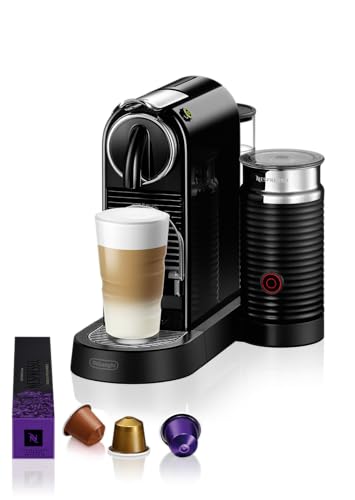
The CitiZ is built by De’Longhi and sold under the Nespresso brand. The model number of the variant with milk frother is EN267.BAE, and in the manufacturer’s shop it runs under the SKU 0132194025. Two devices are in the box: the capsule machine and the Aeroccino, which heats and froths milk. That is exactly what sets it apart from the plainer CitiZ variants.
The sources disagree on the price. This page’s reference value is approx. €167.89 (as of September 2026), a figure from our own data sheet: it applies on the reference date and not on the day you buy. De’Longhi itself asks €229.00 for the same model number, shown as eight per cent below the RRP of €249.00. That is a gap of a good €61 for the same box.
In the shops the bundle carries the addition Milk, and in the catalogue it is written out as NESPRESSO DE’LONGHI CitiZ & Milk Schwarz Original Kapselmaschine EN267.BAE. When ordering, this one word counts, followed by the model number: EN267.BAE for the set with frother, EN167.B for the machine alone. Both boxes run under the name CitiZ.
Dimensions, weight and power connection
De’Longhi gives the edge lengths on the American product page in inches: 8.61 x 14.6 x 10.9 inches, converted roughly 21.9 cm wide, 37.1 cm deep and 27.7 cm high. The Amazon catalogue arrives at 21.8 x 37.2 x 27.7 cm and so matches to within two millimetres. The width matters here: it applies to the bundle, that is, the machine and Aeroccino side by side. The dimensions of the standalone variant describe one device fewer and mislead you when you measure up the space.
The weight is given by De’Longhi as 3.95 kg in the data sheet, and Amazon lists 8.82 pounds, so around 4.0 kg. The two figures are so close that they refer to the device and not to the shipping carton.
Electrically, the EU version runs on 220 to 240 volts at 50 to 60 hertz, and De’Longhi puts the input power at 1,710 watts. At 230 volts that is around 7.4 amperes. A usual kitchen circuit of 16 amperes carries that with room to spare, but a second large appliance on the same power strip will still get tight. This power is only drawn in the seconds when it is heating anyway.
The water tank holds 1 litre. De’Longhi gives the material only as metal and plastic. The colour of this variant is black.
25 seconds to the brew: thermoblock, 19 bar and two buttons
Heating is done by a thermoblock. De’Longhi writes that it brings the water to temperature within 25 seconds, and gives the same figure in the data sheet as the heat-up time. To what temperature exactly, none of the manufacturer sources say, neither in degrees nor as a range. A thermoblock only heats the water that is currently flowing through it anyway. That is the reason for the short wait. This design has no boiler that stays at temperature between two brews.
According to the data sheet the pump delivers 19 bar. This figure describes the pressure the pump can build against a closed resistance, not the pressure applied to the coffee grounds during the brew. On a capsule machine it is in any case the least meaningful entry in the whole data sheet: grind size, dose and compaction are fixed in the capsule, and you change none of that on the machine. Two models with the same capsule and a different bar figure differ less in the cup than the numbers suggest.
From the factory the CitiZ knows two drinks, espresso and lungo. Both buttons are programmable, the machine stores the volume you set, and an automatic flow stop ends the brew without anyone having to stand beside it. There is no display: De’Longhi explicitly lists the control panel as having no display and control by buttons. In our view that is more of an advantage, because one component fewer can fail and the choice of drink sits on these two programmable buttons anyway.
Does the Aeroccino replace a steam wand?
No. It is a separate device next to the machine and heats and froths milk in a fixed cycle. Nespresso describes it as an automatic system for hot or cold milk foam. The manufacturer bullet in the catalogue entry gives hot and cold coffee specialities with hot milk or milk foam as the intended use. Cold foam is therefore part of the described range of functions of this device and not a side effect.
On the German page the accessory is called Aeroccino Milk System, while the American product page for the same bundle calls it the Aeroccino 3. We therefore give the generation number as a statement from the US page.
For the separately sold Aeroccino 3, Nespresso gives two maximum quantities: 120 ml for the foam programme and 240 ml for hot milk without foam. Both are fill quantities of milk, not output quantities of foam. Everyday use is decided by this figure. What it turns into in the cup is shown by the pictorial instructions in the Aeroccino 3 manual: one foam fill makes two cappuccino cups or one latte macchiato glass. After that you refill, clean and start again. Our guide to milk frothers sets the designs and their fill quantities side by side.
The difference from a steam wand lies in control. On a wand you decide through immersion depth and angle how much air is drawn into the milk, and you stop when the temperature suits you. With the Aeroccino you press a button and wait for the cycle to finish. For latte art that means no access to temperature and foam volume. In the morning that is exactly the quicker route.
What De’Longhi does not state for this model
For a device that has been in the range for years, the published data is thin. Gathered in one place so that you do not have to piece it together from the whole text: De’Longhi gives no noise level in decibels, no separate wattage for the Aeroccino, no cable length, no energy efficiency class and no country of manufacture. Also left open are the factory-stored fill volumes for espresso and lungo in millilitres, the question of whether the jug and whisk of the supplied Aeroccino may go in the dishwasher (for the jug of the separately sold Aeroccino 3, Nespresso says no), the duration of a descaling cycle, the availability of spare parts and the exact scope of delivery for the German market. There are also two points we missed when comparing: the materials line does not assign which component is metal and which is plastic, and neither manufacturer publishes a measurable figure for the fineness of the foam. We have not frothed anything with this model and therefore only collect what the sources give.
The manufacturer is also vague on the warranty: De’Longhi lists a full manufacturer’s warranty on the product pages without a duration, and the 24 months appear only in the Amazon catalogue. The statutory warranty applies independently of that, so little changes for you, but it is the difference between a commitment from the manufacturer and a line in a retailer’s catalogue.
Five statements that appeared in older versions of this text do not hold up against the manufacturer sources: a housing width of 13 centimetres, a weight of 3.5 kilograms, a power consumption of 1,260 watts for this bundle (that is the figure for the CitiZ without Aeroccino and also the figure for the 120-volt version for the USA), cup prices of €0.40 to €0.55 and a descaling rhythm of three to four months. They have been removed here without replacement.
This list comes from four sources: the German product page for the EN267.BAE, the English-language pages for the same model for the USA and the UK, the Nespresso accessory page for the Aeroccino 3 and the Amazon catalogue entry. An instruction manual, where such values are otherwise found, is not available in searchable form for this model. De’Longhi support does not yet list a manual for the EN267.BAE. The Nespresso PDF is a pure image document with no text layer.
What else is worth considering?
| Model | The difference | Price | Our rating | Pick this if |
|---|---|---|---|---|
| Nespresso CitiZ with Aeroccino (this one) | 1 l tank, the foam is made in a separate device next to the machine | approx. €167.89 | 8.9 | you want milk drinks without learning to steam with a jug |
| Sage Creatista Plus | Steam wand on the housing, milk temperature and foam height selectable in steps, 1.5 l tank | approx. €489.99 | 9.3 | you want to set the milk yourself and practise latte art |
| Tchibo Cafissimo Milk | Its own Cafissimo format instead of Nespresso Original, 1.2 l tank | approx. €89.00 | 8.3 | you buy your coffee at Tchibo anyway |
| Nespresso Essenza Mini | The same capsule, but no frother in the box and a 0.6 l tank | approx. €81.38 | 7.8 | you drink almost only black espresso |
All four prices are the reference values from our data sheets, as of September 2026, and the rating beside them is our editorial assessment based on manufacturer and catalogue data. What the table does not do: it sets purchase prices side by side, while the larger part of the spending over the years depends on the capsule price, and that depends on variety and consumption. More models in the same category are listed in our best-of list of capsule and pod machines.
When the CitiZ fits and when another machine does
The first question is not whether the machine is good, but how often milk goes into your cup. With two milk drinks a day that is around 730 cups a year. How many cycles of filling, frothing, pouring and rinsing that makes depends on the drink: according to the Aeroccino 3 pictorial instructions, one fill is enough for two cappuccino cups, but only for one latte macchiato glass. Two cappuccinos at the same time make around 365 cycles a year, while two latte macchiatos or two cups at different times make around 730. If it stays at two cappuccinos a week, this effort hardly matters.
On budget you calculate in both directions. To the Essenza Mini the gap is around €87, for which you get the frother and a tank that holds two thirds more. To the Creatista Plus it is around €322 upwards, for which the milk system moves onto the machine and becomes adjustable. As long as it is open whether milk foam becomes a daily habit for you, the middle position of the CitiZ is its strongest argument.
Space is the third point. The height of 27.7 cm fits under any wall cabinet, the depth is more critical: on a 60 cm deep worktop a good 20 cm remain in front of the device, and in that strip stand the cup, the milk carton and the Aeroccino when pouring. In narrow niches between hob and sink it gets tight.
The fourth point is often overlooked at purchase: you are choosing a capsule format, not a machine. The purchase price is paid once, the resupply over five years adds up to far more than that, and it stays tied to the Original format. For this fundamental question two pages help further: the guide to capsule or pod machines with the system comparison and the coffee finder, which sorts by budget and drinking habits.
Care: one machine, two routines
The Aeroccino wants rinsing after every use. Milk leaves protein and fat on the inner wall, both dry on and quickly become an odour problem in the still-warm container. For the separately sold Aeroccino 3, Nespresso rules out the dishwasher, and according to the manual the milk jug is not dishwasher-safe. For the frother in this bundle De’Longhi says nothing on the matter, so washing by hand is the safe way.
On the machine the electronics take over part of the reminding: De’Longhi lists a cleaning and descaling alert for this model. With soft to medium water it is enough as a reminder. From about 14 °dH (German degrees of hardness) you are better off descaling before the alert. Which agents are suitable and how the process works is in the guide to descaling. It also gives the intervals for daily use: every four weeks with hard water, every six to eight weeks with medium, every three months with soft.
Limescale is not a cosmetic problem with a thermoblock. The channel the water runs through is the hottest point in the device. That is exactly where carbonate hardness precipitates as scale. The cross-section narrows over time, and the coated wall gives off its heat less well. In the end the machine takes longer to bring the water to temperature.
Who is it suitable for?
In the Amazon catalogue this model has been listed since 1 August 2016, so for ten years. With a capsule machine that speaks for it rather than against it: the capsule dictates the extraction, and there is little a newer device generation could do differently. De’Longhi advertises the housing as compact and as inspired by a retro-modern style.
It is right for households with one to two milk drinks a day, where nobody wants to learn to steam with a jug and a second device has room on the worktop. In our comparison of capsule and pod machines it solves milk foam as a second device next to the machine, while the Cafissimo Milk has it built in and the Creatista Plus makes it with a steam wand. Three routes to the same drink. This one consists of two parts, both of which can also be bought separately: the CitiZ as the EN167.B, the Aeroccino 3 as an accessory.
It is wrong for two groups. The first is households where four milk coffees land on the table in a row in the morning: with cappuccino that is two cycles, with latte macchiato four, with refilling and rinsing in between. The second is anyone who wants to set milk temperature and foam height themselves. For them the choice starts one price class higher, at the Creatista Plus. You do not steam with a jug there either, though: its steam wand works automatically and only with the supplied milk container.
Our assessment: the premium over the Essenza Mini is fine as soon as milk goes into the cup on five of seven days. Below that you are buying a device that stands dry on the worktop most of the time.