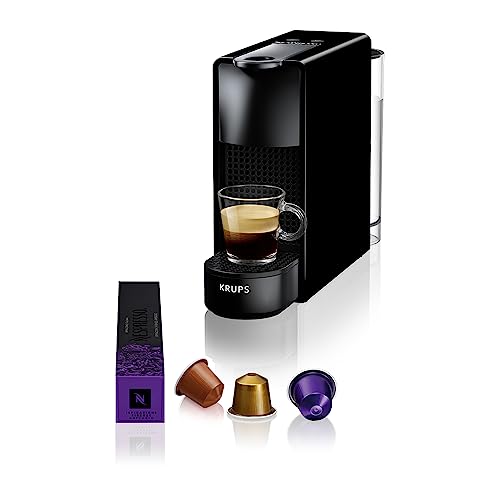
In the product photo the name Krups is printed on the front of the base, but the machine is sold under the name Nespresso. Krups lists this version as the Nespresso Essenza Mini Piano Black XN1108, and in the Amazon catalogue it has the model number XN110810. On its own product page, Nespresso calls the Essenza Mini the smallest Nespresso machine. It takes a single capsule format, Nespresso Original, and has two buttons: espresso and lungo.
Our price box lists it at approx. €81.38 (on Amazon.de). This value could not be cross-checked recently, because when the catalogue was queried on 7 September 2026 the price field on Amazon was empty. In the Nespresso shop on 15 September there are ten colour variants of the Essenza Mini, each for €109.00, two of them marked as unavailable, and one of the two happens to be Piano Black. At Krups the XN1108 cannot be bought; the old product address redirects to a page with spare parts and accessories.
In our comparison of capsule and pod machines it is the cheapest machine for Nespresso Original. Only devices from other systems are cheaper there.
Eight codes, one manual
On the XN1108 page, Krups links a 2022 manual. Under the heading Essenza Mini it lists eight device codes from five brands: Nespresso C30 and D30, Breville BEC220 and BEC250, DeLonghi EN85, Krups XN110 and XN111, and Magimix M115. At Nespresso Germany the variants are called C or D accordingly, and the Piano Black version carries the item code C30-EU-BK-NE2.
In practice this means that if the Krups version is sold out, the same manual also describes the machines of the other four brands. Krups itself still lists a white Essenza Mini in its own shop as the XN1101, at €99.99 on 15 September 2026 and likewise out of stock.
How old the design is can only be narrowed down. The German Krups manual for the XN110 and XN111 carries the print date 20.02.2017, and the Swiss energy label in it is dated 08/2016. The Amazon catalogue gives 22 August 2017 as the release date.
This 2017 manual is the richer source. The 2022 one is not a newer edition of the same booklet but a joint manual for CitiZ, Essenza Mini, Inissia and Pixie, mostly pictorial, and for the safety instructions it refers to an enclosed brochure. The care and safety details that this text attributes to the manual therefore come from the 2017 edition. Only the note about dust when unpacking comes from the 2022 edition.
Narrow and long: dimensions, weight, components
The manual gives the dimensions in millimetres: 84 wide, 204 high, 330 deep. For the height, however, a second figure exists. A dimensional drawing from Krups headed Ultra-Compact Machine shows 22.4 centimetres, and this is also what an Amazon bullet point says. The file name of this graphic names XN1008 and XN1118, not the XN1108 this review is about. For the space under a wall cabinet, it is still better to allow for the 22.4 centimetres.
The product photo shows why the machine is so deep. The transparent water tank sits at the back of the housing, as an extension of the machine, rather than beside it. Placed flush against the wall on a worktop that is 60 centimetres deep, 27 centimetres remain free in front of it, in practice a little less: because Nespresso describes the tank as removable and it is plugged in at the back, the rear should stay accessible for refilling. The manual and Nespresso give its capacity as 0.6 litres, while an Amazon bullet point says 0.7 litres.
According to the manual the weight is approx. 2.3 kilograms. The mains cable is 90 centimetres long according to Nespresso, and the manual requires that it is not pulled over sharp edges, is secured or left hanging, and is kept away from heat and moisture.
The machine overview in the manual lists eight components: the preparation buttons for espresso and lungo, the lever, the coffee outlet, the water tank with lid, the capsule container, the drip grid, the drip tray and the residual water tray. A milk system is not among them, and neither is a display. According to the manual and the Nespresso product page, the capsule container holds 5 to 6 used capsules.
What is not stated in any of the manufacturer sources we checked, collected in one place: a brewing temperature, the noise level in decibels, the power consumption in energy-saving mode and when switched off, the materials of the housing, water tank, drip tray and capsule container, the maximum cup height under the outlet, and the space the lever needs when it is opened upwards. Also left open are the range in which the fill volume can be programmed, the country of manufacture, a year of introduction and any statement about water filters. Bundles of the Essenza Mini and Aeroccino that appear in retail as Krups XN1111 or XN1118 have no manufacturer page of their own; XN1118 appears only in the file name of that dimensional drawing.
Earlier versions of this page contained details that could not be upheld: a capsule container for 9 to 11 capsules (the manual and Nespresso give 5 to 6), a flat power of 1,260 watts (the manual gives 1,200 to 1,310 watts), cup costs of €0.40 to €0.55 without a source, and a flashing signal for descaling that the manual does not describe. They have been deleted.
Two buttons and what can be set on them
From the factory the espresso button dispenses 40 millilitres and the lungo button 110, after which the preparation stops by itself. According to the manual, you press again to stop the coffee flow by hand or to increase the amount of coffee.
The quantity can also be changed permanently. You hold the button and release it when the desired cup volume is reached, and the LED then flashes three times to confirm. You get back to the factory settings by holding the lungo button for 5 seconds with the machine switched off; rapid triple flashing confirms the reset.
After switching on, the buttons flash while the machine heats up. The manual and Krups give 25 seconds for this. If you press a preparation button during this phase, the brew starts automatically as soon as the machine is ready.
To save power, the Essenza Mini has two stages. After three minutes without use it switches to an energy-saving mode, according to the Nespresso product page and the 2022 manual. After 9 minutes it switches off completely. If that is too soon for you, you change it to 30 minutes: with the machine switched off, hold the espresso button for 5 seconds, then press once for 30 minutes or a second time for 9, and with the lungo button, again held for 5 seconds, you leave the setting. Switching off by hand beforehand works with both buttons at the same time.
You eject the used capsule by removing the cup and opening and closing the lever. It then falls into the container. During brewing the lever stays closed, because the manual requires that it is always closed and never opened while the machine is in operation, as this could lead to scalding.
In detail: 19 bar, and how much of it reaches the coffee
On the specification page of the manual, the symbol Pmax stands in front of the 19 bar, followed by the conversion 1.9 MPa. This means the maximum pressure the pump can build up, and the introduction of the same manual puts it that way too: a pressure of up to 19 bar. How much of it is applied to the coffee during brewing depends on the resistance that the ground coffee and capsule offer to the water. For context: on an espresso machine with a portafilter, around 9 bar is the usual extraction pressure. A higher peak value from a capsule pump therefore does not by itself mean stronger coffee.
With a capsule machine, the capsule determines what happens in the brewing chamber anyway. Whoever fills the capsule decides the amount of coffee and the grind size; on the Essenza Mini you choose only the amount of water.
That leaves the programmable fill volume as the only adjustment, and it only changes the dilution. More water through the same capsule gives more drink from the same amount of coffee, so the coffee becomes thinner rather than stronger.
On the heating system, the manufacturer sources we checked say nothing. The word thermoblock appears only in an Amazon bullet point, together with the heat-up time. The short wait would fit such a flow heater, which warms only the water currently flowing through it, whereas a boiler would first have to bring a reserve up to temperature.
Which capsules fit, and what does a cup cost?
Nespresso Original, and a cup costs €0.49 with Arpeggio. On capsules from other suppliers, neither Nespresso nor Krups comments; the 2017 manual says only that the machine was developed specifically for Nespresso capsules, which are available only through the Nespresso Club.
The capsule price is in the page data for Arpeggio in the Nespresso shop, with intensity 9 and ordering in steps of ten (as of 15 September 2026). Nespresso advertises over 30 Original coffee varieties whose prices can differ from one another, and the following calculation applies to Arpeggio.
Two capsules a day make 730 a year and therefore €357.70 per year. After around 166 capsules you have spent as much on coffee as the machine costs according to our price box, so with two cups a day that is after 83 days. Over the years, the purchase price hardly matters compared with the capsule price. How capsule and pod systems differ in running costs, and how to work out your own price per cup, is shown in our guide to capsule or pod machines.
In the Krups accessories shop on 15 September 2026 there was also a capsule holder XB300000 for €34.99. It stores capsules and changes nothing about the machine.
Essenza Mini or one of the other three?
Three machines from our catalogue come into question for the same kitchen, two of them using the same capsule.
| Model | The difference | Price | Our rating | Choose this one if |
|---|---|---|---|---|
| Nespresso Essenza Mini (this one) | Nespresso Original, 8.4 cm narrow, no milk system | approx. €81.38 | 7.8 | you drink espresso and lungo without milk and floor space is tight |
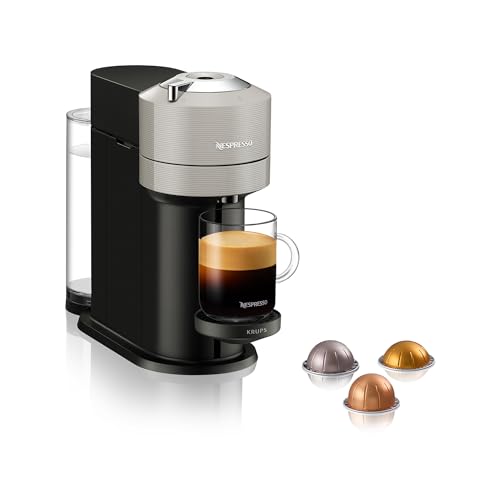
| Nespresso Vertuo Pop | Vertuo capsules with barcode, the machine sets the cup size itself, 13.6 cm wide | approx. €75.90 | 8.0 | you also want large cups and are happy to commit to Vertuo capsules |
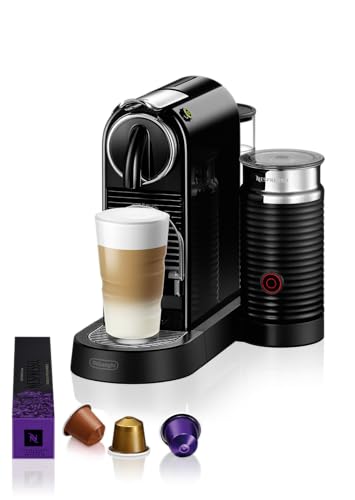
| Nespresso CitiZ with Aeroccino | Same capsule, Aeroccino milk frother in the box, 1 l tank | approx. €167.89 | 8.9 | you drink cappuccino several times a week and have around 22 cm of width free |
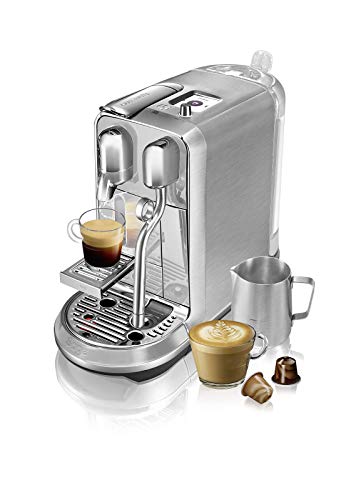
| Sage Creatista Plus | Same capsule, automatic steam wand on the housing | approx. €489.99 | 9.3 | you want to adjust the milk foam directly on the machine and can spend around €409 more |
The prices are the guide values from our data sheets, and the rating is our editorial assessment based on manufacturer and catalogue data. What the table does not show is the capsule costs, and for the Vertuo Pop these depend on a different range than for the three machines for Nespresso Original.
When the Essenza Mini is enough and when it is not
Most depends on the milk. The Essenza Mini has no frother; Nespresso sells it as a separate device: the Aeroccino 3 costs €79.00 in the Nespresso shop (as of 15 September 2026). According to our price boxes, the Essenza Mini and Aeroccino 3 together come to approx. €160.38, while the CitiZ with Aeroccino stands at approx. €167.89 and also has the 1 litre tank. For someone who mostly drinks cappuccino we would lean towards the CitiZ, and for those who want to adjust the foam directly on the machine, the Creatista Plus with its automatic steam wand is worth a look.
Cup size is the second fork in the road. You can only get more than 110 millilitres by programming the lungo button higher, and then the coffee is extended, as described in the detail section. How far the quantity can be raised and how tall a mug may be under the outlet belong to the open points further up. The Vertuo Pop instead reads a barcode on the capsule and sets the cup size itself. In our price box it is approx. €5.48 below the Essenza Mini, but needs more width and ties you to Vertuo capsules.
There are two limits on quantity. On paper, five lungos or 15 espressos at factory volume go through one tank filling. With lungo, the capsule container is full at roughly the same time; with espresso, it happens after a good third of a tank filling. For a household with two or three cups in the morning, that works. A round of six lungos in the office is not possible without refilling. Six espressos, by contrast, need only 240 millilitres, but then the capsule container is at its limit.
That leaves your tap water. How hard it is determines after how many cups you descale (the calculation is in the care section). You can find out the hardness from your water supplier, and there is more in the guide to water hardness. According to the manual, only fresh tap water belongs in the tank, and after a weekend or a longer break it requires the water to be replaced. The general Krups FAQ on the XN1108 page gives two days of standstill as the limit.
Care according to the manual: empty daily, descale by cups
The manual wants three parts emptied daily: the residual water tray, the drip tray and the capsule container. You remove the water tank and lid, clean them with a mild detergent and then rinse them with warm water. Afterwards you dry everything with a clean cloth, a piece of fabric or paper, and reassemble the parts. Regularly, the coffee outlet is added and, after removing the capsule container and residual water tray, carefully the area behind them, both with a damp cloth. According to the manual, you clean the surface of the machine with a soft, damp cloth, strong cleaning agents or solvents are prohibited, and you should use only clean cleaning materials. The machine should not run at all without the drip tray and drip grid, so that no liquid escapes onto surrounding surfaces.
Before cleaning, according to the safety section, you let the machine cool down. The warning in the cleaning section has five points, and they belong together: because of the risk of electric shock and fire, never immerse the machine or parts of it in water, disconnect it from the mains before cleaning, do not use aggressive cleaning agents or solvents, do not use sharp objects, brushes or abrasives, and never put the machine in the dishwasher. In the safety section, the dishwasher ban explicitly applies to the machine or parts of it, so also to the tank and trays.
A descaling indicator does not appear in the manual. When to descale you read from a table whose cup symbol carries 40 millilitres. With hard water, set there at 20 °dH (German degrees of hardness), it is time after 300 cups, with medium water at 10 °dH after 600, and with soft water after 1,200. You have to keep count yourself.
We therefore read the table as a quantity of water: 300 cups is then 12 litres. Someone who drinks two lungos a day at the factory volume sends 220 millilitres a day through the machine and is due after around 55 days with hard water, after around 109 with medium and after around 218 with soft. On the Nespresso page for the descaling kit, the recommendation is at least twice a year with hard water and at least once with soft water. With a lot of lungo, the table is therefore clearly above this recommendation. A third figure is given by the Krups FAQ on the XN1108 page: with an average of four cups a day and hard water every three months, more often with very hard water. This answer is not model-specific; it stands in a general Krups FAQ for coffee machines.
According to the manual, one run takes approx. 15 minutes. You eject the capsule, empty the trays and capsule container, and fill the tank with one sachet of Nespresso descaling solution and 0.6 litres of tap water. A container of at least 1 litre goes under the outlet. With the machine switched on, you hold the espresso and lungo buttons together for 5 seconds, both flash, then you press the lungo button and wait until the tank has run empty. The collected solution goes back into the tank and runs through a second time. Then you rinse the tank, fill it with fresh drinking water and let it run through in the same way. Finally you leave the mode, again with both buttons for 5 seconds, and empty the residual water tray.
The Nespresso descaling kit costs €9.90 in the Nespresso shop (as of 15 September 2026) and contains two units of 100 ml each. One unit is enough for one run, so one descaling costs €4.95. With hard water and two lungos a day, that would be just under seven runs by the calculation above, proportionally around €33 a year. Because the kit is only available with two units, in reality you buy four kits for that, so €39.60. As ingredients Nespresso lists L-(+)-lactic acid and less than 5 per cent phosphonates, and as hazards skin irritation and serious eye damage. The manual warns that the descaling solution could be harmful, that contact with eyes, skin and surfaces should be avoided, and that you should not use other products such as vinegar, which can affect the taste of the coffee.
At the end of its life, according to the manual, the machine does not belong in household waste. It complies with EU Directive 2012/19/EC, the packaging materials and the machine contain recyclable materials, and both therefore belong at a recycling point or civic amenity site.
Placement and children: what the manual rules out
Anyone who wants to make use of the narrow shape quickly thinks of the gap next to the cooker. Krups describes the machine as one that can easily be set up and moved anywhere in the kitchen or home. The manual is stricter: the machine must never be placed on or next to a hot surface such as radiators, hobs, gas rings, open flames or similar, and it should stand protected from direct sunlight, splashing water and moisture. By our reading, the strip between hob and sink is therefore ruled out. The surface must be stable and level and resistant to heat and liquids such as water, coffee, descaling solution or similar. According to the manual, the machine is likewise not intended for outdoors; it was developed exclusively for use inside buildings and under normal temperature conditions.
In households with small children, an age limit applies. The machine and cable belong out of the reach of children under 8 years. From 8 years, children can use the machine if they are supervised, have been given the instructions for safe use and have understood the hazards involved. According to the manual, children should not carry out cleaning and maintenance unless they are older than 8 years and supervised by an adult.