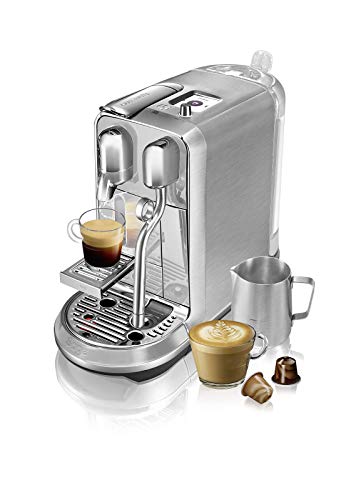
The Creatista Plus is a Nespresso Original machine with a steam wand on the housing. On its German product page, Sage describes it as a combination of Nespresso capsules and the company’s own micro-foam technology. The manufacturer lists the model under the product code BNE800, while the Amazon catalogue gives the model number SNE800BBS and the part number SNE800BSS4EEU1.
The sources disagree on the price. On Amazon.de the machine stands at approx. €489.99 on 06.09.2026, while on the German product page Sage asks €549.90 on the same retrieval date. That is a gap of around €60 for the same machine, a good twelve per cent. We use the Amazon figure here because the purchase link on this page leads there. Both figures are snapshots: what applied on 06.09.2026 does not have to apply on the day you buy.
Dimensions, weight and power
We take the values from the manual: 17 cm wide, 30.9 cm deep, 40.9 cm high. The German product page reverses the order and writes 40.8 x 17.1 x 31 cm, declared as width by depth by height. They are the same three edges, because 17 cm and 40.8 cm cannot both be the width of the same machine.
According to the manual, the machine weighs around 5.2 kg. The Amazon catalogue lists 16.14 pounds, so around 7.3 kg, plus edge lengths of around 41.0 x 31.0 x 17.0 cm. The edges match the manual dimensions to within a millimetre and therefore describe the machine itself. For the weight there is a gap of a good two kilos, and in our reading that is the box with its padding and cardboard.
Electrically, the machine runs on 220 to 240 V at 50 to 60 Hz, and Sage puts the power consumption at 1300 to 1600 W. At 230 volts, 1600 W corresponds to around 7 amps. A kitchen circuit protected with 16 amps carries around 3,680 watts, which leaves a good 2,000 watts for a second appliance on the same circuit. A small kettle fits alongside, but with a 2,200-watt model it gets tight.
The water tank holds 1.5 litres and is removable. As the material, Sage gives a stainless steel finish, and in the Amazon catalogue the colour is called Brushed Stainless Steel. There are three controls: a colour display, a selection dial and the START/CANCEL button. Amazon lists the display as a TFT LCD.
The steam wand works automatically, not by hand
Sage calls the component an automatic steam wand. Of the ten capsule and pod machines in our catalogue, only this model has a wand on the housing, and all the others either have no milk system or froth in a container of their own.
The procedure is in the manual. Milk goes into the supplied container, you place the wand in it, set the container down so that it touches the temperature sensor on the drip tray, then press start. Through this sensor the machine measures the milk temperature and ends the process itself. If you then let go of the wand and it sinks down, it rinses itself through automatically.
You set two values beforehand. The milk temperature ranges from 56 to 76 degrees Celsius, divided into eleven levels. The foam height ranges from 2 to 30 millimetres, divided into eight texture levels. 2 millimetres is a thin layer, as a flat white carries, and 30 millimetres is a cap for a cappuccino in the Italian sense.
At 76 degrees the scale ends. That has to do with the milk: milk protein coagulates in this range, and the hotter the milk gets, the worse the foam holds the air drawn in. The eleven levels are therefore not a gimmick but the difference between a milk that still flows and one that is merely hot. For very hot drinks you have headroom at the top, but for stable foam you stay in the lower part of the scale.
A free steaming mode, by contrast, appears in no manufacturer source: no procedure where you hold the wand in the jug yourself, control the air intake through the angle and shut off the steam when the temperature suits you. Sage also stipulates using only the supplied milk container. So you do not learn the jug handling of an espresso machine on this machine.
19 bar, 40 ml espresso: what comes out of the capsule
According to the manual, the pump pushes a maximum of 19 bar, also given there as 1.9 MPa. Maximum here means the pressure against a closed resistance. During the extraction, less pressure acts on the capsule. With a capsule machine the figure is in any case less useful as a buying argument than with an espresso machine with a portafilter, because grind size and dose are already fixed in the capsule.
The capsule goes into the machine via a lever. Three black drinks are stored at the factory: ristretto at 25 ml, espresso at 40 ml, lungo at 110 ml. All three can be programmed, ristretto and espresso within a window of 25 to 60 ml, the lungo between 70 and 150 ml. For a milk drink you set the coffee portion separately, also between 25 and 60 ml.
For two of these volumes the sources contradict each other. The Amazon catalogue text gives the lungo as 5 ounces, the manual as 110 ml, so 3.7 ounces, and the ristretto as 0.5 ounces, so around 15 ml, while the manual says 25 ml. That is a difference of a good 30 ml in the same cup, so for a drink of this size almost a third. We go with the manual, because it also states the programming window of 70 to 150 ml and both values come from the same table.
As milk drinks, Sage lists flat white, cappuccino and latte macchiato in the Amazon catalogue, while the selection menu in the manual shows cappuccino and café latte. Everything is chosen on the same dial.
In the box, alongside the machine, are a stainless steel milk jug, a sample box of Nespresso capsules, the water hardness strip, the welcome brochure and the instruction manual.
What Sage does not state for this model
For a machine in this price class, the published data is thin. Collected in one place so that you do not have to piece it together from across the text: missing are the brewing temperature of the coffee, the type of heating system (the term Thermocoil appears neither in the manual nor on the product page), the capacity of the capsule container in pieces, the fill volume of the milk container in millilitres, the material of the steam wand, the question of whether solid stainless steel lies behind the stainless steel finish, the noise level in decibels, the cable length, the power consumption per cup or per year, the country of manufacture, and any statement on water filters, on capsules from other brands and on capsule prices.
This list comes from five sources: the German product page for the BNE800, the Producthub, Sage’s warranty page, the instruction manual for the SNE800 hosted by Sage, and the Amazon catalogue entry.
Four claims that appear in retail and in older versions of this text do not hold up against these sources: up to twelve cups from one tank fill, a descaling interval of three months, capsule costs of €0.40 to €0.55 per cup, and a height-adjustable drip tray.
Is that enough for latte art?
It is intended for it. Sage names micro-foam for latte art as the purpose of the automatic wand, and a foam height from 2 millimetres suggests that fine textures are meant.
What a pattern in the cup requires depends not on the machine but on the milk: bubbles small enough for the surface to stay closed, and a temperature at which the milk still flows rather than stands. Both are decided in the first seconds, while air is drawn in. Here the sensor takes care of the temperature, and you set the amount of air through the foam level. How fine the bubbles turn out is not something you control on any dial.
What you do control is the choice of level and how quickly the foam gets into the cup before it separates from the milk. The steps for a pattern are in the guide to latte art. Whether a machine with a fixed container position is enough for it is a matter of expectation. In our assessment nothing speaks against a heart in a cappuccino, but for competition-style multi-layer designs you lack the freely guided wand.
What else is worth considering?
| Model | The difference | Price | Our rating | Choose this if |
|---|---|---|---|---|
| Sage Creatista Plus (this one) | Steam wand on the machine, controlled by a temperature sensor on the drip tray | approx. €489.99 | 9.3 | you make milk drinks every day and want to set temperature and foam height yourself |
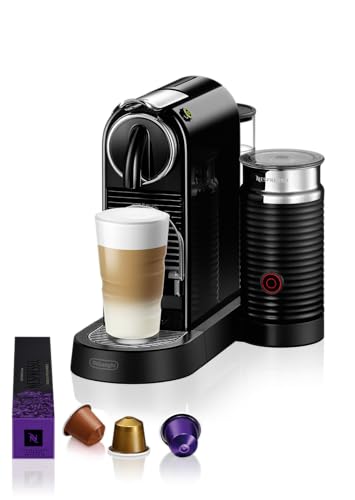
| Nespresso CitiZ with Aeroccino | Same capsule, but the foam is made in a separate electric Aeroccino, plus a 1 l tank and, according to the data sheet, around 25 seconds heat-up time | approx. €167.89 | 8.9 | the extra cost is too high for you and you can wash and store a second appliance |
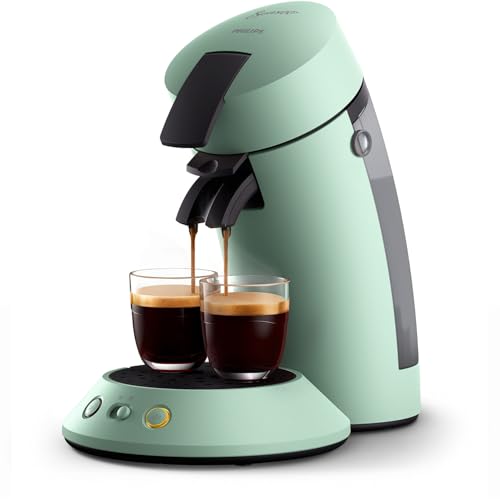
| Tchibo Cafissimo Milk | Milk tank of around 400 ml in the machine, drink ready at the press of a button, but Cafissimo format and 15 bar instead of Nespresso Original and 19 bar | approx. €89.00 | 8.3 | you want the cappuccino to run into the cup at the press of a button and do not mind the rinse after every milk drink |
| Nespresso Essenza Mini | Same capsule format and the same 19 bar, but no milk system, 0.6 l tank and 8.4 cm width instead of 17 cm | approx. €81.38 | 7.8 | you drink almost only black espresso and have little counter space |
All four prices are the guide values from our data sheets, as of September 2026. The rating next to them is our editorial assessment based on manufacturer and catalogue data, not a measurement result. What the table is not suited for: it compares purchase prices, while the running costs depend on the capsule price, which everyone has to calculate for themselves according to their variety and consumption. More models in the same category are in our best-of list of capsule and pod machines.
When the Creatista Plus fits and when another machine does
The only reason for the extra cost is the steam wand. Compared with the CitiZ with Aeroccino, the gap is around €322 by our guide values, and both take the same Nespresso Original capsule. Anyone who drinks two black espressos a day and needs milk foam three times a month pays here for a component that stands dry most of the time and still demands monthly care.
With two cappuccinos a day the sum looks different. Over five years that is around 3,650 milk drinks, and from that order of magnitude it is no longer about the extra cost but about whether foam from a separate jug will do for you in the long run.
The second question is the water hardness where you live. Sage calculates the descaling interval in drinks of 40 ml each, graded by degree of hardness (dH, German degrees of hardness): 4,000 drinks below 3 dH, 3,000 from 4 dH, 2,000 from 7 dH, 1,500 from 14 dH and 1,000 from 21 dH. At two drinks a day, that means in very hard water around 16 months until the first descaling, and in soft water a good five years. What degrees of hardness mean and how to find your value is explained in the guide to water hardness.
The third is space. At 40.9 cm in height it fits under most wall cabinets. In addition you need space in front of the machine for the milk container and air above, because the steam wand is raised to insert the container. With 45 cm between worktop and upper cabinet, it is worth measuring before you buy.
In the morning the machine is ready quickly, and the heat-up takes approx. 3 seconds according to the manual. The milk foam is still a separate step with filling, setting down and rinsing afterwards. It does not disappear entirely with the Cafissimo Milk from the table either: there the cappuccino runs through at the press of a button, but you fill the tank there too, after every milk drink you press the rinse button for the milk system, and on every day with milk foam you take the milk container apart.
And if you are still undecided between capsule, pod and bean in general, our finder sorts by preparation method and budget.
Care: daily, monthly, descaling
The manual wants the drip tray and capsule container emptied daily. You rinse and dry the milk container after every use, and you wipe the wand with a damp cloth. The machine takes care of the rinsing itself as soon as you lower the wand after frothing.
Once a month a cleaning programme for the steam wand is added from the Maintenance menu. Sage gives as the reason avoiding a blockage of the wand. Here the capsule machine behaves like a small espresso machine: milk dries in a narrow opening, and dried milk no longer comes away with water alone.
On the product page this sounds shorter. There Sage writes that the steam wand cleans itself, so that only minimal cleaning effort is needed. Both statements are true but mean different things: the self-rinse takes care of the inside of the wand. Wiping the outside, rinsing the container and the monthly programme remain with you.
None of it may go in the dishwasher. The manual expressly excludes the machine and accessory parts, the milk container included.
According to the instructions, descaling takes approx. 15 minutes and runs via the menu. As the descaler, Sage recommends the Nespresso descaling kit, with the reasoning that it was developed for this machine. If you dismiss the prompt, you get 30 more drinks, after which the machine blocks. Descaling can be postponed here exactly once, and only briefly.
Who is it for?
It fits a household where milk drinks are made every day and nobody wants to learn grind size and puck. You choose volume, milk temperature and foam height on the dial, and Sage expressly advertises the display as a guide through the various preparations.
It is wrong for black coffee drinkers: in our comparison of capsule and pod machines, the Essenza Mini processes the same capsule format for around a sixth of the price. If you want to learn to guide the jug yourself, read the section on the steam wand above to see why that does not work on this machine.
In the Amazon catalogue the model has been listed since 16 February 2021, so it has been on the market for a good five years. With a capsule machine, this age speaks rather in its favour: the capsule dictates the extraction, so there is little a newer generation of machine could do differently. When buying second-hand, however, it is worth looking at the warranty terms. On its own warranty page, Sage guarantees two years from the original date of purchase, and expressly only to the first end consumer. Anyone who buys second-hand no longer has this claim, however young the machine may be.
So our recommendation, very concretely: buy it if you come to at least one milk drink a day and factor in washing the container by hand after every use. If it stays at two or three milk coffees a week, take the CitiZ and put the difference into capsules.