Approx. €59.90 is the reference value this page uses for the Senseo Original Plus, and that is exactly the price the Amazon.de catalogue showed when it was checked on 7 September 2026. Philips itself sells the same machine in its own shop for €65.99 and states a recommended retail price of €94.99, both figures also retrieved on 7 September 2026. Between the manufacturer’s recommendation and the street price there are therefore around €35.
For that you get a pod machine with one bar of pump pressure, 0.7 litres of tank capacity and a strength slider with two positions. Every manufacturer statement in this text comes from the Philips product page for model number CSA210/80, from the instruction manual or from the support articles for exactly this model. Three details come from the Amazon catalogue: the colour name, the catalogue price and the description of the strength selection as a mild long coffee or a short strong one; they are marked as such in the text. The old philips.de addresses now redirect to the Versuni pages, where the documents are kept. Our rating is an editorial assessment of this body of data. None of us has handled the machine.
Model number, dimensions and two colour names for the same machine
The type designation is CSA210/80. The product page, instruction manual and support articles all run under this number, and it is the only detail that lets you match a retailer listing cleanly to the data sheet.
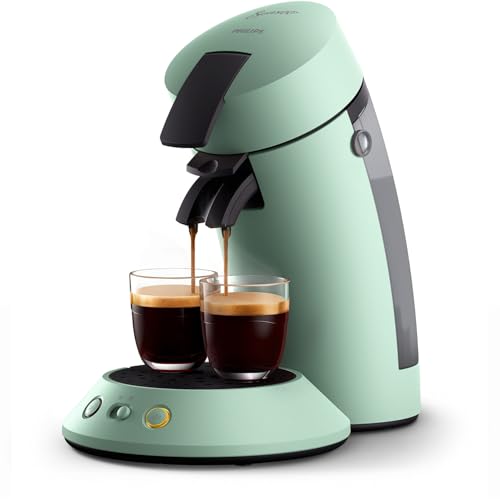
With the colour it gets confusing. The product name at Philips ends in “Wüsten Grün” (desert green), the Amazon catalogue uses the same designation, and in the specification table of the same Philips page the colour is given as Mint. For ordering, that means: search for CSA210/80, not for the colour name.
On the worktop the machine needs 213 millimetres of width and 315 millimetres of depth, and it is 330 millimetres high. Philips states 1.718 kilograms, and the power cable measures 0.8 metres. Those 80 centimetres of cable are the figure that snags first when you set the machine up, because in many kitchens there is more than that between the socket and the free surface.
In the product photo the body is rounded and rises towards the back, and at the front there is a flat base with the drip tray and the control panel. The spout has two openings side by side so that two glasses fit underneath at the same time.
The box contains the machine and two pad holders, one for one cup and one for two. Descaler is not included, and neither are pads. According to Philips the CSA210/80 is built in Romania, and apart from the parts that come into contact with food, 28 percent of the plastic is recycled material.
One bar of pressure and 45 nozzles: what happens during brewing
One bar of pump pressure is given in the specification, and that is the figure that separates this type of machine from everything that makes espresso. Portafilter machines work at around nine bar on the coffee grounds, and capsule machines advertise pumps of up to 19 bar. One bar corresponds roughly to the pressure that a ten-metre column of water produces at its base.
That is down to the pad and not to a saved component. Inside is comparatively coarsely ground coffee, loosely wrapped in paper, neither compacted nor tamped. Such a coffee bed offers little resistance to the water: it needs no high pressure, and it would not withstand it. What comes out of the machine lies between filter coffee and espresso.
Above the pad sits what Philips calls Coffee Boost Technology: 45 aroma nozzles distribute the hot water evenly over the pad surface instead of feeding it in at a single point. For the foam layer the manufacturer uses a second brand name, Crema Plus, and describes the result as particularly fine-pored and velvety. That is manufacturer language. None of us has measured this on the machine.
It is quick. According to the specification one cup takes under 21 seconds and two cups under 60. Pre-heating is not needed: the direct start function switches the machine on and starts brewing with the same press of a button. Once the cycle is finished, the machine switches itself off again.
Mild or strong: the strength selection has two positions
The setting is made with a slider, not in a menu. On the right, according to the manual, the machine brews a classic Senseo, and on the left a stronger coffee. Mild or strong is what Philips calls the two positions on the product page, and that is as far as it goes. How the machine produces the difference is not said on the product page, but the manufacturer’s description in the Amazon catalogue does say: it states the choice between a mild long coffee and a short strong one, so the slider works on quantity.
The second lever is the pad holder. The 1-cup holder takes one pad, the 2-cup holder takes two pads for two cups. Together with the two slider positions that makes four combinations, and that exhausts this machine’s range of adjustment. This is not a cost-cutting measure on this model but the limit of the portion system: grind size and coffee quantity are fixed in the portion, for pads as for capsules, as our guide capsule or pod machine goes through for both systems. A freely selectable fill quantity and a separate brewing temperature are not provided for in this design.
Loose ground coffee is forbidden. The manual expressly warns against putting ordinary ground coffee or damaged pads into the holder, because the machine would otherwise clog. If you need both, pad and powder, you are better off looking at the Senseo Switch, which has a full filter coffee mode alongside the pad brewing unit.
Is a 0.7 litre tank enough for your household?
For one or two people yes, for a round of guests no. The tank holds 0.7 litres. Philips does not publish how many millilitres per cup run through in either programme, so the number of cups per fill cannot be calculated from the data sheet.
The next larger Senseo in our catalogue, the Switch, has one litre. Besides its filter mode, that is the second reason why it appears in this deliberation.
That the water tank is removable is stated indirectly in the specification: it is one of the parts Philips lists as dishwasher safe, and only what can be removed beforehand goes into the dishwasher.
On where to put the machine, the manual sets two requirements that rarely anyone reads. During operation the machine must not stand in a cupboard. And above 1,250 metres above sea level it is not intended for use, which makes no difference in most kitchens in Germany and certainly does for a holiday home in the Alps.
Descaling every three months, and what it depends on
Every three months, regardless of water hardness: that is the recommendation in the Versuni support article. The machine reminds you with the only display element it has. On the Original Plus the button for one cup and the one for two cups flash at the same time as soon as descaling is due. The machine has no display, and the two buttons are the whole of the feedback.
The procedure is also fixed, step by step as in the guide Descaling and cleaning, only with Versuni’s quantities: half a bottle of SENSEO descaler to one litre of tap water, two descaling cycles in a row, then two rinse cycles with clear water before coffee runs through again. If you brew nothing for twelve hours after descaling, the manual says to add a further rinse cycle.
On the product the matter becomes contractual. Versuni permits only citric-acid-based descalers intended for SENSEO machines, and counts omitted descaling as inadequate maintenance. The household remedy from the kitchen cupboard therefore saves a few euros and costs considerably more if damage occurs.
According to the specification, three parts may go in the dishwasher: the pad holder, the water tank and the removable cover of the drip tray. The instruction manual goes further and allows all removable parts, either by hand with hot water and a little washing-up liquid or indeed in the dishwasher.
What else comes into question?
Four machines from our catalogue that solve the same task in very different ways.
| Model | The difference | Price | Our rating | Choose this if |
|---|---|---|---|---|
| Senseo Original Plus (this one) | Pad system with 1 bar, 0.7 l tank, two strength positions | approx. €59.90 | 8.5 | you want black coffee at the press of a button and have little space |
| Senseo Switch | Second mode for filter coffee with thermos jug, 1 l tank | approx. €96 | 8.5 | more than two people regularly drink coffee at the same time in your home |
| Tassimo My Way 2 | Closed T-Disc system with barcode, four storable profiles | approx. €59 | 8.1 | you need different drinks at the press of a button in the morning |
| Sage Creatista Plus | Milk wand on the housing, regulated by a temperature sensor | approx. €490 | 9.3 | you make milk drinks every day and can spend eight times as much |
The prices are the reference values from the data sheets of our own reviews, not current offers. The rating column shows how we classify the data and features of the four machines; nobody has measured anything on them. What the table is not suited for: it says nothing about what ends up in the cup. With pod and capsule machines that is decided by the roast in the portion, not by the housing around it.
When the Original Plus fits and when to look elsewhere
Start with milk, because that is where the decision tips fastest. This machine has no milk preparation, and nothing in the box can froth milk. For a daily cappuccino you therefore buy a frother as well, or you end up straight away with a machine like the Sage Creatista Plus with a milk wand on the housing, which costs roughly eight times as much. In between sits the Tchibo Cafissimo Milk, which does the froth itself straight from the factory and is listed in our data sheet at around €89. Which type of frother suits which quantity is covered in the milk frother buying guide.
Second, the quantity in the morning. Under 21 seconds per cup means that four cups in a row take about a minute and a half. The bottleneck is not the speed but the tank and changing the pad after each cycle. Anyone brewing for four people at once will, in our assessment, be more relaxed with a filter machine or with the Switch than with a pod machine for two cups.
Third, how much you want to adjust. Press one button and walk away: that is what the direct start function with subsequent automatic switch-off is built for. Freely choosing grind size, brewing temperature and the millilitres in the cup: no pad machine is built for that, whatever the price. Mild or strong, the slider gives no more leeway.
Fourth, space. 33 centimetres of height fits under any usual wall cupboard, and 21 centimetres of width fits next to a kettle too. Still, measure the distance to the socket: the cable length mentioned above sets a tighter limit on where you can put the machine than the housing itself.
Fifth, your water. Because the interval is three months across the board, hardness does not change the rhythm, but it does change the amount of limescale that settles in those three months. Our guide to water hardness lists the Senseo in its manufacturer table with a flat three months and gives no general figure for hard water. If you want to descale earlier with hard tap water, you do so on your own judgement, because Versuni names no shorter interval.
Finally, the budget. The purchase price is not the item you think about for long with this machine. More important is the question of whether you are planning a second purchase, namely the frother, and whether two strength positions will be enough for you in the long run.
What Philips leaves open on this model
A data sheet also shows what you search for in vain. For the CSA210/80, the following are missing: power consumption in watts, brewing temperature, fill quantity per cup, heat-up time as a separate value, noise level in decibels, the capacity of the drip tray, and the type of plastic along with the material of tank, pad holder and spout. The time after which the machine switches off if you turn it on and then do not brew coffee after all is also in no source: the manual describes only the switch-off after the brewing cycle. For electrical data Philips publishes 220 to 240 volts and 0.2 watts when switched off, and nothing more.
Two points concern buying again later. How long spare parts for this model remain available after production ends stays open in all the sources checked. And whether pads from other makers fit in the holder is simply not a topic for Philips and Versuni: the documents speak throughout of SENSEO coffee pads, and neither an approval nor an exclusion of third-party pads appears there.
One figure we deliberately left out, namely the price of a pad. Neither Philips nor the Amazon catalogue publishes anything on it, and supermarket prices fluctuate too much to build an annual calculation from them that stays correct for longer than a few weeks. If you want to know what your coffee costs per year, multiply the price of the pack you actually buy by your cups per day. That is more accurate than any reference value we could write down here.
Who is it suitable for?
For households with one or two coffee drinkers who want black coffee and do not want to set anything in the morning. In the category Capsule and pod machines it carries the value pick with us, and what tipped the balance was less the purchase price than what is missing here: no display and no menu navigation, and so nothing of what could fail on them.
For the office it is the wrong choice, and that is not a matter of taste but of the intended use that the instruction manual lays down. In practice the guarantee claim hangs on it: Versuni excludes defects from incorrect use from the two years of guarantee, and anyone operating the machine outside its intended purpose is in a worse position in a dispute.
The second group who are better off elsewhere: everyone who wants to get more than one method of preparation out of one machine. For them the value pick is the wrong purchase, however little it costs. What else is in this category is sorted in the best capsule and pod machines list.