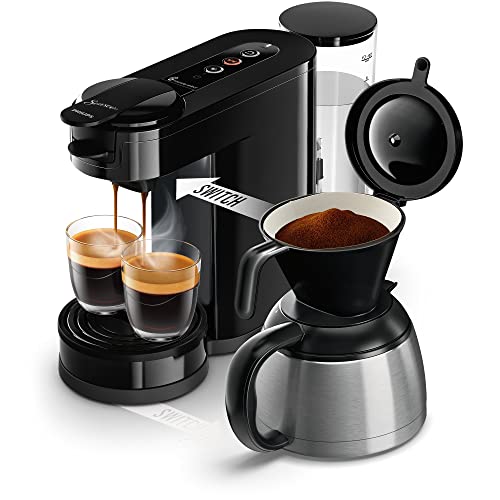
The Senseo Switch holds two brewing routes that share one water tank. In the product photo, the pad brewer with a double spout above the drip tray sits on the left, and on the right is a cone-shaped filter holder with the stainless steel thermal jug underneath. The data sheet for model number HD6592/64 calls the product type a pad and filter coffee machine, coffee type pads and filter. Philips itself describes it there as the only 2-in-1 coffee machine. In our price box it stands at approx. €95.99 on Amazon.de.
Philips also advertises in the Amazon catalogue that it is Germany’s no. 1 coffee machine brand by sales, with a footnote citing GfK Market Intelligence, coffee machines in Germany, 12 months to June 2026. No absolute sales figure is given there, though, and the footnote refers only to unit sales. And the manufacturer’s recommended retail price is well above the street price.
Two brewing stations in one housing
The manufacturer gives 400 millimetres in length, 150 millimetres in width and 270 millimetres in height, plus 1.75 kilograms. The data sheet does not specify which of these edges faces the front of your kitchen. So before buying, measure whether your spot has room for the 40 centimetres in both width and depth. The box measures noticeably more again, 466 by 242 by 322 millimetres at 2.4 kilograms.
A warning for anyone looking things up in the Amazon catalogue: the edge lengths there are given in inches and convert to roughly 33.5 centimetres in length, 24.6 in width and 47.5 in height. That does not match the machine’s dimensions, and measured against the manufacturer’s figures the gap is 16 to 76 per cent. If you instead sort the three values by size and set them beside the packaging dimensions from the previous paragraph, the gap shrinks to just 2 to 4 per cent, with the catalogue value a little higher each time. Our reading: Amazon is listing the box there, just distributed differently across length, width and height. The weight, by contrast, belongs to the machine: 3.86 pounds is 1.75 kilograms and not the 2.4 kilograms of the box. We therefore work consistently with the figures from the manufacturer’s data sheet.
As the main material, the data sheet names up to 50 per cent recycled plastic, with a limitation that Philips itself adds: parts in contact with food may not, under EU Regulation 282/2008, be made from recycled plastic and do not count towards the quota. As a secondary material, the same table lists stainless steel, presumably meaning the jug, the only documented stainless steel part on the machine. The colour is called piano black in the Amazon catalogue, and it is made in Romania. According to the data sheet, the user manual is made from 100 per cent recycled paper and the packaging from over 90 per cent recycled materials.
It is operated with three buttons: one cup, two cups, jug. As the user interface the data sheet simply names buttons, and under connectivity it says no. As included accessories the data sheet lists the pad holder and the thermal jug, which it describes as unbreakable; it gives no quantity. That two pad holders are included, one for one cup and one for two cups, emerges from the manufacturer support’s descaling article, which explicitly describes switching from one to the other.
In detail: one bar, and why it does not make espresso
Under pressure the data sheet gives exactly one figure: 1 bar. An espresso machine works at around 9 bar at the portafilter, and that difference decides what ends up in the cup. At one bar, hot water is pushed through a loosely filled pad rather than pressed through fine, compacted ground coffee. Philips calls the layer of foam on top Crema Plus and describes it as especially fine-pored and velvety. Espresso in the narrower sense is therefore not produced at one bar, with this machine as little as with the other Senseo pad machines that work at the same pressure.
2-in-1 brewing technology is the manufacturer’s name for pressure and water quantity being adapted depending on the route. It connects to 220 to 240 volts at 50 hertz, and according to the data sheet the power consumption is 1,450 watts. Before plugging in for the first time, the manual asks you to look at the base of the machine: the voltage printed there must match your local mains voltage, and the socket must be earthed.
For pad coffee, Philips gives one or two cups in less than a minute. If you press the 1-cup or 2-cup button twice within three seconds, the machine brews smaller and stronger cups. The user manual explicitly lists this strength selection for the models HD6596 and HD6592, so it applies to this machine. As drinks, the data sheet lists normal, mild and small strong coffee, and counts two pre-programmed drinks.
The filter route: paper filter, measuring spoon, run-on
For the jug you insert a paper filter and fill it with ground coffee. You must fold the embossed edges of the filter beforehand, otherwise it collapses and the grounds end up in the jug. Which size belongs in there, 1x2 or 1x4, is something you should measure against the filter holder before your first repeat purchase.
On strength there is a rule of thumb from the manual: one heaped measuring spoon of ground coffee per cup for stronger coffee. You take the pad holder out before brewing into the jug, otherwise preparation takes longer. If you want the coffee to stay hot for a long time, rinse the thermal jug beforehand with hot tap water and brew a full jug rather than a half. The manufacturer advises both in the troubleshooting section, and both cost nothing but a movement of the hand.
After the brew cycle the indicator keeps flashing for up to 90 seconds. That water remains in the tank afterwards is also part of the normal process. The tank holds one litre, which according to the Amazon catalogue text is enough for up to seven cups without refilling, and the data sheet puts the servings per cycle at two to seven.
Four sentences from the safety section belong here. Never fill above the MAX mark, otherwise water drips from the machine. As long as the indicator flashes, hot coffee is in the filter holder. Before every brew the lid must be closed and the locking lever latched. And rinsing or brewing is done only with the coffee spout inserted.
The manual treats two faults with surprising patience. If the lid sticks because negative pressure has built up in the machine, you switch it off, pull the lever up and wait 24 hours before opening it. And if suddenly less coffee runs into the cup, the sieve in the pad holder is usually blocked; it is cleaned with a washing-up brush.
Is the Switch allowed in the office?
No, at least not according to the user manual. It is explicitly intended only for normal household use there, and the list of excluded environments is longer than you would expect.
Excluded are environments such as staff kitchens in shops, offices, farms or other working environments. The last item is the widest: other working environments also cover a workshop or a surgery. In a separate sentence, the manual additionally names use by customers in hotels, motels, bed and breakfasts or other accommodation. We reproduce the list in full because picking out a single item would create a distinction that the manufacturer does not make.
Technically nobody stops you putting the machine in the office kitchenette. But the intended use is the yardstick the manufacturer applies in a dispute, and it appears in the same chapter as the safety and repair conditions. Our assessment: for continuous use in a company the Switch would be the wrong choice anyway, because a one-litre tank is too small for that. Earlier versions of this page named the office as a use scenario, which was a mistake.
What else is worth considering?
| Model | The difference | Price | Our rating | Choose this if |
|---|---|---|---|---|
| Senseo Switch (this one) | Pad and paper filter in one machine, 1 l tank, thermal jug for seven cups | approx. €95.99 | 8.5 | you drink alone on weekdays and need a jug at the weekend |
| Senseo Original Plus | Pad route only, 0.7 l tank, no filter holder that also needs cleaning | approx. €59.90 | 8.5 | you almost never brew more than two cups in a row |
| Tchibo Cafissimo Milk | Capsule system with built-in milk frother, but no jug coffee | approx. €89.00 | 8.3 | someone in the household regularly drinks cappuccino or latte |
| Sage Creatista Plus | Steam wand on the housing, winner of our category comparison, around five times the price | approx. €489.99 | 9.3 | milk foam matters more to you than a jug of filter coffee |
The prices are guide values as of September 2026 and change faster than we touch this page. The rating beside them is our editorial assessment of the available data, not a measurement result: none of these four machines has ever been on our desk. Further candidates are in our overview of capsule and pad machines.
Cleaning and descaling as the manufacturer prescribes
According to the manual, all removable parts may go in the dishwasher except the water container and the thermal jug. The support is more emphatic and writes that you clean the water tank and thermal jug only with washing-up liquid and hot water. Scouring sponges, abrasives and aggressive liquids such as petrol or acetone are prohibited for the whole machine, the inside must never be flushed through with the lid open, and you pull the plug before cleaning.
Descaling is done every three months, exclusively with liquid Senseo descaler. The process consists of two descaling cycles and two rinse cycles of five minutes each, so twenty minutes together, during which you stay with the machine. For each descaling cycle, half a bottle of descaling liquid goes into the tank and the rest is topped up with fresh water. The first cycle runs with the 1-cup pad holder and a used pad or the thin limescale filter, the second with the 2-cup pad holder. You start by pressing the 1-cup and 2-cup buttons at the same time; at the end the machine switches off once the tank is empty. Cancelling is not an option: the CALC indicator keeps flashing until the process has run correctly, and if you then brew no coffee for twelve hours, you rinse once more before the next one.
Vinegar is explicitly ruled out because it can damage the machine and affect the taste. The same applies to descalers based on mineral acids, that is sulphuric, hydrochloric, sulphamic or acetic acid, and to sodium-containing water softeners. How much your water clogs up the machine in the first place depends on the carbonate hardness of your tap water; the basics are in our guide to descaling and cleaning.
Two small points from the manual are easily missed. Before first use you rinse the machine through once, which takes around two minutes and fills the system with water. And if it has stood unused for a day, you let clean cold water run through before the next coffee. Nothing other than clean, cold water ever belongs in the tank.
Pad mode or a whole jug: what suits your household
Work out briefly how often you need more than two cups at once. If it stays at one to two, the Senseo Original Plus takes the same pads, has 0.7 rather than one litre in the tank and costs approx. €59.90. That is a difference of around €36 for a second brewing route that you then never use, plus one component less on the worktop.
From three cups upwards the sums tip the other way. The data sheet gives two to seven servings per cycle, and the insulated jug needs no hot plate. That is no small detail. A hot plate keeps coffee hot by continuing to heat it; our guide to filter coffee would not leave the coffee on the plate for long, because the Deutscher Kaffeeverband (German Coffee Association) and Melitta advise against it, and in the EU new filter machines with a glass jug must end the keep-warm function after 40 minutes at most. A thermal jug does not reheat; it only retains the warmth already in the jug.
Milk is the second criterion and the clearer one. The Switch has no frother. Anyone who drinks cappuccino regularly ends up at the Tchibo Cafissimo Milk with its built-in frother, or straight at the Sage Creatista Plus with a steam wand, though with the Creatista Plus you pay around five times as much.
Then there is your time budget in the morning. The pad route is a single movement: lid open, pad in, press the button. The filter route costs you paper filters, measured powder and the wait for a whole jug, plus the run-on phase of the indicator. We would not recommend the Switch to anyone who takes the filter route twice a year. If you are still unsure whether pad or capsule suits you better, the guide capsule or pod machine sorts the systems by cost and effort, and the Coffee Finder asks in four steps about preparation method, budget, desired convenience and milk drinks.
What the manufacturer does not state
The data sheet is detailed for this price class, but it stays silent in some places. Philips gives no brewing temperature, for either the pad or the filter route, and no fill quantity per cup in millilitres, not even for the mild and strong settings. How many litres the thermal jug holds is likewise not in any source: seven cups are documented, and we do not calculate a volume from outer dimensions. Also open are the heat-up time as a figure, the noise level in decibels, the cable length, the recommended grind size and the suitable paper filter size for filter mode, the maximum amount of powder in the filter holder, and the period for which spare parts are to be available. On water hardness none of the manufacturer sources says anything: neither a setting on the machine nor a water filter for the tank, and the standby consumption is shown in the data sheet itself as not available. What a cup costs depends on your shopping, and there is neither a manufacturer figure nor a reliable estimate from us.
Part of this is down to the source situation. The old philips.de addresses now redirect to the Versuni pages, the former document server no longer responds at all, and the product page is a JavaScript application whose specification table has to be expanded first. On 8 September 2026 we expanded and read it. The user manual is a multilingual PDF for HD7891, HD6596, HD6592 and HD6591, in which passages that depend on the model are marked with the respective model number.
Who is it for?
One group can save itself the purchase, and it is not mentioned in the brochure: motorhome, garden house, unheated holiday home. For safety reasons the manual prohibits operation via a transformer, requires an earthed socket and rules out temperatures below zero, because residual water in the machine can freeze and cause damage. After the first rinse-through, the machine should also stand frost-free between uses. For a kitchen with permanent power this is no issue, but for the allotment cabin in winter it is.
One point for families is in the safety section of the manual and is rarely quoted: children under eight must not be given access to the machine, the accessories or the cable. From eight, operation is allowed provided they are supervised or have received instruction, and they may do cleaning and maintenance only from that age and only under supervision. Playing is taboo. The same page also requires that a switched-on machine is never left unattended.
Finally, a figure that Philips likes to mention and that still says nothing about your own machine: Philips writes that during development its coffee machines are run through more than 10,000 cups of coffee. That does not tell you how long yours will last. And when it has finally had its day, the crossed-out wheelie bin symbol on the housing applies: it does not belong in household waste but at a collection point.