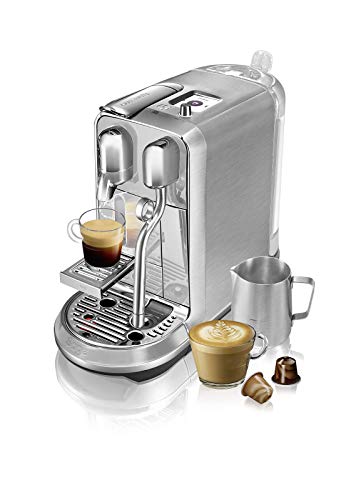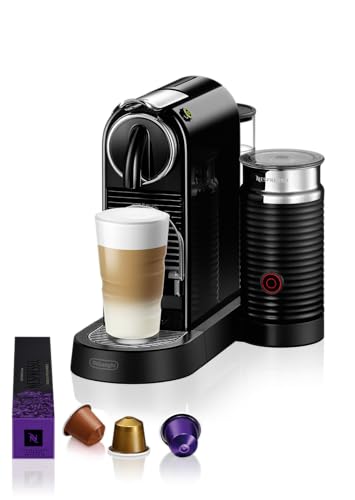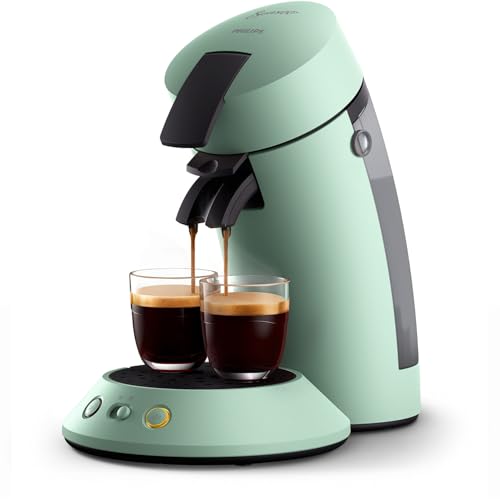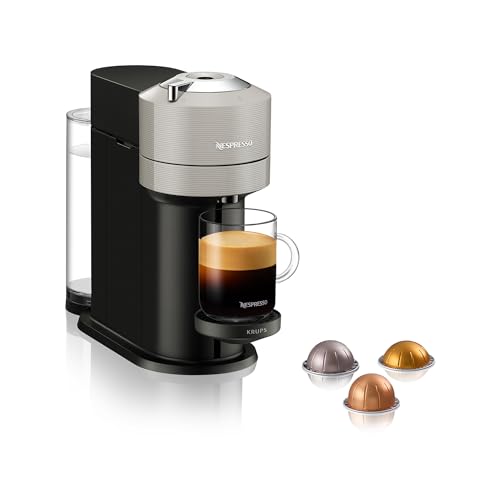
This machine carries more names than most. In the catalogue it appears as XN910B, and the instruction manual lists the same design additionally as GCV1 and GDV1 at Nespresso, as ENV120 at De’Longhi, as M700 at Magimix and as BNV520 to BNV570 at Breville. One device, several brand names. For you that means: when searching for manuals and spare parts, the model number gets you to your goal faster than the product name. As the party placing it on the market, the catalogue data names Groupe SEB Deutschland GmbH.
The reference price on this page is approx. €69.90 (as of September 2026); it comes from our own data sheet and applies to the cut-off date, not to the day you order. The Vertuo Next has been on sale since 18 August 2020, and the catalogue colour of this version is called Light Grey. For this device Krups keeps a spare parts list with article numbers and, by its own account, holds spare parts available for fifteen years after purchase on average.
The difference from a Nespresso Original machine is not in the equipment, it is in the capsule format. Vertuo capsules carry a barcode and are extracted according to a different principle, which the machine itself controls.
Dimensions, weight and the space the machine really needs
14.2 centimetres wide, 42.9 centimetres deep, 31.4 centimetres tall and 4 kilograms in weight: that is how the Vertuo Next appears in the specification table of the instruction manual. The width sounds small; the depth is the figure on which things fail in the kitchen. On a worktop 60 centimetres deep, a good 17 centimetres remain in front of the device, and in that strip stand the cup and the capsule box. Add headroom, because the machine head opens upwards to insert the capsule.
On weight the sources differ: the Amazon catalogue lists 9.46 pounds, which converts to roughly 4.3 kilograms. The dimensions beside it are 39.1 by 25.3 by 37.8 centimetres and match no edge of the device. For us these are the dimensions of the box. We therefore stay with the 4 kilograms of the manual. The cable measures 75 centimetres from the machine, so the spot for the machine and the socket must be close together.
The water tank holds 1.1 litres. In the product photo it is a transparent cylinder on the outside of the housing, not a compartment in the body. Whether the 14.2 centimetres of width include it is not stated in the manual. According to the manual, the container for used capsules takes 10 espresso capsules or 6 mug capsules, depending on which format you drink. The cup holder is adjustable, which Krups puts at four positions. On the housing, Krups states a share of 54 percent recycled plastic.
In detail: Centrifusion, barcode and 7,000 revolutions
The capsule spins. That is the whole technical difference from the Original system: Nespresso describes the method as patented Centrifusion technology; during brewing the capsule rotates in the machine head, according to Nespresso at up to 7,000 revolutions per minute. Centrifugal force drives the water from the inside through the coffee grounds outwards, instead of pressing it through from above with pump pressure as in an espresso machine. For this design Nespresso therefore gives a pressure in bar nowhere, and the figure would also be meaningless here: it would describe a pump that is not doing the main work.
The printed barcode does the rest. The machine reads it, pre-wets the coffee and chooses preparation parameters and coffee length itself. The capsule goes in dome down, and ejection happens automatically the next time the head is opened. For that you need exactly one button.
The process is not rigid all the same. The fill quantity can be programmed between 20 and 535 millilitres, and the machine stores it per capsule type. If you prefer your mug with 200 rather than 230 millilitres, you set that once.
So how many cup sizes are there?
Four capsule sizes, seven cup sizes. That is what the German instruction manual says: capsules in S, M, L and XL, giving Ristretto at 25 ml, Espresso at 40, Double Espresso at 80, Gran Lungo at 150, Mug at 230, Alto and Cold Brew Style at 355, Carafe at 535 millilitres.
The trouble is that every source counts differently. On one product page Krups names five drinks, on a second three capsule sizes, and puts Alto at 414 millilitres. The Amazon catalogue text arrives at six cup sizes and more than four capsule sizes, with Carafe at 535 and Alto likewise at 414 millilitres. Three sources, three ways of counting: for capsule sizes it is three against four against more than four, for Alto 414 against 355 millilitres.
We stick to the instruction manual, because it belongs to exactly this device and gives its values in a specification table. We have aligned the data row at the top of this page to exactly these values; before, it carried the retail description. The 414 millilitres for Alto come from the Krups product page and from the Amazon catalogue text. The manual and the aroma profile card from 2023 agree on 355. For the large cup, therefore, the value from the manual applies, 355 millilitres.
The aroma profile card sorts the range yet another way, namely by drink category: Single Espresso 40 ml, Double Espresso 80 ml, Gran Lungo 150 ml, Mug 230 ml, XL 355 ml and Craft Brew 535 ml, plus the Barista Creations between 80 and 355 ml. In front of the capsule shelf that is the more useful overview, because it is sorted by drink and not by the letter of the capsule size. On the same card are two markings that also help there: one for decaffeinated varieties, one for half-decaffeinated ones such as Half Caffeinato.
Heating up, switching off and the Coffee Creations mode
30 seconds to operating temperature, says the manual, and that is with the machine head closed and locked. Two minutes after the last use the device switches off again. If the second cup comes only after that, it costs the half minute of heating up again.
Electrically, the EU version runs on 220 to 240 volts at 50 to 60 hertz, and the manual gives the power consumption as 1300 to 1500 watts. At 230 volts that is roughly 6.5 amperes by calculation, and it flows only while heating.
There is exactly one adjusting screw on the extraction itself, and it is called Coffee Creations. Press the coffee button twice in quick succession, the button flashes turquoise, and the extraction runs more concentrated. It is intended for recipes with milk, where a normal-length coffee would turn out too thin. For the XL coffees Alto Ambrato and Alto Onice as well as for Cold Brew Style and Carafe Pour-Over Style, Nespresso expressly does not recommend the mode. And under some circumstances it requires a machine update via the Nespresso app, which is why the wireless module does play a role here after all.
Bluetooth and Wi-Fi are switched on from the factory, so the connectivity module works along as soon as power is applied. What it is for is stated by the manufacturer text in the catalogue: for automatic software updates. For making coffee, though, the connection is never needed; the barcode is read at the machine. You switch the module off directly on the device.
What Nespresso does not state about this machine
For a device with a multilingual manual running to several hundred pages, a surprising amount remains open. Collected in one place, so that it is not spread across the whole text: there is no brewing temperature in degrees, no noise level in decibels, no brewing time per cup size (documented is only the 30 seconds to operating temperature), no consumption per cup or per year (documented there is only the standby value), no maximum cup height under the spout and no descaling interval in months or cups. A water hardness setting is also missing from the documents, as is a water filter for this model and any information on whether firmware can be installed without the app. On the materials of the tank, capsule container and drip tray both manufacturers are silent; documented there is only the recycled content of the housing.
Two gaps hurt when calculating. The shop pages of nespresso.com returned no capsule prices when retrieved, and without a capsule price the cost per cup cannot be put at a figure responsibly, although with a capsule machine that is exactly where the larger part of the spending lies. And how many Vertuo varieties are available at all is not given anywhere as a total; the aroma profile card only lists the varieties.
Four statements from the earlier version of this text did not withstand checking against the manufacturer sources and have been removed without replacement: approval of the water tank for the dishwasher, a descaling rhythm of two to three months, a price corridor per cup and remote functions of the app such as preheating. The manual forbids the dishwasher for the machine and prescribes hand cleaning for the removable parts; on the tank itself it says nothing.
Care: clean monthly, descale when indicated
Nespresso requires a monthly cleaning, in addition whenever coffee residue becomes visible in the machine head, and after longer periods of non-use. The capsule container, cup holder and drip tray are cleaned with hot water and a mild, odourless cleaning agent. The device itself does not belong in the dishwasher, and abrasive cleaners and solvents are prohibited.
The machine itself reminds you to descale: the button flashes orange three times and then lights constantly white. The process takes about 20 minutes and cannot be interrupted, so you need a free half hour in one go. You work with the Nespresso descaling kit, plus 0.5 litres of water in the tank, one unit of descaling liquid and a container holding one litre.
Instead of an interval in months, this indicator alone applies. That leaves the responsibility with you, and the yardstick for it is the water hardness where you live: with hard water you do better to descale before the orange flashing than after it. What hardness reaches your tap is stated in the drinking water analysis of your supplier. What follows from it is covered in the guide to water hardness and in the guide to descaling.
What else is worth considering?
| Model | The difference | Price | Our rating | Choose this one if |
|---|---|---|---|---|
| Nespresso Vertuo Next (this one) | Vertuo format with barcode, cups from 25 to 535 ml from one device | approx. €69.90 | 8.6 | your cup size varies between espresso and mug |
| Nespresso Vertuo Pop | 0.56 l tank instead of 1.1 l, but 25 instead of 31.4 cm tall | approx. €75.90 | 8.0 | you brew two cups a day and put the machine away afterwards |
| Nespresso Essenza Mini | Nespresso Original instead of Vertuo, no barcode, largest quantity is the Lungo | approx. €81.38 | 7.8 | you drink almost only espresso and never need a mug |
| Sage Creatista Plus | Steam wand on the housing that froths milk directly at the machine | approx. €489.99 | 9.3 | milk drinks are on the menu every day and the budget stretches to roughly seven times as much |
All four prices are the reference values from our data sheets, as of September 2026; the rating beside them is our editorial assessment from manufacturer and catalogue data. What the table is not suited for: it puts purchase prices side by side, and there is no figure for capsule costs in it. More models are in our best-of list of capsule and pod machines.
Who the Vertuo Next suits and when another machine is better
What is decisive is how big your cup is in the morning. Between Ristretto and Carafe lies the range the Vertuo Next covers without topping up, and that is exactly what Vertuo exists for alongside the Original system. If you drink only espresso, you pay for a capability you never call on, and you are better served by the Essenza Mini in the Original format.
The second point is the number of cups. The tank is enough for just under five mugs of 230 millilitres, and the capsule container is full after six of them. In a two-person household where both drink mugs, that means roughly: fill the tank every two days, empty the container every three days.
Milk is the third point and the only hard limit of this machine. There is nothing for it on the machine itself. Anyone who drinks cappuccino daily either buys a second device, whose designs the guide to milk frothers sorts out, or goes straight to a machine with a steam wand such as the Sage Creatista Plus, which carries the highest rating in our comparison of this category.
The fourth point is space, and there the depth counts, not the slim front. That leaves care: monthly cleaning, plus a descaling that blocks half an hour in one go. It does not work without a fixed routine.
And finally the question of the system. With the purchase you commit to Vertuo capsules, not to a housing. For anyone who wants to choose between brands when buying capsules, this is the wrong machine. Whether capsule, pod or something else entirely suits your household is sorted out by the guide to capsule or pod machines, and anyone still completely open gets to a shortlist faster via the coffee finder.
In our comparison of capsule and pod machines, the Vertuo Next is the cheaper of the two Vertuo entry points that our catalogue carries. Our assessment: 8.6 out of 10. What is missing for the top rating is down to the lock-in to one system and the missing milk system, not to the technology.