The Vertuo Pop is the smaller of the two Vertuo machines in our capsule and pod machines category, and yet the more expensive one. Our price box lists it at approx. €75.90 on Amazon.de (as of September 2026), while the Vertuo Next with the larger tank sits €6 below it. At the manufacturer the order is reversed: on 14 September 2026 the German Nespresso shop asked €119.00 for the Pop and from €149.00 for the Next. In the Krups shop it stood at €77.99 on the same day, but as not available.
Vertuo is Nespresso’s own capsule format, separate from the Original format. Every capsule carries a barcode, and the machine reads from it how to brew.
Dimensions, tank and placement
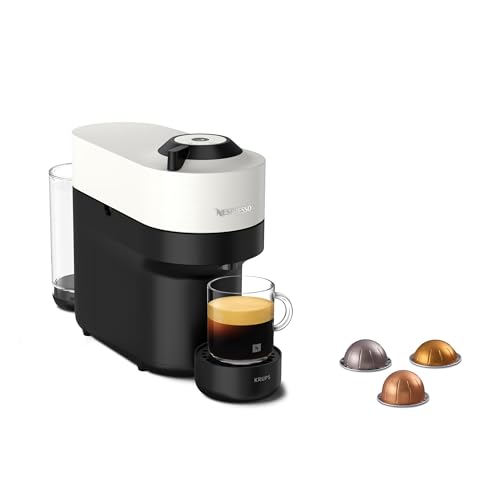
13.6 centimetres wide, 42.6 deep and 25 high: in that order, expressly as width, depth, height, the dimensions appear in the specification table of the instruction manual, along with a weight of 3.5 kilograms. Nespresso’s shop page prints the same three numbers under the heading W x H x D, which would make the machine 42.6 centimetres high. The product photo supports the manual. There the transparent water tank sits at the back of the housing, with the body and drip tray in front of it, so the components lie one behind the other rather than one above the other. Krups gives the width as 13.5 centimetres.
Of the 25.0 by 39.6 by 32.4 centimetres and 3.63 kilograms from the Amazon catalogue, only the 25 matches the height in the manual; the other dimensions and the weight differ. We therefore use the manufacturer’s figures throughout.
For the tank, the manufacturer sources are 40 millilitres apart. 0.56 litres appears in the feature list of the Nespresso shop page, at Krups and in the 2021 manual, 0.6 litres in the current manual of April 2024 and in the product data of the same shop page. We consider the 0.6 to be rounded and use 0.56 litres. On paper that is enough for two mugs from mug capsules of 230 millilitres each, but not for a third, or for 14 espressos of 40 millilitres each. The container for used capsules is full after 8 espresso or 5 mug capsules.
Operation consists of one button, which is power switch and coffee button in one, and a lever for locking and unlocking the machine head. You insert the capsule with the dome facing down and lock the lever to the left. When you unlock it to the right, the machine ejects the capsule itself. The head stays closed during brewing: if you want to cancel, you press the coffee button once and wait until the machine stops. The safety instructions give scalding risk as the reason, because if the machine is opened by force, hot liquids and coffee grounds can splash.
Nespresso states that the machine is made of 35 percent recycled plastic. Krups names six colours, including Spicy Red and Pacific Blue; the Amazon offer is the Coconut White version with the Krups model number XN9201, and Amazon gives 29 July 2022 as the release date. Under “Machine codes” the instruction manual lists, besides XN9201, also Breville BNV120 and BNV150, De’Longhi ENV90, Magimix M800 and Krups XN9204, XN9205 and XN9211. If one of these numbers appears in a listing, the same manual applies to the machine.
For placement, the safety instructions require a stable, level surface that is resistant to heat and to liquids such as water, coffee or descaling solution. While the machine is in operation, it must not stand in a cupboard. The cable measures 75 centimetres from the machine.
In detail: rotating capsule, barcode, own fill volumes
Centrifusion is the name of the technology behind the Vertuo system, which Nespresso describes as patented. On its overview page for the Vertuo machines, Nespresso describes that the capsule rotates in the machine head during brewing. This is the mechanical difference from the Original format, in which the capsule stays still and the water runs through under pump pressure.
The barcode determines which settings apply. According to the manual, the machine recognises the inserted capsule, pre-wets the coffee and chooses the brewing parameters and coffee length itself.
You can still intervene in two places. The first is the fill volume: if you hold the button down until the desired amount is in the cup, the machine remembers the value for that capsule type, programmable between 20 and 535 millilitres. A factory reset sets all volumes back at once. For this you open and close the head, leave the lever unlocked and press the button five times within three seconds.
The second is called Coffee Creations. Press the coffee button twice quickly, the button flashes turquoise, and the machine brews concentrated coffee, intended for recipes with milk, milk foam or ice. In the manual’s graphic an espresso shrinks from 40 to 25 millilitres, a double espresso from 80 to 40, a Gran Lungo from 150 likewise to 40 and a mug from 230 to 80 millilitres. The two largest volumes, 355 and 535 millilitres, are marked there with a red cross. For the XL coffees Alto Ambrato and Alto Onice, for Cold Brew Style and for Carafe Pour-Over Style, Nespresso does not recommend the mode, and under some circumstances the machine first needs an update via the Nespresso app.
The manual gives a heat-up time of 30 seconds, counted from the machine head being closed and locked; the light flashes for that long. Two minutes after last use the Pop switches itself off, and according to Krups this time cannot be changed. You can switch it off by hand at any time while it is not preparing anything, by holding the button down for 3 seconds.
Bluetooth, Wi-Fi and the Nespresso app
The Pop transmits in two ways. Krups lists Bluetooth and Wi-Fi as the route for automatic software updates, and the manual puts the transmission power at a maximum of 4 dBm for Bluetooth and below 20 dBm for Wi-Fi in the frequency band of 2.402 to 2.480 GHz. The connectivity module is switched on from the factory. It can be switched off directly on the machine.
What the connection brings is listed in the manual: Smart Coffee with news, expert tips with videos and a notification as soon as the machine needs maintenance, with step-by-step help for descaling, rinsing and cleaning. It mentions starting a brew from the smartphone nowhere; brewing is described only via the button on the machine.
Which cups fit under the spout?
According to the instruction manual, the Ristretto, Espresso, Double Espresso and Gran Lungo cups from the Nespresso accessories fit, along with Mug (S), Mug (M) and the Reveal glass. Mug (L) and Carafe are listed there among the unsuitable accessories.
The same manual lists four sizes as compatible capsules: S with Ristretto at 25 and Espresso at 40 millilitres, M with Double Espresso at 80 and Gran Lungo at 150, L with the Mug at 230 and XL with Alto and Cold Brew Style at 355 and Carafe at 535 millilitres. The Pop therefore processes the Carafe capsule, but the matching Nespresso vessel counts as unsuitable. Nespresso’s shop page and Krups, by contrast, advertise four cup sizes from espresso to mug, with Krups spreading them over three capsule sizes. The Amazon catalogue text arrives at up to five and counts the carafe.
The manual is also inconsistent on the cup support: adjustable according to the device overview, “removable single position” for large recipes according to the specification table. It can be removed in any case, and the manual requires exactly that for cleaning and descaling.
For us this means: up to 230 millilitres all sources agree, above that it becomes uncertain, and a Carafe requires an almost brimful tank.
Cleaning and descaling according to the manual
Nespresso wants the machine cleaned once a month, and also whenever coffee residue shows in the machine head, and after longer periods of non-use. Before the programme you rinse the tank and lid and fill in fresh drinking water, empty and rinse the capsule container and drip tray, remove the cup support and place a vessel of at least one litre under the spout. There must be no capsule in the machine. If you press the button three times within two seconds with the head locked, it flashes orange, and the cycle takes up to 7 minutes; it can be interrupted at any time by pressing the button.
Then come the removable parts, and the manual is clear here: you clean the capsule container, cup support and drip tray with hot water and a mild, odourless detergent. Strong or abrasive cleaners and solvents are prohibited, the machine does not belong in the dishwasher, and the wording is: “Never immerse the machine or parts of it in water.” The safety instructions expressly extend the dishwasher ban to parts: neither the device nor parts of it belong in the dishwasher. That includes the water tank and capsule container. Finally you dry the machine with a clean, fresh cloth.
You clean the coffee spout regularly with a clean, damp cloth, and because water can collect in the machine head, you wipe the visible parts there afterwards with a clean, dry cloth. Before cleaning, the safety instructions require unplugging the mains plug and letting the device cool down.
The Pop reminds you of descaling itself: the button flashes orange three times and then lights up steady white. From this signal, according to the manual, the machine can only be used a few more times, then descaling is mandatory. In a general FAQ on the product page that does not distinguish between models, Krups recommends descaling every 3 months with an average of 4 cups a day and hard water.
You need the descaling kit from nespresso.com and an empty vessel that holds one litre. Into the tank go 0.5 litres of water and 1 unit of Nespresso descaling solution. Nespresso warns that the solution can cause irritation and damage, and requires avoiding contact with eyes, skin and surfaces. A sequence of holding, locking and unlocking leads into descaling mode, for which you have 45 seconds after the first hold; rapid orange flashing confirms the mode. After the first phase the machine stops, you rinse the tank and drip tray thoroughly, fill in drinking water, empty the collecting vessel and start the rinse cycle. The whole process takes around 20 minutes and cannot be interrupted. Afterwards the machine wants to dry for 10 minutes before it brews again.
According to the safety instructions, only fresh drinking water belongs in the tank. Other liquids are excluded; the examples given there are cow’s milk, soya milk, fortified milk and flavoured liquids. If the machine has stood over the weekend or longer, you replace the water; before a longer absence such as a holiday you empty the tank. How hard your tap water is and what that means for descaling is explained in the guide to water hardness.
What the Pop costs to run
This page gives no capsule price, because the capsule pages of nespresso.com returned no prices when we checked. The Pop processes Vertuo capsules only; the shop page says “VERTUO exclusive” under capsule compatibility, and according to a general FAQ on the same page the Vertuo Coffee Menu comprises 32 coffees. You see the unit price when ordering, and you can estimate the quantity beforehand: at two cups a day, 730 capsules run through the machine in a year, at four cups 1,460. Multiplied by the unit price, that gives your capsule costs per year.
Milk foam costs extra. For this the manual refers to the separate Aeroccino range. On 14 September 2026 the German Nespresso shop listed a bundle of Vertuo Pop Coconut White and Aeroccino3 for €179.00, €60 above the shop price of the machine alone. According to our guide prices, the Pop and the Aeroccino 3 bought separately would come to approx. €154.90 together, though from the retailer in the Amazon catalogue and as of 7 September 2026.
That leaves electricity. According to the manual, the EU version works with 220 to 240 volts and 50 to 60 hertz at a power consumption of 1300 to 1500 watts. For standby the specification table says “0.39 W/h”, a unit that makes no sense for a standby value; we use 0.39 watts. Over the 8,760 hours of a year that would come to around 3.4 kilowatt-hours.
What is missing from the manufacturer documents
Collected in one place: the manual, the Nespresso page and Krups give no pump pressure in bar, no rotation speed of the capsule specifically for the Pop, no brewing temperature, no noise level in decibels and no brewing time per cup size. Nor is there any power consumption per brew or per year, an energy efficiency class, an adjustable water hardness, a water filter or a descaling interval that applies specifically to this model. Also missing are a maximum cup height under the spout and the height of the machine with the head open. On the materials of the housing, tank, capsule container and drip tray, nothing is stated apart from the recycled content, nor on the place of manufacture, the official market launch, or the roast level and varieties of the enclosed capsule box. Whether the Amazon offer includes a capsule box or the Aeroccino3 described in the catalogue text remains open. On the warranty there are two texts: the Nespresso warranty under the manual path of the Vertuo Pop and the general Krups terms for the whole product range; neither source says which of them applies to the Krups version XN9201.
Pop, Next, Essenza Mini or Creatista Plus?
| Model | The difference | Price | Our rating | Choose this one if |
|---|---|---|---|---|
| Nespresso Vertuo Pop (this one) | 25 cm high, 0.56 l tank | approx. €75.90 | 8.0 | you do not have 31.4 cm free above your worktop and you drink one to two cups a day |
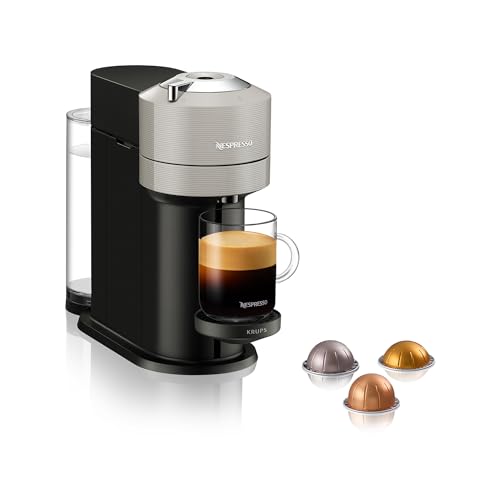
| Nespresso Vertuo Next | 1.1 l tank, but 31.4 cm high | approx. €69.90 | 8.6 | you brew several mugs in a row and the height under the cabinet is enough |
| Nespresso Essenza Mini | Original capsules instead of Vertuo | approx. €81.38 | 7.8 | you drink almost only espresso and never need a mug |
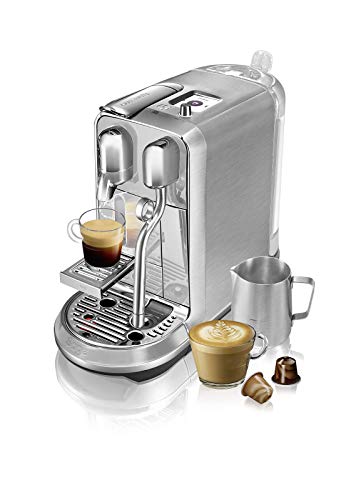
| Sage Creatista Plus | automatic steam wand, Original capsules | approx. €489.99 | 9.3 | you make milk drinks every day and want to froth the milk on the machine |
The prices are the guide prices from our price boxes; for the Pop and Next they match the Amazon catalogue of 7 September 2026, for the Creatista Plus the one of 6 September 2026, and for the Essenza Mini the catalogue had no price on 7 September, so its guide price carries no date. The rating is our editorial assessment from manufacturer and catalogue data.
When the Pop is enough and when it is not
Under a low-hanging wall cabinet, height decides: 25 centimetres for the Pop, 31.4 for the Next. Then also measure the space above the machine: to insert each capsule you open the head, so above the 25 centimetres you need air.
Then the quantity. An espresso in the morning and a Gran Lungo in the afternoon come to 190 millilitres together, which a tank filling covers well. If two of you drink mugs, the tank is nearly empty after every round together, and the capsule container wants emptying by the third morning at the latest. For this household we would choose the Next. It holds 1.1 litres and takes 6 mug capsules.
Milk is the hard limit. Nothing froths on the Pop itself; Coffee Creations only delivers the concentrated coffee for the recipe. Anyone who makes a cappuccino now and then, in our assessment, manages well with a separate frother; the guide to milk frothers sets the designs side by side. A steam wand that Sage describes as automatic is found on the Sage Creatista Plus. It costs around €414 more and carries the highest rating of the category in our comparison.
The Pop is the wrong choice for anyone who does not want to tie themselves to a format whose capsules, according to the safety instructions, are available exclusively through Nespresso or authorised retailers. The Essenza Mini does use the Original format, but it is no way out of this tie: its 2017 manual describes it as developed specifically for Nespresso capsules, which are available only through the Nespresso Club. The basic question of whether capsule or pod suits your daily routine is covered by the guide on capsule or pod machines.