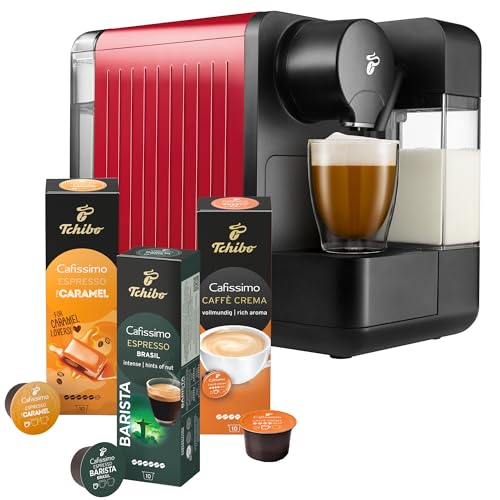
The Cafissimo Milk is a capsule machine from Tchibo with a milk container that plugs into the housing. On the product page it is called “Cafissimo milk, rot” (red) and carries item number 122750; the operating manual gives the type and model number 375 273.
Our reference price is approx. €89 on Amazon.de (as of September 2026), taken from the Amazon catalogue of 7 September. In the Tchibo shop a day later the machine stood at €129.00 with the note “Currently unavailable”, and the category overview said “Available again soon”. The same overview shows the current range: Cafissimo now for €79.00, Cafissimo pure+ for €89.00, and the Milk as the only one of the three with an integrated milk system. If you buy from Tchibo you have a 30-day right of return, except for food, in particular coffee.
Tchibo counts 30 capsules in three varieties in the scope of delivery, namely Caffè Crema vollmundig (full-bodied), Caffè Crema mild and Espresso kräftig (strong). The Amazon offer also promises 30 capsules in three varieties, but its product image partly shows different packs, including an Espresso Caramel. Which varieties are in the Amazon box is therefore open. At two cups a day the supply lasts 15 days.
Housing, buttons and capsule slot
Tchibo gives the dimensions as approx. 18 cm wide, 31.5 cm deep and 25 cm high, and the weight as approx. 4.8 kg, and the Amazon catalogue arrives at the same values. In the product photo the side wall is red, the front and base are black, and the transparent milk container sits to the right of the coffee spout. Tchibo lists the pure+ from the same range at 11.9 cm wide, so the Milk is 6.1 cm wider.
It is operated with six illuminated buttons and one control light. Three buttons belong to coffee, namely Espresso, Caffè Crema and Kaffee (coffee). The other three are called Cappuccino, Milk froth and Rinse milk system. If the milk container is not plugged into the connection, only the lower three coffee buttons light up. To switch on, a short press on any button is enough; to switch off, press Espresso and Caffè Crema at the same time. After about 9 minutes without a button press the machine goes into standby by itself, though Tchibo still advises switching it off by hand. If the control light flashes red and several signal tones sound, then according to the troubleshooting table the water container is empty or the lever was opened during preparation.
For each capsule you fold the lever all the way back and insert the capsule with the lid facing the front. When the lever is folded down, two spikes in the capsule slot pierce the capsule from both sides, in the base and the lid. Tchibo therefore forbids reaching into the slot and requires fingers and objects to be kept away while the lever folds down. After brewing you fold the lever back again and the used capsule falls into the capsule container in the front drawer. It holds approx. 6 capsules and must be emptied daily, and also whenever it is full. The machine should not run without the front drawer inserted, and you should lift it by the outer housing, never by the lever.
Power consumption is 1,350 watts, connected to 220 to 240 volts at 50 hertz. Because Tchibo lists the appliance in protection class I, that is with a protective earth conductor, it belongs on a socket with an earthing contact. The cable measures approx. 80 cm. You pull the 1.2 litre water container straight up and out.
The manual describes commissioning in 19 steps, ending with rinsing the milk system, cleaning the milk container and two runs with water. Small residues of coffee or water in a new appliance are normal, because Tchibo checks every machine with capsules and water before delivery.
Pump pressure, pre-brewing and volumes
In Tchibo’s Coffee Academy the principle sounds simple: the machine heats the required quantity of water from the tank and forces it under pressure through the capsule. For the Cafissimo machines, Tchibo there speaks of a patented three-pressure brewing system.
The technical data in the manual state a pump pressure of max. 15 bar. The figure describes the most the pump can manage. How much pressure actually bears on the coffee depends on the resistance that ground coffee and capsule offer the water, and with a capsule the fill quantity and grind are fixed at the factory. Espresso from a portafilter machine is usually made at around 9 bar at the coffee bed. A higher pump figure therefore says little about what arrives in the cup.
Tchibo is more precise about the difference between the coffee buttons. With Espresso and Caffè Crema a small amount is pre-brewed first, recognisable by a short stop right at the start, which Tchibo justifies with aroma. The Kaffee (coffee) button runs straight through without this stop, like a conventional filter coffee machine.
The idea behind it comes from espresso technology. Dry ground coffee takes up water unevenly. If the machine first wets it with a little water, it swells, and the water that then follows at full pressure flows through the grounds more evenly instead of finding individual channels.
From the factory, espresso runs approx. 40 ml into the cup and Caffè Crema and Kaffee approx. 125 ml each; the water volume can be set between approx. 30 and 250 ml. At Tchibo the volume is at the same time the control for strength, and the relevant chapter is titled “Adjusting the strength of the drink (drink volume)”. The machine permanently stores one setting per button: hold the button down, after approx. 2 seconds a signal tone sounds, and release as soon as there is enough in the cup. For a single brew it also works without saving: you stop the run early with the flashing button if the drink is too weak for you, or start it a second time without a new capsule if it is too strong.
Milk froth from the plug-in container
According to Tchibo the milk container holds approx. 400 ml. You pull it straight out towards the front of the machine and, for frothing, push it back into the connection as far as it will go. If the milk buttons stay dark, then according to the troubleshooting table it is probably not connected correctly. For coffee without milk it can stay removed; Tchibo then recommends closing the cover on the connection so that no dust gets in.
It is filled at most to the MAX mark and at least to the mark for frothed milk or for cappuccino. According to the operating chapter, the Cappuccino button prepares approx. 90 ml of milk froth from the factory and then brews approx. 40 ml of espresso, both starting and stopping automatically. When saving, you therefore hold the button twice: first for the froth volume, then, as soon as coffee preparation begins, for the coffee volume. For the cappuccino Tchibo recommends an espresso capsule. The Milk froth button runs without a capsule and is set to approx. 130 ml. Latte macchiato and milk coffee are on the drink list of the product page, but neither drink has a button of its own. Judging by the button panel, you put them together from milk froth and one coffee brew.
You should fill in fridge-cold milk with at least 1.5 per cent fat. Behind such recommendations is the chemistry of froth, which our guide to frothing milk explains in more detail: milk proteins attach themselves around the drawn-in air bubbles and hold them, and the fat content helps determine how dense and stable the bubble structure becomes. If you use lower-fat milk, you are working outside the manufacturer’s recommendation.
Can I use capsules from other manufacturers?
No, at least not with Tchibo’s consent. The manual prescribes original Cafissimo capsules only. According to Tchibo, capsules from other manufacturers, damaged or deformed capsules, and loose coffee powder or beans filled in damage the machine, and in that case the warranty does not cover a repair.
Tchibo sells the capsules as a pack of 10 and, depending on the variety, as a large pack of 30, 80, 96 or 120, and the shop lists the decaffeinated Decaffeinato as a large pack of 80 or 120 capsules. Each capsule is portioned for one cup. The manufacturer rates the Caffè Crema vollmundig, one of the three varieties in Tchibo’s scope of delivery, at intensity 4 out of 6 and acidity 2 out of 6.
On price, the pack size decides. On 8 September 2026 this variety cost €4.29 at Tchibo for 10 capsules, around €0.43 per capsule, and €41.99 for 120 capsules, around €0.35 per capsule. Tchibo’s Coffee Academy puts a cup from a capsule machine at 20 to 40 cents, depending on the system. The Caffè Crema vollmundig is therefore at the upper end of that range or above it.
We have extrapolated this to two capsules a day, following the calculation method from the guide on capsule or pod machines: 730 capsules cost around €255 a year from the large pack, around €313 from packs of 10. Even the cheaper calculation comes to almost three times the machine price in the first year, and with every cappuccino the milk is added.
Rinsing, taking apart, descaling: the care plan from the manual
You press the Rinse milk system button straight after a milk drink. The rinse takes approx. 50 seconds and ends with two signal tones. In the Amazon catalogue this sounds as if the milk tank were already taken care of by it, being “particularly easy to clean thanks to the integrated cleaning button”. Tchibo counters in the manual that the rinsing “in no way replaces” the daily cleaning.
Daily means, in the cleaning chapter: if you have frothed milk on a given day, you take the milk container completely apart once, best after the last use. The safety notes put it more strictly. They say milk is a quickly perishable food and therefore prone to germ formation, that absolute cleanliness must be observed with coffee specialities containing milk, and that all parts of the milk container must be cleaned thoroughly after every use.
The container comes apart into milk container lid, milk spout, connection piece, suction tube, cover, a transparent and a black adapter, and the container itself; the numbers on the lid give the order. You clean all parts in warm water with mild washing-up liquid, if necessary with a soft brush, and all may also go in the dishwasher. Then you rinse them with clear, cold water, dry them carefully and leave them open to dry overnight. Tchibo justifies the effort with hygiene, froth quality and the service life of the appliance, and recommends regularly soaking the parts in warm water with durgol Milchsystem-Reiniger (milk system cleaner). If the machine does not draw in milk, the troubleshooting table advises checking the seating of all parts and, if necessary, taking the container apart and cleaning it again.
With water the rhythm is similarly tight. Only fresh, cold tap or drinking water belongs in it, no carbonated mineral water and no other liquids. You change the water daily to prevent germ formation, and rinse the container out daily under running water so that limescale or other particles do not block the opening in its base. Once a week you clean it thoroughly in warm water with washing-up liquid; Tchibo calls it “not dishwasher-safe”. The drip tray and drip grid, front drawer and capsule container, on the other hand, may go in the dishwasher, and you wipe the housing with a soft, damp cloth.
On the product page, by contrast, under cleaning and care it says across the board “Not dishwasher-safe”. We go by the manual, because it names every part. If you want to avoid the contradiction, wash by hand.
Before cleaning you switch the machine off and pull out the mains plug. The machine, mains plug and mains cable must never be immersed in water or other liquids. Tchibo also rules out a jet of water; cleaning is done only as described, and without harsh chemicals or aggressive or abrasive cleaning agents.
Descaling is due as soon as the control light shows yellow, and within the next few days. The machine has no water hardness setting. On the choice of agents, the safety notes draw a narrow limit: only the cleaning and descaling agents given in the manual, together with suitable cleaning utensils, because other agents carry health risks. A standard liquid descaler for coffee and espresso machines is specified; Tchibo rules out agents based on formic acid. durgol swiss espresso is recommended: one portion of 125 ml into the empty water container, then cold tap water up to the MAX mark. If you use another descaler of this kind, follow the instructions of its manufacturer.
For the run, the milk container is plugged into the connection, and under the coffee spout and milk spout stands a vessel that holds at least 600 ml and must be emptied several times in between. For around 25 minutes the machine pumps the solution at intervals alternately through both spouts and then pauses for approx. 2.5 minutes. Only then do you wash the water container, front drawer and capsule container with washing-up liquid, fill in cold tap water up to MAX and start the rinse phase, which lasts approx. 2 minutes and runs another approx. 600 ml through. Finally the milk container is to be cleaned.
The whole process takes approx. 30 minutes, and you should not leave the machine unattended during it. Putting it off becomes expensive: according to Tchibo, anyone who waits too long risks so much limescale that no descaler works any more, and the warranty excludes such a self-inflicted defect. According to the manual, maintenance beyond cleaning and descaling is not required.
What Tchibo does not state and what we have removed
Open are the brewing temperature in degrees, the heat-up time in seconds (the manual reports only a signal tone and permanently lit buttons), the distribution of the three pressure levels across the drinks, and the material of the housing, water container and milk container. Also missing are the height of the water container, a country of manufacture (only “Made exclusively for” Tchibo is given), a market launch date (the manual on Tchibo’s site carries only the status January 2022, version 2), the number of cups from one tank fill or of cappuccinos from one fill of the milk container, the time to the finished drink, the number of varieties in the range, the material of the capsules, and a spare parts list with an availability period (you order wear parts and consumables from Cafissimo Service). Plant-based drinks appear neither as approved nor as forbidden, and a water filter is not mentioned anywhere.
Several statements have been removed from earlier versions of this page because the product page and manual do not support them. The data sheet said 1,250 watts; Tchibo gives 1,350 watts. A Caffitaly technology with compatible capsules from other suppliers was also described. Tchibo nowhere describes the system that way, and which capsules the manual permits is stated above in the capsule section. Instead of “two sieves” in the capsule, the manual describes two spikes in the slot. Also without evidence were a plastic housing, a touch variant of the control panel, a water tank at the back, a descaling rhythm of six to eight weeks, only a weekly cleaning run for the milk container, capsule prices from €0.25, and judgements on the fine-poredness of the froth, which nobody can make without preparing it themselves.
Cafissimo Milk or one of the other three?
| Model | The difference | Price | Our rating | Choose this one if |
|---|---|---|---|---|
| Tchibo Cafissimo Milk (this one) | Milk container of approx. 400 ml plugs into the machine, cappuccino at the touch of a button | approx. €89.00 | 8.3 | you make several milk drinks in a row in the morning |
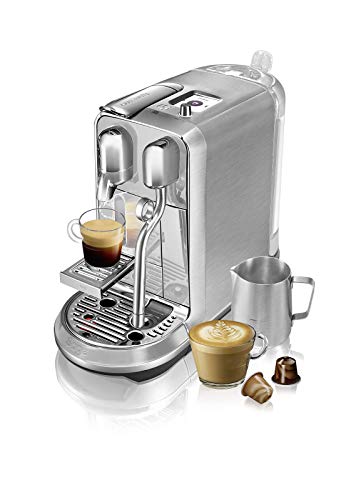
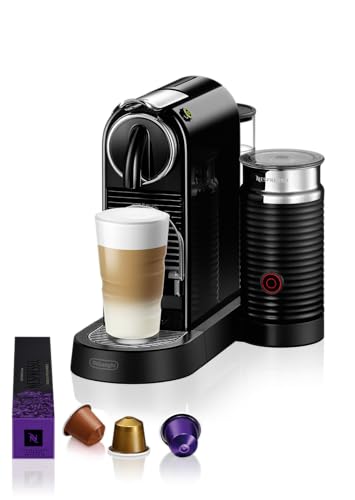
| Nespresso CitiZ with Aeroccino | Nespresso Original capsule format, milk is frothed by a separate Aeroccino beside the machine | approx. €167.89 | 8.9 | you want Nespresso capsules and have room for a second appliance |
| Tassimo My Way 2 | T-Disc system without a milk container, intensity, volume and temperature adjustable depending on the drink | approx. €59.00 | 8.1 | you rarely drink milk and would rather turn the dials on strength and temperature |
| Sage Creatista Plus | Steam wand on the housing, milk temperature in 11 levels, milk froth texture in 8 levels | approx. €489.99 | 9.3 | you want to set the temperature and froth of the milk yourself |
The prices are the reference values from our price boxes and not the price on the day of your purchase; the rating is our editorial assessment from manufacturer and catalogue data. Capsule costs are missing from the table, and they cannot be set directly against each other here, because the four machines take three different capsule formats. More models with ratings are in our overview of capsule and pod machines.
When the Cafissimo Milk fits and when another machine does
The first question is how often milk goes into the cup. You have the care plan from above on every day you froth milk, even if it stays at a single cappuccino. If you only take milk now and then and do not want fresh milk in the fridge for it, look at the My Way 2. It has no milk container: milk drinks there are made only with milk or latte T DISCs, and according to the Tassimo shop one pack of Jacobs Typ Latte Macchiato Classico makes eight portions of 295 ml each.
If several milk drinks fall due in a row in the morning, the container speaks for the Cafissimo Milk. For the Aeroccino 3, the frother of the CitiZ with Aeroccino, Nespresso gives at most 120 ml of milk in the froth programme, just under a third of what fits in the container of the Cafissimo Milk. On the Aeroccino, every further portion of froth therefore begins with refilling.
On money: by our reference values the Cafissimo Milk costs €30 more than the My Way 2 and around €79 less than the CitiZ with Aeroccino. The Creatista Plus is around €401 above. By our assessment that sum is worthwhile only for those who want to set the milk themselves, because on the Cafissimo Milk you determine the volume and nothing else. Over the years the capsules count for more than the purchase price anyway, and the calculation is further up.
Then the space. For commissioning, Tchibo requires a level surface insensitive to moisture, proximity to a socket given the approx. 80 cm cable, at least 1 m clearance from hot, combustible surfaces such as hob, oven or radiator, and 15 cm clearance from walls. Because of the metre clearance it must not stand directly next to the hob. Under a wall cupboard the 25 cm appliance height is not enough as a measure, because the water container comes out straight upwards, and Tchibo does not state its height. So plan for air above the machine, or a spot where you can pull it forward for refilling.
Who is it suited to?
According to the manual, the Cafissimo Milk is designed for preparing conventional coffee, Caffè Crema and espresso with capsules of the Tchibo Cafissimo brand, as well as coffee and milk specialities. It is intended for the household and household-like areas; as examples Tchibo names shops, offices or similar working environments, farm properties, and guests in hotels, motels, bed and breakfasts and other residential accommodation. In commercial use, trained staff must supervise and clean it.
For the office kitchen that is an approval. Rubbing against everyday office life, however, is a requirement from the safety notes: the machine must never be operated unattended.
It is wrong for anyone who has planned a place for it in a niche. The manual requires it to be set up free-standing for operation, on no account directly against a wall or in a corner, in a cupboard, by a curtain or the like, and not to be covered during operation. A tall-cupboard compartment as a coffee station is therefore ruled out.