In its own machine overview, Tassimo lists the My Way 2 as the most personalisable Bosch Tassimo. At Bosch, the appliance is called TAS6502.
Our price box lists the machine at approx. €59 on Amazon.de. When we checked on 7 September 2026, it stood at €54.00 in the Amazon catalogue, and the Bosch shop asked €74.99 on 14 September 2026. The Amazon catalogue gives 4 March 2020 as the release date.
The information comes from Bosch: the data sheet, the product page, the product information published under EU law, the warranty conditions for Germany and the current instruction manual 8001346131_B. Where that is silent, we used an older version with the print note 12/18; it is the source of, for example, the note that Bosch gives no guarantee for the availability of T DISCs because the capsules do not come from Bosch. In addition there are the Amazon catalogue and the Tassimo shop with its machine overview and capsule prices. We have not had the appliance in our hands.
TAS6502 on the worktop: dimensions, tank, parts
According to the data sheet, the My Way 2 is 290 millimetres high, 230 wide and 325 deep, with a net weight of 3.0 kilograms. It is connected to 220 to 240 volts via an earthed Schuko plug, and the rated power is 1500 watts. The removable water tank holds 1.3 litres.
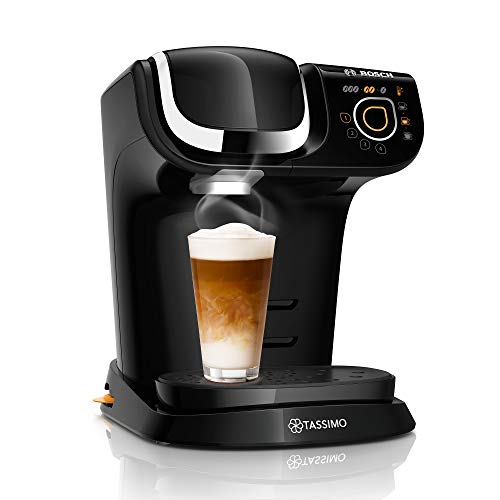
In the product photo, the brewing unit sits at the top under a lid with a light, U-shaped bracket. To the right of it is the control panel, called Sensor Touch at Bosch: a ring, and below it to the left, in an arc, the numbered buttons 1 to 4.
After the control panel, the parts overview in the instructions names the T DISC reading window, T DISC piercing unit, T DISC holder, lock and brewing unit. Then comes the water tank with water filter, water filter holder, the filter change indicator, the tank lid, the markings max and calc and a float. The list ends with the drip tray, cup platform and drip grid; as the data sheet adds, the platform can be adjusted in height and removed. A storage compartment on the appliance holds the Service T DISC and a quick guide to cleaning and descaling. If the Service T DISC is lost, the number 17001491 from the current instructions helps with reordering.
According to the data sheet, the box contains one BRITA cartridge. Descaling tablets are not included; Bosch sells them as special accessories.
By Bosch’s account, the machine has no heat-up time, and the first drink starts straight after switching on. After brewing, the machine automatically switches to standby, according to the product page. When switched off it draws at most 0.5 watts, and it takes at most 30 minutes for the automatic energy management function to kick in; both values come from the product information. The TAS6502 has no app and no Wi-Fi, and Bosch states explicitly that it is not a connected product within the meaning of the Data Act (an EU regulation).
Before the first drink, the illustrated instructions require a rinse cycle (fig. 13 and 14): fill the tank to max, insert the Service T DISC, place a container for at least 250 ml underneath and start the rinse four times.
In detail: barcode, three levels, four memory buttons
Every T DISC carries a barcode. When you insert it, a scanner reads the code and, according to the instructions, controls the flow of hot water. The data sheet is more specific and lists water volume, temperature and brewing time. Bosch markets this under the name INTELLIBREW.
The principle explains how a single brewing system can process first tea and then espresso. The recipe is in the capsule. A tea needs a different water volume and a different temperature than an espresso, and the machine reads this specification from the code. So that nothing from one drink carries over into the next, the data sheet says each preparation is followed by an automatic burst of steam for cleaning.
The product page lists eight drink types: caffè crema, cappuccino, espresso, filter coffee, hot milk, hot chocolate, latte macchiato and tea. The data sheet speaks of over 70 specialities but refers to tassimo.de for what is actually available, and lists the brands L’Or, Costa, Jacobs, Kenco, Gevalia, Cadbury, Milka and Twinings as examples.
On top of these specifications you set your own. Intensity, size and temperature each have three settings; Bosch does not give the degrees Celsius or millilitres behind them. According to the older instructions, the available settings differ by drink, so the 27 combinations that arithmetically result are not selectable for every variety.
Once a setting suits you, you put it on one of the buttons 1 to 4 by holding the button down; the illustrated instructions show five seconds for this (fig. 53). It is later recalled with the same number button, and the instructions list saving and recalling as a shared function of the control panel. A single serving also works without the memory. A short press on Start/Stop ends it early.
Our assessment: four memory slots fill up faster than the number suggests. Anyone who wants a short, strong coffee in the morning and a long, mild one in the afternoon already needs two for that alone.
The BRITA cartridge: inserting, starting the indicator, breaks
According to the product page, the filter sits in an inner tank inside the water tank. Bosch promises less chlorine and limescale residue from it. What the cartridge is called depends on the document: the data sheet, product page and Amazon catalogue write BRITA MAXTRA+, the current instructions BRITA MAXTRA PRO. When buying a replacement, we would follow the instructions that came with your machine; the older version says MAXTRA+ with the order number 17000917.
It is changed every eight weeks, as the calendar in fig. 28 shows. Before inserting, you dip the unpacked cartridge in water for five seconds (fig. 18) and rinse the filter insert through with tap water, shown three times (fig. 22). The change indicator is a digital memo in the tank lid. It is started with its START button, which you likewise hold down for five seconds, after which it shows the level in steps of 100, 75, 50 and 25 per cent.
The memo runs on a battery. If the display no longer works, it is empty according to the troubleshooting table, and this is checked with the same long press on the START button.
For longer breaks, the BRITA section of the instructions has its own procedure: empty the water in the tank completely and leave the cartridge in the funnel. Before the next use, you take it out, clean the tank and funnel and rinse the cartridge. Store replacement cartridges sealed in the original packaging in a cool, dry place. The notice explains black particles in the water as slight abrasion of small carbon particles; then you rinse the cartridge. If an official notice to boil tap water is issued, it also applies to BRITA-filtered water; afterwards you clean the machine and insert a new cartridge.
Descaling and cleaning according to the illustrated instructions
When calc lights up, you run the descaling programme, immediately according to the instructions. They give no interval in weeks and no water hardness setting, such as the guide Descaling and cleaning describes for other machines. On the My Way 2, the indicator alone determines the timing.
The procedure according to fig. 81 to 99: remove the water filter, fill water up to the calc marking and put descaling tablets in the tank, two are shown. Then insert the Service T DISC, place a container of at least 500 ml underneath and hold the calc button down for three seconds. The programme takes 30 minutes. Afterwards you rinse out the tank, fill it to max and run four rinses.
“Do not use descaling agents containing phosphoric acid,” say the instructions. Bosch’s own tablets are listed there under the numbers TCZ6004/00311909 and TCZ6008/00312249.
For normal cleaning, the illustrated instructions (fig. 60 to 80) show these steps: pull the mains plug, remove and rinse the drip tray, T DISC holder and piercing unit, wipe the brewing unit with a cloth, rinse the tank by hand. Finally a rinse cycle runs with the Service T DISC over a container of at least 250 ml. You clean the controls with a soft, damp cloth with the mains plug pulled, and the water tank and funnel should be cleaned regularly.
Before you take the used T DISC out of the opened brewing unit by hand and throw it away (fig. 42 and 43), you let the hot parts of the appliance cool down, according to the safety instructions.
What does a cup cost with the My Way 2?
At the regular pack price of 14 September 2026, we arrive at 33 to 44 cents per cup for two coffee varieties from the Tassimo shop, and 87 cents per portion for one latte macchiato variety. The values are our own division of price by number of portions.
All three packs regularly cost €6.99. Jacobs Caffè Crema Classico XL contains 16 capsules for 16 cups of 215 ml each, which gives the 44 cents. The Big Pack Morning Café XL holds 21 capsules, hence the 33 cents, and Jacobs Typ Latte Macchiato Classico yields 8 portions of 295 ml each. The calculation does not hold for other varieties: even these three packs give 8, 16 or 21 drinks at the same price, so the price per cup depends on the pack size of the variety you buy.
Prices move with promotions. On the same day all three were reduced, the 16-pack and the latte macchiato to €5.24, the Big Pack to €5.52. That brings the cup of coffee down to 26 to 33 cents and the latte macchiato portion to 66 cents.
Two cups a day from the 16-pack come to roughly €319 a year at the regular price, from the Big Pack roughly €243 a year. Measured against our price box, the capsules caught up with the machine’s purchase price after two to three months at this consumption.
Cartridges and tablets come on top; with the change rhythm from fig. 28, that is roughly six and a half cartridges a year. Neither item is in our calculation. How capsule and pod systems differ in cost in general is worked through in the guide Capsule or pod machine.
Three machines to consider alongside the My Way 2
All three are in the same category in our catalogue, the capsule and pod machines, and each takes a different buyer away from the My Way 2.
| Model | The difference | Price | Our score | Choose this if |
|---|---|---|---|---|
| Tassimo My Way 2 (this one) | T DISCs with barcode, three setting dimensions and four memory slots, 1.3 l tank with BRITA cartridge | approx. €59 | 8.1 | there are several of you and each person sets their drink differently |
| Tassimo Happy | same T DISC system, according to Bosch 0.7 l tank and only manual strength adjustment | approx. €34.99 | 7.6 | you drink almost always the same variety, alone or as a pair |
| Senseo Original Plus | pods instead of T DISCs, 0.7 l tank, slider for mild or strong, 2-cup pod holder | approx. €59.90 | 8.5 | you drink almost only black coffee and want two cups in one run |
| Sage Creatista Plus | automatic steam nozzle for fresh milk | approx. €489.99 | 9.3 | you want cappuccino with milk from the fridge and will spend roughly eight times as much |
The prices are the guide values from our own price boxes, not daily offers, and the score is our editorial assessment of the available data. The table says nothing about running costs: we have not researched cup prices for the Senseo’s pods and the Creatista’s capsules, so a comparison with the T DISC calculation above would be pure guesswork.
When the My Way 2 fits and when another machine does
The decision tips fastest on milk. The My Way 2 does not process fresh milk; cappuccino and latte macchiato come only from dedicated T DISCs. If you want foam from the milk in the fridge, you need either a separate device, whose types the guide to the milk frother sorts by capacity, or a machine with a steam nozzle such as the Sage Creatista Plus, which costs roughly €431 more in our price box.
With many cups a day, the capsule calculation decides. Four cups daily from the 16-pack would come to roughly €638 a year at the regular price, and we would put that figure next to the appliance price before buying.
According to the safety instructions, the machine must not run inside a cupboard, and under a low wall cupboard what matters most is how far the opened lid of the brewing unit extends beyond the 290 mm appliance height. This figure is in no Bosch document.
With a connection cable of 100 cm, the socket must be close to the spot, because the safety instructions exclude extension cables and multi-socket strips. If the mains cable is too short and no longer one is available, the instructions say to contact a qualified electrician to adapt the house installation.
What Bosch leaves open about the My Way 2
Our search covered the data sheet, product page, the legal product information and the versions of the instructions. The brewing pressure in bar is missing; a retailer’s figure for it could not be confirmed at Bosch and is therefore not stated here. Likewise open are the maximum cup height under the outlet with and without the platform, and the noise level in decibels.
On power, only the rated power and the off-state figure are documented; consumption per drink, per year or in switched-on idle mode is missing. What the housing, water tank and drip grid are made of, and whether recycled plastic is used in them, is not stated. For the cartridge, no capacity in litres is given, only the time rhythm is documented, and prices for replacement cartridges and descaling tablets appear in none of the documents. How many drinks one tank filling yields cannot be calculated without fill volumes.
Also unknown: country of manufacture, market launch according to the manufacturer, a recommended retail price, how long spare parts are supplied and a complete list of what is in the box.
Who is it suitable for?
For the private household, and that is to be taken literally. Under intended use, the instructions name three points: use the appliance only to prepare hot drinks, in a private household and in enclosed rooms of the domestic environment, and up to an altitude of 2000 m above sea level. For the office kitchen, the My Way 2 is therefore the wrong purchase, since an office is not a domestic environment. The exclusions of the BSH warranty for Germany also include defects attributable to use that is not normal for a household.
Two notes from the BRITA section of the instructions are aimed at particular groups. During filtering, the potassium content initially rises slightly; anyone with a kidney condition or on a potassium-restricted diet should seek medical advice first. The notice also reminds you that boiling tap water is generally recommended for certain groups of people even when it has been filtered; immunocompromised people and babies are given as examples. For hygiene reasons the filter material is treated with silver, and a small amount of silver can pass into the water.
If you wear an electronic implant, the safety instructions say to keep a minimum distance of 10 cm from the appliance, including from the removed water tank.