The KG520.M is the only grinder from the Dedica range that De’Longhi lists in its German online shop. On 25 September 2026 there were four models in the coffee grinders category: this one, the KG200, the KG210 and the KG79. The variant is called “Dedica, Metall”, with article number 0177111039. De’Longhi gives China as the country of origin.
It is designed mainly for espresso from a portafilter. The grounds fall either into a ground coffee container or, via an accessory, straight into the portafilter of your machine. In our overview of electric coffee grinders it stands at approx. €131.89 according to our price box, recorded in July 2026. In its own online shop De’Longhi charged €235.00 on 25.09.2026, just over €103 more.
Design: beans on top, grounds below
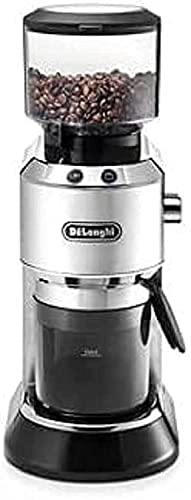
The product photo shows a slim, tall tower. At the top sits the transparent bean hopper, in the middle the silver body with two round buttons, and at the bottom the dark ground coffee container on a black base. De’Longhi gives the dimensions as 240 × 154 × 382 mm. Going by the product photo, we take the 382 mm to be the height.
On weight, two manufacturer sources contradict each other. The product page says 2.86 kg, the technical data in the manual says 3.5 kg. If the grinder is to go on a wall shelf, we would plan with the higher value. Packed, it weighs 3.54 kg according to the product page, and the box measures 17.5 × 28.5 × 46.0 cm.
The bean hopper holds 350 g, the ground coffee container 170 g.
The manual’s parts list has 13 items: bean hopper and its lid, grind setting dial, selector dial for the number of cups, the mount for the holder accessory, a box for the portafilter accessory, the portafilter accessory itself, the tray of the ground coffee container, the on/off button, lid and cap of the ground coffee container, the ground coffee container and a cleaning brush. A portafilter is not on it. Your machine supplies that.
You start it with two buttons with symbols: one with a container for grinding into the ground coffee container, one with a portafilter symbol for output without a detour. Then there is the on/off button, and De’Longhi calls the whole set soft-touch buttons. You set grind size and number of cups on two separate rotary controls, the grind setting dial and the selector dial. The motor draws 150 W and runs on 220 to 240 V at 50/60 Hz, with a Schuko plug on the cable. According to the manual, the grinder needs an earthed, correctly installed socket of at least 10 A; which mains voltage your device expects is shown on the rating plate on the base.
In detail: conical burrs, 18 settings, six of them for the portafilter
A conical burr set consists of a cone-shaped inner burr that turns inside an outer ring. How fine the grounds become is determined by the gap between the two, and that gap is exactly what the grind setting dial changes. De’Longhi speaks of two stainless steel burrs, and the upper one can be taken out for cleaning. According to the product page, the two burrs prevent overheating so that the aroma of the beans is preserved. To us this is an advertising claim; no temperature is given.
You choose the grind size in 18 settings. For grinding straight into the portafilter, the manual narrows the range: the dial then belongs in the “ESPRESSO” section at 1 to 6, and you should not go beyond 6, because otherwise the portafilter overflows. That leaves a third of the scale for espresso from this grinder.
Why this matters is explained by the preparation itself. In espresso, the machine forces water under pressure through a compacted coffee puck, and how quickly it runs through depends heavily on particle size. If the right setting for a bean lies between two steps, you can only compensate through the amount or the tamping pressure. Double-wall baskets, often called pressurised baskets, are more forgiving because the resistance builds up in the basket itself. In our assessment, with such a basket six settings are more likely to be enough than with a single-wall basket where you work towards a particular flow time.
For the French press, the manual sets a quantity limit instead of a setting: at most 8 cups on the selector dial. Where filter coffee and French press sit on the scale, we did not find in the documents, and the PDF of the manual that De’Longhi links to lacks illustration page 3. How to feel your way step by step with a new bean is described in our guide Setting the grind size.
How does the KG520.M dose without a scale and display?
By preset and by time. Into the ground coffee container it grinds the amount for 1 to 14 cups, which you set on the selector dial, and then stops on its own. Into the portafilter it grinds a portion for one or two espressos, the duration of which you programme once. Nothing is weighed.
With the ground coffee container you set the number of cups and the grind size and start with the button that carries the container symbol. When the amount is reached, the grinder stops; it stops earlier if you press the button again. When the grounds reach the max mark in the container, you end grinding. According to the manual, the number of cups is only a rough guide, because the right amount depends on taste, variety, roast and grind size, and the ground amount also changes with the grind size. Leftover grounds may stay in the container with the cap closed. Before the next grinding you always empty it.
With the portafilter accessory, cup selection does not apply. One press of the portafilter button grinds the amount for one espresso. If you press a second time within 1 second of grinding starting, you get double the amount, and then too the grinder stops on its own.
You set the single portion yourself: hold the portafilter button down and release it as soon as enough grounds are in the basket. According to the manual, no more than about 7 seconds can be stored, and the portion for two cups is double that. You get back to the factory setting by switching the device on, taking out the ground coffee container or portafilter accessory and pressing both buttons at the same time.
Timed dosing counts seconds. How much ground coffee falls in that time depends on the throughput of the burrs, and that shifts with the grind size, as above for the ground coffee container. After every adjustment we would weigh a portion on the kitchen scale and then reprogramme the grinding time.
Which portafilters fit the accessory?
According to the manual, the portafilter accessory is designed for standard sizes and does not fit all models, which is why De’Longhi advises holding the portafilter while grinding. Which diameters count as standard, and whether the portafilters of the Dedica machines are among them, is not stated in any manufacturer document we have read. The shared range name proves nothing technically. If you own a Dedica, the safest way is to ask the retailer or De’Longhi customer service before buying.
If the portafilter does not fit, the ground coffee container remains. You grind into it and transfer the grounds to the portafilter by hand. That works with any machine and costs one extra step. How much water belongs to your amount of coffee is worked out by the Brew Calculator.
The Dedica grinder or one of the others?
| Model | The difference | Price | Our rating | Choose this one if |
|---|---|---|---|---|
| De’Longhi Dedica KG520.M (this one) | 18 settings, only settings 1 to 6 into the portafilter, stored portion for 1 or 2 espressos | approx. €131.89 | 8.2 | you want a fixed espresso dose at the press of a button and your portafilter has a standard size |
| Graef CM800 | 40 grind settings on the adjustment collar plus fine adjustment on the upper burr, grinds as long as the portafilter presses the contact switch | approx. €139.99 | 8.8 | you want to adjust more finely and control the amount at the portafilter yourself |
| Sage Dose Control Pro | 60 grind settings, grinding time on a rotary selector, holder for 50 to 54 mm and 58 mm | approx. €153.25 | 8.4 | your machine has a 58 mm portafilter |
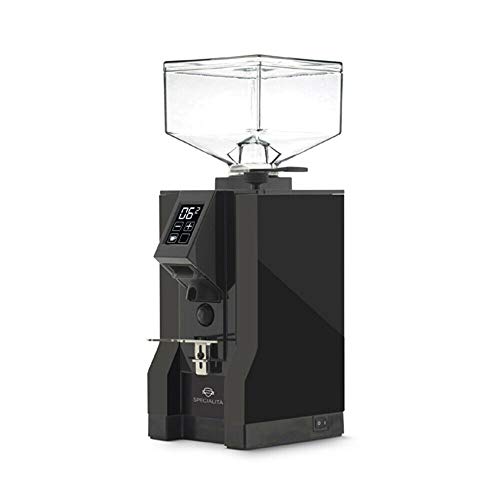
| Eureka Mignon Specialita | 55 mm flat burrs, stepless adjustment | approx. €431.90 | 9.4 | you pull espresso almost daily and also want to adjust between two steps |
The prices come from our price boxes, and their retrieval date may differ from grinder to grinder. The rating is our editorial assessment based on manufacturer data; we measured nothing on any of the four grinders.
When the KG520.M suits you and when another grinder does
First the portafilter. If yours fits the accessory, the KG520.M grinds a stored portion into it at the press of a button. For a 58 mm portafilter we would reach for the Sage Dose Control Pro, which costs approx. €21 more and comes with a holder in exactly that size.
Then fineness. If you often pull light roasts in a single-wall basket, six espresso settings are more likely to hit a limit. The Graef CM800 offers more settings and a fine adjustment on the upper burr, costs approx. €8 more and gives up a stored dose in exchange. Only the Eureka Mignon Specialita adjusts steplessly, for around €300 more.
One point you will find only in the manual’s tips: after two preparations in a row you should wait 15 minutes. In a household where four people want espresso one after another, that means, as we read it: two double portions, then a break. For one or two people the rule hardly matters.
Under a wall cupboard you need more clearance than the height of the device. It is filled from the top with the lid removed, and we would allow about 10 cm of clearance above the 382 mm, or pull the grinder forward to fill it. The manual requires a level surface. According to the safety sheet, the grinder does not belong on or next to an electric or gas hob, nor in a heated oven. It should not stand next to a tap or sink either, because water getting in can damage the device; in the German part of the sheet this point appears only in English.
If you are buying machine and grinder together, the KG520.M and the Dedica EC685 come to a good €250 together according to our price boxes. The fit question from the section on the accessory applies just the same.
Cleaning according to the manual
After unpacking, the manual says to check that the device is complete and undamaged and that all accessories are there; if there is visible damage, leave it switched off. Before the first grinding, wipe the housing and bean hopper with a clean, damp cloth and rinse the accessory once with hot water. Only the accessory tolerates water; the burrs always stay dry.
Before every cleaning you switch the grinder off and pull the mains plug, and you never immerse the device in water. Then you release the bean hopper anticlockwise and take it off, empty: it must never be removed with beans in it. The ground coffee container and accessory box come out, and you lift the tray of the ground coffee container. You wash the accessory in mild soapy water, not in the dishwasher, and dry it thoroughly before the next use.
For the burrs, you turn the dial anticlockwise to “OPEN”, lift out the upper one and brush it off with the stiff brush. You clean the lower one with the brush and vacuum cleaner. Then you put the upper one back and choose the grind size. For fresh coffee, De’Longhi advises cleaning the device after every use.
The safety sheet rules out solvents, abrasive or alkaline cleaning agents, alcohol and flammable liquids; use a soft cloth, if necessary with a neutral cleaning agent. You are also to check the product regularly for signs of material deterioration; the sheet lists microcracks, blisters, delamination, shrinkage, stickiness, loss of transparency and corrosion. Descaling does not apply: no water runs through the grinder, and it needs no filters or cartridges either.
What De’Longhi leaves open
Collected in one place, from the product page, manual, product data sheet and German safety sheet: still open are the material of the housing, bean hopper, ground coffee container and portafilter accessory, the diameter of the conical burrs, the diameter the portafilter accessory is built for, the motor speed, the noise level in decibels, the throughput in grams per second, the residual amount in the burrs, an anti-static measure, the cable length, a separate list of what is in the box, prices and part numbers of the replacement burrs, and the year of market launch. In the Amazon export of our catalogue the data record for this ASIN is missing, so there are neither bullet points nor dimensions.
The manual itself also has gaps. It carries no model name, and in chapters 7 and 9 it partly swaps the names of the two start buttons; in one place one is even called “(A1)”, like the bean hopper. When resetting to the factory setting it mentions a “display contrast”, while the KG520.M product page knows no display. De’Longhi presumably uses a shared manual for several Dedica grinders.
Who is it suitable for?
The safety sheet intends the grinder exclusively for household use, and according to the manual it is not suitable for commercial use. Expressly not intended, according to the sheet, are staff kitchens in shops and offices, farms, hotels, motels and room rentals, and a café already counts as commercial use. A terrace and a garden house are also ruled out: the sheet restricts use to indoor spaces and non-extreme temperatures, protected from direct sun and moisture, and to at most 2000 m above sea level.
With children De’Longhi is strict. For European markets the sheet says the device must not be used by children, the device and cable must be kept out of their reach, and children must not play with it. It demands the same for plastic bags and polystyrene from the box. People with limited knowledge or an impairment of the senses may use the grinder if they are supervised or have been instructed in safe use and understand the hazards.