The Graef CM800 is an electric coffee grinder with stainless steel conical burrs and 40 grind settings. Graef lists espresso, filter coffee and French press as preparation methods, and the AeroPress as well on the product page. It is sold under the article number CM800EU in silver. In our price box it stands at approx. €139.99 on Amazon.de. On 7 September 2026 the Amazon catalogue showed €149.59, and on 25 September 2026 the Graef online shop showed €189.99.
The manufacturer is Gebr. Graef GmbH & Co. KG from Arnsberg. Hermann Graef founded the company in 1920 with his brothers, and today the fourth generation of the family runs it.
How long the CM800 has existed can only be narrowed down. The Amazon catalogue gives 11 May 2020 as the release date. What exactly Amazon records with this is unclear, and it does not serve as a market launch date in any case: Graef itself advertises on the product page a rating from Stiftung Warentest (Germany’s consumer testing foundation) in issue 12/2019, so the grinder was on the market by the end of 2019 at the latest. In our overview of electric coffee grinders it is listed among the espresso grinders with conical burrs.
Construction and what is in the box
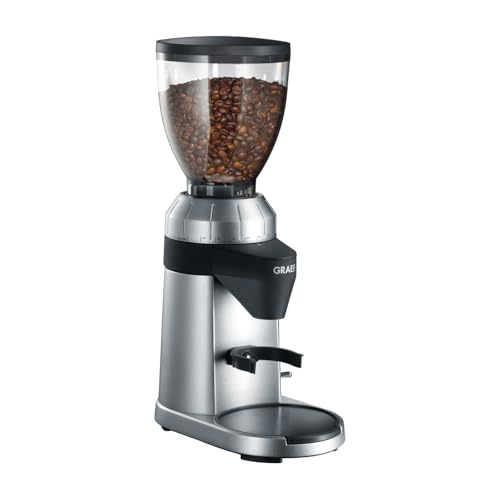
The manual numbers seven components: lid, bean hopper, sliding shutter, grinding ring, outlet, contact switch and a switch with the positions ON, OFF and AUTO. In the product photo, the transparent bean hopper with a dark lid sits on top and widens towards the top. Below it is the silver grinding ring with the scale, and in front of it a black outlet with the brand lettering. A fork for the portafilter projects beneath the outlet, and the base extends forward to below this fork.
The housing is aluminium, painted silver. The bean hopper holds 350 g, and it has a dust lid and a sliding shutter at the bottom. You close the hopper with the shutter before removing it, so that no beans fall out when you change varieties. When fitting it, pay attention to the locking mechanism: press the hopper down, turn it about 30 degrees clockwise, then open the sliding shutter. Before the first grind, according to the manual, you clean all parts as described in the care chapter. According to Graef, the ground coffee container takes grounds for up to approx. 12 cups of filter coffee.
Graef gives the dimensions as 230 × 135 × 397 millimetres, in the order length, width, height. On weight, the product page contradicts itself: the features list 2.58 kg net, the comparison table on the same page 2.63 kg, and Amazon also gives this second value. The grinder runs on 230 volts and 50 hertz with 128 watts, and the cable can be wound up.
The manual lists as accessories two filling funnels with diameters of approx. 56 and approx. 48 millimetres, two portafilter holders of approx. 60 and approx. 70 millimetres, a cleaning brush and the ground coffee container. The product page also mentions a rubber storage mat, and the Amazon catalogue speaks of the filling funnel in the singular.
In detail: 40 settings on the ring, the rest with a screwdriver
In a conical burr grinder, a cone-shaped grinding body turns inside a ring with cutting edges. The beans are crushed in the gap between them, and the narrower this gap, the finer the grounds. In Graef’s spare parts list the cone is called “lower conical burr” (“Unteres Kegelmahlwerk”); its counterpart is the upper burr, which sits in the grinding ring. When you turn the ring, which Graef also calls the adjustment ring, the gap changes and the scale moves to one of 40 settings. Graef describes the whole thing as a stainless steel conical burr; for the lower part the spare parts shop specifies chromium-alloy, stainless steel.
The second adjustment option is the fine adjustment, and for it you need a tool. According to the manual, you take out the upper burr, remove the small screws with a screwdriver, turn the burr one position to the right if you want it coarser, or to the left if you want it finer, and screw the screws back in. Graef advises adjusting by no more than 2 to 3 positions at first. Our assessment: the fine adjustment is not meant for everyday readjusting, as the procedure is too laborious for that. We would only touch it if your espresso machine runs through too fast even at the finest setting. Graef has put videos on this procedure and on cleaning on its YouTube channel “gebrgraef”.
On speed, the Graef page only mentions a “slow-running motor”. The Amazon catalogue is more specific and speaks of approx. 800 to 900 revolutions per minute. The argument for low speed is friction: the more slowly the burrs run, the less the grounds are supposed to heat up, and Graef therefore promotes the CM800 as aroma-preserving.
Two components work at the outlet. According to the Amazon catalogue, an anti-static insert is meant to prevent stray grounds, and on the product page Graef also speaks of improved anti-static properties “thanks to ionizer technology”. The manual mentions neither the insert nor the ionizer, so whether every CM800 on sale already has the ionizer is unclear. The second component is a five-part aluminium paddle wheel that, according to Graef, conveys the grounds to the outlet.
Does the CM800 grind straight into the portafilter?
Yes. You set the switch to AUTO and press the portafilter against the contact switch on the holder, and the CM800 grinds into the basket. When you pull it back, it stops. This way you determine the amount yourself, as the grinder has no timer.
According to the manual, you first fit the large or the small portafilter holder, open the sliding shutter, choose the grind setting and put the filling funnel on the portafilter before pushing it between the holder. The funnel is meant to prevent grounds from landing beside the basket. When the basket is full enough, you pull the portafilter back and take off the funnel.
Which holder and which funnel go with a basket of 51, 54 or 58 millimetres, Graef leaves open. If you are unsure about your portafilter, we would ask Graef customer service before buying.
For filter coffee and French press, you place the ground coffee container under the outlet and switch to ON. The grinder then keeps grinding until you switch back to OFF.
We would plan for a scale. For espresso, the manual asks you to keep tamping pressure and dosing constant and to adjust only the grind to suit, and that only works if you know the dose. How to work your way towards the right grind is explained in our guide Setting the grind size. Instead of setting numbers, Graef gives a rule of thumb: fine for espresso, medium for filter coffee, coarser for French press. The reasoning comes with it: bean variety, room temperature and personal taste are too varied for fixed values.
This grinder or one of the three others?
| Model | The difference | Price | Our rating | Choose this one if |
|---|---|---|---|---|
| Graef CM800 (this one) | 40 settings plus fine adjustment, grinds into the portafilter via a contact switch, no timer | approx. €139.99 | 8.8 | you grind for espresso and filter and dose with a scale |
| Sage Dose Control Pro | electronic timer, portafilter inserts for 50 to 54 and 58 mm (according to Sage) | approx. €153.25 | 8.4 | you want to repeat the same dose by time every morning |
| Baratza Encore ESP | settings 1 to 20 finely graduated for espresso, dosing cup to tip out instead of a contact switch | approx. €179.95 | 9.0 | you mainly pull espresso and weigh the portion anyway |
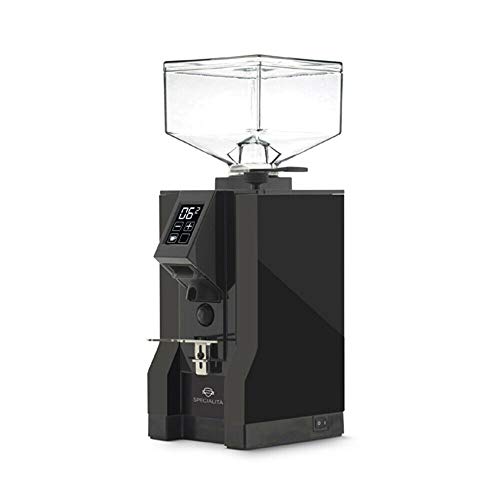
| Eureka Mignon Specialita | 55 mm flat burrs, stepless adjustment, two programmable doses | approx. €431.90 | 9.4 | you drink almost only espresso and want to land between two steps |
The prices are the guide values from our price boxes and may differ from day to day. The rating is our editorial classification by build quality, performance, handling and value for money; we measured nothing.
When the CM800 fits and when another grinder does
The deciding factor is dosing, and with the CM800 you stop it by hand (see above). If you want the same amount every morning without a scale, a timer control serves you better: according to Sage, the Sage Dose Control Pro has an electronic timer and, at approx. €153.25, costs a good €13 more.
Then there is the question of how much espresso you drink. The CM800 covers espresso, filter and French press with one scale, and if a household needs all of them, you only turn the ring. The Baratza Encore ESP costs around €40 more and, according to Baratza, divides its likewise 40 settings into two halves: 1 to 20 are finely graduated for espresso, 21 to 40 extend to cold brew. However, it grinds into a dosing cup that you turn over together with the portafilter fitted.
If you pull almost exclusively espresso and notice that the right flow time lies between two click positions, the only other lever on the CM800 is the fine adjustment with a tool (see “In detail”). According to Eureka, the Eureka Mignon Specialita adjusts steplessly, grinds with 55 mm flat burrs and stores two doses on the touch display. It costs around €292 more, a good three times the CM800.
For the placement, it is worth looking upwards. Graef gives the height as 397 mm. To refill you open the lid, to clean you lift off the bean hopper, and for both you need clearance above these just under 40 centimetres. If your wall cabinet hangs lower, we would pull the grinder forward for filling; according to Graef it is not intended for installation in a wall or built-in cabinet anyway. For an overview of designs and price classes, see our grinder guide.
Cleaning according to the manual
Graef justifies the care routine with the coffee itself: old coffee left in the appliance can oxidise, and according to the manual this can lead to an unpleasant and undrinkable taste. It should therefore be cleaned at least once a week, depending on use, and you pull the mains plug before every cleaning.
You clean the outer surfaces “with a soft, damp cloth”, and for heavy soiling a mild detergent may be added. For the bean hopper, you hold the grinding ring, press the hopper down and turn it anticlockwise to remove it. The flow outlet must be closed while you do this. According to the manual, leftover beans go into an airtight container so that the aroma is preserved. You wash the bean hopper and the ground coffee container “in warm water with a little washing-up liquid” and dry both thoroughly.
You reach the burrs via the grinding ring. Pull the plug, remove the bean hopper, then turn the ring as far as possible to the right, press the button marked PUSH and keep turning. When the two arrows are aligned, you lift off the grinding ring together with the upper burr and take the upper burr out of the ring. You clean the upper and lower burrs “with the supplied brush”.
When reassembling, you place the grinding ring on the motor block arrow to arrow, insert the upper burr and turn the ring clockwise to the desired grind setting. According to the manual, you check that everything is seated correctly like this: set the ring to coarse, about setting 35, and pull on the metal ring. If the burr can no longer be removed, it is correctly inserted. Then the bean hopper goes back on.
The manual does not explicitly answer two questions: whether the containers may go in the dishwasher, and whether water may touch the burrs. It provides warm water with washing-up liquid for the containers and the brush for the burrs, and we would leave it at that in both cases. Two sentences from the safety instructions belong here: do not use aggressive or abrasive cleaning agents or solvents, and do not scrape off stubborn dirt with hard objects. What generally builds up in grinders is described in the guide Cleaning a coffee grinder.
Repairs and spare parts
According to the manual, repairs may only be carried out by a specialist or Graef customer service. According to the manual, improper repairs can pose considerable dangers to you. You replace defective components only with original spare parts, because only these are guaranteed to meet the safety requirements. You must never open the housing, because touching live connections carries a risk of electric shock. According to the safety instructions, a damaged power cord may only be replaced by the manufacturer, its customer service or a similarly qualified person.
Graef sells the two burrs separately: the upper one for €47.99 (article number 145355), the lower conical burr for €24.99 (article number 145677), both listed for the CM800EU. You take out the upper one for every burr cleaning anyway, and Graef describes the lower one on the product page as removable. According to the manual, you can reach customer service on 02932-9703677 or by email at service@graef.de.
What Graef does not state
Collected in one place, what neither the product page nor the manual quantifies: the diameter of the burrs, the grinding rate in grams per second or the grinding time per portion, the noise level in decibels, the amount left behind in the burrs, the capacity of the ground coffee container in grams, the material of the bean hopper, ground coffee container and filling funnel, the cable length, a duty cycle or rest time for the motor, the country of manufacture and the year of market launch. It also remains open how far one position of the fine adjustment goes compared with one setting on the ring, and how the lower burr is removed: the product page calls it removable, but the manual does not describe the procedure. A speed appears only in the Amazon catalogue, not on Graef’s own page. If you weigh single doses, we advise weighing the beans before and the grounds after grinding to see how much stays behind on the way.
Who is it suitable for?
The manual intends the CM800 for use in households and similar settings, and lists as examples: staff kitchens in shops and offices, farm properties, use by guests in hotels, motels and other residential facilities, and bed and breakfasts. It is expressly not intended for commercial use. If you want to equip a café or a kiosk with espresso, it is the wrong choice.
With children in the household, two sentences of the safety instructions apply. The appliance must not be used by children, and the appliance and its cord must be kept away from them. And children should be supervised so that they do not play with the grinder.
For the connection, Graef requires a socket with a correctly installed protective earth conductor, fused with at least 10 amperes. Operation on a socket without a protective earth conductor is prohibited according to the manual, and if you are unsure, an electrician should check the house wiring.
Anyone who wants to control kitchen appliances via a timer or a switchable Wi-Fi socket is also in the wrong place. According to the manual, the CM800 is not intended for use with an external timer or a separate remote control, and in our understanding a smart socket falls under this.