WMF sells the Stelio as a milk frother with a removable jug and its own base. On wmf.com it carries the article number 3200000855, in the instruction manual the model designation 04 1322 0011, and in the Amazon catalogue the release date is given as 28 May 2019. Our reference price is approx. €45.99 (as of September 2026).
The appliance data comes from three sources: the product page, the Amazon catalogue entry with the manufacturer’s product texts, and the instructions. Warranty, repair and spare parts come from the service pages on wmf.com, together with WMF’s page on Cromargan cookware and the company history. There are two official versions of the instructions. The current one, from November 2025, is on the document server of Groupe SEB, which WMF has belonged to since 2016. It lacks the safety instructions; these are printed in full in the older version, which can be retrieved via the group domain wmf.it. Nobody on our side has had the Stelio in their hands. How it compares with the other milk frothers in our catalogue is shown in the table further down.
Jug, DISC and a base with cable winding
The instructions number six parts: lid, sealing ring, WMF milk foam DISC, jug, start/stop button with indicator light, and appliance base with cable winding.
For one of them WMF changes the name. The product description speaks of the stirring arm, while the scope of delivery and the instructions speak of the milk foam DISC, and the same part is meant. It is inserted from the side into its seat, where a magnet inside holds it. To remove it, you slide it down off the seat sideways with light pressure.
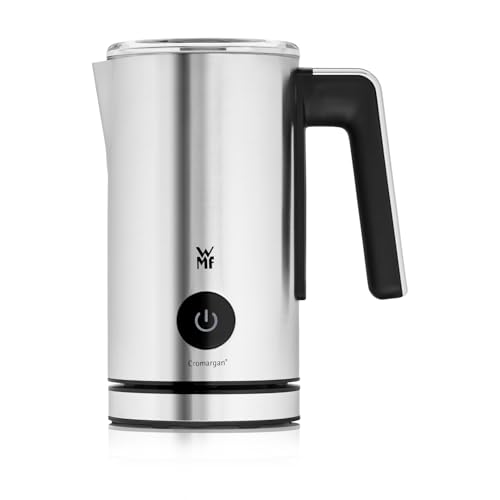
The product photo shows a round jug with a spout and a black handle. On the front of the jug sits the round button with the power symbol, above it the WMF logo, below it the Cromargan lettering, and under the jug the base. The jug itself has no cable. WMF advertises the base as a 360° base, and you wind the unneeded length of the cord around its bottom.
Housing and milk container are made of Cromargan, WMF’s name for stainless steel. The Stelio page says simply Cromargan: Edelstahl Rostfrei (stainless steel). In the catalogue title the finish is called cromargan matt, the colour silver. The jug is non-stick coated inside, and what follows from that is covered in the detail section.
On size and weight the sources contradict each other. The product page lists 1.339 kilograms and package dimensions of 29.5 x 25.5 x 37 centimetres, which is the box. Appliance dimensions appear only in the Amazon product text: 16.5 x 10.5 x 19.6 centimetres, without assignment to height, width and depth. The dimensions field of the same catalogue entry, by contrast, reports 20.0 by 10.0 by 3.0 centimetres and 0.65 kilograms, which fits neither the photo nor the weight on wmf.com. The values from the product text are also envelope dimensions that include handle and spout. You cannot read a jug diameter from them, and we do not calculate a volume from such figures. The jug does have fill marks instead.
The product page states 500 watts. The technical data in the instructions give a power consumption of 420 to 500 watts, so the advertised figure is the upper end. In addition there are 220 to 240 volts at 50 to 60 hertz and protection class I, which is why, according to the instructions, the plug belongs in an earthed socket.
Three programmes, one button
The Stelio has no dial or display. Which programme runs depends on how you press the single button.
If you press it until the symbol lights red, warm milk foam starts, which WMF describes as warm, creamy and fine-pored and recommends especially for cappuccino or latte art. Pressed twice in a row, until the symbol lights blue, it produces cold foam, according to WMF especially for frappé, cocktails, iced coffee or desserts. If you hold the button for 3 seconds, until the symbol lights red and flashes, the Stelio heats the milk and froths it lightly in the process. According to the instructions this third programme is intended for milky coffee, hot chocolate or cocoa. At the end of the programme the appliance switches itself off.
The sequence is fixed. To fill it, you take the jug off the base, pour in the milk and fit the lid, lightly pressed down so that it seals. Only then does the jug go back on the base. The lid must be in place before you switch on, and you must never remove it while the appliance is switched on.
One rule from the safety instructions narrows the list of drinks, and it reads literally: “Use the appliance only for heating or frothing milk. Do not use it for other ingredients.” Cocoa powder or syrup therefore do not belong in the jug. How that fits with the third programme, which WMF also recommends for hot chocolate, we understand like this: the Stelio heats the milk, and the mixing is done in the cup.
From the same chapter: the appliance must not be switched on without milk, it must never be operated unattended, and during operation you may neither move it nor pull on the mains cable. The important safety instructions also state that the touchable surfaces can become very hot and stay hot for some time after switching off.
In detail: the coating inside the jug and what makes foam stable
That the jug is coated inside reads like a marginal note from the data sheet. Two rules in the instructions depend on it, though, and both affect daily use more than the wattage does.
Why milk jugs are coated at all is explained by the milk itself. When heated, the whey proteins unfold and deposit on hot surfaces, together with minerals such as calcium phosphate; in dairy technology this deposit is called fouling. On bare metal the film sticks firmly, while a non-stick layer gives it less to hold on to.
The downside shows when you skim off the foam. WMF warns: “Do not use sharp-edged, metallic objects to skim off, as they can damage the coating.” The coating also sets a limit on cleaning agents, more on that under cleaning. We would use a plastic or silicone spoon for skimming.
The second part concerns the milk. According to the instructions, the consistency and volume of the foam depend on the milk used, among other things on fat and protein content and temperature. This agrees with food chemistry: when milk is whipped, proteins form a thin skin around the air bubbles and hold them together, while fat disrupts this skin. Low-fat milk therefore usually froths higher, and whole milk gives less volume.
For plant-based drinks the same logic applies with different proteins. Soy drinks naturally bring comparatively a lot of protein, oat drinks clearly less, and barista versions with additives exist especially for them. The appliance has no dedicated programme for plant-based drinks. In the Amazon text WMF explicitly mentions milk alternatives alongside cow’s milk, and soy milk is given as the example there.
Are 150 millilitres enough for two cappuccinos?
Arithmetically only with small cups. Our coffee drinks guide puts a cappuccino at 60 to 100 millilitres of milk depending on the source, so 120 to 200 for two. With the Nespresso recipe of 60 millilitres per cup, 150 millilitres are enough for two; at 100 millilitres per cup they are not.
The limits are in the instructions, with the corresponding marks inside the jug. Both foam programmes take 100 to 150 millilitres of chilled milk, the hot milk programme 100 to 250. No more may go in under any circumstances, otherwise foam or milk overflows and soils the appliance. The 150 millilitres that WMF gives on the product page as milk foam are therefore the upper limit of cold milk you fill in, not the finished foam volume.
Downwards, the minimum quantity sets a limit. A single cappuccino needs less than 100 millilitres, so some of the foam is left over. For a latte macchiato the same guide allows 200 to 250 millilitres of milk. That exceeds every foam programme, even though WMF explicitly advertises hot milk foam on the product page for latte macchiato too. That quantity fits into the hot milk programme, but that only froths lightly.
If you need more, you froth twice. In between, the instructions demand a pause: “Let the appliance cool down between two uses.” No number of minutes is given. For three cappuccinos at the same breakfast table, going by the guideline above, that means two runs with a wait, and that is exactly where the Stelio becomes impractical for families in our view.
What goes in the dishwasher and what only sees a damp cloth
You clean after every use; beforehand you pull the mains plug and let the appliance cool down. Lid and milk foam DISC are dishwasher safe, and you take the sealing ring off the lid for easier cleaning. According to the instructions, the jug and appliance base must not go in the dishwasher.
The care table in the same chapter goes a step further. It has three columns: dishwasher safe, can be rinsed under running water, wipe with a damp cloth. Lid, sealing ring and DISC have a tick in all three columns. For the jug there is a dash in the first two and only the third is ticked. Rinsing under the tap is therefore not intended for the jug. The appliance base follows the same pattern, and the text says of it: wipe only with a slightly damp cloth.
In the paragraph that mentions the non-stick coating, WMF prohibits aggressive or abrasive cleaning agents and solvents for the jug. It is dried with a soft cloth. Right after that comes a warning: the underside of the jug must be dry before the appliance is used.
Two sentences from the important safety instructions of the older version add to this. “Do not immerse the appliance in water.” And: “Take care not to spill any water on the base.”
What else is there to consider?
| Model | The difference | Price | Our rating | Choose this if |
|---|---|---|---|---|
| WMF Stelio (this one) | Jug can only be cleaned with a damp cloth, programmes from 100 ml of milk | approx. €45.99 | 8.6 | you froth for one or two people |
| Tchibo induction milk frother | Larger fill quantities: according to the Tchibo product page about 260 ml for frothing and up to 500 ml for heating, according to the instructions approx. 250 and approx. 475 ml | approx. €49 | 8.3 | you froth for three people and want to put the container in the dishwasher |
| Severin SM 3587 | 13 programmes, including dedicated ones for soy, cashew, lactose-free milk and hot chocolate from pieces | approx. €114 | 9.4 | you regularly froth soy drink or lactose-free milk or want to choose the temperature yourself |
| WMF Lono Silk Milk & Choc | Two separate inserts for milk and chocolate, jug dishwasher safe according to WMF | approx. €129.99 | 8.8 | you want to put the jug in the dishwasher after frothing |
Stelio, Severin and Lono Silk appear in the table with their Amazon.de catalogue price of 7 September 2026. For the Tchibo the catalogue listed no price that day, so the approx. €49 is our reference price from July 2026. The rating is our editorial assessment of the manufacturers’ specifications, and none of the figures in any row are our own measurements. For the whole category, see the list of the best milk frothers.
When the Stelio fits and when a different frother does
The roughly 260 millilitres that Tchibo gives on the product page for frothing (the instructions say approx. 250) are enough for two to four cups at 60 to 100 millilitres per cappuccino, as our guide puts it.
In our assessment, cleaning weighs more heavily, because it comes up every day. All three alternatives in the table approve their container for the dishwasher according to the manufacturer. If you prefer to put milk residues in the dishwasher in the evening, you should decide against the Stelio, even though it is the cheapest of the four.
For soy drink or lactose-free milk, it is worth a look at the Severin SM 3587. It has dedicated programmes for them and a temperature adjustable between 45 and 65 degrees, but costs around €68 more than the Stelio. Oat is missing from Severin’s list of special programmes too, so for a household that drinks only oat drink, the temperature selection counts for more there than a matching programme.
On where to put it, the safety instructions draw two limits. The appliance does not belong on hot surfaces such as hobs or near an open gas flame, because it could melt. Nor does it belong on water-sensitive surfaces that splashes could damage. The corner right next to the gas hob is therefore out.
Spare parts and what WMF leaves open
On 8 September 2026 the spare parts shop on wmf.com showed glass lids, steamer inserts and PET bottles, but for the Stelio neither lid nor sealing ring, DISC, jug or base. For the base this has a consequence, because according to the important safety instructions the milk frother may only be operated with its matching base. WMF generally points out that its repair centres offer original accessories and spare parts. According to the instructions, a damaged power cord must be replaced by the manufacturer’s central customer service or a similarly qualified person.
If the appliance leaks, the appliance or mains cable is damaged, or a defect is suspected after a fall or similar, then according to the safety instructions you do not put the Stelio into operation or you pull the mains plug immediately. In these cases it should go for repair.
When it has reached the end of its life, it does not belong in household waste but in special collection and return systems. From private households you can hand it in free of charge at the collection points of the public waste management authorities or at take-back points set up by manufacturers or distributors under the German Electrical and Electronic Equipment Act (Elektrogesetz). According to the instructions, you can find out where the nearest collection point is from the manufacturer or retailer.
Gathered together, what appears in none of the WMF sources evaluated: how the Stelio heats the milk (the word induction appears neither on the product page nor in the November 2025 instructions), how hot foam and milk get, how long a programme runs, how loud the appliance is, how much foam comes from the milk filled in, and how many cups WMF counts per run. Also left open are the steel grade of the housing (WMF mentions 18/10 only on its cookware page), whether oat, almond or pea drinks are suitable, the type of non-stick coating, the material of lid, sealing ring and DISC, the cable length, the country of manufacture, the power consumption per run, and a period for how long spare parts remain available. The instructions have no chapter on descaling, and filters or a prescribed care product do not appear in them either. The appliance heats milk rather than water, and it is cared for solely according to the cleaning chapter.
Who is it suitable for?
According to the instructions, the scope goes beyond your own kitchen. The Stelio is intended for household and similar applications, and the list given is: staff kitchen areas in shops, offices and other commercial environments, farm houses, use by clients in hotels, motels and other residential environments, and bed and breakfast establishments. The office tea kitchen and a guesthouse breakfast room are therefore expressly included.
WMF excludes purely commercial use. The Stelio is therefore the wrong purchase for a café or snack bar that sells milk drinks, and with its fill quantity and cooling pause we also consider it impractical for that use.