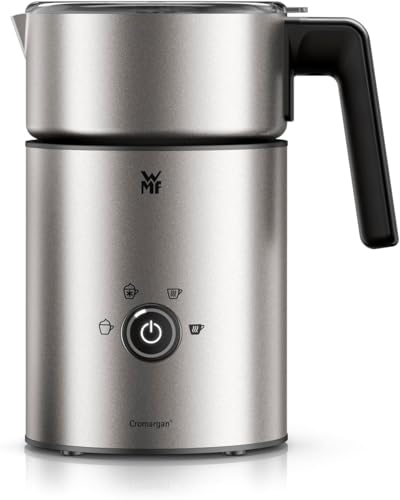
Severin calls the device the Spuma 700 Plus induction milk frother; in the shops it runs under the article number SM 3587. Both names appear on the same data sheet and mean the same construction: a stainless steel jug with a handle, a base with an induction coil underneath, plus a dial and an OLED display.
We have not had it in our hands. What is written here comes from the Severin data sheet dated 27 March 2026, from the instruction manual for the SM 3587, from the German product page at severin.com and from the Amazon catalogue entry for the SM 3587 dated 6 September 2026. Where these sources disagree, we say so.
Spuma 700 Plus: 500 watts, 0.7 litres, a guide value
The data sheet gives 500 watts and a capacity of 0.7 litres. For frothing and heating, the product page lists adjustable temperature levels from 45 to 65 degrees.
The price gets confusing, and that comes before everything else. Our guide value is approx. €114.00 on Amazon.de (as of 6 September 2026, Amazon catalogue). Severin itself lists the device in its own shop at €139.90, with €189.90 struck through beside it. On 6 September 2026 it was out of stock there. So retail sits below the manufacturer’s list price. Which figure applies today is shown by the retailer, not here.
The construction is not new. The Amazon catalogue dates the market launch to 2 September 2019, and the same date appears there for the smaller SM 3586. Severin gives no market year for the SM 3587 itself, but still lists both models side by side on its own website.
Design and controls: jug, whisk, dial
The device measures 19.5 centimetres in width, 15.5 in depth and 25.0 in height, and the net weight is 1.63 kilograms. The Amazon catalogue gives 3.57 pounds, so around 1.62 kilograms, which matches. The cable is 75 centimetres long, and there is a cable winder under the device. As colour and material, the data sheet lists black, silver and plastic; the milk jug itself is stainless steel. “Brushed” appears only in the Amazon title; the data sheet sticks to the word stainless steel.
According to the parts list in the manual, the box contains five parts: lid with lid insert, cover for the whisk insert, milk jug with handle, ribbed whisk insert and base. Here the sources disagree. The product page describes three configurations, including a smooth insert for heating. The manual does not know this smooth insert and solves the same task differently: the ribbed whisk insert runs without the cover for frothing and with the cover for heating. The third configuration, ribbed whisk plus lid attachment, is according to the product page meant for mixing powders.
On the rim of the jug sits what Severin calls the barista pouring spout. The data sheet describes it as pouring precisely and as also suitable for latte art, the topic of the guide Latte art for beginners. The everyday gain is unspectacular: one less small jug that has to be washed afterwards.
Selection runs through the Easy-Select dial with OLED display: turning selects, pressing confirms. A press on the display stops heating and stirring at any time. The data sheet also lists a 360-degree LED light ring that glows red for hot and blue for cold operation and takes over the status display. That is why the data sheet says No for indicator light: the ring does that job. The audible end signal can be deactivated, and according to the manual, signal tones and light ring can be switched on and off. The data sheet also lists a separate on/off switch.
You should know two quirks before buying. As soon as the mains plug is pulled, the device resets to factory settings. And if it is not operated for two minutes, it switches itself off.
In detail: why induction rather than a heating coil
In a conventional milk frother, a heating element sits under the base of the jug and passes its heat on through a hot contact surface. Induction works differently. A coil in the base generates an alternating magnetic field, eddy currents arise in the ferromagnetic base of the jug, and that base heats itself. The heat arises where the milk is, rather than underneath it.
The practical difference lies in the connection between jug and base: there is none. No plug contacts, no heating rod protruding into the milk. That is why the jug may be taken off completely and put in the dishwasher while the base stays dry. In its product information, Severin advertises that the induction method prevents milk from scorching. Behind that is the absence of an overheated contact surface, where milk protein would otherwise curdle and bake on first.
Severin specifies 500 watts here, the same power as the smaller SM 3586. For a device that is meant to heat up to 700 millilitres, that is not a big reserve. As a rough calculation: milk needs about 3.9 kilojoules per kilogram and kelvin, so for 0.7 litres from a fridge-cold 6 to 60 degrees that is about 147 kilojoules, which at 500 watts means just under five minutes of pure heating time, losses not yet included. This calculation is ours, not Severin’s.
One requirement from the manual weighs more in daily use than any wattage: before the next preparation, the device must cool down for a few minutes and be cleaned. Two portions directly one after the other are therefore not intended.
The 13 programmes and their quantity limits
Thirteen programmes sound like a menu jungle, but they sort quickly. Five make milk foam: hot creamy milk foam, cold creamy milk foam, Boost for maximum, firm foam, Cappuccino and Latte Macchiato. Three are tuned for other milk, namely lactose-free, cashew and soy. The rest are drinks: hot milk, hot chocolate, protein shake, mulled wine and infant formula.
More important than the number are the quantities, and they are not where you would look for them. The jug holds 0.7 litres, but you can only froth up to the lower maximum marking, which according to the instruction manual is at 350 millilitres. The upper marking at 700 millilitres applies to stirring and heating without foam. At the bottom, 120 millilitres is the minimum, because the port in the base of the jug must be covered.
Which limit applies depends on the programme. The foam programmes and the hot chocolate work up to 350 millilitres; hot milk, protein shake, mulled wine and infant formula up to 700.
One figure falls out of line. For mulled wine, Severin gives 65 to 70 degrees as the target temperature, that is above the 65 degrees that the product page lists as the upper temperature level for frothing and heating. The list of what may go in at all is also short: milk, hot chocolate, cocoa, infant formula, protein shakes and mulled wine. Soup, punch or tea are not listed there, and the device is to be operated only under supervision.
What Severin does not state
Gathered in one place so that it does not drip through the whole text: for not a single one of the 13 programmes is a running time given in the documents, neither a heating-up time nor a duration per portion. Neither the data sheet nor the manual gives a decibel value. How finely the temperature can be set between 45 and 65 degrees remains open: the Amazon text speaks of stepless, while Severin itself gives neither a number of levels nor a step size. The manual contains no descaling section. On material, it stays with stainless steel for the jug and black, silver, plastic for the rest, with no steel grade, no wall thickness and no statement on double walls. On foam height and foam firmness there are only the words creamy and firm, no measurable value. The permitted temperature in the dishwasher programme, the power consumption per preparation and a standby value are also missing, as are a country of production and any statement on repairability.
On accessories it gets thinner than it needs to be. Which spare parts exist, at what price and over what period, is stated nowhere, and whether the jug or whisk insert are interchangeable with the SM 3586 or older Severin models also remains open. What bothers us most is the missing programme duration. Two or five minutes make a difference to a morning routine, and the documents are otherwise precise enough that this gap stands out.
Cleaning, error codes and spare parts
Three parts may go in the dishwasher: milk jug, whisk inserts and lid. Severin requires cleaning them immediately after every use, either thoroughly in warm water with a little washing-up liquid or in the machine. The base must never be immersed in liquid or held under running water; for it, a soft, damp cloth with a little washing-up liquid remains. Harsh and abrasive cleaning agents are prohibited.
Rinsing has a second reason. Severin’s warranty statement for the SM 3587 gives a two-year voluntary manufacturer’s guarantee from receipt of the device, expressly in addition to the statutory rights. According to this document it is not a durability guarantee and does not apply to devices bought used or refurbished. Among the exclusions, alongside improper use and impact damage, is also failure to follow the care and cleaning work in the instruction manual. Anyone who leaves the jug unrinsed for days therefore risks, by this wording, more than dried-on milk protein.
If something jams, the display reports a code. E01 stands for a missing whisk insert, E02 for a blocked motor, E03 for the jug having been removed during operation. According to the manual, E04 to E09 mean the device is defective. You solve the first three cases at the kitchen table; for the rest, service remains. According to the manual, you order spare parts via the Service Center on severin.de, in the spare parts shop there.
What else comes into question?
From our Milk frothers category, we compare here three devices that a buyer actually weighs against the SM 3587. All four work with induction. They differ in the quantity they froth and in how much choice is on the control panel.
| Model | The difference | Price | Our rating | Take this if |
|---|---|---|---|---|
| Severin SM 3587 (this one) | 13 programmes, OLED display, foam up to 350 ml | approx. €114.00 | 9.4 | you want cocoa, protein shake or mulled wine in the same device as well as milk foam |
| Severin SM 3586 | Severin gives three programmes for it and no display, otherwise the same 500 W and 0.7 L | approx. €100 | 8.9 | you almost always froth cow’s milk for cappuccino and want to hit the programme directly |
| WMF Lono Silk Milk & Choc | Removable DISC system in the jug instead of a ribbed whisk insert, heats up to 500 ml according to WMF rather than 700 ml | approx. €129.99 | 8.8 | Cromargan stainless steel on the worktop matters to you and you can manage with 500 instead of 700 millilitres of heating capacity |
| Tchibo Induktions-Milchaufschäumer | Froths around 260 ml according to the Tchibo product page (manual: approx. 250 ml) instead of 350 ml, heats up to 500 ml (manual: approx. 475 ml) instead of 700 ml | approx. €49.00 | 8.3 | you froth for one person and want to stay under €50 |
The prices are guide values as of September 2026 and change. Our editorial team draws up the rating in the fourth column from data sheets and manuals, without any of the four devices ever having been on our desk. The table says nothing about foam quality: for that, you would have to run all four side by side with the same milk, the same quantity and the same temperature. Our best-of list Milk frothers sorts the whole field.
Which quantity, which milk, which budget?
Three questions decide it here, and a folding rule comes at the end.
Quantity first. For two milky coffees in the morning, the 350 millilitre foam limit in one run is enough. With four cups it gets awkward, because the cooling and cleaning break mentioned above sits in between. Anyone who regularly froths for four people should therefore plan two runs with a wait.
Then the milk. Severin lists three special programmes for cashew, soy and lactose-free milk, and in the Amazon catalogue text cow’s milk is the first of three named varieties. What studies and manufacturers say about fat and protein when frothing, and where they contradict each other, is in the guide How to froth milk. A daily oat drink shares a programme here with cashew or soy.
Then the budget. The SM 3586 costs around €14 less, and what it lacks for that is in the table above. So the question is not whether thirteen programmes are better than three, but whether cocoa, protein shake, mulled wine or infant formula really come up for you. If not, you are paying for a display and menu items that you scroll through once. In that case we would reach for the smaller model and put the difference into milk.
That leaves the footprint. The 25 centimetres of height are given above; in addition, the jug is lifted vertically off the base and the ventilation slots at the back must stay free. With 75 centimetres of cable you are also tied to a socket within reach, and with a device that has a heating function we would not run an extension lead across the worktop. If you are still missing the right machine for the coffee to go with the milk, the coffee finder can help you sort it out.
Who is it suitable for?
Severin is a family company from Sundern and dates its own founding to 1892; the manual mentions over 250 products in the range. In the data sheet, the manufacturer addresses vegans, athletes and families, among others, and the programme list reflects that: soy and cashew, protein shake, infant formula.
Two groups should keep their hands off. The first wants to build the frother into an automatic morning routine, via a timer or a switchable socket. According to the manual, the device is expressly not intended for this. On top of that comes, as described above, the reset to factory settings as soon as the power is gone. The second wants only hot milk without foam. There is a programme for that, up to 700 millilitres, but an OLED display, a light ring and twelve other programmes then remain permanently unused alongside it.
If you order and want to be sure that the SM 3586 is not in the box after all: the EAN of the SM 3587 is 4008146033247.