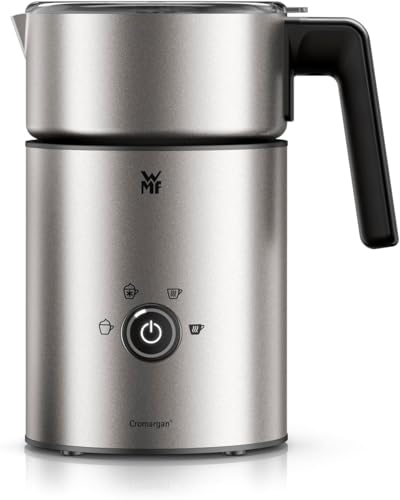
Severin sells the SM 3586 under the second name Spuma 700. Both names appear in the title on Amazon. The unit has been in the Amazon catalogue since 2 September 2019, currently for approx. €99.99 on Amazon.de (as of September 2026). Severin itself asks €119.90 in its own shop, reduced from €169.90. That gap of around €20 between the manufacturer’s shop and the retail trade is the reason a price comparison is genuinely worthwhile here.
What the dial actually offers
The German data sheet has the line Programmes: 3, and the instruction manual lists exactly these three positions on the dial: cold frothing, warm frothing or heating milk, and hot chocolate and cocoa. It is operated with two elements, an on/off button and the Easy Select dial.
Whether you end up with froth or just warm milk in the jug is not decided by the dial, though. One component decides it: Severin specifies that the ribbed whisk insert is used without the cover for frothing and with the cover for heating. If you misplace the small cover, you do not lose a substitute function in the menu, you are simply missing a part.
The temperature can be chosen independently between 45 and 65 degrees, in steps according to the data sheet. The data sheet also gives these steps for cold frothing, but the instruction manual lists the range only for warm frothing and heating, and cold froth is made without heating. At this point the two manufacturer sources do not agree. If you prefer your milk drinkably warm rather than scalding hot, set it at the lower end of the scale. There is no setting for froth firmness: Severin gives neither consistency levels for this model nor any statement about how firm the froth ends up. You choose function and temperature; the whisk insert and the milk determine the rest.
Construction: six parts, no display
Taken apart, you have in front of you the lid with the rotating lid insert, the cover for the whisk insert, the milk jug with handle, the ribbed whisk insert itself, the base and the power cable. Severin does not name two separate whisks for this model, one for frothing and one for stirring. It stays with the one ribbed insert. The jug is stainless steel; for the rest the data sheet says plastic in general terms, and lists brushed, black and silver as colours.
On the worktop the Spuma 700 takes up 18.5 centimetres in width and 15.8 centimetres in depth, and it is 27.5 centimetres tall. The cable is 75 centimetres long and, according to the data sheet, can be wound up on the underside. On weight, the two manufacturer sources contradict each other: the data sheet gives 1.62 kilograms net, the spec table on the product page 1,702 grams. The difference does not matter in daily use; for the question of whether the unit may go on a kitchen shelf, the order of magnitude is enough.
There is no display, and the data sheet even states explicitly under its special features that an indicator light is missing. The feedback comes from an LED light ring that glows all the way round and sits on the base. According to the instructions, red means a function with heating is running, blue a function without. An audible signal sounds at the end of preparation, and if nobody operates anything for two minutes, the unit switches itself off.
In detail: what the coil in the base does differently
In a classic milk frother, a heating element sits under the jug and passes on its heat by contact. The bottom becomes much hotter than the milk above it, and that is exactly where protein and milk sugar settle. The induction design works differently: a coil in the base creates an alternating field, the jug bottom heats itself, and no heating element reaches into the milk. Severin advertises this as heating without scorching.
The power is 500 watts. The more expensive SM 3587 from the same series works with the same 500 watts according to the manufacturer, so the extra money there buys programmes and a display, not heating power.
How the froth is made, on the other hand, depends on a completely different component, and the route there differs from that on an espresso machine. On a steam wand, too, the volume comes from air: as long as the tip sits just below the surface, it draws in air, and the froth builds up from that. The steam itself heats the milk by condensing in it, and this condensate stays in the jug, so at the end you pour out somewhat more liquid than you put in. Here the whisk insert works purely mechanically: it whips air into the cold or warmed milk while the jug bottom heats from below. No water is added. 200 millilitres of milk stay 200 millilitres of milk, whipped to a much larger volume. For dosing, you therefore count with the amount you put in, and for the fill level with the lower marking.
Why the scale ends at 65 degrees and not at 80, Severin does not say. The limit suits milk froth: it is stabilised by the whey proteins, which denature above roughly 65 to 70 degrees; that is our classification and not a manufacturer statement. The froth then becomes coarse-pored and collapses faster. Nobody has measured this on this unit.
How much milk fits in?
For frothing 120 to 350 millilitres, for pure heating up to 700. That covers two large milky coffees in one go. The limit is harder at the bottom than at the top.
The reason is in the instructions: the stud in the bottom of the jug must be covered by milk, otherwise the insert stirs into nothing. Two markings in the jug separate the operating modes, the lower one for froth, the upper one for heating without froth.
Converted to cups, and this is our calculation, not Severin’s: a cappuccino needs around 100 to 150 millilitres of milk depending on cup size, a latte macchiato more like 200. Filling to the lower marking therefore covers two cappuccinos or one latte macchiato with some left over. For four people at once you fill twice, and we would rinse the jug in between rather than pour fresh milk onto the warm remainder.
Chocolate, cocoa and the house rules for them
The third function is the one for hot chocolate, and it comes with requirements that are better read before the first cup. Severin recommends 15 to 20 grams of chocolate for 200 millilitres of milk and 30 to 35 grams for 350 millilitres. The chocolate is grated, or broken into pieces at least 5 x 4 centimetres in size, by no means smaller, and it must not be partly melted.
It is added only after the start, through the lid insert, which can be turned out and removed while running. The instructions give no reason for the minimum piece size. It is stated there as a requirement, together with the gram quantities, and anyone who tips in crumbs of chocolate from an advent calendar is going against that requirement.
Cleaning, spare parts and the gaps in the data sheet
According to the instructions, the milk jug, whisk inserts and lid belong in warm water or the dishwasher immediately after every use. For the base the opposite applies, with no room for interpretation: never immerse it in liquids, never hold it under running water. It is wiped with a damp cloth, and nothing more is intended there.
Gathered in one place, so that it is not scattered through the text, here is everything Severin leaves open for this unit: heating time and duration per preparation are missing from both data sheet and instructions, as is a decibel figure for noise, the number of temperature steps between 45 and 65 degrees and their increment, the energy use per preparation, the mains voltage (the instructions refer to the rating plate on the underside of the unit for this), whether the stainless steel jug is coated on the inside, the material of the lid and whisk insert in detail, the maximum froth height, the country of manufacture, and the prices and availability period of spare parts. In addition there are the protection class and IP rating, on which the documents say nothing beyond the general CE notice, and any recommendation on water hardness or a filter. We could not ask about this: support.severin.com was not reachable when we checked. The basis is the data sheet, the instruction manual dated March 2026 and the warranty statement.
According to the instructions, spare parts can be ordered via severin.de in the Service Center and spare parts shop section. Have the article number 10003586000 ready, because with the SM 3587 the series includes a second, outwardly similar model. The data sheet also gives the EAN 4008146033223, which keeps you on the safe side in the spare parts shop.
What else is worth considering?
| Model | The difference | Price | Our rating | Choose this if |
|---|---|---|---|---|
| Severin SM 3586 Spuma 700 (this one) | Induction coil in the base, froth up to 350 ml | approx. €99.99 | 8.9 | you want cold and warm froth plus cocoa and can do without a display |
| Severin SM 3587 | 13 programmes and OLED display in addition to the light ring | approx. €114 | 9.4 | you need dedicated programmes for cashew or soy drink, baby food or mulled wine |
| WMF Lono Silk Milk & Choc | 650 watts, but heats only up to 500 ml | approx. €130 | 8.8 | Cromargan with anti-fingerprint finish matters more to you than the larger jug |
| WMF Stelio | froths up to 150 ml, heats up to 250 ml | approx. €46 | 8.6 | you drink alone and want to save around €54 |
The prices are guide values from early September 2026 and change faster than the data sheets. The rating in the fourth column is our editorial assessment based on build quality, performance, handling and value for money, and it rests on no measurement. It says nothing about the froth quality of the four units, because we have not handled any of them.
When this frother suits you and when another one does
The first question is how much you make per round. A household with one to three milk drinks a day is well served by a jug of this size, a breakfast for four is not; for that you refill. The WMF Stelio froths less than half of that and costs around €54 less, and for a single-person household that is the better calculation.
Then the milk. Severin recommends it fridge-cold and with as high a protein content as possible; that is the manufacturer’s statement, and it is aimed at cow’s milk. With plant-based drinks, the recipe decides instead: barista editions of oat, soy or almond contain additional fats and stabilisers tuned for frothing, while the standard versions froth less predictably. If you mainly froth such standard drinks, factor that in before blaming the unit. How to handle the milk for this is covered in the guide How to froth milk.
The third point is the display. If you want a display on the unit, you need the OLED model, and then the roughly €14 extra for the SM 3587 is quickly decided. If you always run the same setting anyway, you will never notice the difference.
And the footprint: a frother of this height does not fit under every wall cabinet; the centimetres are given further up. Count in the cable length too; it is short enough that you should settle the socket question beforehand. Our assessment: for two-person households with a cappuccino routine, the SM 3586 is the most sensible buy in this category in our comparison, because the money here goes into the jug and the induction base rather than a longer programme list. More units are in the overview Milk frothers.
Who is it for?
Anyone who imagines an all-purpose warmer for the worktop is wrong here. The instructions allow only milk, hot chocolate and cocoa, explicitly no other liquids and no solid foods. Mulled wine, soup, baby bottles: none of that is in that list.
At the other end of the scale is the minimum quantity, and it costs milk. Anyone who has an espresso macchiato with a dash of milk in the morning still fills in 120 millilitres, because otherwise the stud in the bottom of the jug stays uncovered. The surplus then sits warm in the jug. For that portion size the unit is simply conceived too large.
The right buyer is someone who wants cold froth for iced coffee in summer and cocoa made from real chocolate in winter. That is exactly who we would give it to.