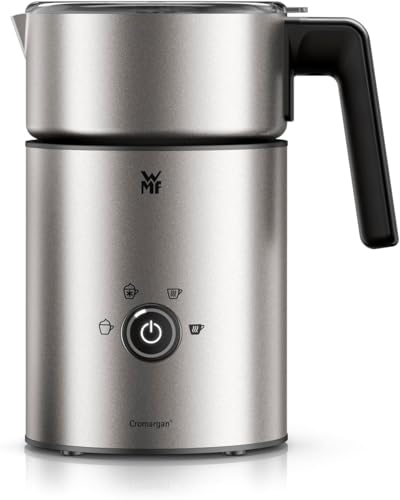
At approx. €129.99 on Amazon.de (as of September 2026), the Lono Silk Milk & Choc is the most expensive of the sixteen devices in our milk frother category. The second most expensive is the Severin SM 3587 at approx. €114.00, which also works with induction, comes with considerably more programmes and heats up to 700 millilitres. What sets the Lono Silk apart from it are two things from the manufacturer’s documents: the Cromargan finish and a second stirring system of chocolate cage and chocolate DISC that exists only for chocolate. Underneath are 650 watts of induction and four programmes. The two Severin devices in the comparison table further down work with 500 watts, and so does the WMF Stelio according to the product page, while according to its instructions it is 420 to 500 watts.
We have not had the device in our hands. What is written here comes from the WMF product page for the Lono Silk with the item number 3201114652, from the instructions for use that WMF links from that page, from WMF’s international warranty statement and from the Amazon catalogue entry for ASIN B0FSKW28KN as of 7 September 2026. One quirk of this source situation belongs right at the start: the linked manual is called 04_1317_0011_IFU_LD.pdf and so carries the item number of the predecessor, while Amazon lists the model number 413170041 for the Silk, written 04.1317.0041 in WMF style. The same file is attached to both product pages. The information from it is provided by the manufacturer for this device, but comes from a document whose file name designates the predecessor. Where two sources contradict each other, this is stated on the spot.
Cromargan, 2.588 kilograms and a jug that is lifted off
The jug stands loose on the device base and is lifted off completely for pouring, and WMF explicitly lists the device as cordless. The structure is easy to see in the product photo: a cylindrical body, the handle sticking out at the side, and at the front of the base a round start button with four programme symbols around it. At the bottom of the front is the word Cromargan.
That is exactly what the material is about. Cromargan is not an advertising word for some steel, but WMF’s own name for 18/10 stainless steel. The manufacturer describes the surface of the Silk as silky and matt and as resistant to fingerprints. For a device in which milk is heated every day, another property of the material is more interesting than the look: according to WMF, Cromargan is odour- and taste-neutral. That leaves the inside of the jug. In practice a different difference counts there: according to the instructions for use, the jug of the Lono Silk may go into the dishwasher, while the jug of the WMF Stelio is, according to its instructions, only wiped with a damp cloth. Whether the Lono jug is coated on the inside is in the gap list further down.
On weight the sources disagree. The WMF data table gives 2.588 kilograms, the Amazon catalogue 5.236 pounds, so roughly 2.375 kilograms. That is a good 200 grams of difference for the same product. We stick to the manufacturer’s figure.
There are seven items in the box: the milk frother itself, the jug, the milk foam DISC, the chocolate DISC, the chocolate cage, the device base and the lid. The chocolate cage is not an accessory on the side, it carries half of the chocolate function. Electrically the situation is simple: 220 to 240 volts, 50 to 60 hertz, 650 watts power consumption. When switched off, the device draws 0.5 watts according to the consumption table in the instructions.
Four programmes and their quantity limits
Hot milk foam, cold milk foam, hot milk, hot chocolate. There is no more choice than that, and for most households it is the choice that matters. More interesting than the number are the quantities, because they differ by programme.
For hot and cold foam alike, WMF sets 150 millilitres as the minimum and 350 as the maximum. Pure heating runs up to 500 millilitres. The chocolate programme again works with 150 to 350 millilitres of milk, but has its own upper limit for the chocolate, more on that below. The programme table also says which insert belongs in the jug in each case: the WMF Milk system for hot foam, the Choc system for the chocolate.
The lower limit of 150 millilitres applies to all four programmes, and it is the point where a one-person household should pause for a moment. Pouring in less means going below the MIN mark in the jug, and so against the instructions. What is left after a single cup is milk that has already been warm and foamy once, and WMF lists exactly that among the causes of missing foam. Keeping it and frothing it again in the next run is therefore ruled out.
Operation is via an LED-lit one-touch system. After the programme is selected, around three seconds pass and then the preparation starts by itself. If you forget the milk, the overheating protection kicks in: without a fill the device switches off instead of heating an empty jug. According to the instructions for use, you are supposed to pour in milk straight from the fridge.
In detail: induction, a magnet and the insert in the jug
On most frothers a heating element sits under the base of the jug and passes its heat on through a hot surface. Here a coil in the base creates an alternating magnetic field, eddy currents arise from it in the bottom of the jug, and that bottom heats itself. The heat is therefore created in the component that touches the milk, and not in a plate underneath. The DISC itself lies loose in the jug, with a magnet at the bottom of the jug holding it in place.
One sentence that is often written about induction frothers is not right as it stands: that there is nothing inside the jug. According to the instructions for use something very much does sit there, namely the WMF Milk system of handle, DISC holder and milk DISC, held by a magnet at the bottom of the jug. What is missing is a fixed motor shaft that leads down through the wall.
The cleaning advantage remains, just justified differently: there is no axle around which milk can collect in the jug, and the insert comes out completely. It can also be taken apart. You unscrew the handle from the DISC holder, then the milk DISC comes out. With the Choc system you additionally pull the chocolate cage off upwards. The smooth jug is therefore paid for with small parts, three for the Milk system, four for the Choc system.
Is the chocolate function worth it?
If chocolate from real pieces regularly comes to the table in winter, yes. Otherwise no. WMF advertises precisely this point, and the instructions draw the line: at most 34 grams of chocolate for 150 to 350 millilitres of milk.
The instructions advise breaking the chocolate into small pieces; chocolate shavings or drinking chocolate also work. If you work with a bar: 34 grams is roughly a third of a 100 gram bar, and with 350 millilitres of milk used to the full that corresponds to just under ten grams per 100 millilitres. The conversion is ours, WMF gives only the two limit values.
If pieces remain unmelted in the jug, the fault table lists two causes: pieces that are too large or a variety that is hard to melt. The programme can then be started again.
Our assessment on this: the Severin SM 3586 at approx. €99.99 also has a chocolate function, but there it runs via an insert in the lid through which the chocolate is only added by hand after the start. The dedicated cage plus dedicated DISC is the more elaborate construction. Which of the two designs dissolves the pieces more reliably, we could only have found out with both devices side by side, and they were never on one table together.
Dishwasher: three parts yes, one not
Lid, jug and the WMF Milk/Choc system are dishwasher-safe according to the instructions for use. For the device base the opposite sentence applies there: it must not go into the dishwasher and is only wiped with a slightly damp cloth. That is a correction to our own earlier version. On the product page the word dishwasher does not appear a single time, and we had derived hand washing from that. The approval is in the instructions that WMF links from exactly this page.
When reassembling afterwards, two sources of error are worth a look, which are also in the fault table: if no foam forms, the DISC is the wrong way round or the system sits crooked in the jug. Both happen mostly after the wash cycle, when three or four small parts have to find each other again.
What WMF does not state
This list is deliberately kept in one piece so that it does not drip into every second paragraph. First the dimensions of the device itself. The product page gives only package dimensions of 23.5 by 58.5 by 37 centimetres, and these say little about the footprint. The Amazon catalogue enters the same value of 9.055 inches three times for height, length and width, so roughly 23 centimetres in a cube. The product photo shows a round jug with a handle sticking out at the side. Three identical edges are therefore not a device dimension but a placeholder, and we calculate neither a footprint nor a volume from it.
Times and temperatures are missing completely: no heat-up time, no duration per programme, no target temperature in degrees Celsius, neither for foam nor for hot milk or chocolate, and no figure for how long the device should cool down between two uses. The only documented figure is the start delay of around three seconds. In addition there are the noise level, the cable length, the total volume of the jug beyond the MAX mark, the material of the lid, sealing ring, DISC holder and chocolate cage, the question of whether the jug is coated on the inside, a recommended retail price, a market launch, a country of manufacture, a standby value besides the 0.5 watts in the off state, and any figure on foam height and foam firmness. The symbol assignment for the sealing ring of the lid could also not be read reliably from the cleaning table of the PDF.
What bothers us most about this is the missing programme duration, because it decides whether the device fits into a morning routine.
What else is worth considering?
Three devices from our milk frothers category are what a buyer really weighs against the Lono Silk. Like the Lono Silk, the two Severin devices work with induction and can also do chocolate; for the WMF Stelio, WMF does not name the heating method.
| Model | The difference | Price | Our rating | Choose this if |
|---|---|---|---|---|
| WMF Lono Silk Milk & Choc (this one) | Dedicated Choc system of cage and DISC, foam up to 350 ml, heating up to 500 ml | approx. €129.99 | 8.8 | you drink chocolate from real pieces and want Cromargan on the worktop |
| Severin SM 3587 | 13 programmes with OLED display, heats up to 700 ml, dedicated programmes for cashew and soy drink | approx. €114.00 | 9.4 | you often froth soy or cashew drink and heat for four people |
| Severin SM 3586 | Chocolate via a lid insert instead of cage and DISC, three programmes, up to 700 ml | approx. €99.99 | 8.9 | one chocolate function is enough for you and you want to save €30 |
| WMF Stelio | Foam programmes up to 150 ml of milk, hot milk up to 250 ml, 500 W according to the product page, jug only to be wiped damp | approx. €45.99 | 8.6 | you drink alone or as a pair and use cocoa powder instead of bar chocolate |
The prices are guide values as of September 2026 and change. The rating in the fourth column is our editorial assessment from data sheets and instructions, not a measurement result, because none of the four devices has ever stood on our table. The table therefore says nothing about foam quality. Our best-of list Milk frothers 2026 sorts the whole area.
When the extra money pays off, and when it does not
Four points decide it. The first is quantity. WMF converts the 350 millilitres of foam into two full latte macchiatos. For three cappuccinos with less foam per cup one run is enough, for three latte macchiatos it is not. For pure heating it is 500 millilitres, so around 165 per person for three. This split into cups is our calculation. As a single person you run into the limit from the other direction, namely the lower limit from the programme table above.
The second point is the chocolate. The Choc system is the difference that the Stelio from the same company does not have at all. Cocoa powder dissolves in hot milk anyway, and for that you need no dedicated programme and no cage. With the Silk, WMF explicitly advertises hot chocolate from real pieces; on the Stelio the third programme heats the milk and froths it lightly, and according to WMF it is also suitable for hot chocolate or cocoa. The Stelio’s safety instructions, however, allow only milk, so cocoa powder and pieces do not belong in the jug there.
The third point is the type of milk. For plant-based drinks the Lono Silk has no dedicated programme, you run them through the same four buttons as cow’s milk. The Severin SM 3587 keeps three extra programmes ready for this, namely for cashew, soy and lactose-free milk. Oat is on neither of the two programme lists. What fat and protein content do to the foam is explained in our guide How to froth milk.
The fourth point is the budget. The Stelio in the table above costs less than half and is therefore the more sensible figure for many one- and two-person households. The extra money for the Lono Silk pays off only through the first two points, larger quantities and chocolate from pieces, and through a jug that you put in the dishwasher instead of only wiping it damp as with the Stelio. Neither of the two has a dedicated programme for plant-based drinks.
What you have to measure yourself is the space. The tape measure in your own kitchen is the only source here, and it has to allow for the jug being lifted vertically off the base. Under a low-hanging wall cupboard that can get tight. For the machine that delivers the coffee under the foam, the coffee finder sorts the designs, and two devices side by side also need two footprints.
Who is it suitable for?
WMF has existed since 1853, founded in Geislingen an der Steige by Daniel Straub and the brothers Friedrich and Louis Schweizer, and since 2016 the company has belonged to the French Groupe SEB. Cromargan was created in 1930 in the company’s own house. Part of the price is this material history, and that is a legitimate reason to buy as long as you call it by its name and do not reinterpret it as a performance feature.
One group is expressly excluded by WMF. The instructions for use contain this sentence: the device is not intended for purely commercial use. Which uses besides the household the manufacturer allows in detail is in a list there that we only have in summary. We therefore draw no line for office kitchens or guesthouses from it. The one sentence is reliable, and it affects the business that lets the frother run all day.


