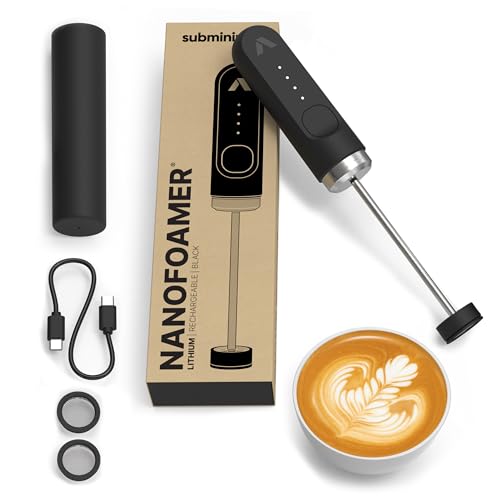
The NanoFoamer Lithium is a whisk with a battery, and that is where the equipment list ends: no jug, no base, no heating element. What sets it apart from a simple milk frother wand sits right at the front of the shaft. There is a fine screen there, which Subminimal calls the NanoScreen, and the impeller pushes the milk through it. On Amazon.de the device costs approx. €49.95 (as of September 2026), and in the manufacturer’s shop the same figure appears in US dollars.
We have not handled the NanoFoamer, and nobody has counted foam bubbles for us. Every statement about the device in this text comes from subminimal.com, from the manufacturer’s Help Center or from the German Amazon catalogue data, retrieved on 7 September 2026. The prices and ratings in the comparison table further down come from our own catalogue.
By its own account, Subminimal is based in Singapore and lists dispatch centres in Hong Kong, Singapore, Europe and the USA. It sums up its own aim in a single sentence: it wants to build tools that bring café quality into the home.
Dimensions, materials and what is in the box
Subminimal states 234 x 35 x 35 millimetres, at 135 grams. The German Amazon catalogue lists slightly different values: 9.4 x 1.4 x 1.4 inches, which converts to roughly 239 x 36 x 36 millimetres, plus 0.33 pounds, which makes about 150 grams. Catalogue fields often refer to the shipping unit. The difference changes nothing about handling.
In the catalogue the device is listed under the model number NF-03-LI, and the black variant is listed. The manufacturer also offers a white one at the same price. On its own site both colours were marked as sold out on 7 September 2026, while in the German Amazon catalogue the device was shown as available on the same day.
The materials list is unusually complete for a tool of this size. The mesh of the NanoScreens is stainless steel 304, their ring is BPA-free Tritan, the shaft and cap are again stainless steel 304, and the connector on the shaft is POM. Subminimal adds that all materials used are food safe. On the impeller, the manufacturer contradicts itself: the specification page lists Tritan, the materials list POM. Both plastics are food safe; POM is the stiffer and more dimensionally stable, Tritan the more impact resistant.
According to the product page, the box contains the device, a charging cable with USB-C at both ends, one impeller, two NanoScreens, a protective cap and the manual.
In detail: why a screen sits in front of the whisk
Micro-foam is not foam with little air, but foam with very small bubbles. A wand with a wire coil beats air into the milk, and the bubbles that form come in all sizes. The large ones rise, collect at the top and form the dry cap that separates from the drink as you pour. On top of that comes an effect that foam physics calls disproportionation: gas migrates through the thin lamellae from small bubbles into larger ones, so the large ones grow at the expense of the small ones, and the foam gets coarser from minute to minute. This applies to every whisk without a screen, regardless of manufacturer, and it is the reason why a cap of coarsely whipped milk sits on a cappuccino like bubble bath.
The NanoScreen steps in at that point. The impeller does not throw the milk around freely but presses it through a fine mesh, and large bubbles are broken up before they can rise. Two screens are included, Fine and Superfine. For a first attempt Subminimal advises the Fine, saying it is slightly easier to handle.
On rotation speed, the manufacturer’s sources disagree. The product page gives 3,500 rpm, while two support articles give 4,000 rpm with the impeller fully immersed. The addition weighs more than it sounds: a small electric motor spins up without load and drops under load, and milk is a load. A speed figure without an operating state therefore says little. In our comparison we treat the higher value as the more reliable one, because only it comes with the operating state.
Switching is done with a digital switch with two settings. The device has no more controls than that.
Does the NanoFoamer heat the milk?
No. Subminimal answers this in a dedicated help article with one sentence: the NanoFoamer does not heat the milk. So you bring it to temperature yourself, in a pan or in the microwave, and froth afterwards.
As a target range the manufacturer gives about 55 to 65 degrees Celsius. Behind this is the usual food-chemistry explanation: up to that point milk tastes sweeter, because the perception of sweetness rises with temperature and lactose dissolves better. Above it the whey proteins increasingly denature, above all beta-lactoglobulin from about 70 degrees, the foam turns coarse and the milk takes on a cooked note. Nobody has measured this on this device, and the temperature remains your part of the work anyway.
On the movement itself, Subminimal gives few but concrete details. A milk depth of at least 40 millimetres is required, and for control the manufacturer recommends a narrow jug. You start just below the milk surface, after which the impeller sinks deeper and draws the vortex.
How long you froth depends on the drink. The manufacturer’s Quick Start Guide gives three seconds for a flat white and 15 to 20 seconds for a cappuccino with a tall cap. The Amazon listing for the same brand, by contrast, speaks generally of about 30 seconds of stirring. We consider the graded figure the more useful one. A flat white carries only a thin layer of micro-foam, a cappuccino a tall cap, and that difference arises in exactly the seconds in which the impeller draws in air.
The guide How to froth milk explains the technique behind fine foam.
Battery: 35 minutes, seven hours and a calculation
The Battery Guide is the most productive page the manufacturer publishes on this device. It gives roughly 35 minutes of running time per charge, about 25 uses and a cycle that lasts about 90 seconds. Charging is via USB-C, for up to seven hours.
These three figures fit together as soon as you multiply them: 25 cycles of 90 seconds make 37.5 minutes. The manufacturer is therefore calculating with fully used-up runs. For a cappuccino, however, its own Quick Start Guide says 15 to 20 seconds, and anyone who froths only that long gets, with the same motor running time, more than 100 drinks on paper. The 25 uses are therefore the cautious figure, not the realistic one. We did this calculation ourselves, from two statements by the manufacturer.
On capacity, two values are again in play. The specification page lists 1300 mAh, while the Battery Guide and the article on battery replacement list 1400 mAh. The voltage is the same everywhere: 3.7 volts.
A power adapter is not included; the cable ends in USB-C on both sides. So you need a free port on a computer or an existing phone charger. And the seven hours are the real catch of the battery solution. It therefore makes sense to charge overnight; between two coffees it is not possible.
What Subminimal does not state
Some things remain open, and some of them we would have needed for this text.
On motor power in watts and on noise level there is nothing on any manufacturer page, nor on the country of manufacture or the market launch of the Lithium model. How many LEDs show the charge level is not listed by any accessible manufacturer source; the only thing documented is a low-battery warning from the Amazon listing. What the sleeve around the handle is made of also remains open, as stainless steel 304 is stated only for the shaft and cap. Also missing are the standard behind the IPX-4 rating, an upper limit for the amount of milk in the jug, a service life or replacement interval for impellers and NanoScreens, permissible storage temperatures for the battery and prices for spare parts in euros. Three help articles we would have liked to read could not be retrieved after several attempts: the one on cleaning the NanoScreens, the one on fast chargers and the one on milk alternatives. And the manufacturer provides the user manuals only in a Dropbox shared folder, without a direct address for this model.
Cleaning without limescale
The product page states IPX-4, meaning protection against splashing water from all directions, and promotes this as easy cleaning. The X stands where the IP code would otherwise have the digit for dust protection, so only water protection has been rated. That is not an explicit approval for a water jet, but it is enough reserve to hold the front part with the screen under the tap. We would keep the handle with motor and battery dry.
Without a heating element there is no heated surface on this device where milk could dry on or build up. Limescale forms where water is heated or evaporates, and neither happens here. Descaling is not an issue for this whisk, in our assessment. What remains is milk protein in the mesh of the NanoScreen. It dries on quickly and then sits in meshes finer than any washing-up brush. Milk protein also sticks more stubbornly the warmer it was when it dried on, and here the milk is in the range of around 60 degrees. We would therefore rinse straight after frothing, while nothing has dried on.
What else is worth considering?
Three devices from our catalogue realistically stand beside it in this decision, two of which we list, like the NanoFoamer, as handheld frothers.
| Model | The difference | Price | Our rating | Choose this if |
|---|---|---|---|---|
| Subminimal NanoFoamer Lithium (this one) | Impeller presses the milk through one of two interchangeable screens, no heating element | approx. €49.95 | 8.8 | you heat the milk yourself anyway and only want the foam texture |
| OutIn LattoGo | Mesh whisk without interchangeable screens, but with a detachable whisk shaft; whisk and shaft are dishwasher safe below 85 degrees according to the manufacturer | approx. €49.99 | 8.2 | you want to put the frothing part in the dishwasher |
| Powerlix Pro 3-in-1 | Around €30 cheaper, 10,000 rpm according to the Amazon listing; we have not yet checked further details on the device for this comparison | approx. €19.99 | 7.8 | you want to find out for under €20 whether handheld frothing suits you |
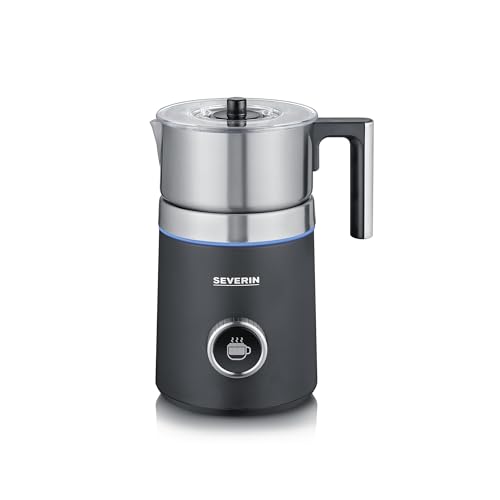
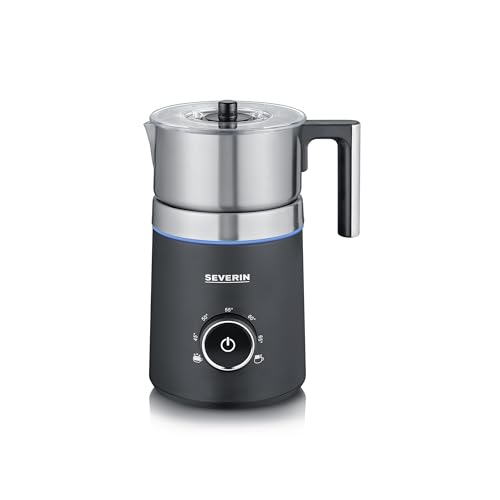
| Severin SM 3587 | Heats by induction to an adjustable 45 to 65 degrees, with its own programmes for plant-based milk | approx. €114.00 | 9.4 | heating and frothing should be done by one device at the press of a button |
The prices are guide values as of September 2026, and the ratings are our editorial assessment based on the available data and features. What the table cannot do: it says nothing about how fine the foam will be for you. That depends on milk, vessel and temperature, and none of these variables appears in a column. The whole category is gathered in the best-of list Milk frothers 2026.
When this whisk fits and when an induction device does
The first question concerns the heat source, and it decides almost everything. If the milk goes briefly into the microwave or onto the hob in the morning anyway, the NanoFoamer costs no extra step; it simply comes afterwards. If you lack that routine, you are buying half a system and have to build the rest yourself.
The second question is quantity, and the battery section sets two calculations side by side here. With the manufacturer’s cautious 25 uses, one charge lasts a little under two weeks at two milk coffees a day. If you base it on the 15 to 20 seconds from the Quick Start Guide, it is more than seven weeks. If you are unsure, plan with the cautious figure: with four cups each morning the device then sits on the cable about every week.
The third question is money. Here the difference is more instructive than the price. The Severin SM 3587 costs approx. €114.00, so a good €64 more. For that you get the heating as well, with adjustable temperature. In the other direction there are around €30 between the NanoFoamer and the Powerlix. What the Powerlix does differently for the lower price, we have not checked against manufacturer sources for this text.
The fourth question concerns the vessel in your cupboard. Subminimal makes only the immersion depth a condition, and the manufacturer recommends the narrow jug for better control. Our assessment on this: in a wide cup the vortex lacks the nearby vessel wall, and the milk turns more sluggishly.
That leaves the willingness to practise. The manufacturer describes immersion depth and frothing times so precisely because both can be adjusted and both change the result. Without this willingness, an induction device with its own programmes is, in our assessment, the more suitable purchase. The guide Milk frother buying guide sorts out the right type of frother, and the Coffee Finder narrows down the right machine.
Who is it suitable for?
If you own an espresso machine with a steam wand, you do not need this device. The wand heats and froths in one go, and it aims at the same fine-bubbled texture as the NanoScreen. The whisk makes sense where the wand is missing: with a filter coffee machine, with a bean-to-cup machine without a milk system, in the office, in a holiday flat.
According to the product page, this model’s scope of delivery includes access to a masterclass from the manufacturer. Including a practice guide assumes that a movement has to be learned, and that is exactly where the whisk differs from a device with a start button.
The Amazon listing promotes the whisk not only for cappuccino and latte but also for hot chocolate. That is plausible, because the impeller does nothing more than move liquid, and because there is no hot surface nearby on which cocoa could build up.
The NanoFoamer is wrong in two kitchens: where nothing is measured or prepared in the morning, and where there is no second device for heating and none is meant to be added. For both, an induction frother is the answer. In our category Milk frothers this device is the tool for the second step, not the one for the whole way.