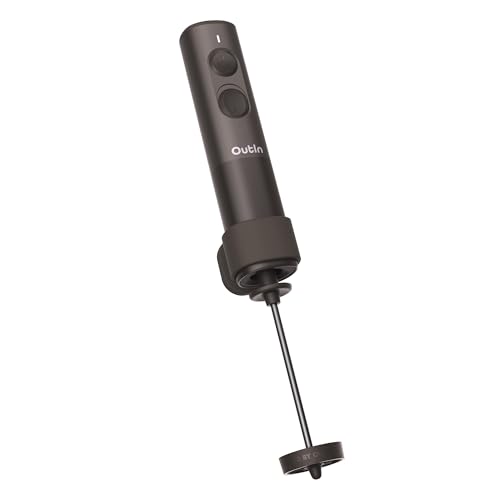
The LattoGo is a milk frother without a base and without a jug: a cordless wand with two buttons, below it a thin shaft and a round frothing disc. It cannot heat, so for hot drinks it only comes into play once the milk is already warm. A carry case for your luggage is included. On Amazon.de it costs approx. €49.99 (as of September 2026).
The manufacturer is OutIn Inc., based in Colorado. According to the entry at the iF Design Award, the LattoGo came onto the market in 2025, and in 2026 it received an award there in the Product Design discipline, Household Appliances group. In the manual it appears as model OTMF-LG-01. OutIn sells it in Tundra Brown and Starburst Silver at the same price, in its own US shop for $49.99. The Amazon offer we link to is the brown version.
We have not held the LattoGo and have not frothed any milk with it. The information in this text comes from outin.com, from the manufacturer’s FAQ and from the German operating instructions, which take up pages 13 to 23 of the multilingual PDF. Manufacturer, market launch and design award are in the iF Design Award entry, colour and some material details in the Amazon catalogue. Prices and ratings of the other devices come from our own catalogue.
Design: handle, shaft, disc and a silicone ring
The product photo shows a slim, round handle with two buttons one above the other. At the lower end sits a wider collar, below it the thin shaft and right at the bottom the round frothing disc with a small tip in the middle. OutIn gives 219 × 39 × 32 mm and 165 g, measured overall. Incidentally, the Amazon catalogue carries shifted values: the largest dimension is listed there as 0.0862 inches, too small by a factor of 100. The weight there matches the instructions.
The two buttons are separate, physical buttons, one for on and off, one for switching speed. It has no touch panel. OutIn describes the operation as equally suitable for left-handed and right-handed users.
As materials, the instructions list food-safe plastic, SUS 304, aluminium and silicone. SUS 304 is the Japanese designation for the stainless chromium-nickel steel that is known in Germany as 1.4301. The product page assigns the materials more precisely: the housing is made of a recyclable aluminium alloy, the shaft of stainless steel 304, the frothing head of Tritan. Tritan is a copolyester made without bisphenol A, and the Amazon description accordingly calls the head BPA-free.
According to the parts overview in the manual, the silicone ring, the carry case and a Type-C charging cable are included alongside the device. A cup or small jug is not among them. The silicone ring, which OutIn calls intelligent, is attached to the rim of the cup and prevents the frothing disc from hitting the wall of the container. It also serves as a rest: the device can be laid down without the disc touching a surface.
According to the instructions, assembly is done only with the device switched off, all parts must sit firmly, and a click can be heard when assembled correctly.
In detail: a mesh instead of the spring
Many simple wand frothers carry a wire spiral at the front. OutIn replaces this classic spring with a dense mesh with reinforced ribs and speaks of a patented whisk in its FAQ. Foam physics explains why this can make a difference. A spiral beats air into the milk, and the bubbles form in all sizes. Large bubbles rise quickly and form the dry cap on top that separates from the drink when poured. If the milk has to pass through a fine grid instead, large bubbles are broken up before they rise. How fine the foam from the LattoGo actually turns out, nobody has counted for us.
OutIn explains the small tip in the middle of the disc on the product page as being for working down to the bottom of the container. It probably keeps the mesh surface at a distance from the bottom.
At OutIn the two settings have separate jobs. The high setting draws in more air and gives a voluminous foam for cappuccino. The low one reduces the air intake, the foam becomes denser and silkier, and this is the one the manufacturer recommends for latte art. Anyone who has worked with a steam wand knows the principle: first draw in air, then only roll. A third control is the angle of tilt. With the ring hanging on the cup rim, the angle at which you hold it determines how much air the disc draws in, as the FAQ describes it. How to pour a heart or a tulip afterwards is shown in our guide Latte art for beginners.
The instructions also lay down a sequence: immerse the frothing disc first, then switch on, and do not pull the running device out of the liquid, otherwise it splashes. They rule out continuous operation because an overheated motor ages faster. OutIn advertises the motor itself as precisely balanced and fast-spinning, vibration-free and quiet.
How much milk fits in one go?
OutIn does not answer this in millilitres. The instructions set a rule: fill the container with milk to a maximum of 40 per cent, because the volume doubles when frothing. The quantity therefore depends on your own vessel.
You can check the rule with any cup you have at home. If it holds 300 ml to the brim, no more than 120 ml of milk belongs in it, and after frothing there are around 240 ml in the cup. A fifth of the space then remains as a reserve against slopping over. If you froth 150 ml of milk for two cups together, by the same rule you need a vessel of 375 ml or more.
On the vessel itself the instructions are precise. The frothing disc is intended for smooth surfaces, with glass, ceramic and stainless steel given as examples. In a container with a rough surface, the disc must touch neither the bottom nor the walls. This limits the work near the bottom for which the tip is intended: in a rough stoneware cup the disc stays above the bottom.
On the type of milk, OutIn writes that fresh whole milk gives the best foam, while low-fat and skimmed milk make foam formation considerably harder. On volume, our understanding of foam physics is that it is rather the other way round: milk fat interferes with bubble formation, skimmed milk froths up high but then carries a drier foam. The manufacturer’s rule therefore fits the fineness and durability of the foam better than its height. For the fine-pored foam that the low setting aims at, we would stay with whole milk.
Battery and charging
In the handle sits a battery of 3.7 V and 1,400 mAh, which multiplies to around 5.2 watt-hours. Charging is via a Type-C port at the end of the device, which lies under a silicone cover. The rated input is 5 V ⎓ 1 A, the maximum charging power 5 W. A lower limit follows from these two values: a charge from empty cannot take less than about an hour. It probably takes longer, because charging electronics usually throttle towards the end.
An LED shows the charge level in three colours. White stands for at least 50 per cent, orange for 20 to under 50 per cent, red for less than 20. While charging, the light pulses white and stays constant once the battery is full.
How many small jugs one charge manages, OutIn answers nowhere, neither in minutes nor in portions. Earlier versions of this page gave a standby time of up to 35 days and attributed it to the manufacturer. That figure appears nowhere on the product page, FAQ, manual or in the iF entry, so we have deleted it.
Cleaning and safety notes according to the instructions
The cleaning rules are on page 23 of the PDF, six points:
- Remove the frothing disc. It is suitable for hand washing or the dishwasher.
- Rinse the frothing disc straight after use, because milk residues reduce performance.
- Wipe the housing with a soft sponge and mild, neutral detergent.
- Do not use metal sponges, hard brushes or abrasive cleaners.
- Do not use organic solvents, as they can damage coatings.
- Do not rinse the housing under water or immerse it.
The manufacturer’s FAQ sets a limit for the dishwasher: the operating temperature should be below 85 °C, to protect the Tritan. The product page adds a trick for drying. After washing, put the shaft back in, hold the whisk pointing down and switch the device on briefly so that the residual water is spun off.
For point 2 we have a second reason. Milk protein dries quickly in fine meshes and adheres more firmly the warmer the milk was. A mesh is more susceptible to this than an open spiral, because the washing-up brush cannot get between the strands.
The safety notes on PDF pages 14 and 15, complete and paraphrased:
- Read all instructions before use, especially if children are nearby.
- The LattoGo works at high speed; anyone who ignores the notes risks injury.
- Do not use with third-party accessories, otherwise there is a risk of injury, fire, electric shock or damage.
- The device is intended for adults only; children and persons in need of help are to be supervised during use.
- Store the device and charging cable dry and out of the reach of children and pets, protected from falling and knocks.
- Do not place the device or its battery in a microwave or on an induction hob.
- Unauthorised removal, replacement or disposal of the battery is strictly forbidden.
- Clean the surface only with a damp cloth. For the device itself the same ban on water applies as in point 6 above, dishwasher included.
- The LattoGo is intended for household use only; continuous operation in commercial environments is excluded.
- During longer periods of non-use, charge and discharge the battery every three months, and unplug the cable immediately after charging.
- Do not take apart, modify or repair it yourself; in case of problems, contact only authorised retailers or service centres.
- Use only in accordance with these instructions.
- For safety reasons the LattoGo is supplied with a partially charged battery.
Two places in the care rules are not worded identically: page 23 allows a soft sponge with mild detergent for the housing, page 15 mentions only the damp cloth. With a damp cloth you are right according to both places.
What OutIn does not state
Despite instructions in seven languages, some things remain open. Besides battery life and fill quantity in millilitres, which were already covered above, the charging time, the motor speed, a sound level in decibels and the motor’s power consumption in watts are missing; only the 5 W for charging is documented. A protection rating according to the IP code is likewise missing, as is the duration of a frothing run in seconds. For the carry case neither material nor dimensions are stated anywhere. Shaft, frothing disc and silicone ring are not listed as spare parts in OutIn’s shop. Where the device is manufactured remains open, as does the number of the patent the manufacturer refers to. We found no warranty terms specifically for the LattoGo in Germany. OutIn’s product page links to no Amazon offer; that our link leads to this device is supported by brand, model number OTMF-LG-01 and colour in the Amazon catalogue.
What else is worth considering?
Three devices from our catalogue realistically stand alongside this purchase decision.
| Model | The difference | Price | Our rating | Choose this if |
|---|---|---|---|---|
| OutIn LattoGo (this one) | a single mesh with no interchangeable attachment, frothing disc dishwasher-safe, no heating element | approx. €49.99 | 8.2 | warm milk is ready for you anyway and the device often travels in your bag |
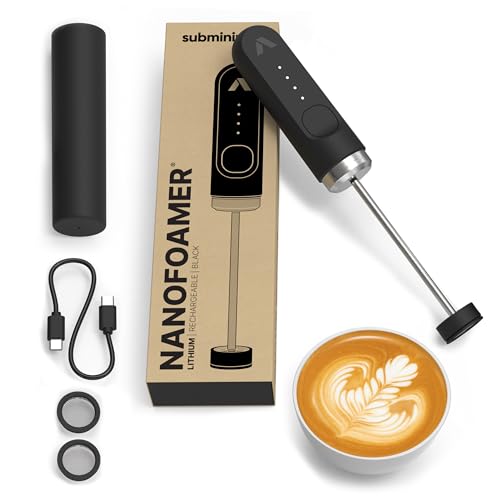
| Subminimal NanoFoamer Lithium | same design, but two interchangeable meshes (Fine and Superfine) instead of a single whisk | approx. €49.95 | 8.8 | you are practising latte art and want to choose the foam fineness via the attachment |
| Powerlix Pro 3-in-1 | also a cordless hand whisk without heating, with three interchangeable attachments and 10,000 rpm according to the Amazon catalogue | approx. €19.99 | 7.8 | you only need foam occasionally and want to spend at most €20 |
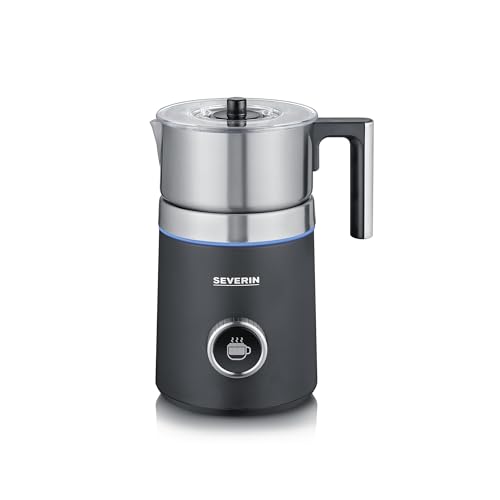
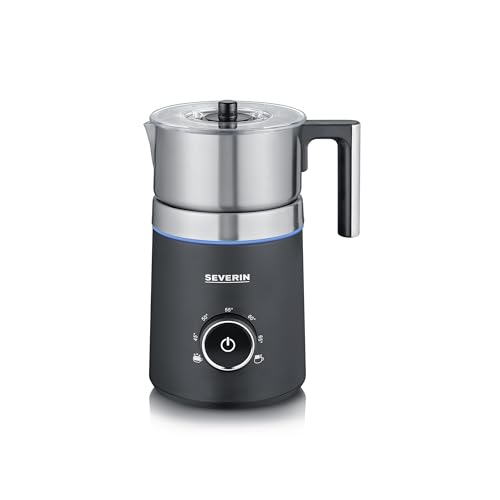
| Severin SM 3587 | heats the milk itself by induction, adjustable from 45 to 65 °C, up to 350 ml of foam, needs a socket and counter space | approx. €114.00 | 9.4 | you make several milk drinks a day at home |
The prices are guide values as of September 2026, the ratings our editorial assessment based on data and features. How fine the foam in your cup turns out is in no column; that depends mainly on milk and temperature. The whole category is sorted by the best-of list Milk frothers 2026.
When the LattoGo fits and when an induction device does
First, the heat source decides. If the milk stands briefly on the hob or in the microwave every morning anyway, the LattoGo is just one more step afterwards. Without this routine you are buying half a system. The Severin SM 3587 costs around €64 more and does the warming as well.
Then the quantity. Because you provide the vessel yourself and, by the rule above, must not even fill it halfway, one run for a whole family quickly becomes unwieldy. If you make three or four milk drinks in a row in the morning, our assessment is that you are better served by a jug-style device that fixes the quantity.
For taking along, the LattoGo plays to its equipment: 165 g and a case in the box. If you only buy it for the summer holiday, you should know the care rule for long breaks. During the break, the instructions say the battery wants to be charged and discharged once every three months.
Against the NanoFoamer Lithium, money is not the deciding factor. In our rating the NanoFoamer is ahead, and its interchangeable meshes are the reason to reach for it if you want to fine-tune foam texture. In the LattoGo’s favour is the explicit dishwasher approval for the frothing disc. We would take the LattoGo if the device travels a lot and is to go in the dishwasher after use.
The Powerlix Pro 3-in-1 is around €30 cheaper and, according to the Amazon catalogue, comes with three attachments: two foam attachments with single and double layers and a whisk for beaten egg white. Powerlix states there 1200 mAh, 3 hours of running time, 2 hours of charging time and frothing elements of stainless steel 304; for the Powerlix we rely solely on this catalogue text. The LattoGo has the slightly larger battery at 1,400 mAh and only one mesh whisk; for it, however, detailed instructions with care and safety rules are available. Anyone who also wants to stir protein shakes, for which Powerlix advertises its device, is wrong with the LattoGo; more on that in the last paragraph.
Who is it suitable for?
If you have an espresso machine with a steam wand, you do not need this frother. The wand warms and froths in one go. The LattoGo makes sense where there is none, for example next to the filter coffee machine or the moka pot on the camping stove. Which machine suits milk foam is narrowed down by the coffee finder, and all devices of this kind are in our milk frothers category.
It is the wrong purchase for anyone looking for a wand to stir protein shakes. The instructions designate the LattoGo exclusively for frothing milk, not for stirring other liquids, and the manufacturer’s FAQ expressly mentions protein shakes in this context.